 11
Gainward GeForce RTX 3080 Ti Phantom GS Review
(11 Comments) »Introduction

NVIDIA announced the GeForce RTX 3080 Ti at Computex this year, in June. The GeForce RTX 3080 Ti replaces the RTX 3080 as NVIDIA's new flagship gaming product. The RTX 3090 is still positioned higher, but that SKU is more of a TITAN-like halo model, with its massive 24 GB VRAM favoring certain professional use-cases when paired with Studio drivers.

Based on the same 8 nm GA102 silicon as the RTX 3080, the new RTX 3080 Ti has 12 GB of memory, maxing out the 384-bit GDDR6X memory interface of the chip while packing more CUDA cores and other components—10,240 vs. 8,796, 320 TMUs, many Tensor cores, 80 RT cores, and 112 ROPs. The announcement of the RTX 3080 Ti and its sibling, the RTX 3070 Ti, may have been triggered by AMD's unexpected return to the high-end gaming graphics segment with its Big Navi Radeon RX 6000 series graphics cards, particularly the RX 6900 XT and RX 6800.
The GeForce Ampere graphics architecture debuts the 2nd generation of NVIDIA RTX, bringing real-time raytracing to gamers. It combines 3rd-generation Tensor cores that accelerate AI deep-learning neural nets DLSS leverages, second-generation RT cores that introduce more hardware-accelerated raytracing effects, and the new Ampere CUDA core that significantly increases performance over the previous-generation Turing.
The Phantom GS "Golden Sample" is Gainward's top model for the RTX 3080 Ti. It comes with adjustable RGB lighting and the ability to synchronize your motherboard's effects to the graphics cards. With three eight-pin power inputs, the card is ready for the toughest challenges. The cooling solution is a large triple-slot, triple-fan design. In terms of clock speeds, the Phantom GS offers a small factory overclock to 1725 MHz. Pricing isn't available from Gainward, but given current market conditions, we're expecting a price of around $1800.
| Price | Cores | ROPs | Core Clock | Boost Clock | Memory Clock | GPU | Transistors | Memory | |
|---|---|---|---|---|---|---|---|---|---|
| RTX 2080 | $750 | 2944 | 64 | 1515 MHz | 1710 MHz | 1750 MHz | TU104 | 13600M | 8 GB, GDDR6, 256-bit |
| RTX 2080 Super | $800 | 3072 | 64 | 1650 MHz | 1815 MHz | 1940 MHz | TU104 | 13600M | 8 GB, GDDR6, 256-bit |
| RTX 3060 Ti | $700 | 4864 | 80 | 1410 MHz | 1665 MHz | 1750 MHz | GA104 | 17400M | 8 GB, GDDR6, 256-bit |
| RX 6700 XT | $770 | 2560 | 64 | 2424 MHz | 2581 MHz | 2000 MHz | Navi 22 | 17200M | 12 GB, GDDR6, 192-bit |
| RTX 2080 Ti | $1100 | 4352 | 88 | 1350 MHz | 1545 MHz | 1750 MHz | TU102 | 18600M | 11 GB, GDDR6, 352-bit |
| RTX 3070 | $1000 | 5888 | 96 | 1500 MHz | 1725 MHz | 1750 MHz | GA104 | 17400M | 8 GB, GDDR6, 256-bit |
| RTX 3070 Ti | $1100 | 6144 | 96 | 1575 MHz | 1770 MHz | 1188 MHz | GA104 | 17400M | 8 GB, GDDR6X, 256-bit |
| RX 6800 | $1300 | 3840 | 96 | 1815 MHz | 2105 MHz | 2000 MHz | Navi 21 | 26800M | 16 GB, GDDR6, 256-bit |
| RX 6800 XT | $1400 | 4608 | 128 | 2015 MHz | 2250 MHz | 2000 MHz | Navi 21 | 26800M | 16 GB, GDDR6, 256-bit |
| RTX 3080 | $1400 | 8704 | 96 | 1440 MHz | 1710 MHz | 1188 MHz | GA102 | 28000M | 10 GB, GDDR6X, 320-bit |
| RTX 3080 Ti | $1750 | 10240 | 112 | 1365 MHz | 1665 MHz | 1188 MHz | GA102 | 28000M | 12 GB, GDDR6X, 384-bit |
| Gainward RTX 3080 Ti Phantom GS | $1800 | 10240 | 112 | 1365 MHz | 1725 MHz | 1188 MHz | GA102 | 28000M | 12 GB, GDDR6X, 384-bit |
| RX 6900 XT | $1700 | 5120 | 128 | 2015 MHz | 2250 MHz | 2000 MHz | Navi 21 | 26800M | 16 GB, GDDR6, 256-bit |
| RTX 3090 | $2300 | 10496 | 112 | 1395 MHz | 1695 MHz | 1219 MHz | GA102 | 28000M | 24 GB, GDDR6X, 384-bit |
Packaging


The Card


The Gainward GeForce RTX 3080 Ti Phantom GS is dominated by a black color theme. A beautiful highlight are the two dark glossy metal pipes that run along the top and bottom of the cooler. On the back, you'll find a high-quality metal backplate with cutouts to let some airflow through.


Dimensions of the card are 30.0 x 14.0 cm, and it weighs 1581 g.


Installation requires three slots in your system.

Display connectivity options include three standard DisplayPort 1.4a and one HDMI 2.1. The DisplayPort 1.4a outputs support Display Stream Compression (DSC) 1.2a, which lets you connect 4K displays at 120 Hz and 8K displays at 60 Hz. Ampere can drive two 8K displays at 60 Hz with just one cable per display.
Ampere is the first GPU to support HDMI 2.1, which increases bandwidth to 48 Gbps to support higher resolutions, like 4K144 and 8K30, with a single cable. With DSC, this goes up to 4K240 and 8K120. NVIDIA's new NVENC/NVDEC video engine is optimized to handle video tasks with minimal CPU load. The highlight here is added support for AV1 decode. Just like on Turing, you may also decode MPEG-2, VC1, VP8, VP9, H.264, and H.265 natively, at up to 8K@12-bit.
The encoder is identical to Turing. It supports H.264, H.265, and lossless at up to 8K@10-bit.

This ARGB header lets you connect your motherboard's RGB output to the graphics card to synchronize it with the rest of your system.

Near the ARGB header, we spotted these four measuring points for various voltages on the card.

The card has three 8-pin power inputs. This configuration is rated for up to 525 W of power draw.

The GeForce RTX 3080 Ti doesn't support multi-GPU.
Teardown


Gainward's heatsink uses six heatpipes that provide cooling for the GPU, memory, and VRM circuitry. The thermal pads on memory are 0.75 mm thick, and those on the VRM are 1.0 mm thick.
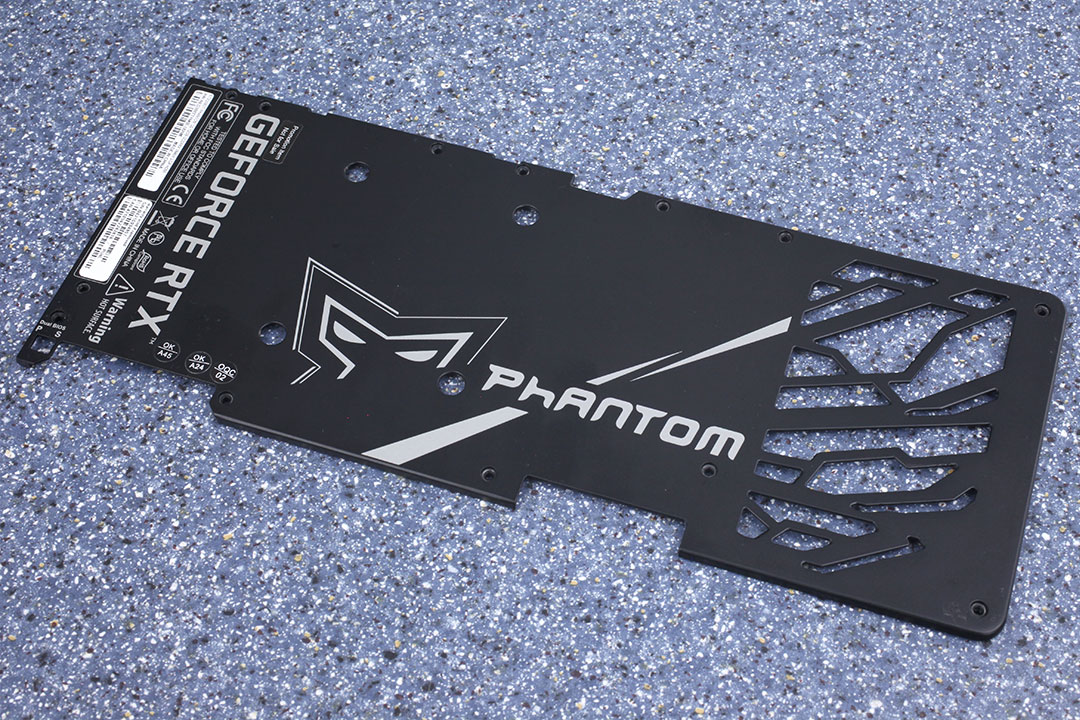
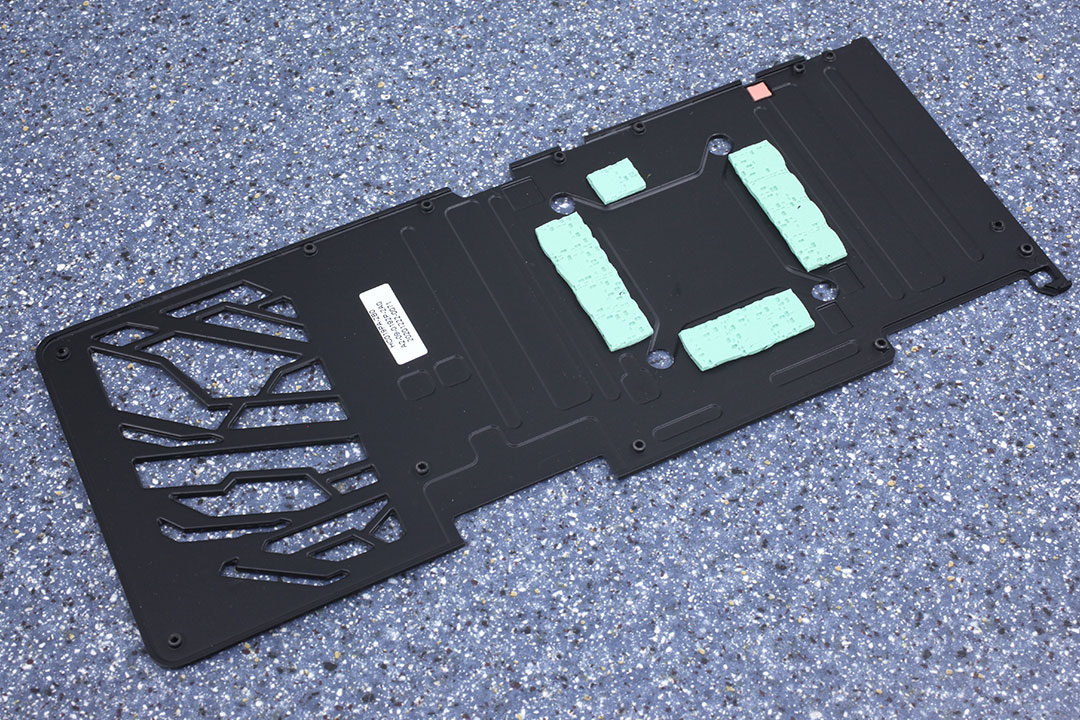
The backplate is made out of metal and protects the card against damage during installation and handling. Thermal pads on the backplate are 2.0 mm thick.
High-resolution PCB Pictures
These pictures are for the convenience of volt modders and people who would like to see all the finer details on the PCB. Feel free to link back to us and use these in your articles, videos or forum posts.

High-res versions are also available (front, back).
Circuit Board (PCB) Analysis


GPU voltage uses a 17-phase design and is powered by a pair of OnSemi NCP81611 controllers.

The GPU VRM uses AOZ5311NQI DrMOS components by Alpha & Omega Semiconductor, rated for 55 A.


Memory voltage uses a three-phase design and is generated by an NCP81610 controller.

For memory, 55 A Alpha and Omega AOZ5311NQI are used.

The GDDR6X memory chips are made by Micron and carry the model number D8BWW, which decodes to MT61K256M32JE-19G:T. They are specified to run at 1188 MHz (19 Gbps GDDR6X effective).

NVIDIA's GA102 graphics processor is the company's second Ampere architecture chip, the first one targeted at GeForce gamers. It is produced on a 8 nanometer process at Samsung and has a transistor count of 28 billion with a die size of 628 mm².
Our Patreon Silver Supporters can read articles in single-page format.
Nov 13th, 2026 21:57 CST
change timezone
Latest GPU Drivers
New Forum Posts
- no "PhysX" workable (8)
- AI generated images... (224)
- Tell me about your favourite graphics card (28)
- Crimson Desert (31)
- RenoDX HDR - how to view the differnce Before&After in game? (0)
- Displayport DP80 3M (10ft) cable that can achieve 80gbps stable? (5)
- I'll flash a ASUS ROG Strix RX480 O8G in Cause of Code 43, as a Newbie (1)
- Opinion on Monitor Replacement (6)
- TMOG - post your benchmark results here (16)
- Microsoft Exchange/365 outages? (61)
Popular Reviews
- AMD Zen 6 Technical Deep Dive
- Corsair HX1000i Shift Crystal Review
- NZXT C1200 Platinum Review
- Upcoming Hardware Launches 2027 (Updated Nov 2026)
- ASUS ROG Strix B850-I Gaming Wi-Fi7 W Review
- Montech King 95 3D PRO Review
- NZXT H7 RGB+ Review
- NZXT H5 Review
- Phantom Blade Zero Performance Benchmark Review - 35 GPUs Tested
- XPG NIMBUS PLUS Review - Mid-range Chair With Strong Competitors
TPU on YouTube
Controversial News Posts
- NVIDIA Co-Founder and CEO Jensen Huang Officially Resigns (379)
- OpenAI CEO Argues Home PCs Waste the World's Limited DRAM Supply (152)
- NVIDIA Launches Investigation Into Jensen Huang's Relationship With Suspected Chinese Spy (136)
- Intel "Raptor Lake Next" 16-Core and 20-Core CPUs Surface (130)
- Legendary Game Studio BioWare Shuts Down Following EA Layoffs (104)
- Dell CEO Says the Memory Shortage Will Get Worse in 2027 (95)
- NVIDIA GeForce RTX 50-Series Scheduled for up to $500 Price Hike This Week (89)
- Modder Fits RTX 5090 With Four 8-Pin Connectors, Halving Current per Wire (80)