 10
GEEKOM A9 Max (2026 Update) Review
Value & Conclusion »Power and Noise Levels
Power and efficiency can be just as important as raw performance in a more compact system, so I measured how much the system draws under CPU stress, during GPU-heavy tests, while gaming, and during a 24-hour idle period.24-Hour Idle Power Draw
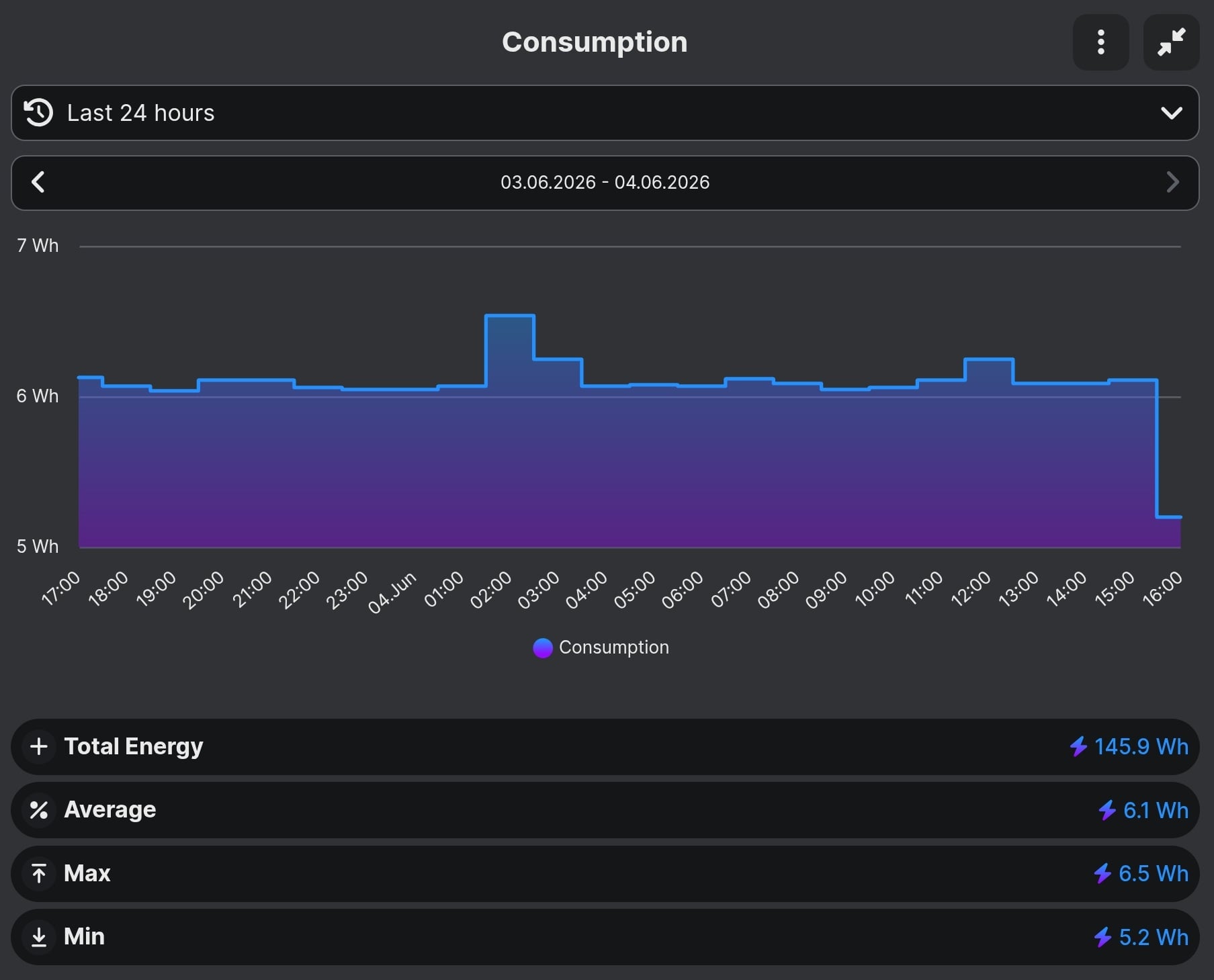
Over a full 24-hour idle period, the GEEKOM A9 Max (2026) averages 6.1 W, with a peak of 6.5 W and a low point of 5.2 W. For most of the run, power draw sits very close to 6 W, with only minor fluctuations throughout the day and no meaningful spikes in background activity.
In context, this is an excellent result for a high-performance mini PC based on AMD's Ryzen AI platform. Despite offering substantially more processing and graphics capability than many entry-level systems, the A9 Max maintains a very low idle power draw.
At an average of 6.1 W, leaving the system idle around the clock would use roughly 53.4 kWh per year, which works out to about $8 to $10 annually, depending on local electricity rates. Combined with its strong performance, the A9 Max delivers some of the best idle efficiency we've seen from a premium Mini-PC.
CPU and GPU Power Draw
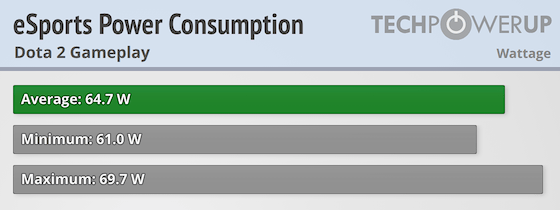
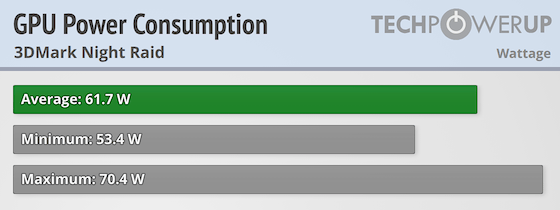
I looked at three different power scenarios to see how the system behaves under different types of load: an esports gaming run with Dota 2 to observe real-world gaming power and consistency, a GPU-focused pass using 3DMark Night Raid to show how the system ramps under heavy graphics demand, and a Cinebench multicore run that fully loads the CPU to measure sustained power delivery over time.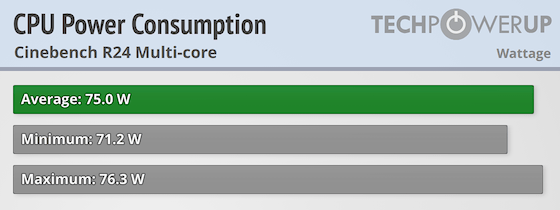
Cinebench (Multicore)
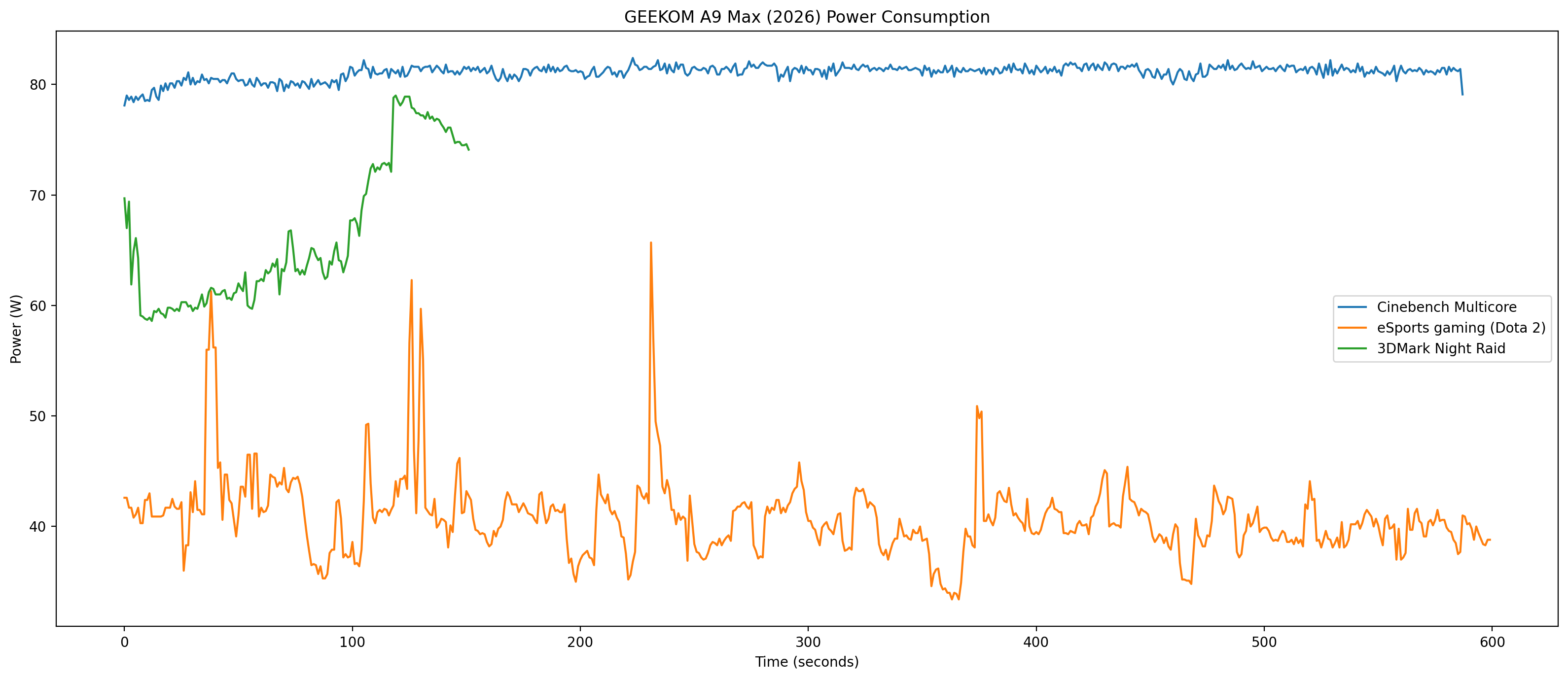
During the Cinebench multicore test, the A9 Max averages 81.1 W, with readings ranging from 78.1 W to 82.4 W. Power draw remains remarkably consistent throughout the workload, indicating the Ryzen AI 9 HX 470 can sustain heavy all-core loads without significant fluctuations or power throttling.
eSports (Dota 2)
In the Dota 2 workload, the system averages 40.8 W, with readings between 33.4 W and 65.7 W. Power consumption remains relatively modest for a gaming workload, highlighting the efficiency of the Radeon 890M integrated graphics while still allowing for occasional boost behavior during more demanding scenes.
3DMark (Night Raid)
Running 3DMark Night Raid, the system averages 66.4 W, with readings between 58.6 W and 79.0 W. The relatively tight range suggests the system maintains a consistent level of CPU and GPU performance throughout the benchmark, with fewer dramatic swings in power draw than we typically see in burst-heavy gaming workloads.
Here's a full view of the GEEKOM A9 Max (2026)'s power draw across all three profiles:
Noise Levels
During idle or light use, the A9 Max 2026 is effectively silent at around 31 dB(A), with no fan noise that stood out during normal desktop work. This is very close to the 2025 model, so anyone familiar with that system should expect nearly the same acoustic profile during browsing, office work, media playback, or light editing.Under heavier workloads, the fans become much easier to hear as the system works to control thermals. With the Windows power plan set to Balanced and the default BIOS fan profile in use, noise levels peaked at 54.6 dB(A), with the microphone placed roughly 30 cm away. That is slightly higher than the 2025 unit, but close enough that the two systems sound basically the same while in use. It is noticeable in a quiet room under sustained load, though not unusual for a compact Mini-PC with this level of hardware.
Nov 25th, 2026 22:05 CST
change timezone
Latest GPU Drivers
New Forum Posts
- Claude credits purchased on or after Dec. 7 now have an expiry date (15)
- AI generated images... (235)
- Exploring Local LLMs: Models, Hardware and Setup Experiences (1)
- What's your main Black Friday / Cyber Monday purchase? (10)
- Smokin Hot Lappy (10)
- Gacha Games - Discussions, Pulls, Updates, etc. (1165)
- Linpack Xtreme Released (511)
- Sexy Hardware Close-Up Pic Clubhouse. (10345)
- AAF Optimus Modded Driver For Windows 10 & 11 - Only for HDAUDIO Chips [WINDOWS 11 RECOMMENDED] (1155)
- Which ryzen am5 cpu ? (219)
Popular Reviews
- ASRock X870E Challenger Wi-Fi White Review
- VZMORE AX9 Max Review
- Upcoming Hardware Launches 2027 (Updated Nov 2026)
- Microsoft Surface Laptop Ultra Review - The Next-gen Arm Laptop
- AMD Ryzen 7 9800X3D Review - The Best Gaming Processor
- AMD Zen 6 Technical Deep Dive
- Corsair RM1200e (Second Generation) Review
- Phantom Blade Zero Performance Benchmark Review - 35 GPUs Tested
- Pulsar Office Tour & First Look at P1 Dual-Sensor Mouse
- Ocypus lota P1000 Review
TPU on YouTube
Controversial News Posts
- Jensen Huang Reinstated as CEO of NVIDIA (573)
- NVIDIA Co-Founder and CEO Jensen Huang Officially Resigns (492)
- Report: Jensen Huang Eyes NVIDIA Comeback (281)
- Open Letter Asking NVIDIA to Reinstate Jensen Huang Passes 115,000 Signatures (184)
- OpenAI CEO Argues Home PCs Waste the World's Limited DRAM Supply (152)
- NVIDIA Launches Investigation Into Jensen Huang's Relationship With Suspected Chinese Spy (136)
- Intel "Raptor Lake Next" 16-Core and 20-Core CPUs Surface (130)
- Intel Razor Lake Gets a 12 P-Core bLLC Chip With No E-Cores, Per Leak (94)