 10
GEEKOM A9 Max (2026 Update) Review
Web & Office Productivity »General Performance
AIDA64 Cache & Memory
The AIDA64 memory benchmark measures how quickly data moves between system memory and the CPU's cache hierarchy. It is also a useful check for systems with integrated graphics, since the Radeon 890M uses system memory as graphics memory.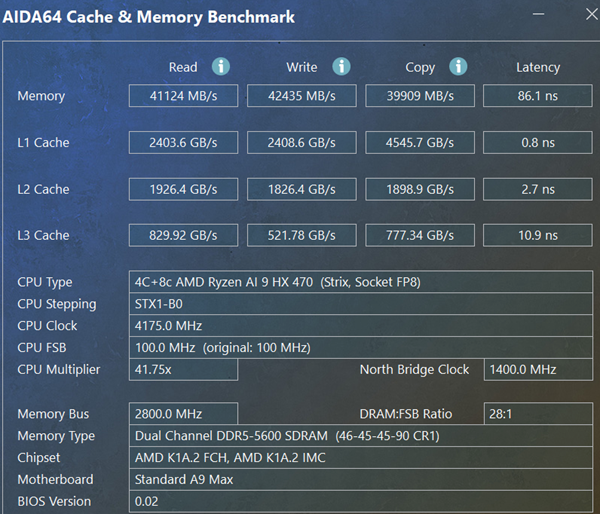
The A9 Max 2026 posted 41,124 MB/s read, 42,435 MB/s write, and 39,909 MB/s copy, with latency at 86.1 ns. AIDA64 reports the memory type as Dual Channel DDR5-5600, but HWiNFO showed the actual installed configuration as a single 32 GB Micron DDR5 SO-DIMM running in single-channel mode. It's useful to know that DDR5 reporting can look confusing depending on how a tool reads the memory controller, module layout, or DDR5 subchannel structure.
For performance analysis, I am treating this sample as a single-channel system because only one SO-DIMM was installed. That helps explain why the Radeon 890M does not perform like the 2025 A9 Max in several graphics-heavy tests, even though both systems use the same integrated GPU. The cache results are much stronger, with L1 reaching 2,403.6 GB/s read, 2,408.6 GB/s write, and 4,545.7 GB/s copy at 0.8 ns latency. L2 came in at 1,926.4 GB/s read, 1,826.4 GB/s write, and 1,898.9 GB/s copy at 2.7 ns, while L3 posted 829.92 GB/s read, 521.78 GB/s write, and 777.34 GB/s copy at 10.9 ns.
Cinebench
Cinebench is a CPU rendering benchmark based on Maxon's Cinema 4D engine. It evaluates both single-threaded and multi-threaded workloads, giving a clear picture of how a processor handles everyday tasks as well as heavier rendering scenarios.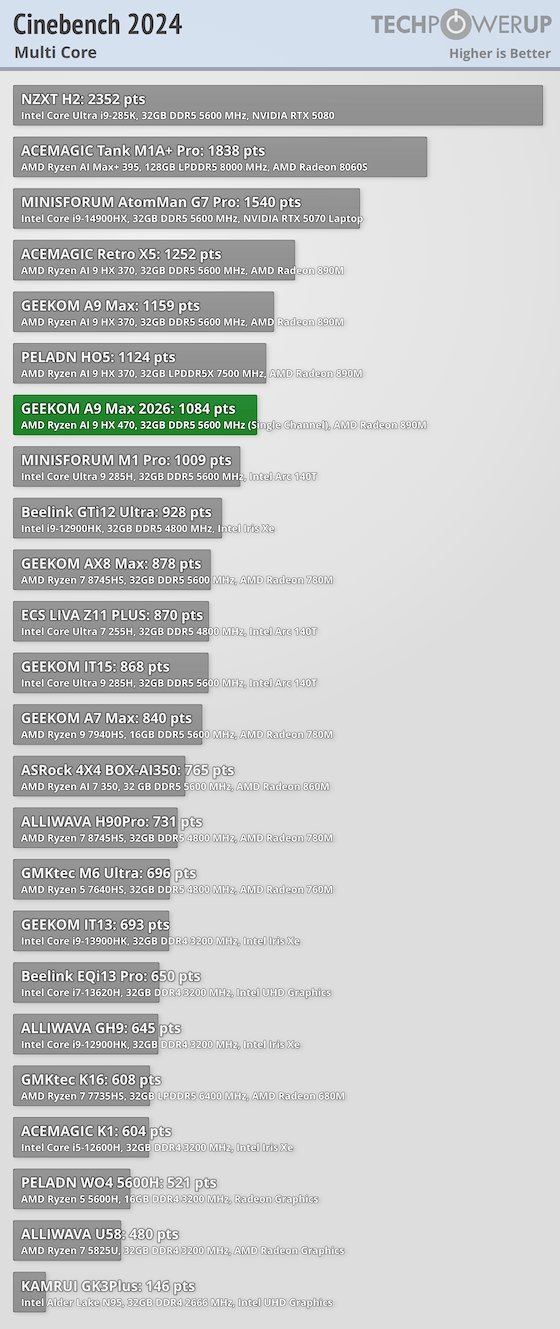
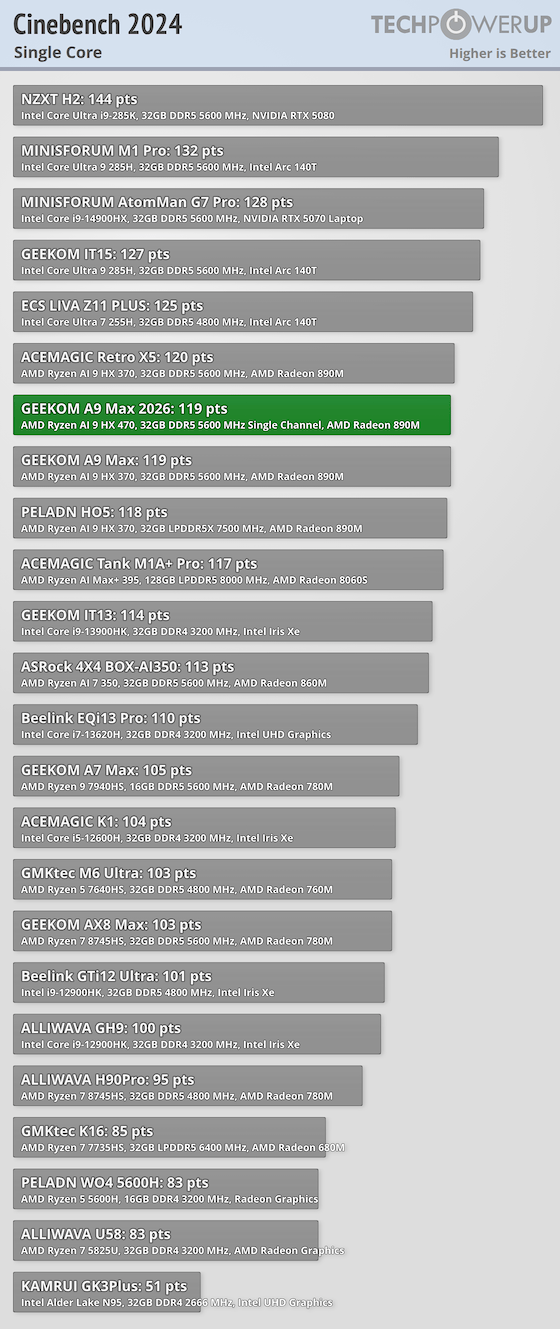
The A9 Max 2026 scores 1,084 in Multi Core and 119 in Single Core. Single-core performance matches the 2025 A9 Max exactly, while multicore is a little lower than the 2025 model's 1,159. It also trails the Retro X5, which scored 1,252 in Multi Core and 120 in Single Core.
7-Zip
7-Zip's built-in benchmark measures CPU performance when compressing and decompressing data. It's a good indicator of how a system handles file-heavy workloads such as packing archives, installing software, or building projects.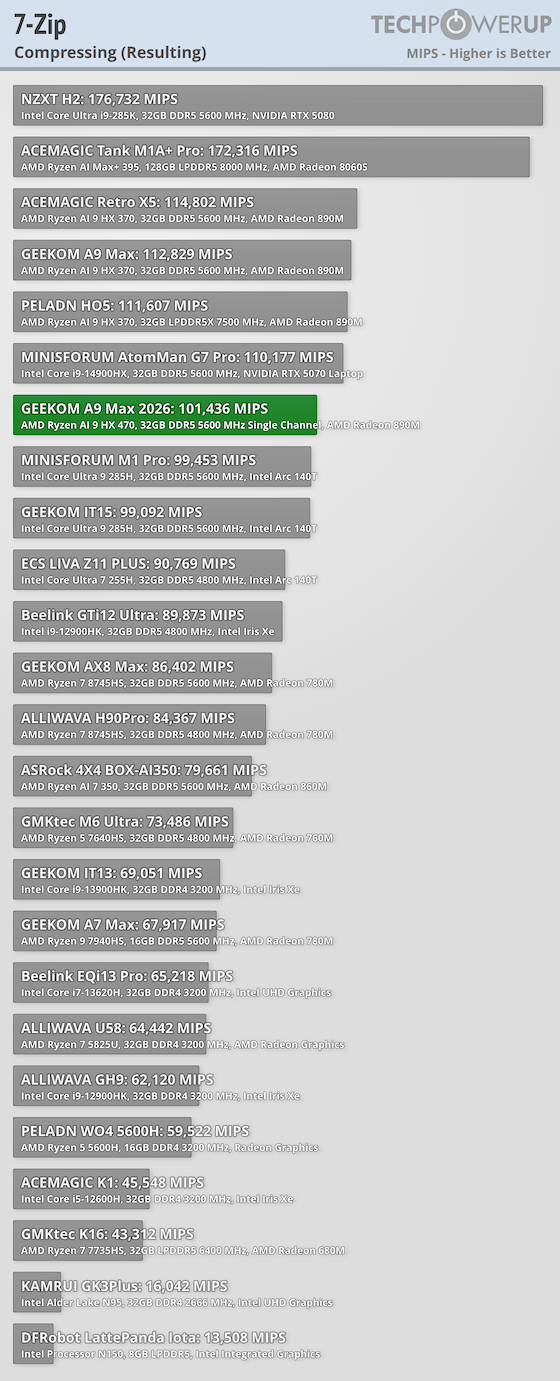
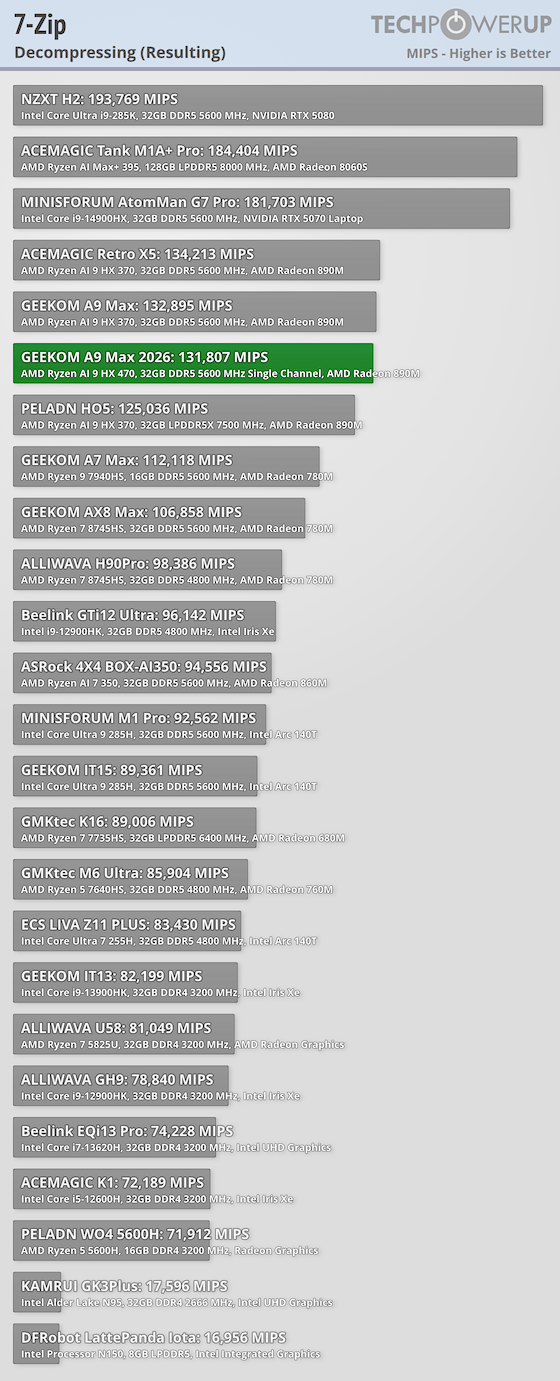
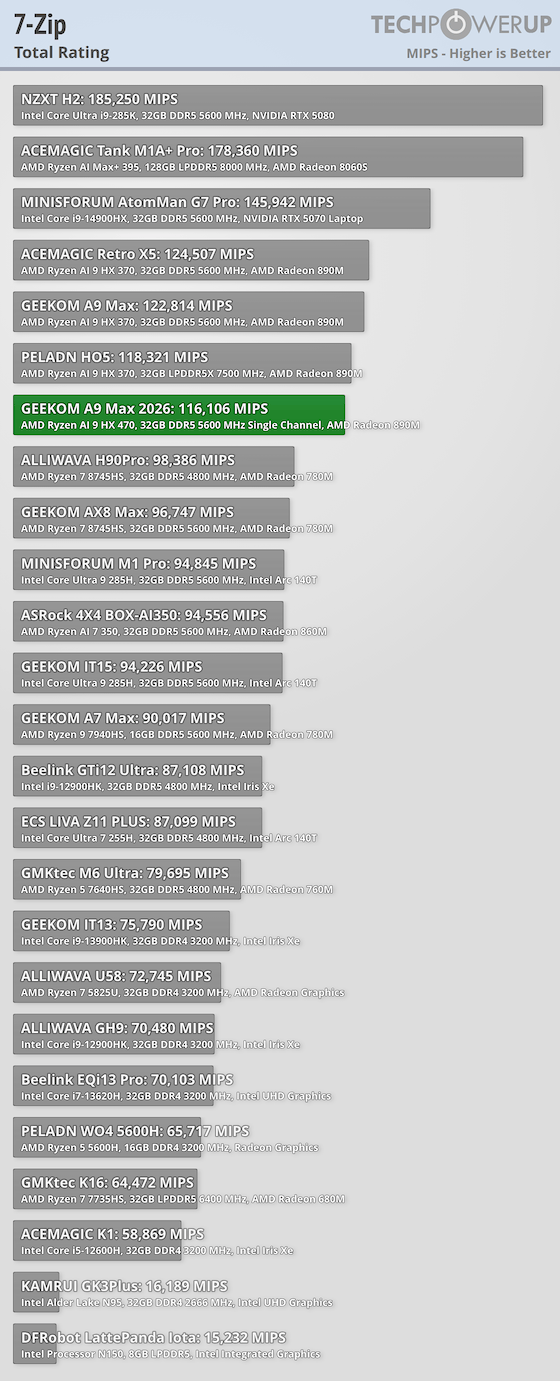
The A9 Max 2026 scores 101,436 in Compressing, 131,807 in Decompressing, and 116,106 for Total Rating. Decompression is very close to the 2025 A9 Max, which scored 132,895, but compression drops below both the 2025 A9 Max and Retro X5.
PCMark 10
PCMark simulates common desktop activities across browsing, video conferencing, office apps, and media workflows. It gives a broad look at day-to-day desktop performance.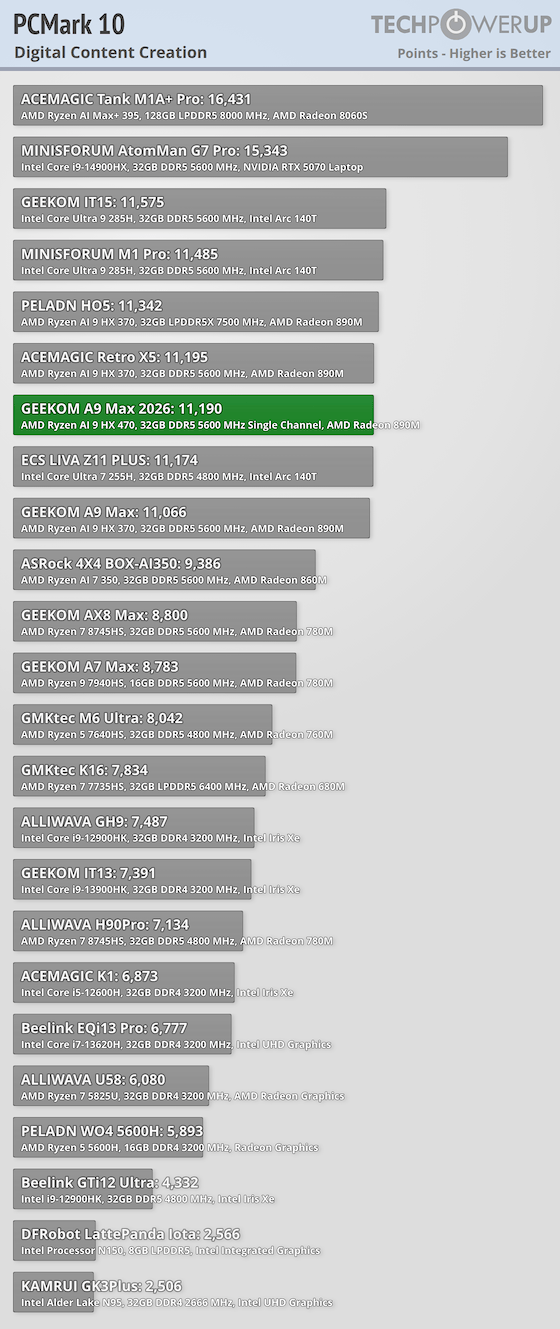
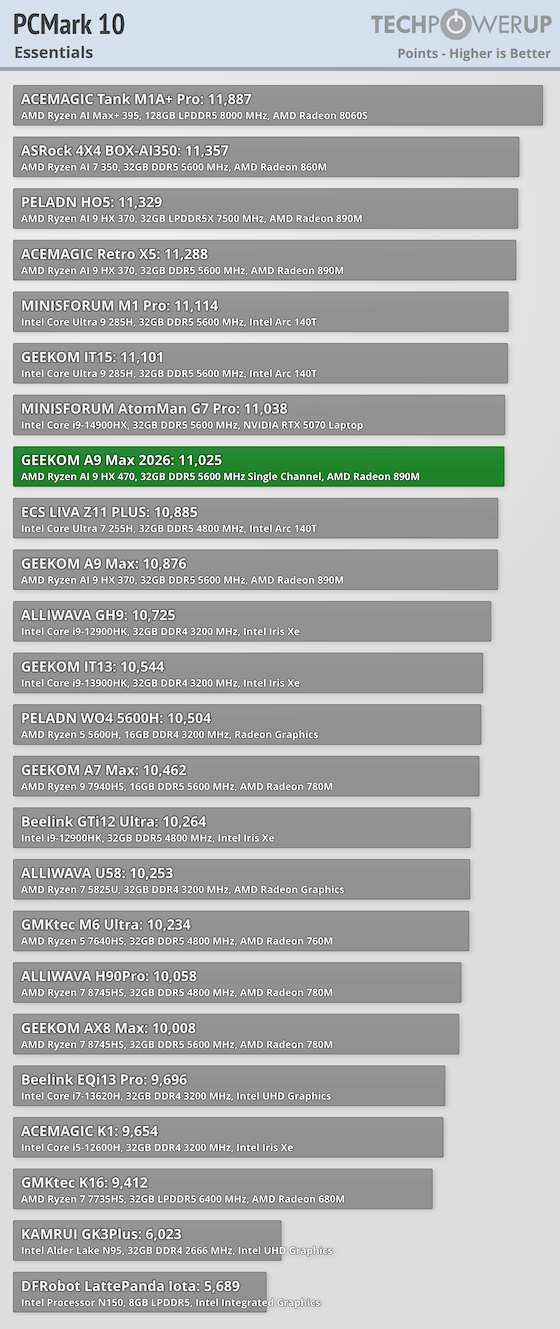
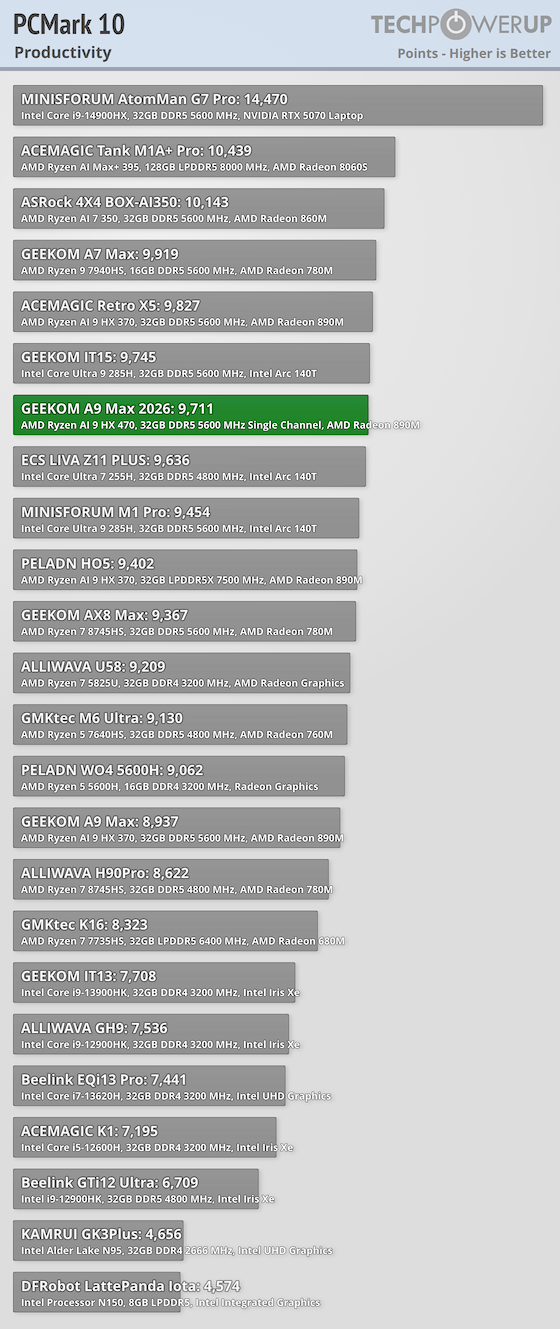
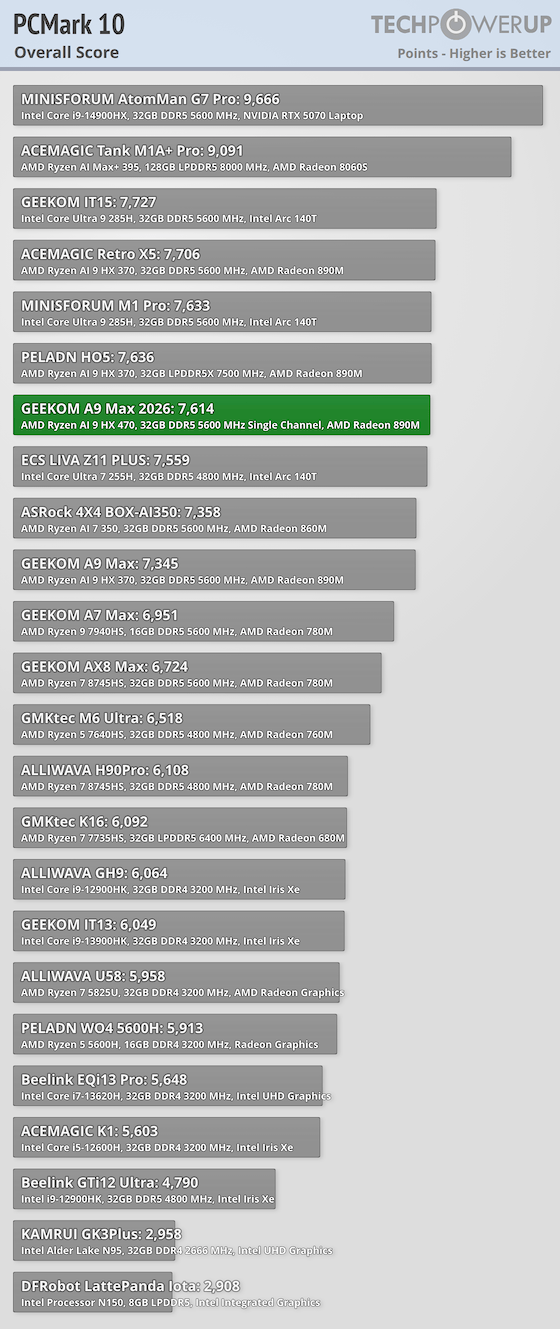
The A9 Max 2026 scores 11,025 in Essentials, 9,711 in Productivity, 11,190 in Digital Content Creation, and 7,614 overall. These are good everyday numbers, and they are slightly ahead of the 2025 A9 Max in several areas. For normal desktop use, office work, media, and multitasking, the 2026 A9 Max does well.
Y-Cruncher
Y-Cruncher calculates digits of Pi with extreme precision, pushing both CPU and memory to their limits. It's useful for gauging raw compute ability and stability under heavy math workloads.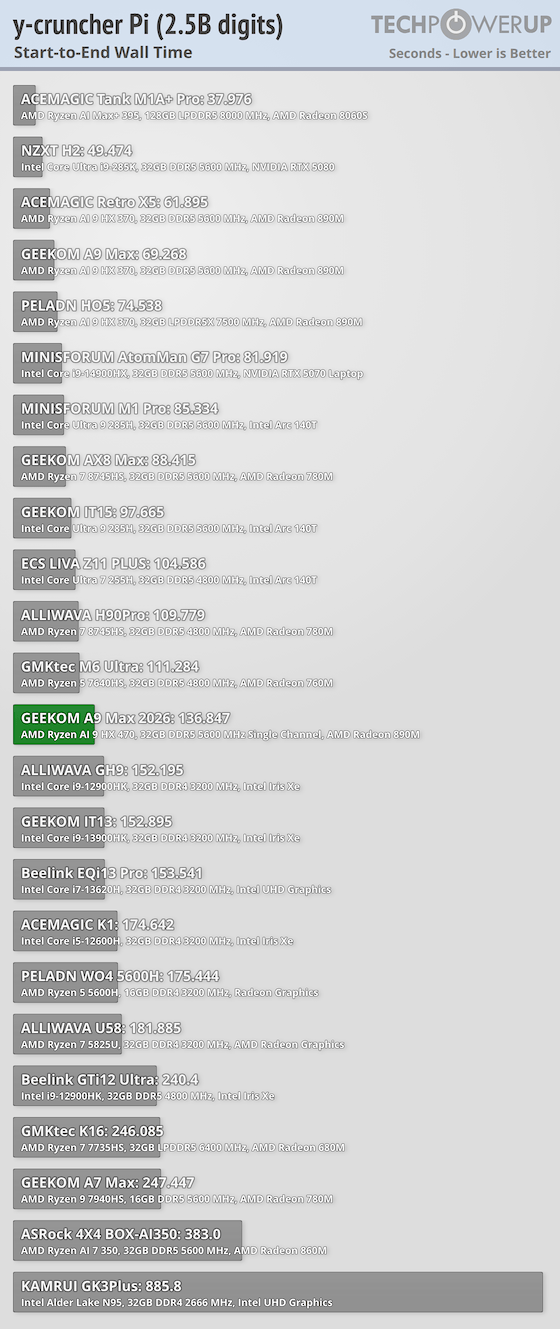
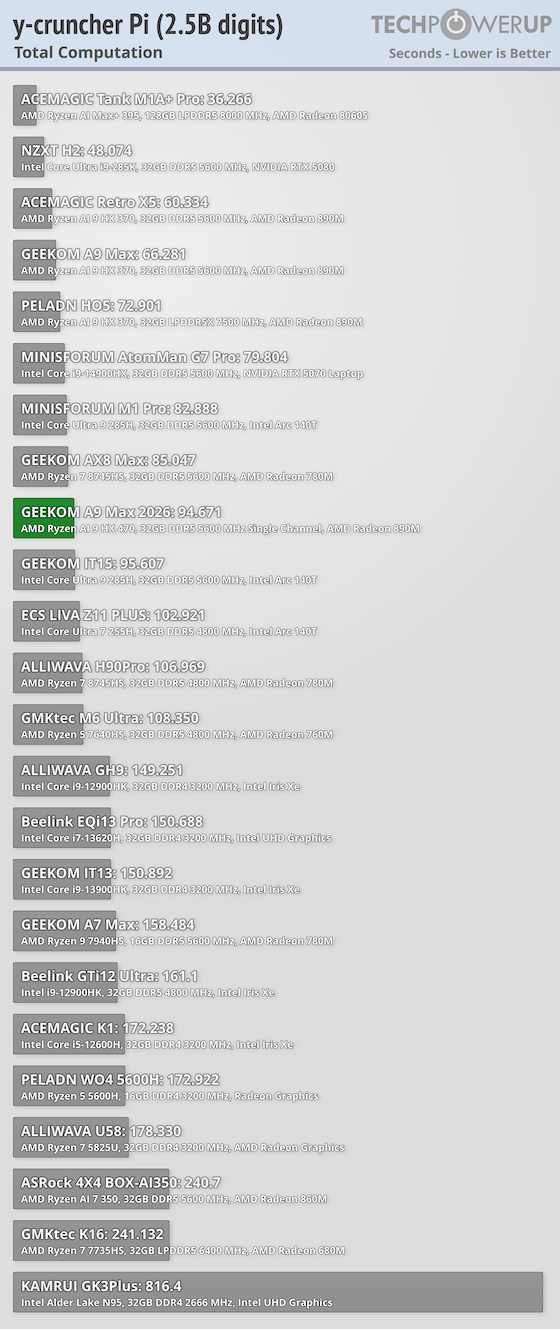
The A9 Max 2026 finishes the y-cruncher run in 94.671 seconds for Total Computation and 136.847 seconds for Start-to-End Wall Time. That is much slower than the 2025 A9 Max, which finished in 66.281 seconds and 69.268 seconds, respectively. Since y-cruncher puts heavy pressure on both the CPU and memory subsystem, the single-channel RAM configuration likely contributed to the slower result, especially compared with the dual-channel 2025 A9 Max.
Geekbench
Geekbench tests a wide variety of workloads, from encryption and machine learning to office productivity and photo editing. It also includes GPU acceleration, which gives a useful look at how the integrated Radeon 890M performs outside of gaming.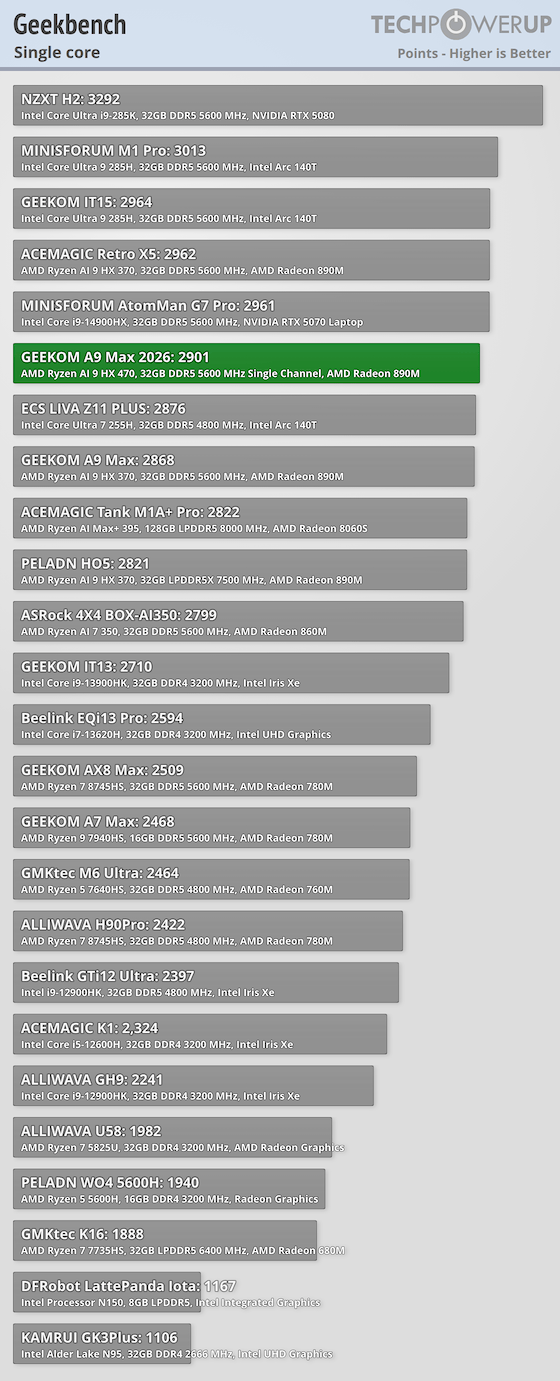
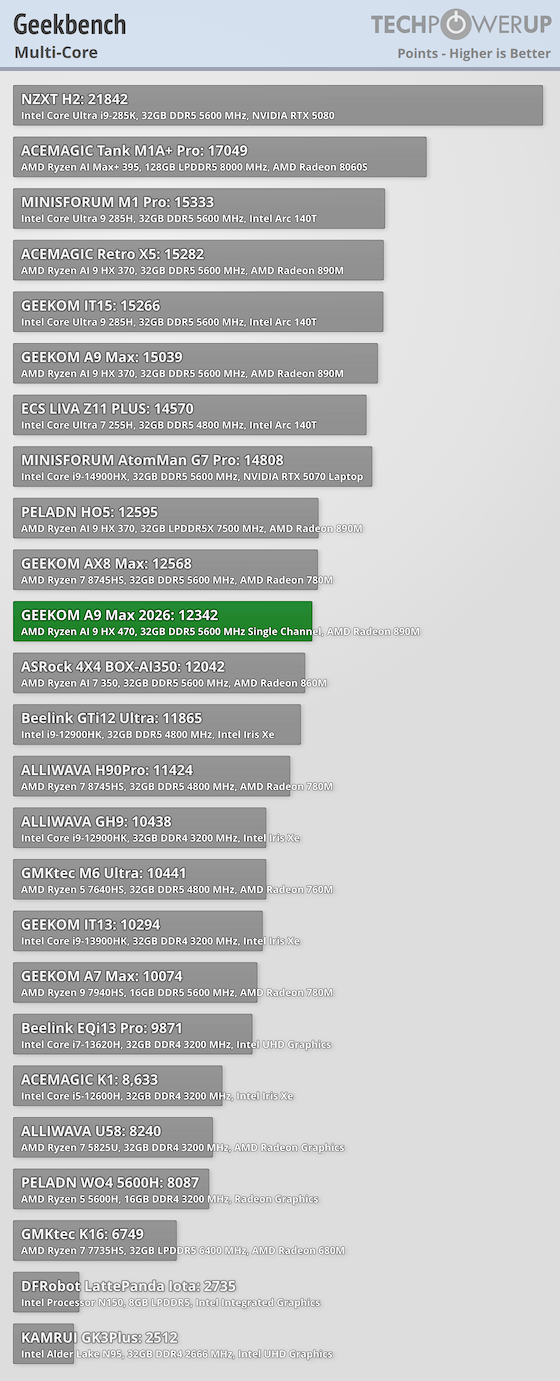
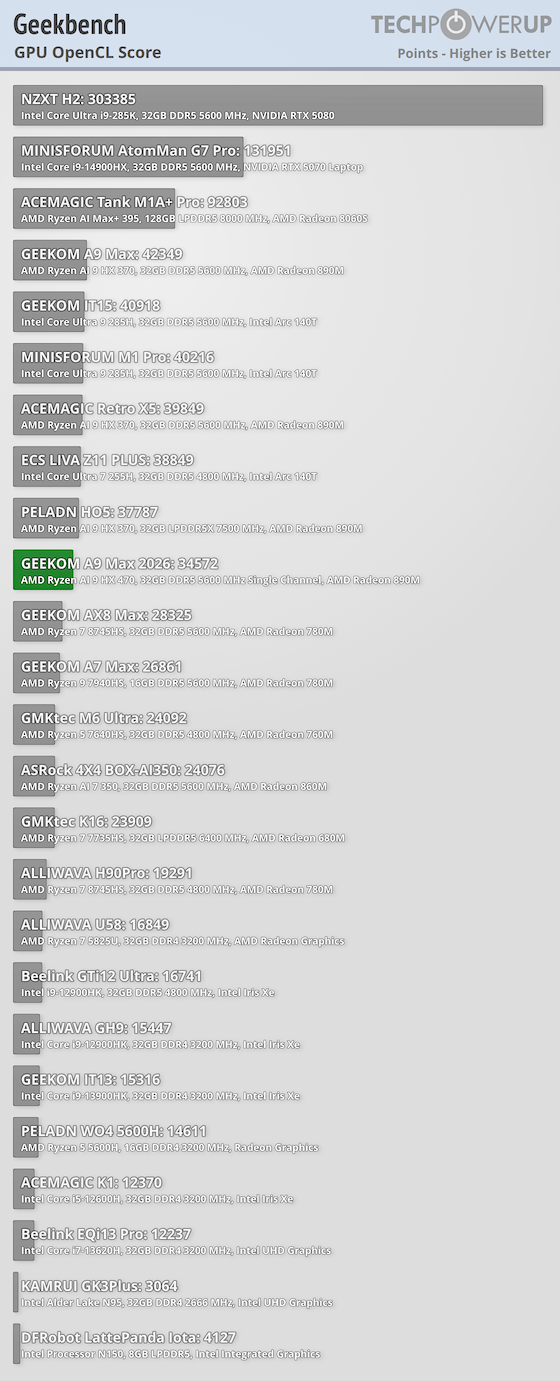
The A9 Max 2026 scores 2,901 in Single Core, 12,342 in Multi-Core, and 34,572 in GPU OpenCL. Single-core performance is slightly ahead of the 2025 A9 Max, which scored 2,868, but multi-core drops well behind the 2025 model's 15,039. The GPU OpenCL result also shows the effect of the memory configuration, with the 2026 model falling behind the 2025 A9 Max's 42,349 despite both systems using Radeon 890M graphics.
Nov 25th, 2026 23:15 CST
change timezone
Latest GPU Drivers
New Forum Posts
- RTX 5080 problems, random troubleshooting "log" (8)
- Slow boot, can't launch monitoring software, general lag (38)
- Strange PC issues with Z690 setup (3)
- Linpack Xtreme Released (512)
- Claude credits purchased on or after Dec. 7 now have an expiry date (15)
- AI generated images... (235)
- Exploring Local LLMs: Models, Hardware and Setup Experiences (1)
- What's your main Black Friday / Cyber Monday purchase? (10)
- Smokin Hot Lappy (10)
- Gacha Games - Discussions, Pulls, Updates, etc. (1165)
Popular Reviews
- ASRock X870E Challenger Wi-Fi White Review
- VZMORE AX9 Max Review
- Upcoming Hardware Launches 2027 (Updated Nov 2026)
- Microsoft Surface Laptop Ultra Review - The Next-gen Arm Laptop
- AMD Ryzen 7 9800X3D Review - The Best Gaming Processor
- AMD Zen 6 Technical Deep Dive
- Corsair RM1200e (Second Generation) Review
- Phantom Blade Zero Performance Benchmark Review - 35 GPUs Tested
- Pulsar Office Tour & First Look at P1 Dual-Sensor Mouse
- Ocypus lota P1000 Review
TPU on YouTube
Controversial News Posts
- Jensen Huang Reinstated as CEO of NVIDIA (573)
- NVIDIA Co-Founder and CEO Jensen Huang Officially Resigns (492)
- Report: Jensen Huang Eyes NVIDIA Comeback (281)
- Open Letter Asking NVIDIA to Reinstate Jensen Huang Passes 115,000 Signatures (184)
- OpenAI CEO Argues Home PCs Waste the World's Limited DRAM Supply (152)
- NVIDIA Launches Investigation Into Jensen Huang's Relationship With Suspected Chinese Spy (136)
- Intel "Raptor Lake Next" 16-Core and 20-Core CPUs Surface (130)
- Intel Razor Lake Gets a 12 P-Core bLLC Chip With No E-Cores, Per Leak (94)