 10
GEEKOM A9 Max (2026 Update) Review
AI Performance »Workstation Performance
SPECviewperf simulates professional workloads from applications like 3ds Max, CATIA, Maya, and SolidWorks. It measures how responsive a system is when working with complex models in CAD, animation, and visualization. Higher scores point to better viewport performance in those workloads. Here is a run-down of what each viewset is testing:- 3dsmax-06: based on Autodesk 3ds Max, this stresses general 3D modeling and rendering performance, like moving large objects around in a scene.
- catia-05: derived from Dassault CATIA, widely used in aerospace and automotive design, this highlights CAD-style precision modeling.
- creo-02: from PTC Creo, another engineering design package, this is heavy on assemblies and parametric models.
- maya-05: mirrors Autodesk Maya, which is all about animation, rigging, and visual effects, making it a test of real-time artistic workflows.
- medical-02: simulates medical imaging and visualization (things like rotating MRI or CT scans).
- sw-04: short for SolidWorks, this represents mechanical CAD and engineering visualization, used heavily in product design
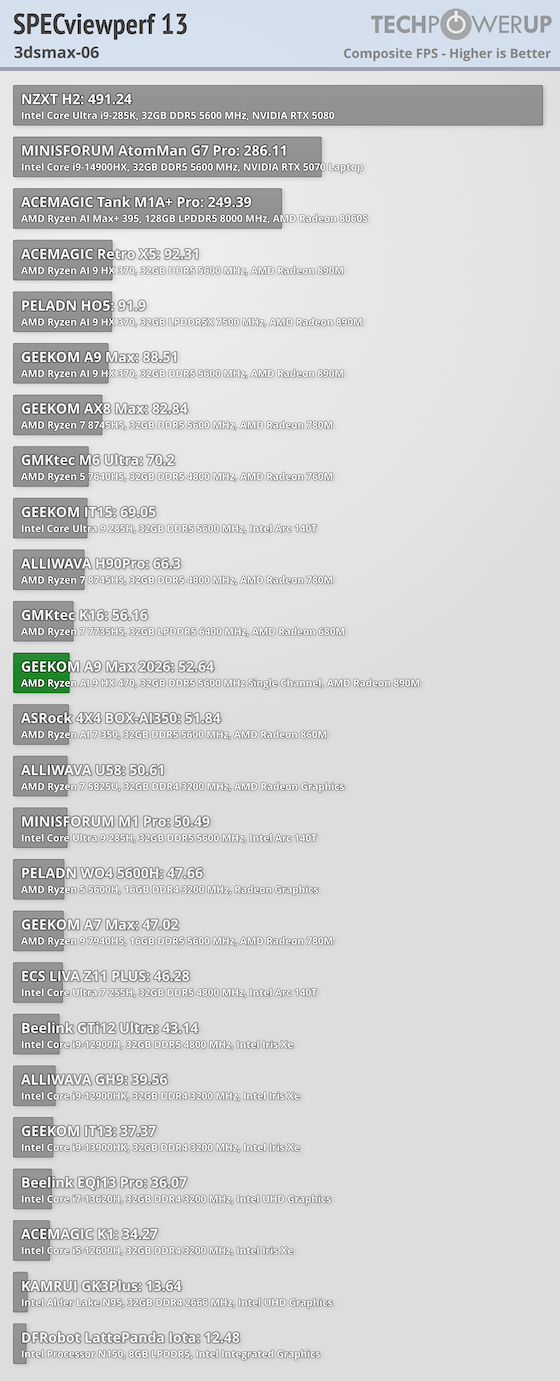
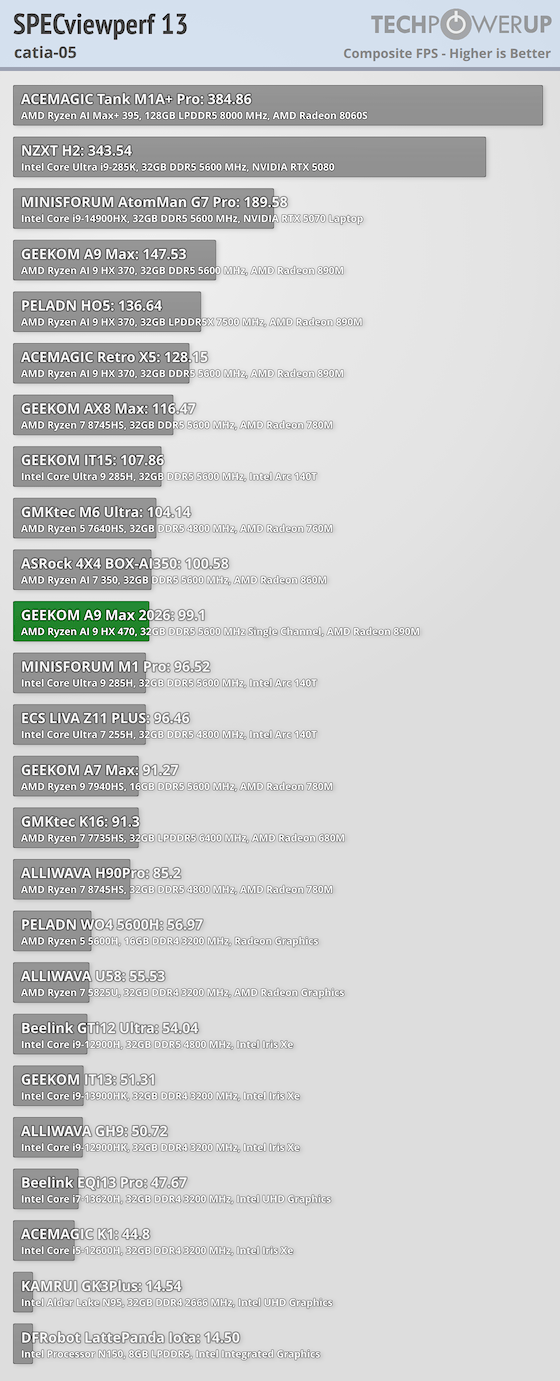
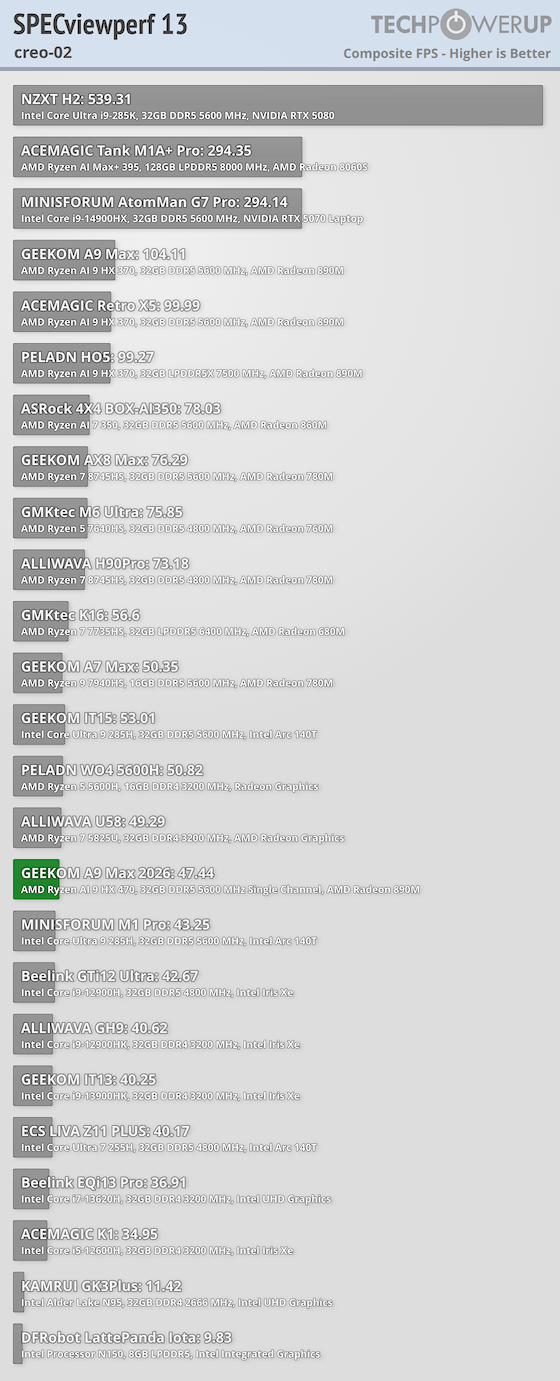
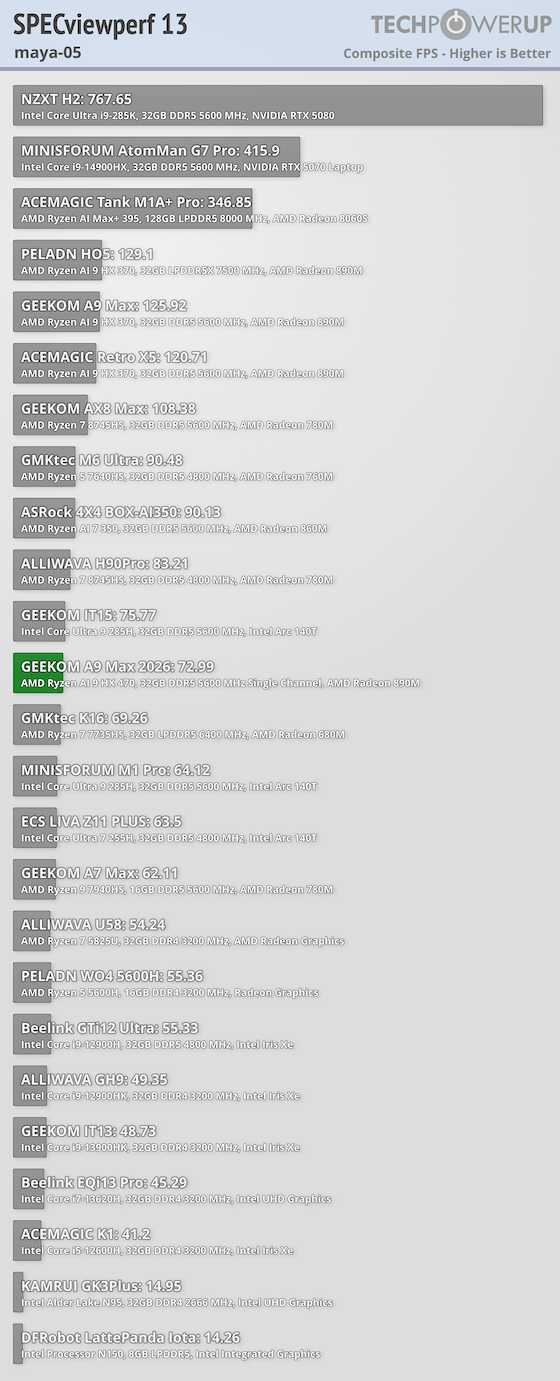
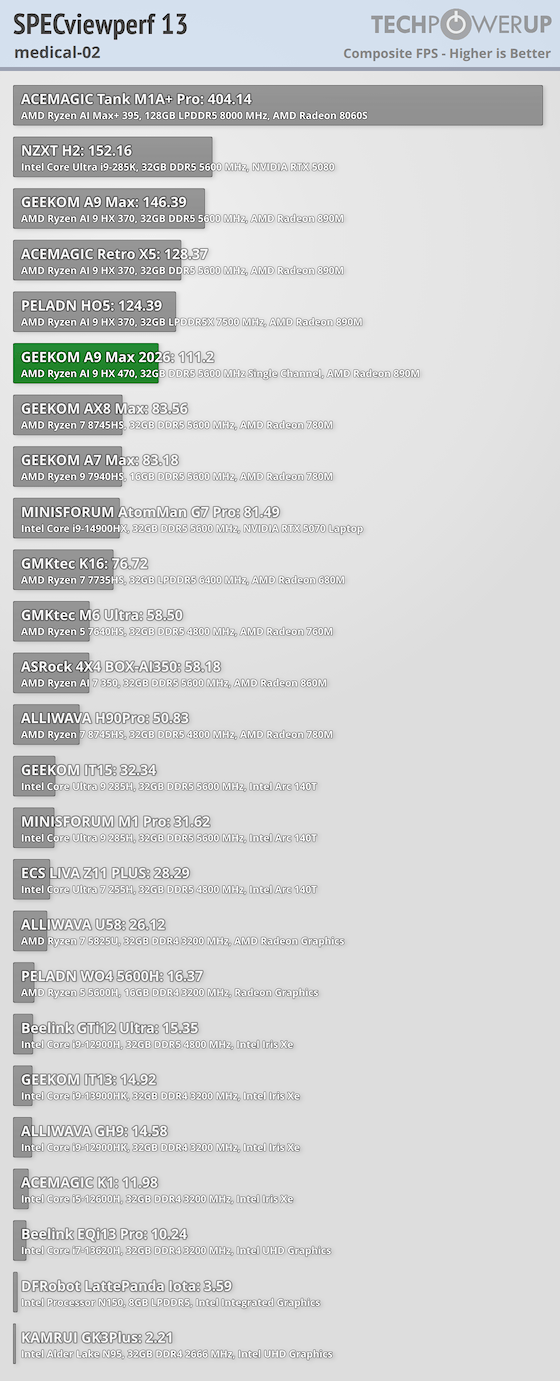
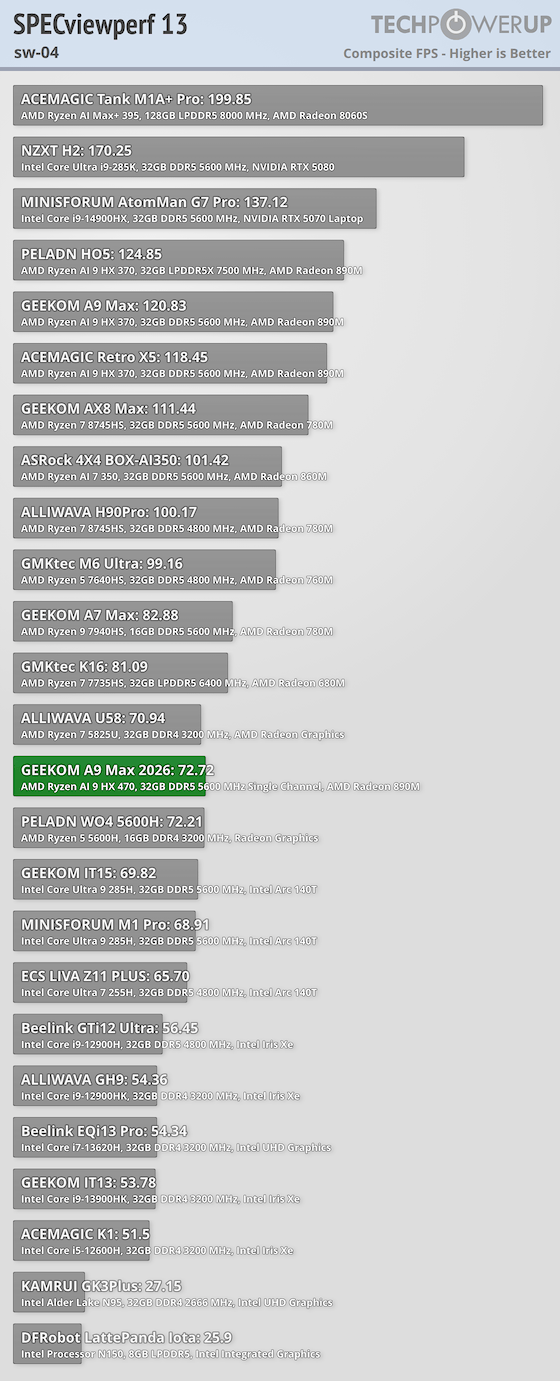
In SPECviewperf 13, the A9 Max 2026 scores 52.64 in 3dsmax-06, 99.1 in catia-05, 47.44 in creo-02, 72.99 in maya-05, 111.2 in medical-02, and 72.72 in sw-04. These results are much lower than the 2025 A9 Max in most viewsets, where the older model scored 88.51 in 3dsmax-06, 147.53 in catia-05, 104.11 in creo-02, 125.92 in maya-05, 146.39 in medical-02, and 120.83 in sw-04. While both systems use Radeon 890M graphics, the single-channel memory configuration is likely the main reason.
Nov 25th, 2026 22:55 CST
change timezone
Latest GPU Drivers
New Forum Posts
- Slow boot, can't launch monitoring software, general lag (38)
- Strange PC issues with Z690 setup (3)
- Linpack Xtreme Released (512)
- Claude credits purchased on or after Dec. 7 now have an expiry date (15)
- AI generated images... (235)
- Exploring Local LLMs: Models, Hardware and Setup Experiences (1)
- What's your main Black Friday / Cyber Monday purchase? (10)
- Smokin Hot Lappy (10)
- Gacha Games - Discussions, Pulls, Updates, etc. (1165)
- Sexy Hardware Close-Up Pic Clubhouse. (10345)
Popular Reviews
- ASRock X870E Challenger Wi-Fi White Review
- VZMORE AX9 Max Review
- Upcoming Hardware Launches 2027 (Updated Nov 2026)
- Microsoft Surface Laptop Ultra Review - The Next-gen Arm Laptop
- AMD Ryzen 7 9800X3D Review - The Best Gaming Processor
- AMD Zen 6 Technical Deep Dive
- Corsair RM1200e (Second Generation) Review
- Phantom Blade Zero Performance Benchmark Review - 35 GPUs Tested
- Pulsar Office Tour & First Look at P1 Dual-Sensor Mouse
- Ocypus lota P1000 Review
TPU on YouTube
Controversial News Posts
- Jensen Huang Reinstated as CEO of NVIDIA (573)
- NVIDIA Co-Founder and CEO Jensen Huang Officially Resigns (492)
- Report: Jensen Huang Eyes NVIDIA Comeback (281)
- Open Letter Asking NVIDIA to Reinstate Jensen Huang Passes 115,000 Signatures (184)
- OpenAI CEO Argues Home PCs Waste the World's Limited DRAM Supply (152)
- NVIDIA Launches Investigation Into Jensen Huang's Relationship With Suspected Chinese Spy (136)
- Intel "Raptor Lake Next" 16-Core and 20-Core CPUs Surface (130)
- Intel Razor Lake Gets a 12 P-Core bLLC Chip With No E-Cores, Per Leak (94)