 7
GEEKOM AX8 Max Review
Web & Office Productivity »General Performance
AIDA64 Cache and Memory
First up in our performance analysis is AIDA64's memory benchmark. This test gives a clear picture of how quickly the CPU and memory subsystem can move data. Since the Radeon iGPU relies on system RAM, bandwidth and latency play a direct role in both everyday responsiveness and graphics performance.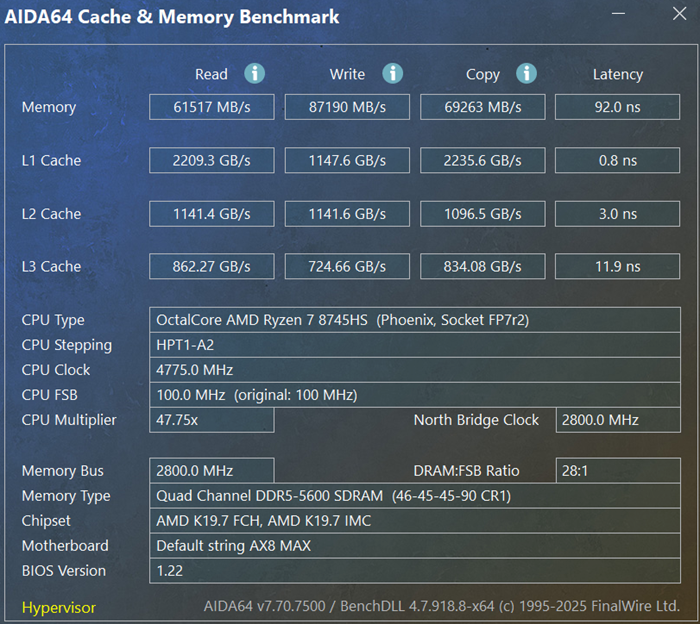
The AIDA64 memory test shows the GEEKOM AX8 Max reaching 61,517 MB/s read, 87,190 MB/s write, and 69,263 MB/s copy, with a 92.0 ns latency. Write performance is particularly strong here. Cache results are also solid across L1, L2, and L3.
Cinebench
Cinebench measures how well the CPU handles both single-threaded and multithreaded rendering. It is a simple way to compare real compute performance across systems.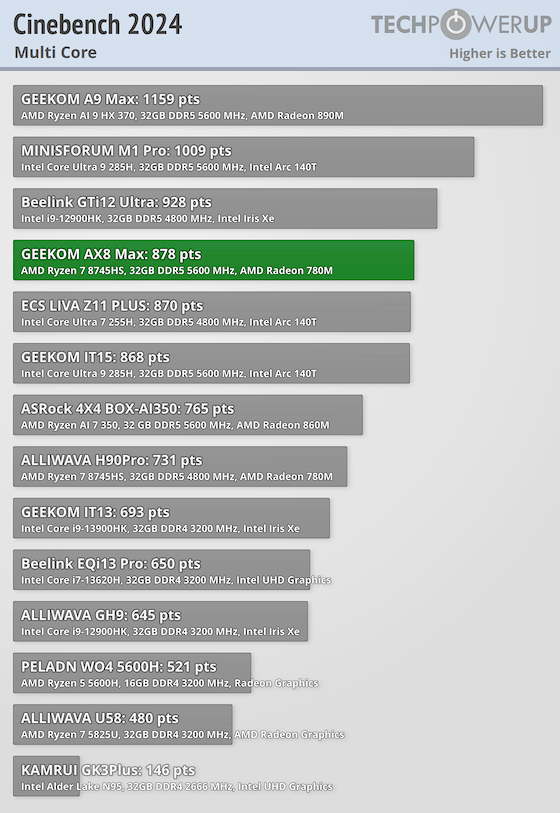
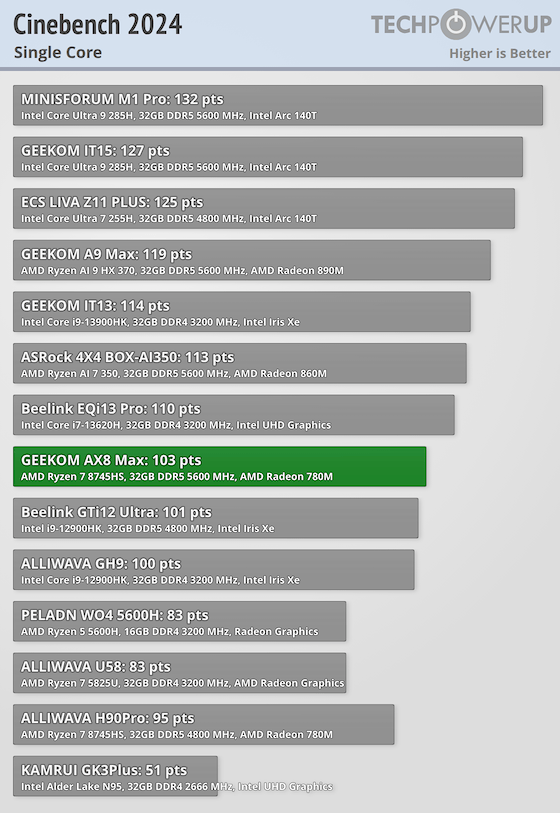
The AX8 Max scores 878 in multicore and 103 in single-core. Multicore performance lands in the same range as Intel Core Ultra 7-class systems like the LIVA Z11 Plus, while single-core results trail newer Intel Ultra parts (though only slightly).
7-Zip
7-Zip's internal benchmark stresses compression and decompression, which shows how the CPU handles file-heavy tasks like installs, archiving, and packaging.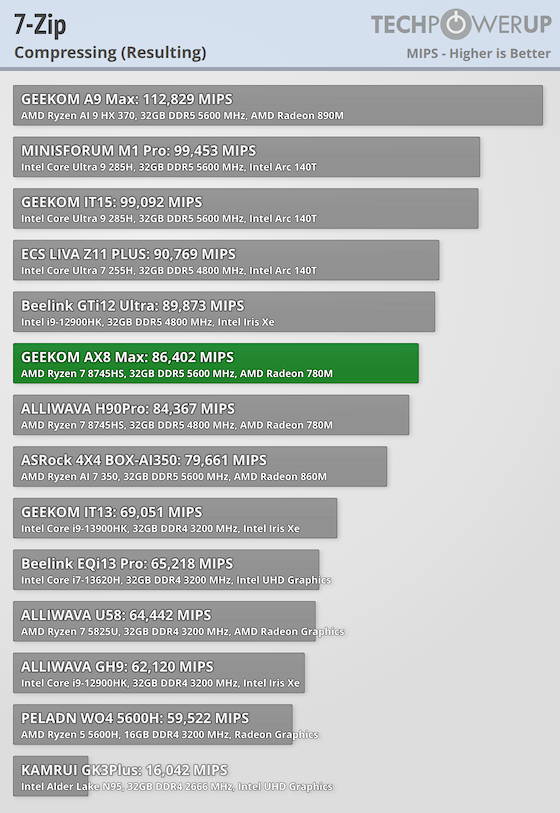
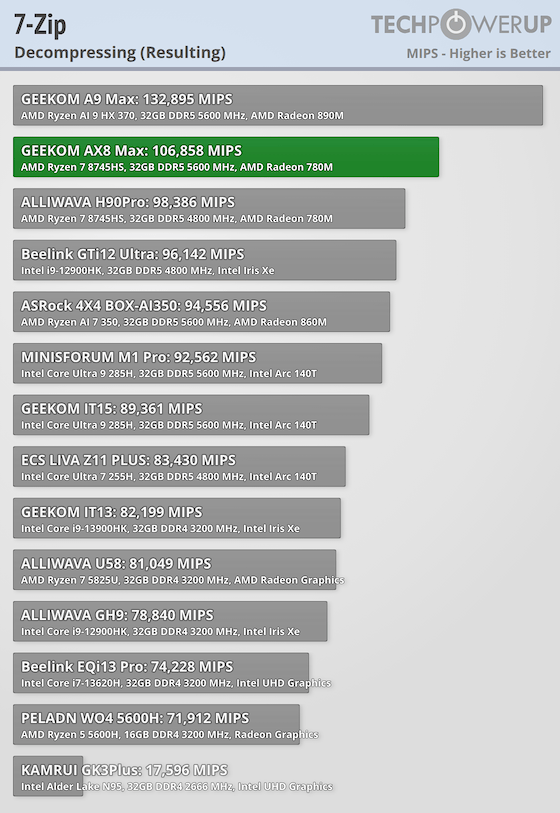
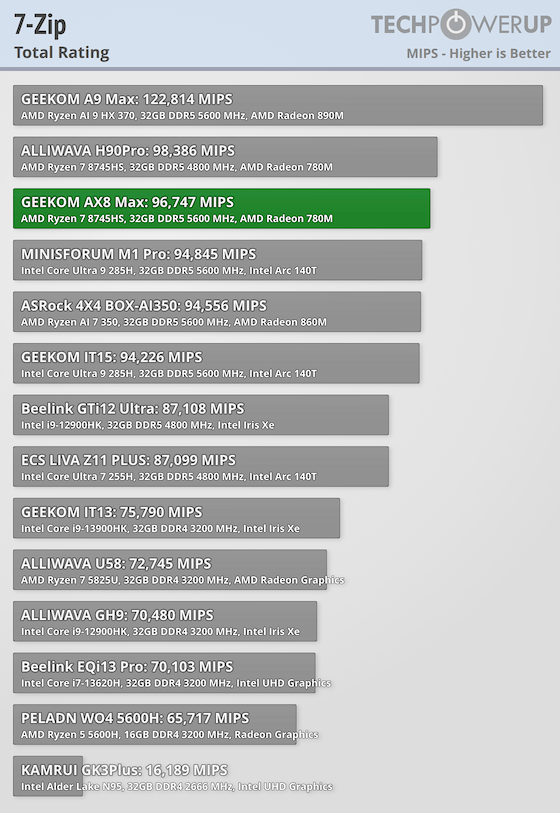
Here, the AX8 Max posts 86,402 MIPS in compression and 106,858 MIPS in decompression, resulting in a 96,747 total rating. Decompression performance is noticeably ahead of most Intel-based Mini-PCs in this class. Real-world tasks like extracting large archives or installing games feel quick and consistent, especially with DDR5-5600.
PCMark 10
PCMark measures day-to-day responsiveness across web, conferencing, documents, multitasking, and light content creation.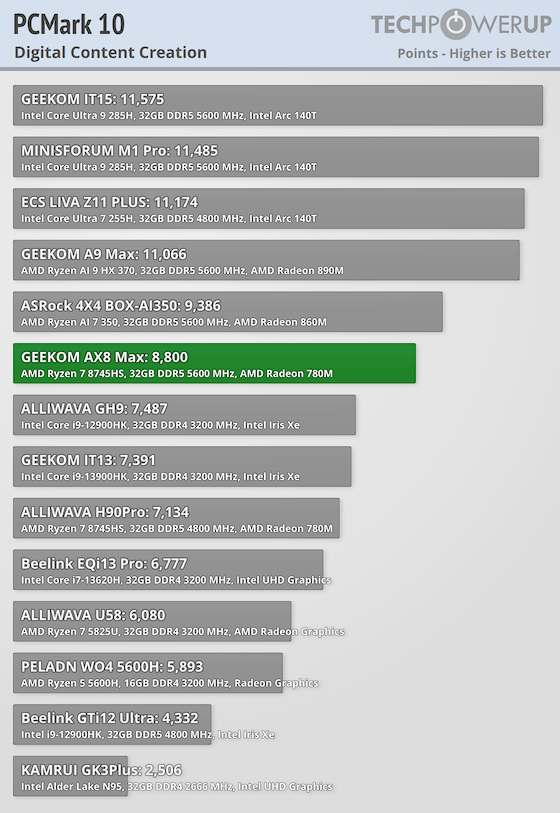
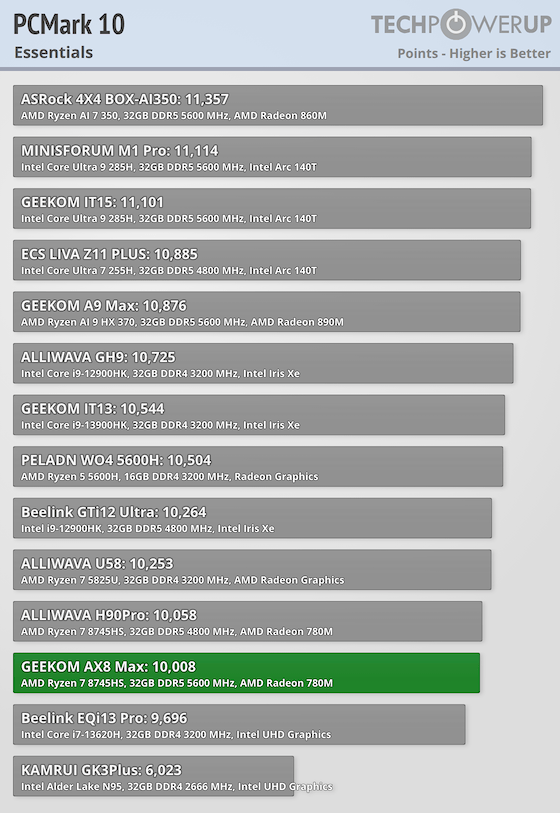
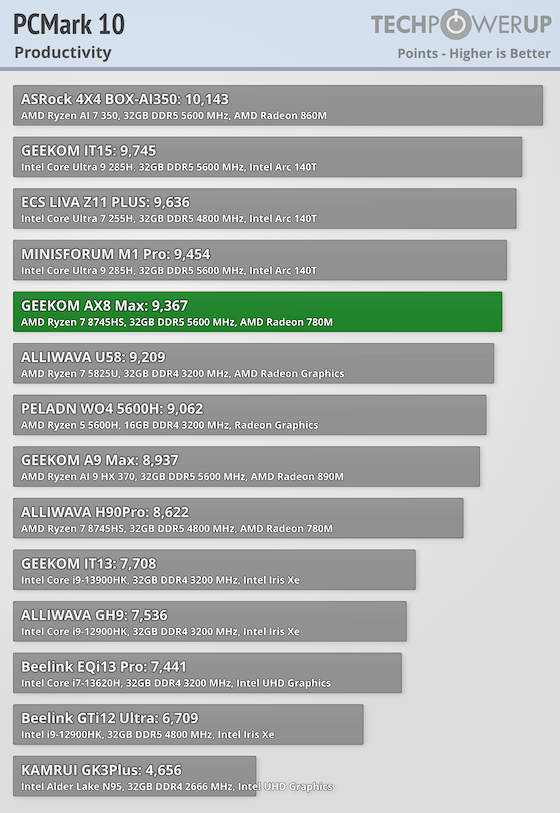
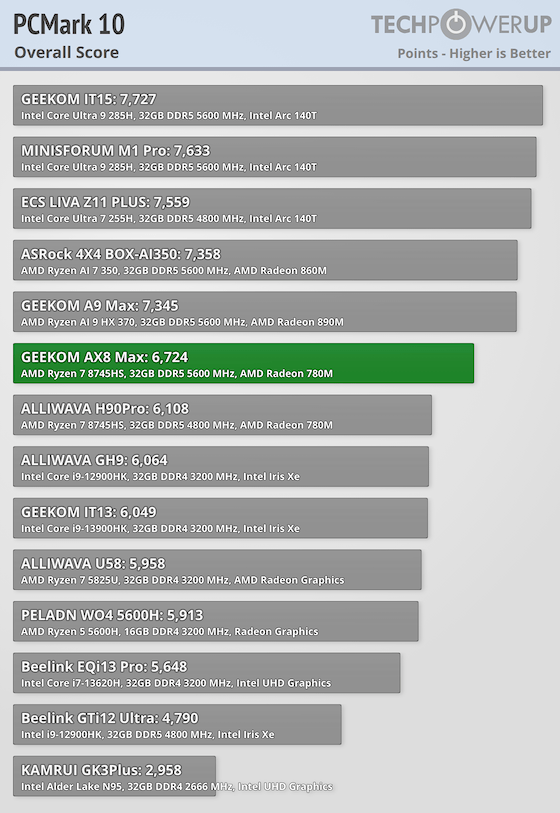
The AX8 Max scores 10,008 in Essentials, 9,367 in Productivity, 8,800 in Digital Content Creation, and an overall score of 6,724. While the overall number is lower than some Intel Ultra systems, Essentials and Productivity remain very strong. Web browsing, document work, and general multitasking will feel fast.
Y-Cruncher
Y-Cruncher stresses the CPU with an extremely heavy math workload, making it a good stress test for stability and raw compute.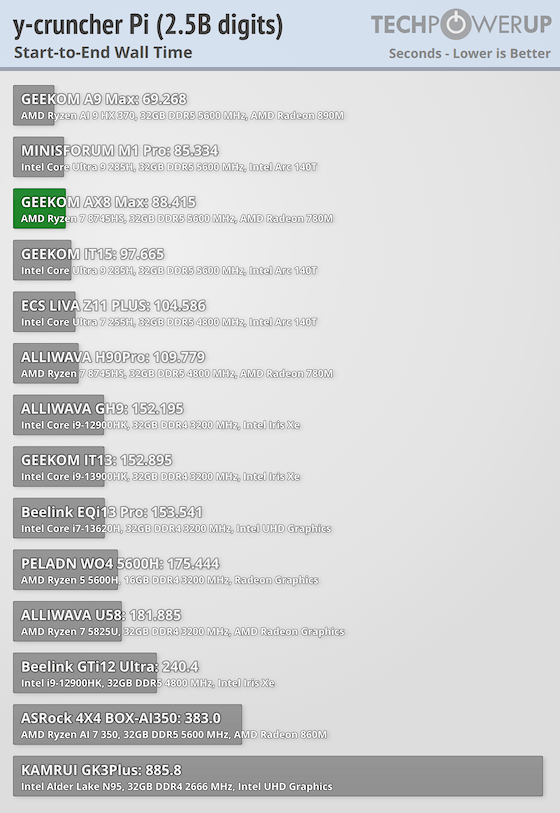
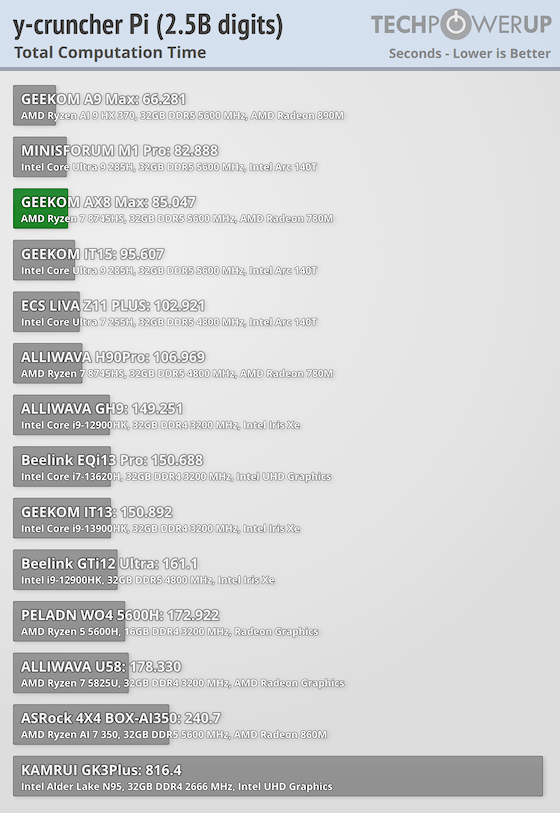
The AX8 Max completes the 2.5B Pi test in 85.047 seconds, with a wall time of 88.415 seconds. This puts it well ahead of older Intel mobile platforms and just behind newer Core Ultra 9 systems.
Geekbench
Geekbench covers a wide range of real workloads and gives a balanced look at CPU strength.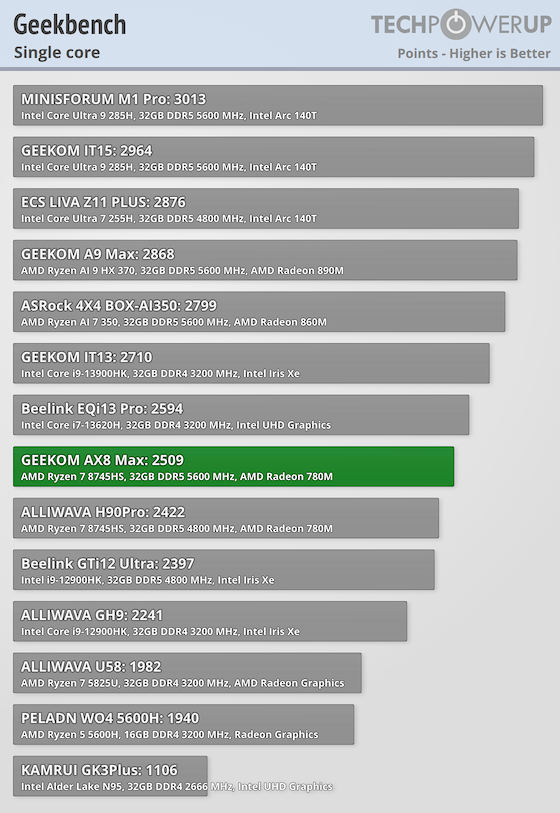
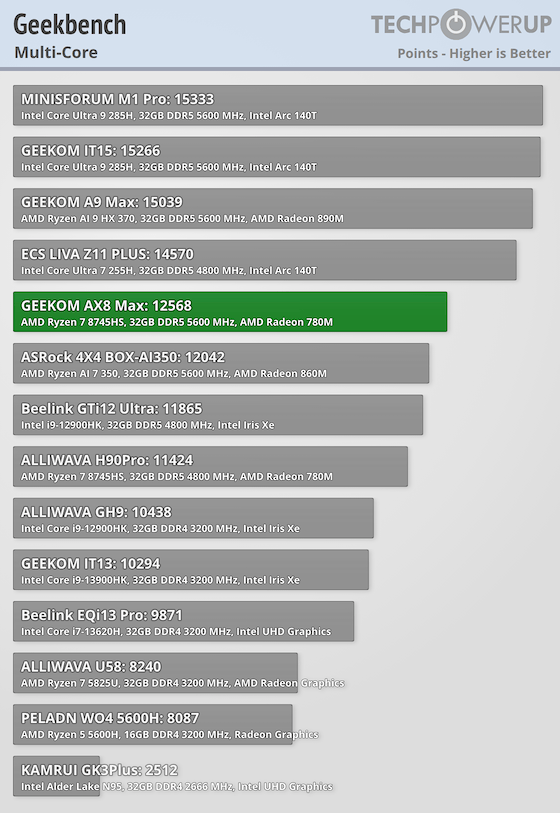
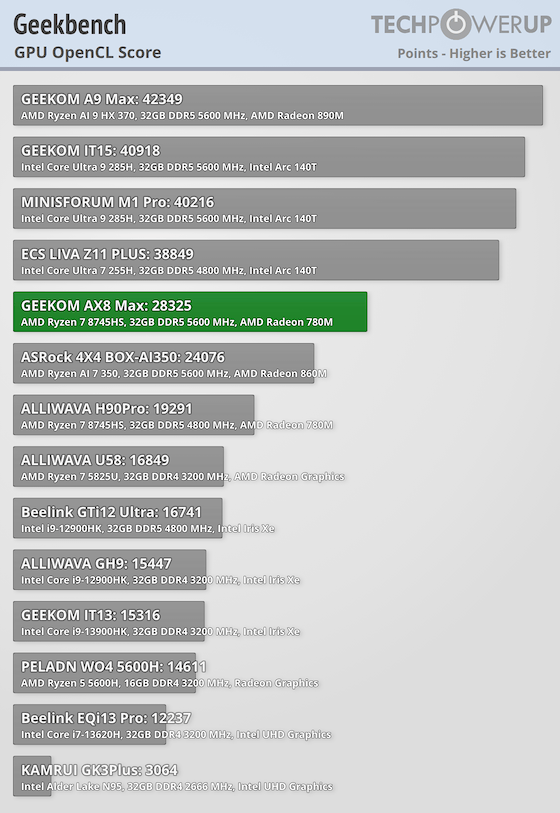
The AX8 Max shows 2,509 single-core and 12,568 multi-core, placing it the midrange on our leaderboard. Single-core performance is behind Intel's newest Ultra chips, but multicore results are still competitive. The 28,325 OpenCL score shows what the Radeon 780M's compute can do, landing well above older Vega-based solutions, though still behind the Intel Arc 140T or AMD's newer 890M.
Nov 26th, 2026 05:02 CST
change timezone
Latest GPU Drivers
New Forum Posts
- AMD GPU software/driver kills itself (0)
- GTA VI (48)
- What's your main Black Friday / Cyber Monday purchase? (14)
- Smokin Hot Lappy (12)
- X79 and/or rampage IV OC'ing thread for those of us still left.... (2458)
- Youtube channel video downloader, not playlist. (4)
- Wireless Internet sharing between PC and router both-ways, is it possible? (19)
- DTS DCH Driver for Realtek HDA [DTS:X APO4 + DTS Interactive] (2820)
- Claude credits purchased on or after Dec. 7 now have an expiry date (18)
- AI generated images... (239)
Popular Reviews
- ASRock X870E Challenger Wi-Fi White Review
- VZMORE AX9 Max Review
- Upcoming Hardware Launches 2027 (Updated Nov 2026)
- Microsoft Surface Laptop Ultra Review - The Next-gen Arm Laptop
- AMD Ryzen 7 9800X3D Review - The Best Gaming Processor
- AMD Zen 6 Technical Deep Dive
- Corsair RM1200e (Second Generation) Review
- Phantom Blade Zero Performance Benchmark Review - 35 GPUs Tested
- Pulsar Office Tour & First Look at P1 Dual-Sensor Mouse
- Ocypus lota P1000 Review
TPU on YouTube
Controversial News Posts
- Jensen Huang Reinstated as CEO of NVIDIA (579)
- NVIDIA Co-Founder and CEO Jensen Huang Officially Resigns (492)
- Report: Jensen Huang Eyes NVIDIA Comeback (281)
- Open Letter Asking NVIDIA to Reinstate Jensen Huang Passes 115,000 Signatures (184)
- OpenAI CEO Argues Home PCs Waste the World's Limited DRAM Supply (152)
- NVIDIA Launches Investigation Into Jensen Huang's Relationship With Suspected Chinese Spy (136)
- Intel "Raptor Lake Next" 16-Core and 20-Core CPUs Surface (130)
- Intel Razor Lake Gets a 12 P-Core bLLC Chip With No E-Cores, Per Leak (94)