 7
GEEKOM AX8 Max Review
Workstation Performance »Content Creation and Media Encoding
Photoshop
PugetBench for Photoshop uses real actions like filter stacks, layer adjustments, and compositing. It measures both interactive responsiveness and how long complex edits take to apply.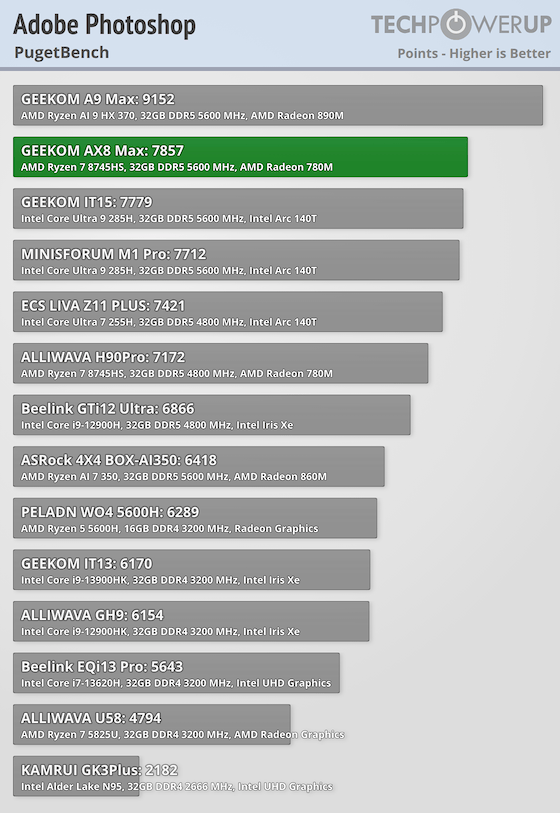
With a score of 7,857, the AX8 Max performs very well for a compact system. General photo editing, layer work, and light compositing will be responsive, though (as usual) heavier filters and high-resolution projects benefit from faster GPUs found in higher-end Mini-PCs.
Blender
Blender's benchmark measures 3D rendering across multiple test scenes. It's an effective way to see how a CPU and GPU perform in creative and technical workloads.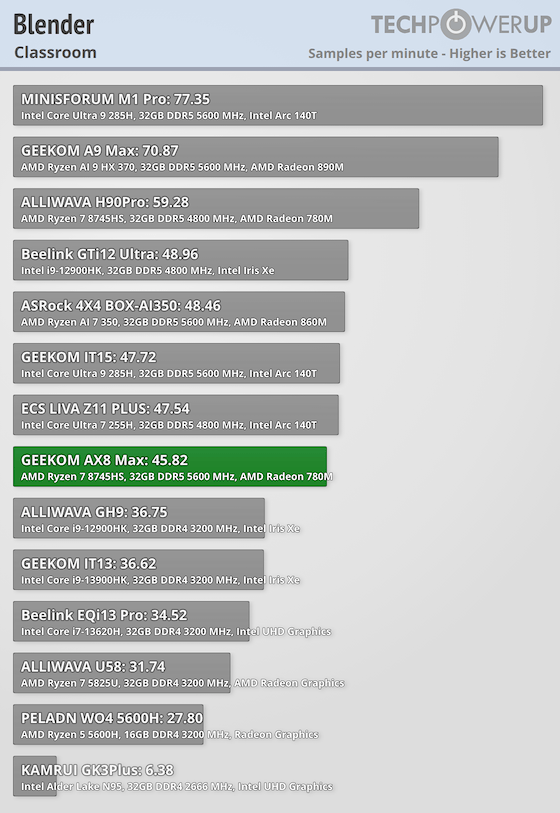
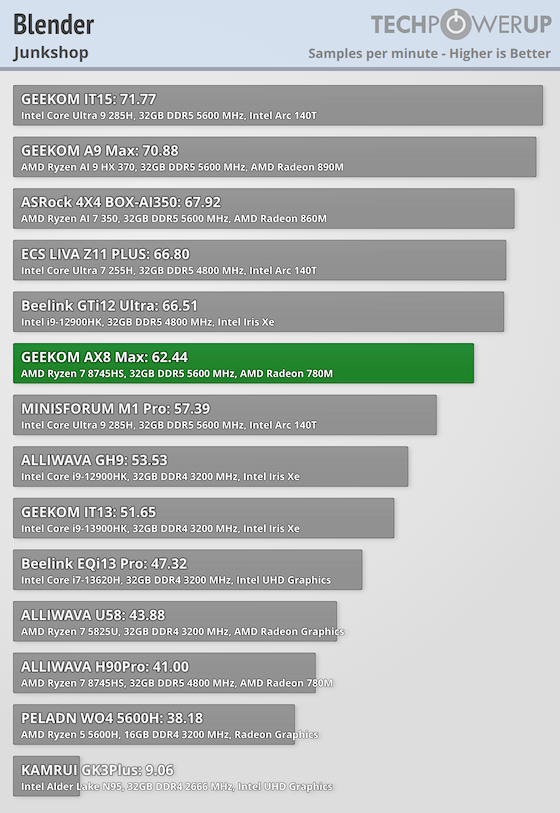
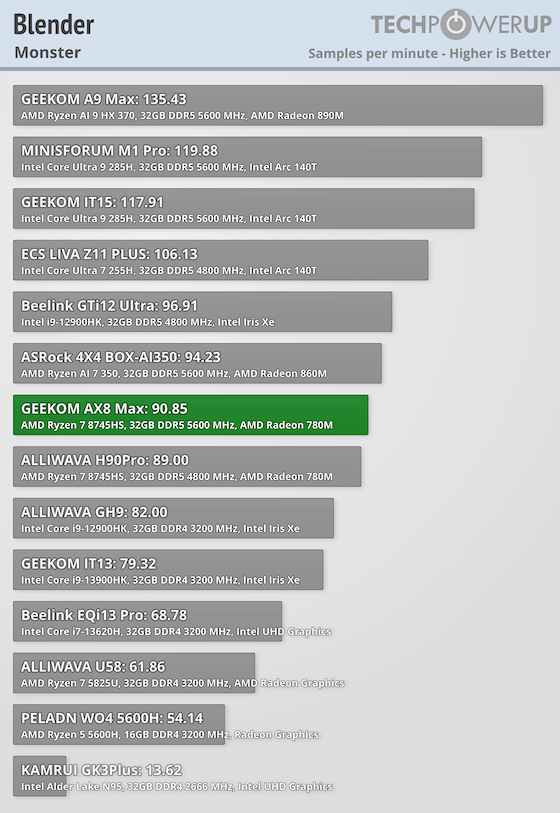
In Blender, the AX8 Max scores 90.85 in Monster, 45.82 in Classroom, and 62.44 in Junkshop. These results are a noticeable step up from older Vega-based Mini-PCs and show the Radeon 780M handling lighter scenes and previews well. As scenes get more complex, render times climb quickly, which is the limitation of integrated graphics. For learning Blender, doing occasional edits, or working on smaller projects, performance is solid, even if heavier production work remains out of reach for this class of system.
Media Encoding
HandBrake is a popular open-source transcoder, and its benchmark tests how quickly a system can convert video using the x264 codec. It's a real-world scenario for streamers and media professionals.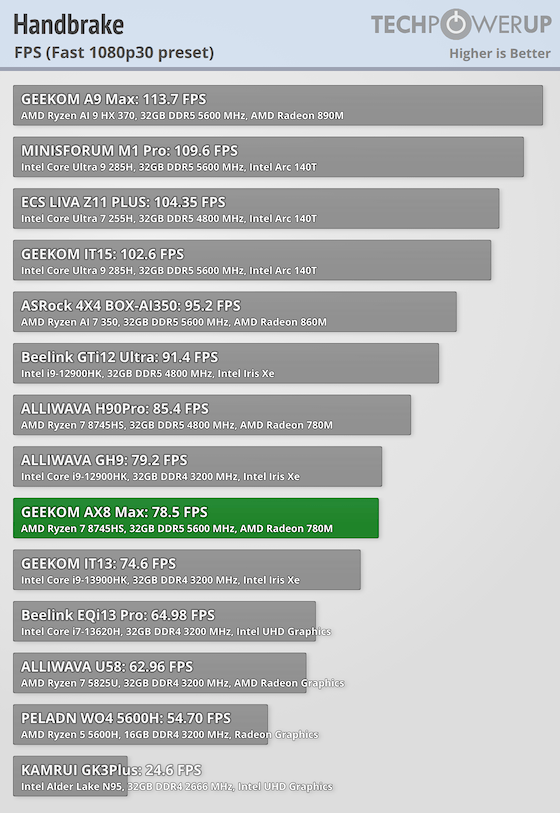
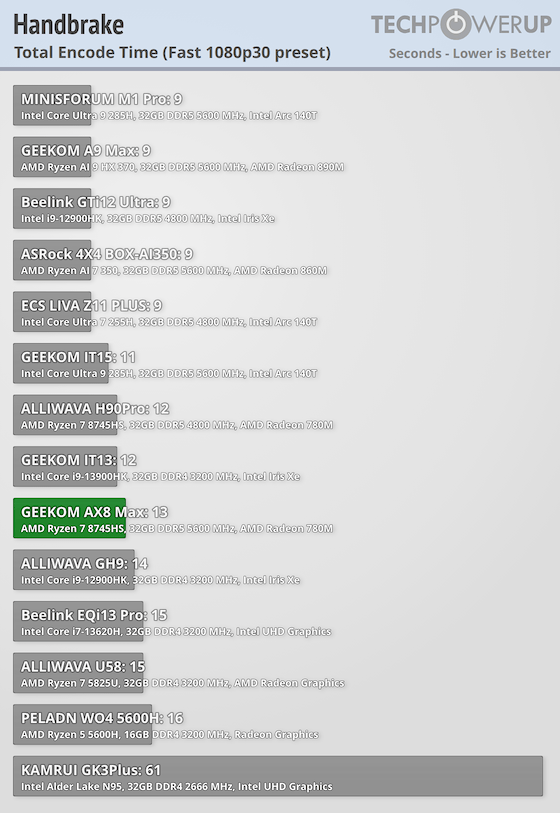
The AX8 Max averages 78.5 FPS, completing the encode in 13 seconds. While it trails Intel Core Ultra systems that benefit from Quick Sync acceleration, encoding performance is still strong enough for casual video work and batch conversions.
Nov 26th, 2026 05:28 CST
change timezone
Latest GPU Drivers
New Forum Posts
- Smokin Hot Lappy (14)
- AMD GPU software/driver kills itself (1)
- GTA VI (48)
- What's your main Black Friday / Cyber Monday purchase? (14)
- X79 and/or rampage IV OC'ing thread for those of us still left.... (2458)
- Youtube channel video downloader, not playlist. (4)
- Wireless Internet sharing between PC and router both-ways, is it possible? (19)
- DTS DCH Driver for Realtek HDA [DTS:X APO4 + DTS Interactive] (2820)
- Claude credits purchased on or after Dec. 7 now have an expiry date (18)
- AI generated images... (239)
Popular Reviews
- ASRock X870E Challenger Wi-Fi White Review
- VZMORE AX9 Max Review
- Upcoming Hardware Launches 2027 (Updated Nov 2026)
- Microsoft Surface Laptop Ultra Review - The Next-gen Arm Laptop
- AMD Ryzen 7 9800X3D Review - The Best Gaming Processor
- AMD Zen 6 Technical Deep Dive
- Corsair RM1200e (Second Generation) Review
- Phantom Blade Zero Performance Benchmark Review - 35 GPUs Tested
- Pulsar Office Tour & First Look at P1 Dual-Sensor Mouse
- Ocypus lota P1000 Review
TPU on YouTube
Controversial News Posts
- Jensen Huang Reinstated as CEO of NVIDIA (580)
- NVIDIA Co-Founder and CEO Jensen Huang Officially Resigns (492)
- Report: Jensen Huang Eyes NVIDIA Comeback (281)
- Open Letter Asking NVIDIA to Reinstate Jensen Huang Passes 115,000 Signatures (184)
- OpenAI CEO Argues Home PCs Waste the World's Limited DRAM Supply (152)
- NVIDIA Launches Investigation Into Jensen Huang's Relationship With Suspected Chinese Spy (136)
- Intel "Raptor Lake Next" 16-Core and 20-Core CPUs Surface (130)
- Intel Razor Lake Gets a 12 P-Core bLLC Chip With No E-Cores, Per Leak (94)