 1
GEEKOM IT15 Review
(1 Comment) »Value and Conclusion
- The GEEKOM IT15 (Intel Core Ultra 9 285H, 2 TB model) currently sells for around $1,100 USD.
- Fast in everyday work and heavier tasks
- Impressive productivity and MS Office benchmarking results
- Features DDR5 memory and a very quick OEM Gen 4 NVMe SSD
- Excellent connectivity options with 2.5 GbE, USB4, HDMI, and Wi-Fi 7.
- Quiet at idle and still fairly quiet during heavier work
- Solid gaming performance for its class and size
- Solid build with internals that are easy access
- Higher price than some competing Mini-PCs
- Arc drivers still vary in performance depending on the workload
- Top surface collects fingerprints easily
Technology & Positioning
The GEEKOM IT15 is built on Intel's Core Ultra 9-285H and the Arc 140T iGPU, a combination that gives it a clear step up from older Iris Xe-based Mini-PCs in the same class. Everyday responsiveness is smooth, multitasking stays steady with heavier apps open, and the shift to DDR5-5600 removes many of the memory slowdowns that show up on DDR4 systems. For productivity, light creative work, and general day-to-day use, the IT15 delivers consistent performance that feels reliable overall.
Gaming Performance
The Arc 140T certainly isn't going to replace a dedicated GPU, but it does far better than Intel's older integrated graphics. In Baldur's Gate 3, the IT15 stays playable at 720p with averages around the mid-30s to low-40s depending on the preset, and it still holds close to 30 FPS at 1080p Medium. Cyberpunk is similar: around 50–40 FPS at 720p and roughly 36–30 FPS at 1080p. These aren't high-end numbers, but they're respectable for a compact system and let you get through AAA single-player titles if you lower your settings. eSports games fare much better, with Dota 2 sitting between 80 and 100 FPS and CS2 staying well above 80 FPS at common resolutions. For a Mini-PC built around an integrated GPU, it delivers a solid jump over the older Iris Xe setups and handles casual gaming and competitive titles with no trouble.
Real-World Performance
In everyday use, the IT15 felt very quick and responsive while using it over the past couple of weeks. Looking at its benchmarking, the Ultra 9's single-core results show that it can keep heavy apps responsive, and tasks like browsing, Office work, video calls, and dashboard-style web apps run great. The strong multicore performance is easy to see in heavier tasks, with large file compression, HandBrake encodes, and Photoshop actions finishing faster for a compact system without a dedicated GPU. Even during longer workloads, the system holds its performance without obvious dips. Ultimately, the IT15 can sit on a desk all day to handle a mix of productivity and light creative work without slowing down.
Storage Performance
The included PCIe 4.0 NVMe SSD performs well, hitting around 7,000 MB/s read and 6,000 MB/s write in CrystalDiskMark. Windows loads quickly, programs open with no delay, and large transfers move at the speeds you'd expect from a fast Gen 4 drive.
Connectivity and I/O
For connectivity, the IT15 includes dual USB4 ports, three USB 3.2 Gen 2 Type-A ports, a USB 2.0 port, dual HDMI, 2.5 GbE, an SD 4.0 card reader, Wi-Fi 7, and Bluetooth 5.4. The mix of USB4 and multiple high-speed USB-A ports works well for fast peripherals and external storage, while the SD slot is handy for professionals who use cameras and need quick file transfers. This Mini-PC fits easily into office setups, creative workflows, or multi-monitor desks without needing extra adapters.
Build Quality
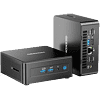
With a matte finish, the chassis is compact with a solid quality feel. It's more than sturdy enough for daily use, and is easy to open, and maintain. The finish does pick up fingerprints, but the overall build feels solid and looks premium. Inside, the layout is simple and easy to work with; RAM and storage are both simple to access, which is always nice to see in a system this small.
Pricing and Alternatives
At around $1,100 for the Intel U9-285H/2 TB SSD model, the IT15 sits on the higher end of the compact PC market, and its closest competitor is the A9 Max in the GEEKOM line.
The GEEKOM A9 Max and IT15 take different approaches, even though they sit in the same premium Mini-PC tier. The A9 Max uses AMD's Ryzen AI 9 HX 370 with Radeon 890M graphics, and in many of our CPU- and GPU-heavy tests it pulls ahead thanks to stronger integrated graphics and higher multithreaded throughput. It also offers more connectivity with its dual 2.5 Gb Ethernet, USB ports, Wi-Fi 7, and two NVMe slots. The IT15, on the other hand, is the smaller of the two systems and runs Intel's Core Ultra 9-285H with Arc 140T graphics. It doesn't reach the top of every benchmark, but it delivers great everyday performance, lower idle power draw, and a quieter profile under light workloads. Users who prefer Intel's platform and connectivity, compatibility, or driver behavior may still lean toward the IT15, but the A9 Max generally offers more raw performance for the money.
Because of those differences, the price gap between the two doesn't always reflect performance alone. The A9 Max tends to give you more power and more I/O, while the IT15 counters with a smaller footprint, and strong single-core behavior. There's also the MINISFORUM M1 Pro, which sits somewhere between them and is built around an Arrow Lake processor like the IT15. Depending on your workload, the M1 Pro can land closer to the A9 Max in heavy tasks while still keeping many of the Intel platform benefits. Overall, your pick comes down to what matters most: top-end performance (A9 Max), more compact size, efficiency, and Intel compatibility (IT15), or a balanced middle ground (M1 Pro).
All three Mini-PCs approach the compact PC market from different angles, so the right choice depends on which strengths matter most to you. Yes, it's true that a larger desktop can offer more raw power per dollar, but the systems in this size class aren't really competing with full towers. What you're paying for is the footprint, the lower power draw, and the ability to put a full work machine on a desk or behind a monitor without any clutter. For people who want something quiet, compact, and easy to fit into a small workspace, that trade-off can be worth more than the extra performance and modularity a larger system would bring.
Bottom Line
While the IT15 sits on the higher end of the price range, it delivers strong day-to-day performance for a system this size. It stays quick and responsive in regular work, handles light creative tasks smoothly, and the Arc iGPU can run a good number of modern games when tuned to reasonable settings. The A9 Max offers more raw power for less money, but the IT15 counters with a smaller footprint, steady single-core performance, and a quieter, more desk-friendly presence. For users who prefer Intel's platform and want a compact machine they can rely on every day, the IT15 is a great option.
GEEKOM IT15 Product Page
Nov 25th, 2026 22:55 CST
change timezone
Latest GPU Drivers
New Forum Posts
- Slow boot, can't launch monitoring software, general lag (38)
- Strange PC issues with Z690 setup (3)
- Linpack Xtreme Released (512)
- Claude credits purchased on or after Dec. 7 now have an expiry date (15)
- AI generated images... (235)
- Exploring Local LLMs: Models, Hardware and Setup Experiences (1)
- What's your main Black Friday / Cyber Monday purchase? (10)
- Smokin Hot Lappy (10)
- Gacha Games - Discussions, Pulls, Updates, etc. (1165)
- Sexy Hardware Close-Up Pic Clubhouse. (10345)
Popular Reviews
- ASRock X870E Challenger Wi-Fi White Review
- VZMORE AX9 Max Review
- Upcoming Hardware Launches 2027 (Updated Nov 2026)
- Microsoft Surface Laptop Ultra Review - The Next-gen Arm Laptop
- AMD Ryzen 7 9800X3D Review - The Best Gaming Processor
- AMD Zen 6 Technical Deep Dive
- Corsair RM1200e (Second Generation) Review
- Phantom Blade Zero Performance Benchmark Review - 35 GPUs Tested
- Pulsar Office Tour & First Look at P1 Dual-Sensor Mouse
- Ocypus lota P1000 Review
TPU on YouTube
Controversial News Posts
- Jensen Huang Reinstated as CEO of NVIDIA (573)
- NVIDIA Co-Founder and CEO Jensen Huang Officially Resigns (492)
- Report: Jensen Huang Eyes NVIDIA Comeback (281)
- Open Letter Asking NVIDIA to Reinstate Jensen Huang Passes 115,000 Signatures (184)
- OpenAI CEO Argues Home PCs Waste the World's Limited DRAM Supply (152)
- NVIDIA Launches Investigation Into Jensen Huang's Relationship With Suspected Chinese Spy (136)
- Intel "Raptor Lake Next" 16-Core and 20-Core CPUs Surface (130)
- Intel Razor Lake Gets a 12 P-Core bLLC Chip With No E-Cores, Per Leak (94)