 22
Gigabyte GTX 1080 Aorus Xtreme Edition 8 GB Review
(22 Comments) »Introduction

NVIDIA's GeForce GTX 1080 was released last summer and impressed with incredible performance and even more incredible power efficiency. The GeForce GTX 1080 is based on NVIDIA's "Pascal" architecture. This architecture sees the streaming multiprocessors (SMs), the indivisible subunits of an NVIDIA GPU, get even more dedicated components, which increases their performance. NVIDIA claims to have "meticulously" designed the GPU architecture to be as energy efficient as possible given the silicon fab node and is leveraging the 16 nm FinFET node at TSMC for "Pascal."
The GTX 1080 features more CUDA cores than its predecessor – 2560 vs. 2048. It features even more TMUs (160 vs. 128) and, at 8 GB, double the memory. Memory technology sees a major update with NVIDIA's adoption of the GDDR5X memory standard. The memory is clocked at a staggering 10 GHz effective, which gives the GPU 320 GB/s of memory bandwidth over a 256-bit wide memory interface.

Today, we have on the test bench the Gigabyte Aorus GTX 1080 Xtreme, which is a highly overclocked, triple-slot, triple-fan custom design of the GTX 1080. Aorus is Gigabyte's new brand, which is more focused on Gaming and RGB. The Gigabyte GTX 1080 Aorus Xtreme in this review is similar to the Gigabyte GTX 1080 Extreme Edition, but comes with the addition of RGB LEDs and a copper backplate to help with the thermal performance of the GPU. Price-wise, the card clocks in at $680.
| GeForce GTX 1060 | Radeon R9 Fury | GeForce GTX 980 Ti | Radeon R9 Fury X | GeForce GTX 1070 | GeForce GTX 1080 | AORUS GTX 1080 Extreme | |
|---|---|---|---|---|---|---|---|
| Shader Units | 1280 | 3584 | 2816 | 4096 | 1920 | 2560 | 2560 |
| ROPs | 48 | 64 | 96 | 64 | 64 | 64 | 64 |
| Graphics Processor | GP106 | Fiji | GM200 | Fiji | GP104 | GP104 | GP104 |
| Transistors | 4400M | 8900M | 8000M | 8900M | 7200M | 7200M | 7200M |
| Memory Size | 6 GB | 4 GB | 6 GB | 4 GB | 8 GB | 8 GB | 8 GB |
| Memory Type | GDDR5 | HBM | GDDR5 | HBM | GDDR5 | GDDR5X | GDDR5X |
| Memory Bus Width | 192 bit | 4096 bit | 384 bit | 4096 bit | 256 bit | 256 bit | 256 bit |
| Core Clock | 1506 MHz+ | 1000 MHz | 1000 MHz+ | 1050 MHz | 1506 MHz+ | 1607 MHz+ | 1759 MHz+ |
| Memory Clock | 2002 MHz | 500 MHz | 1750 MHz | 500 MHz | 2002 MHz | 1251 MHz | 1276 MHz |
| Price | $240 | $260 | $390 | $380 | $360 | $580 | $680 |
Packaging
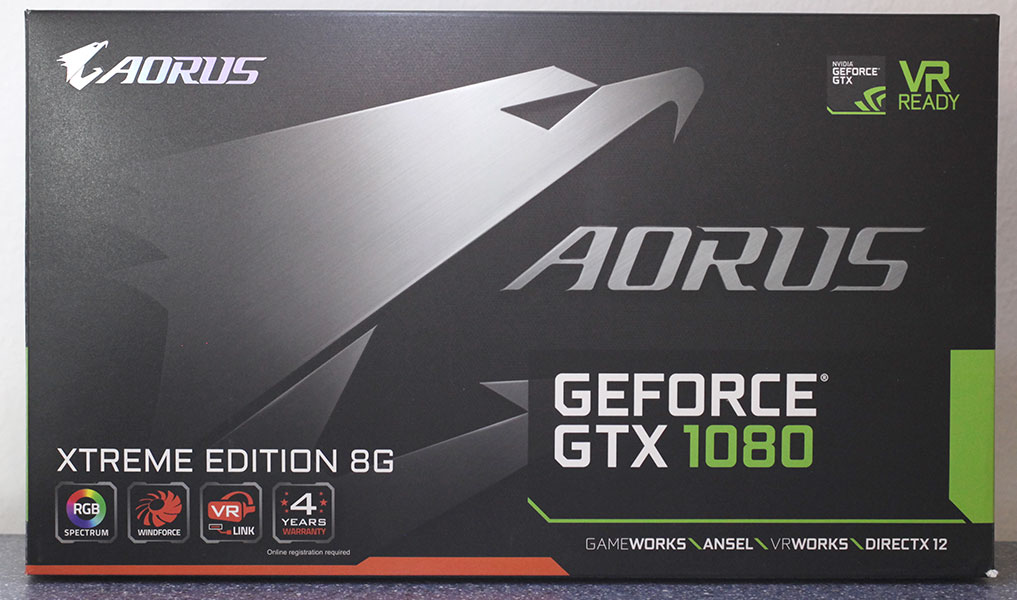


You will receive:
- Graphics card
- Driver CD
- Documentation
- PCIe power cable
- Aorus case badge
The Card


At first glance the card seems almost identical to the Gigabyte GTX 1080 Extreme Edition, but when you take a look at the back, you'll see the copper backplate which is integrated with the metal backplate. Dimensions of the card are 29.0 cm x 14.5 cm.


You will find adjustable RGB lighting on the Gigabyte GTX 1080 AORUS Xtreme.

Installation requires three slots in your system.

Display connectivity options include a DVI port, an HDMI port, and three DisplayPorts. On the back of the card are another two HDMI ports. Since the NVIDIA GPU does not support as many active outputs at the same time, Gigabyte added extra circuitry to the board to detect your output configuration. Detection requires a reboot, so when running in VR mode with 3x HDMI and 3x DP ports enabled, connecting a DVI monitor does nothing until you reboot. The card will detect the outputs and switch to the non-VR configuration of 1x DVI, 1x HDMI and 3x DP once the reboot has taken place. Unlike previous NVIDIA cards, the DVI port no longer includes an analog signal, so you'll have to use an active adapter. NVIDIA also updated DisplayPort to be 1.2 certified and 1.3/1.4 ready, which enables support for 4K @ 120 Hz and 5K @ 60 Hz or 8K @ 60 Hz with two cables.
The GPU also comes with an HDMI sound device. It is HDMI 2.0b compatible, which supports HD audio and Blu-ray 3D movies. The GPU video encoding unit has been updated to support HEVC at 10-bit and 12-bit.
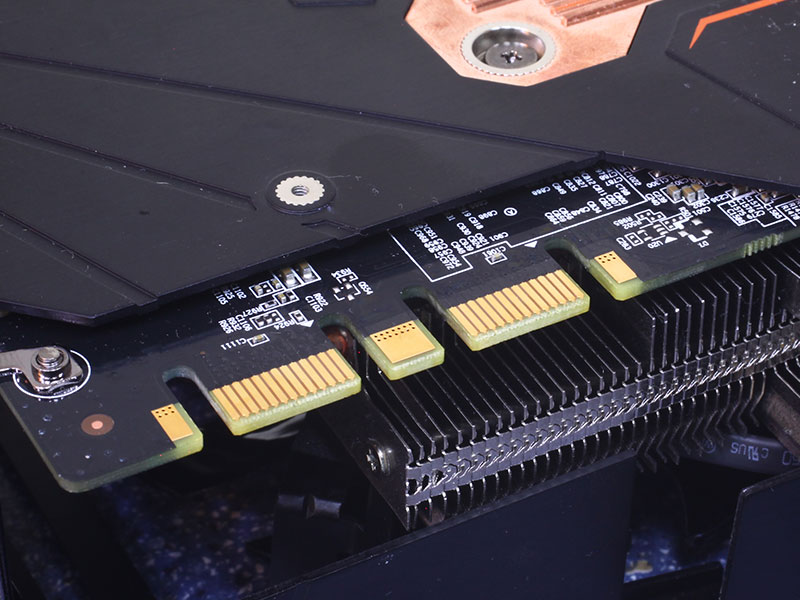
NVIDIA made some changes to SLI with Pascal. Two-way SLI is now the only officially supported configuration for gaming. Three-way or Quad SLI can no longer be enabled in games; however, both do work in a few benchmarks. Also, for 4K at 60 Hz and above, NVIDIA recommends a new high-bandwidth SLI bridge called "SLI HB," which occupies both SLI fingers. The old bridges will work fine at lower resolutions.


Pictured above are the front and back, showing the disassembled board. High-res versions are also available (front, back).
A Closer Look


Gigabyte's thermal solution uses six heatpipes and a large copper baseplate.

The backplate has a bunch of thermal pads to improve heat transfer.


One of the new features of this card is this slab of copper which is tightly stuck opposite of the GPU, on the other side of the PCB. Gigabyte promises it will improve thermal dissipation of the GPU, which we will test later.

Gigabyte upgraded the power input of their GTX 1080 to two 8-pins. This input configuration is specified for up to 375 watts of power draw.

The uP 9511 voltage controller is a new model for recent NVIDIA cards. It does not support voltage control via I2C.

The GDDR5X memory chips are made by Micron and are marked with "D9TXS," which decodes to MT58K256M32JA-100. These are specified to run at 1250 MHz (10,000 MHz GDDR5X effective).

NVIDIA's GP104 graphics processor is the first consumer chip using the Pascal architecture. It is produced on a 16 nm process at TSMC, Taiwan, and has a transistor count of 7.1 billion and a die size of 314 mm².
Our Patreon Silver Supporters can read articles in single-page format.
Nov 13th, 2026 18:15 PST
change timezone
Latest GPU Drivers
New Forum Posts
- Opinion on Monitor Replacement (6)
- Tell me about your favourite graphics card (25)
- TMOG - post your benchmark results here (16)
- no "PhysX" workable (7)
- Microsoft Exchange/365 outages? (61)
- Unallocated space in ssd , is it normal? (18)
- Last game you purchased? (1401)
- Game Soundtracks You Love (1286)
- I'll flash a ASUS ROG Strix RX480 O8G in Cause of Code 43, as a Newbie (0)
- WarpCoreBench scores! (28)
Popular Reviews
- AMD Zen 6 Technical Deep Dive
- Corsair HX1000i Shift Crystal Review
- NZXT C1200 Platinum Review
- Upcoming Hardware Launches 2027 (Updated Nov 2026)
- ASUS ROG Strix B850-I Gaming Wi-Fi7 W Review
- Montech King 95 3D PRO Review
- NZXT H7 RGB+ Review
- NZXT H5 Review
- Phantom Blade Zero Performance Benchmark Review - 35 GPUs Tested
- XPG NIMBUS PLUS Review - Mid-range Chair With Strong Competitors
TPU on YouTube
Controversial News Posts
- NVIDIA Co-Founder and CEO Jensen Huang Officially Resigns (377)
- OpenAI CEO Argues Home PCs Waste the World's Limited DRAM Supply (152)
- NVIDIA Launches Investigation Into Jensen Huang's Relationship With Suspected Chinese Spy (136)
- Intel "Raptor Lake Next" 16-Core and 20-Core CPUs Surface (130)
- Legendary Game Studio BioWare Shuts Down Following EA Layoffs (104)
- Dell CEO Says the Memory Shortage Will Get Worse in 2027 (95)
- NVIDIA GeForce RTX 50-Series Scheduled for up to $500 Price Hike This Week (89)
- Modder Fits RTX 5090 With Four 8-Pin Connectors, Halving Current per Wire (80)