 24
Gigabyte Radeon RX 5500 XT Gaming OC 8 GB Review
(24 Comments) »Introduction

AMD last week launched its all-important 1080p workhorse, the Radeon RX 5500 XT. Designed to replace the likes of the RX 580 and RX 570 from the product stack, the RX 5500 XT leverages AMD's latest RDNA graphics architecture and is based on its brand new 7 nm "Navi 14" silicon. Other forms of generational updates come from GDDR6 memory and support for PCI-Express Gen 4.0. Gigabyte released its premium rendition of the RX 5500 XT in the form of its Radeon RX 5500 XT 8 GB Gaming OC graphics card.

The Radeon RX 5500 XT comes in two variants based on memory size, 4 GB and 8 GB. Besides memory, the two choices have an identical GPU core-configuration and clock speeds. Interestingly, the RX 5500 XT shares its configuration with the RX 5500 4 GB, which was exclusively launched to desktop OEMs. We had a chance to review one of these last month. At the time we thought the RX 5500 XT would max out the "Navi 14" silicon, which it ended up not doing.
The 7 nm "Navi 14" silicon physically has 24 RDNA compute units, of which only 22 are enabled on the RX 5500 XT. This works out to 1,408 stream processors. Other vital specs include 88 TMUs and 32 ROPs. The memory interface is interesting: a 128-bit wide GDDR6 memory bus is used to keep costs low (just four memory chips on the card). 8 GB is achieved on cards such as the one we're reviewing today, using high-density 16 Gbit chips that were previously exclusive to professional or halo products such as the TITAN RTX. The memory ticks at 14 Gbps, yielding 224 GB/s memory bandwidth.
The RX 5500 XT is designed to offer high-setting AAA gaming at 1080p, as well as high framerate e-Sports gaming. It competes with the likes of the GeForce GTX 1650 and GTX 1650 Super. The 4 GB variant is designed to be plenty for today's titles and occupies a $169 (MSRP) price point, forming the SKU's baseline. The 8 GB variant is designed to offer some future-proofing and access to some of the higher graphics settings that are locked out below a certain VRAM limit. AMD priced the 8 GB variant at $199 (MSRP). The Gigabyte Radeon RX 5500 XT Gaming OC we're reviewing today is priced at $220, a $20 premium.
The Radeon RX 5500 XT Gaming OC from Gigabyte is based on a custom-design PCB and implements the company's WindForce 3X cooling solution. Under the shroud, it uses a compound fin-stack heatsink with two copper heat pipes that make direct contact with the GPU at the base. A trio of 80 mm fans ventilates the heatsink. Gigabyte has also overclocked the RX 5500 XT to offer up to 1737 MHz game clocks (vs. 1717 MHz reference) and 1685 MHz base clock (vs. 1607 MHz reference), while the boost clock remains a unicorn at 1845 MHz. In this review, we put the card through our entire gaming test bench.
| Price | Shader Units | ROPs | Core Clock | Boost Clock | Memory Clock | GPU | Transistors | Memory | |
|---|---|---|---|---|---|---|---|---|---|
| GTX 1650 | $150 | 896 | 32 | 1485 MHz | 1665 MHz | 2000 MHz | TU117 | unknown | 4 GB, GDDR5, 128-bit |
| RX 570 | $110 | 2048 | 32 | 1168 MHz | 1244 MHz | 1750 MHz | Ellesmere | 5700M | 4 GB, GDDR5, 256-bit |
| RX 5500 | unknown | 1408 | 32 | 1670 MHz | 1845 MHz | 1750 MHz | Navi 14 | 6400M | 4 GB, GDDR6, 128-bit |
| RX 5500 XT | $170 | 1408 | 32 | 1717 MHz | 1845 MHz | 1750 MHz | Navi 14 | 6400M | 4 GB, GDDR6, 128-bit |
| RX 5500 XT 8 GB | $200 | 1408 | 32 | 1717 MHz | 1845 MHz | 1750 MHz | Navi 14 | 6400M | 8 GB, GDDR6, 128-bit |
| Gigabyte RX 5500 XT Gaming OC 8 GB | $220 | 1408 | 32 | 1737 MHz | 1845 MHz | 1750 MHz | Navi 14 | 6400M | 8 GB, GDDR6, 128-bit |
| GTX 1650 Super | $160 | 1280 | 32 | 1530 MHz | 1725 MHz | 1500 MHz | TU116 | 6600M | 4 GB, GDDR6, 128-bit |
| RX 580 | $160 | 2304 | 32 | 1257 MHz | 1340 MHz | 2000 MHz | Ellesmere | 5700M | 8 GB, GDDR5, 256-bit |
| GTX 1060 3 GB | $170 | 1152 | 48 | 1506 MHz | 1708 MHz | 2002 MHz | GP106 | 4400M | 3 GB, GDDR5, 192-bit |
| GTX 1060 | $210 | 1280 | 48 | 1506 MHz | 1708 MHz | 2002 MHz | GP106 | 4400M | 6 GB, GDDR5, 192-bit |
| RX 590 | $180 | 2304 | 32 | 1469 MHz | 1545 MHz | 2000 MHz | Polaris 30 | 5700M | 8 GB, GDDR5, 256-bit |
| GTX 1660 | $210 | 1408 | 48 | 1530 MHz | 1785 MHz | 2000 MHz | TU116 | 6600M | 6 GB, GDDR5, 192-bit |
| GTX 1070 | $300 | 1920 | 64 | 1506 MHz | 1683 MHz | 2002 MHz | GP104 | 7200M | 8 GB, GDDR5, 256-bit |
| RX Vega 56 | $270 | 3584 | 64 | 1156 MHz | 1471 MHz | 800 MHz | Vega 10 | 12500M | 8 GB, HBM2, 2048-bit |
| GTX 1660 Super | $230 | 1408 | 48 | 1530 MHz | 1785 MHz | 1750 MHz | TU116 | 6600M | 6 GB, GDDR6, 192-bit |
| GTX 1660 Ti | $280 | 1536 | 48 | 1500 MHz | 1770 MHz | 1500 MHz | TU116 | 6600M | 6 GB, GDDR6, 192-bit |
Packaging


The Card


Visually, the Gigabyte Radeon RX 5500 XT Gaming OC looks identical to the RX 5700 XT Gaming OC because they are the same physical size, and Gigabyte is using the same fan shroud for both models. On the back, you'll find a plastic backplate.

Dimensions of the card are 28.5 cm x 11.5 cm.


Installation requires two slots in your system.

Display connectivity options include three DisplayPort 1.4a outputs and one HDMI 2.0b.

The board uses one 8-pin power connector. This input configuration is specified for up to 225 watts of power draw.

AMD's Navi generation of GPUs no longer supports CrossFire. DirectX 12 does include its own set of multi-GPU capabilities, but the implementation requires game developers to put serious development time into a feature only a tiny fraction of their customers might ever use.
Disassembly


Gigabyte's WindForce 3X cooling solution uses three 80 mm fans. The fan in the center rotates clockwise, while the other two rotate counter-clockwise. All three blow air down onto the heatsink, but according to Gigabyte, the difference in rotation for the central fan minimizes turbulence between fans.
The heatsink consists of three aluminium fin stacks that are skewered by two copper heat pipes in direct contact with the GPU at the base.


The backplate is made out of plastic; it adds to the card's aesthetic and should protect components on the PCB when handling the card.
High-resolution PCB Pictures
These pictures are for the convenience of volt modders and people who would like to see all the finer details on the PCB. Feel free to link back to us and use these in your articles or forum posts.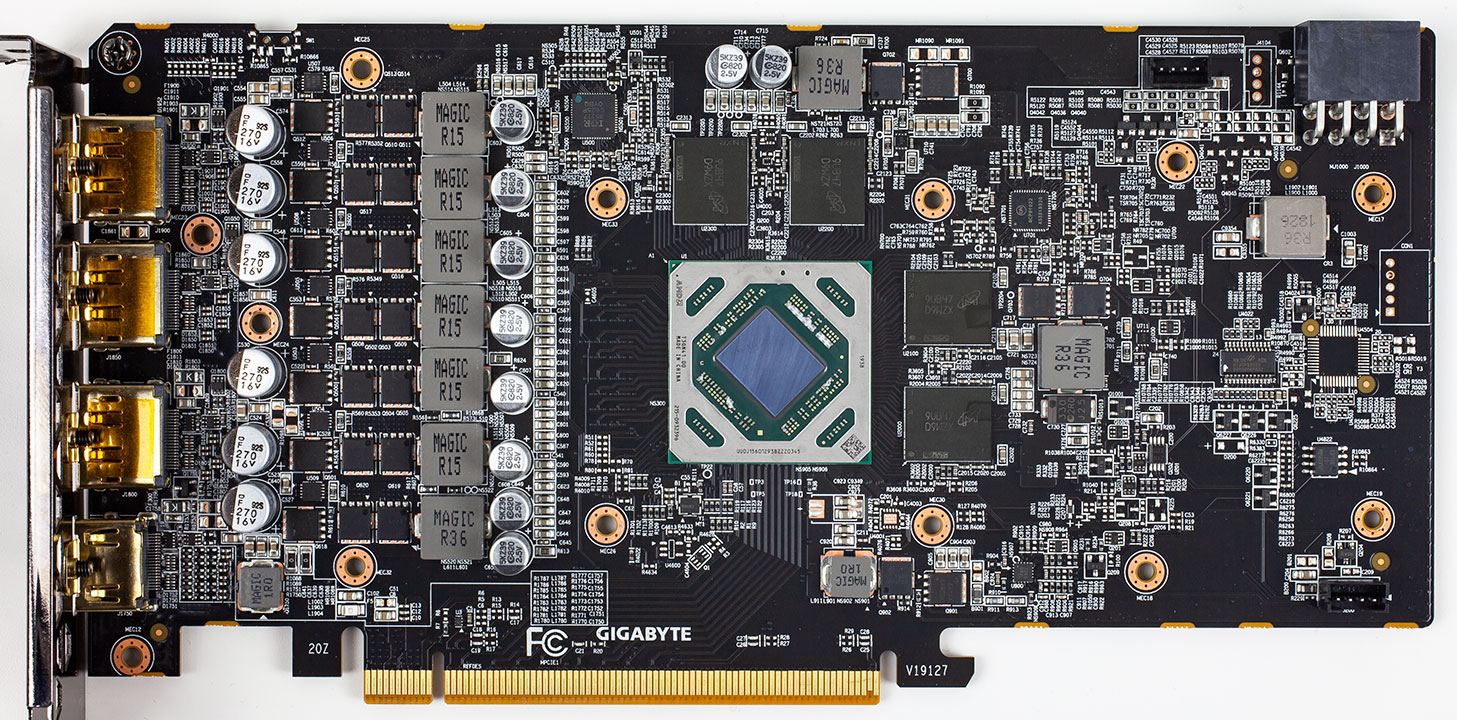
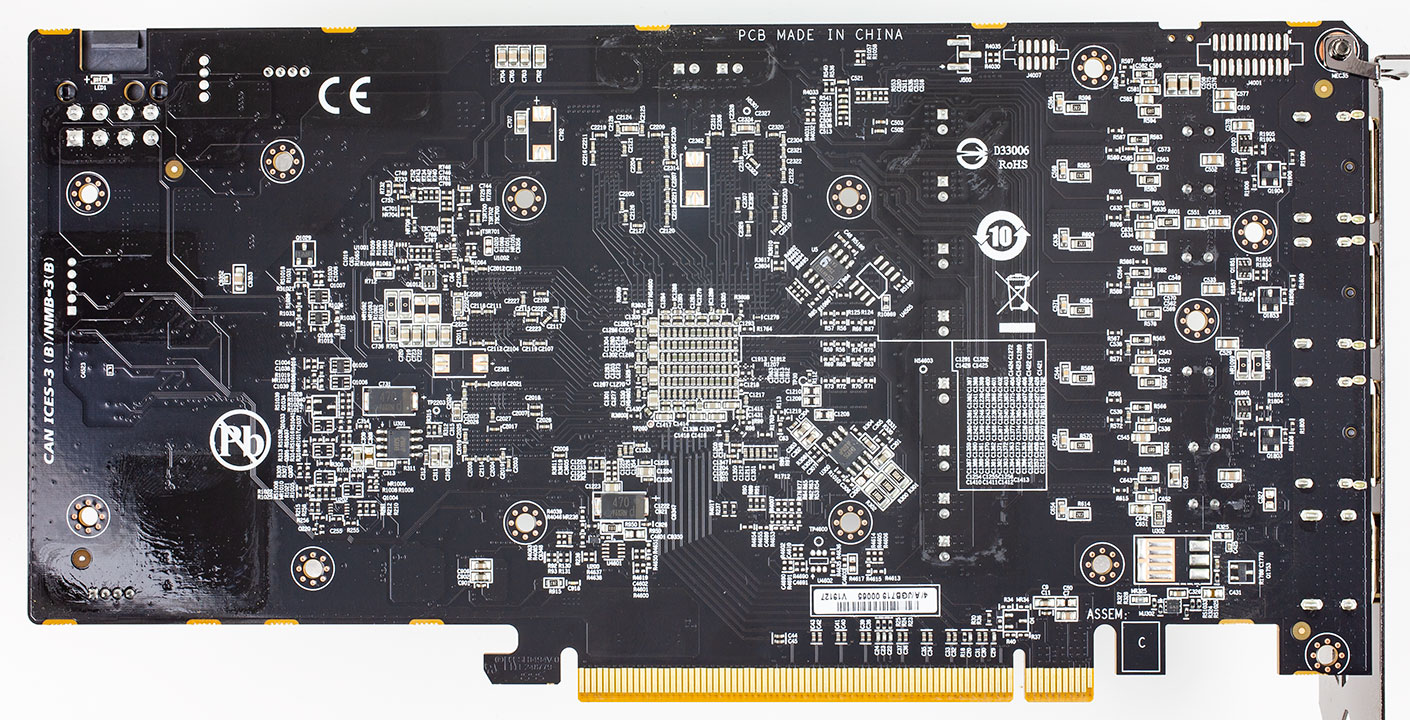
High-res versions are also available (front, back).
Our Patreon Silver Supporters can read articles in single-page format.
Nov 13th, 2026 05:17 PST
change timezone
Latest GPU Drivers
New Forum Posts
- Microsoft Exchange/365 outages? (33)
- To AiO CPU Cooler users? (0)
- Home page search by category (6)
- I won't download games that are larger than 30–40 GB. (104)
- Windows 11 General Discussion (7727)
- Slow SSD read speeds - help! (1)
- Warning for Windows 10 and 11 users running newer AMD GPU drivers (58)
- TPU's Nostalgic Hardware Club (22150)
- DDR5 CL30 SK HYNIX A Die ram overclocking - End goal is CL26 6400, FCLK 2200 if possible (26)
- CPU debug LED stays red on Gigabyte AORUS X870E Elite WiFi 7, system works normally (1)
Popular Reviews
- AMD Zen 6 Technical Deep Dive
- NZXT C1200 Platinum Review
- Corsair HX1000i Shift Crystal Review
- Upcoming Hardware Launches 2027 (Updated Nov 2026)
- Montech King 95 3D PRO Review
- NZXT H7 RGB+ Review
- NZXT H5 Review
- Phantom Blade Zero Performance Benchmark Review - 35 GPUs Tested
- XPG NIMBUS PLUS Review - Mid-range Chair With Strong Competitors
- Gigabyte Z890I Aorus Ultra Review
TPU on YouTube
Controversial News Posts
- NVIDIA Co-Founder and CEO Jensen Huang Officially Resigns (346)
- OpenAI CEO Argues Home PCs Waste the World's Limited DRAM Supply (152)
- NVIDIA Launches Investigation Into Jensen Huang's Relationship With Suspected Chinese Spy (136)
- Intel "Raptor Lake Next" 16-Core and 20-Core CPUs Surface (130)
- Legendary Game Studio BioWare Shuts Down Following EA Layoffs (104)
- Dell CEO Says the Memory Shortage Will Get Worse in 2027 (95)
- NVIDIA GeForce RTX 50-Series Scheduled for up to $500 Price Hike This Week (89)
- Modder Fits RTX 5090 With Four 8-Pin Connectors, Halving Current per Wire (80)