 6
GMKtec NucBox K16 Review
Workstation Performance »Adobe Photoshop
PugetBench for Photoshop uses real actions like filter stacks, layer adjustments, and compositing. It measures both interactive responsiveness and how long complex edits take to apply.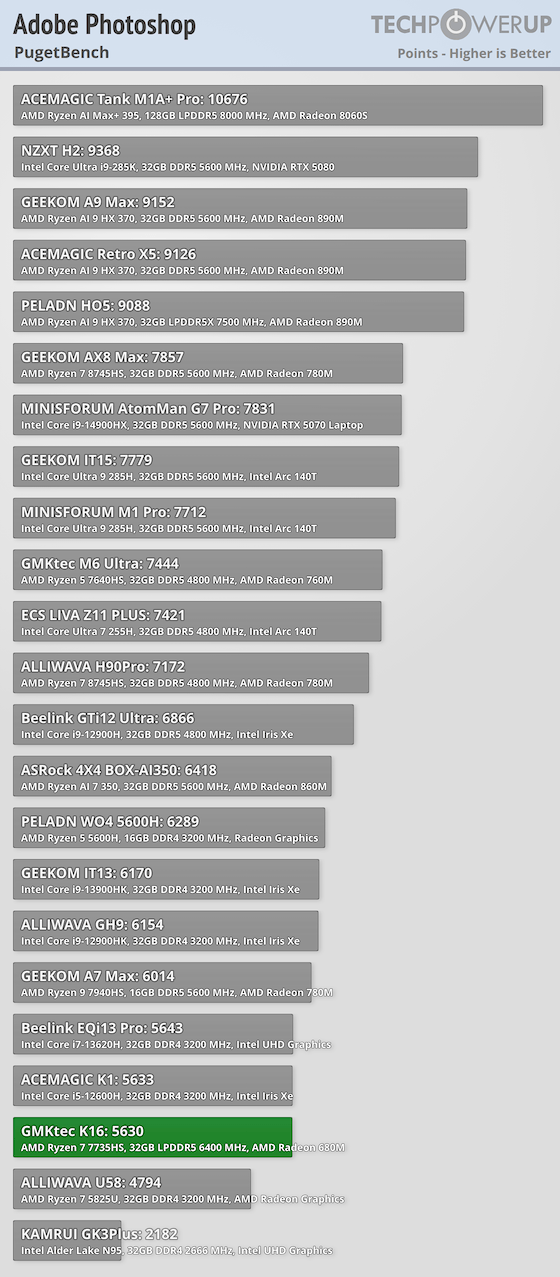
Its 5,630 result in PugetBench for Photoshop is on the low side in this chart group and does not put the K16 among the stronger content creation Mini-PCs here. That does not mean Photoshop use will be bad, but it does point to a system that is a better fit for lighter editing than heavier or more demanding project work.
Blender
Blender's benchmark measures 3D rendering across multiple test scenes. I used the CPU test here, so this gives a good look at processor performance in creative and technical workloads.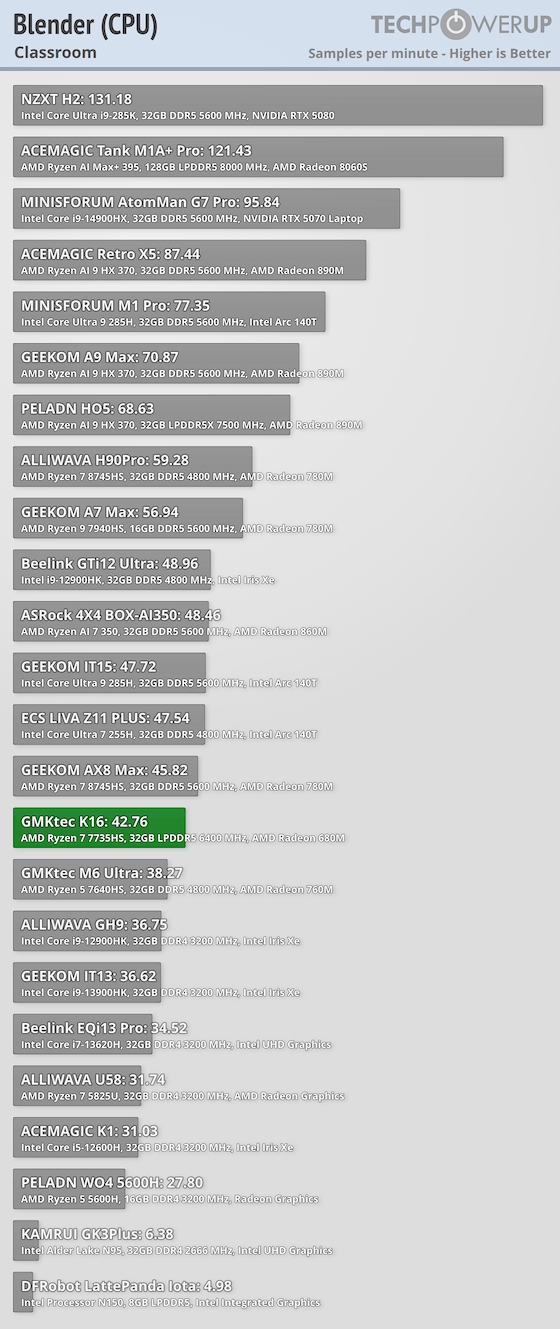
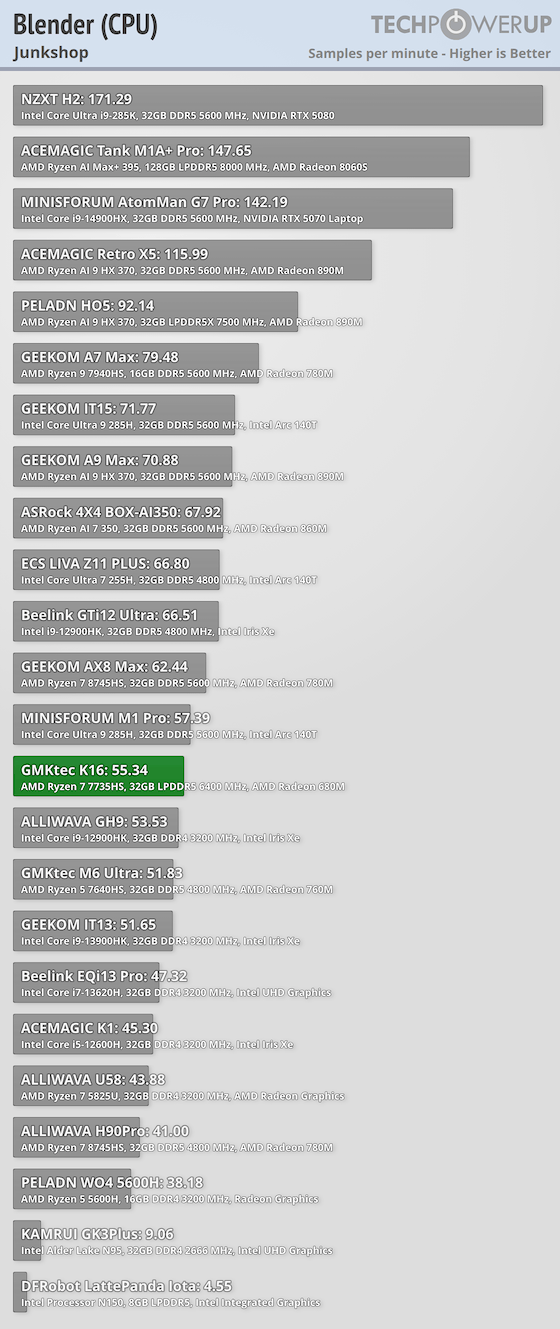
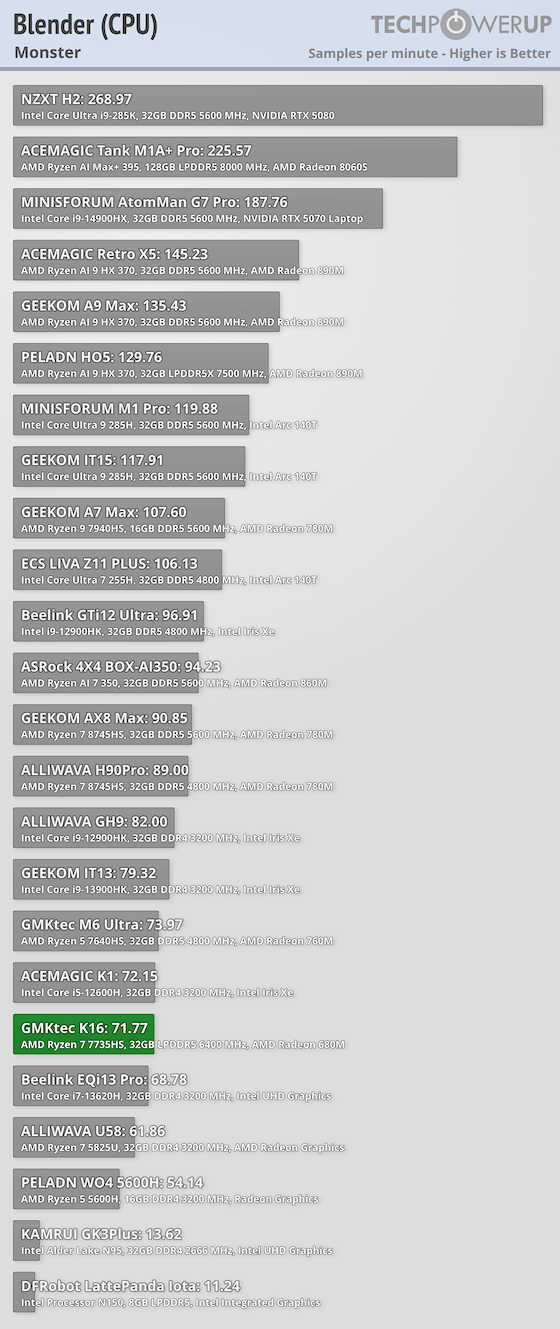
In Blender CPU mode, the K16 records 71.77 in Monster, 42.76 in Classroom, and 55.34 in Junkshop. Those results place it in the lower half of the chart set, though not at the very bottom. For a Ryzen 7 7735HS Mini-PC, the numbers are usable enough, but they do not give the K16 much of an edge for CPU-based rendering work.
Media Encoding
HandBrake is a popular open-source transcoder, and its benchmark tests how quickly a system can convert video using the x264 codec. It's a real-world scenario for streamers and media professionals.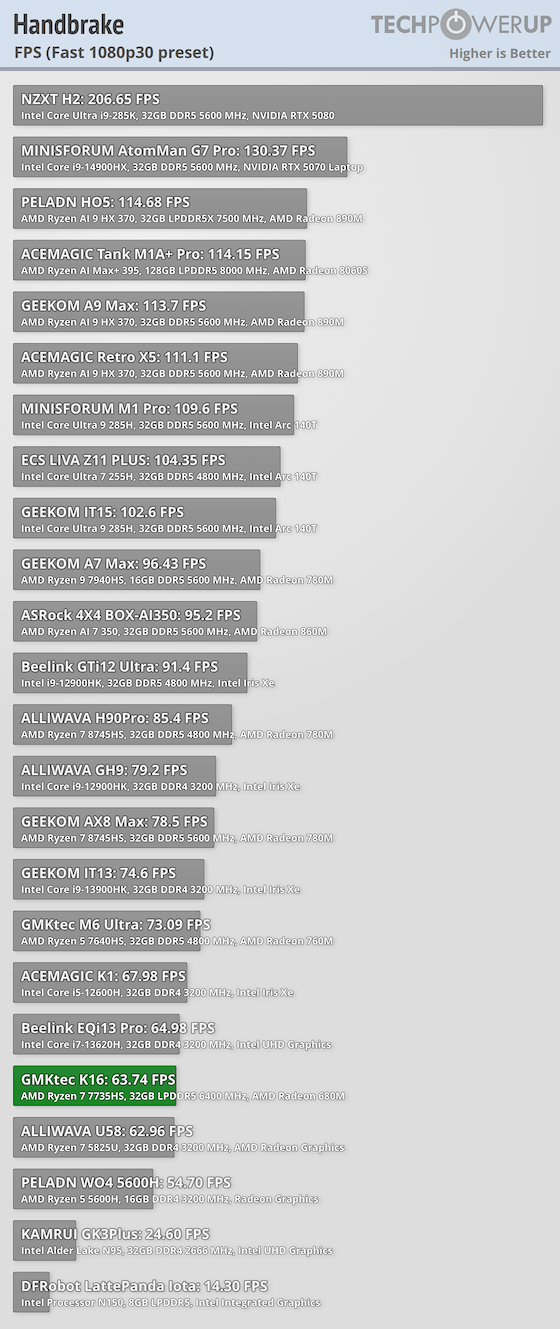
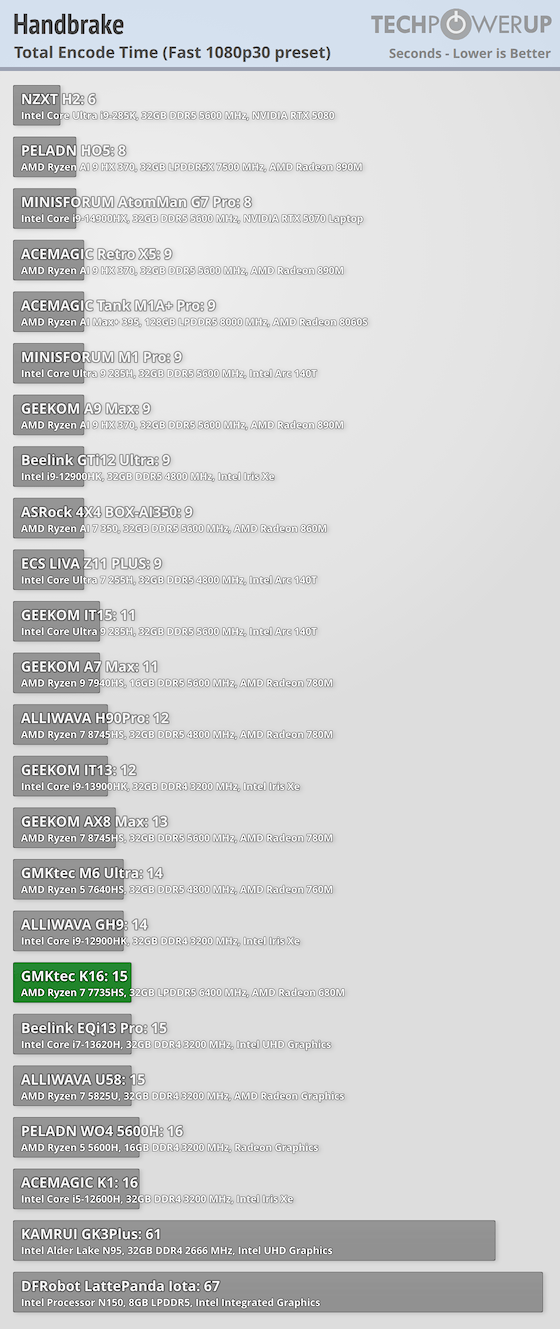
HandBrake posts 63.74 FPS with a 15-second Total Encode Time. That result is decent, but it is still well behind the quicker mini PCs in this chart group. Video encoding is certainly workable here, though this is another area where the K16 looks more like a midrange Mini-PC than a stronger creator-focused one.
Nov 20th, 2026 14:05 PST
change timezone
Latest GPU Drivers
New Forum Posts
- How to prevent OLED burn damage due to PC freezes or power outtages? (48)
- Honestly, do you care about GTA VI? (208)
- When you could finally run Crysis maxed out? (63)
- WarpCoreBench scores! (80)
- GTA VI (20)
- Anthrophics IPO (25)
- GeekMagic Ultra Smart WiFi Weather Station (8)
- Very unusual two gaming-pc scenarios. (35)
- Can i play GTA 6 now? (Joke) (14)
- Zen 3 IF/IMC degradation (239)
Popular Reviews
- AMD Zen 6 Technical Deep Dive
- Ugreen NASync DXP4800 GT Review
- Microsoft Surface Laptop Ultra Review - The Next-gen Arm Laptop
- Corsair RM1200e (Second Generation) Review
- Acemagic Retro X3 Review
- Upcoming Hardware Launches 2027 (Updated Nov 2026)
- Pulsar Office Tour & First Look at P1 Dual-Sensor Mouse
- Biwin Black Opal NV7400 2 TB Review
- AMD Ryzen 7 9800X3D Memory Performance Scaling
- AMD Ryzen 7 9800X3D Review - The Best Gaming Processor
TPU on YouTube
Controversial News Posts
- NVIDIA Co-Founder and CEO Jensen Huang Officially Resigns (490)
- Report: Jensen Huang Eyes NVIDIA Comeback (255)
- Open Letter Asking NVIDIA to Reinstate Jensen Huang Passes 115,000 Signatures (184)
- OpenAI CEO Argues Home PCs Waste the World's Limited DRAM Supply (152)
- NVIDIA Launches Investigation Into Jensen Huang's Relationship With Suspected Chinese Spy (136)
- Intel "Raptor Lake Next" 16-Core and 20-Core CPUs Surface (130)
- Legendary Game Studio BioWare Shuts Down Following EA Layoffs (104)
- Dell CEO Says the Memory Shortage Will Get Worse in 2027 (95)