 25
HIS Radeon HD 7970 X Turbo 3 GB Review
(25 Comments) »Introduction

AMD's Radeon HD 7970 has been on the market for a while now. The card introduced a new shader architecture and brought numerous improvements in power consumption. It met heavy opposition from NVIDIA's GeForce GTX 680 and 670, which has caused HD 7970's pricing to go down quite a bit.
We have seen several recent releases of premium HD 7970 variants geared towards overclocking through high clock-speeds and maximum cooling-power. Prominent members of these cards are the ASUS MATRIX, MSI Lightning, Gigabyte SuperOC, and Sapphire Toxic.

HIS is now entering the arena with their HD 7970 X Turbo, which, unlike many other enthusiast HD 7970 cards, comes in a dual-slot form factor. The clock speeds have been increased significantly to 1180 MHz on the GPU, which is the highest GPU clock we've seen on an HD 7970, and 1500 MHz on the memory; only the ASUS MATRIX comes with a higher memory clock.
Price-wise, HIS is also asking a lot. The card can be yours for $600.
| GeForce GTX 670 | Radeon HD 7970 | GeForce GTX 680 | HD 7970 GHz Ed. | MSI HD 7970 Lightning | Gigabyte HD 7970 SuperOC | Sapphire HD 7970 Toxic | ASUS HD 7970 Matrix | HIS HD 7970 X Turbo | GeForce GTX 690 | |
|---|---|---|---|---|---|---|---|---|---|---|
| Shader Units | 1344 | 2048 | 1536 | 2048 | 2048 | 2048 | 2048 | 2048 | 2048 | 2x 1536 |
| ROPs | 32 | 32 | 32 | 32 | 32 | 32 | 32 | 32 | 32 | 2x 32 |
| Graphics Processor | GK104 | Tahiti | GK104 | Tahiti | Tahiti | Tahiti | Tahiti | Tahiti | Tahiti | 2x GK104 |
| Transistors | 3500M | 4310M | 3500M | 4310M | 4310M | 4310M | 4310M | 4310M | 4310M | 2x 3500M |
| Memory Size | 2048 MB | 3072 MB | 2048 MB | 3072 MB | 3072 MB | 3072 MB | 3072 MB | 3072 MB | 3072 MB | 2x 2048 MB |
| Memory Bus Width | 256 bit | 384 bit | 256 bit | 384 bit | 384 bit | 384 bit | 384 bit | 384 bit | 384 bit | 2x 256 bit |
| Core Clock | 915 MHz+ | 925 MHz | 1006 MHz+ | 1050 MHz | 1070 MHz | 1080 MHz | 1100 MHz | 1100 MHz | 1180 MHz | 915 MHz+ |
| Memory Clock | 1502 MHz | 1375 MHz | 1502 MHz | 1500 MHz | 1400 MHz | 1375 MHz | 1500 MHz | 1650 MHz | 1500 MHz | 1502 MHz |
| Price | $380 | $390 | $480 | $400 | $500 | $500 | $600 | $500 | $600 | $1000 |
Packaging


Contents

You will receive:
- Graphics card
- Driver CD + Documentation
- DVI adapter
- CrossFire Bridge
- Active single-link mini-DP to DVI adapter
- "Weight Lifter" to support the card in the case
The Card


HIS is using a large dual-fan cooler with a stylized X in the center. The back of the card is bare; other companies put something here to protect the card against damage, or to help with cooling.

Installation of the card requires two slots in your system.
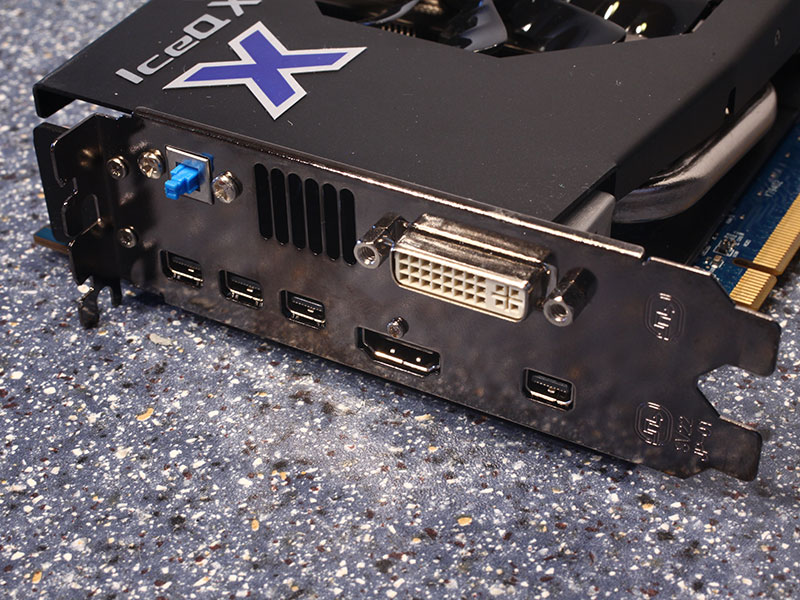
Display connectivity options includes one DVI port, one full-sized HDMI port, and four mini-HDMI ports. You may use all the outputs at the same time, but doing so makes the DVI port a single-link port (up to 1920x1080). If you want to run higher resolutions, you have to press the blue button. It switches the DVI port to dual-link by disabling one of the DisplayPorts. Unlike other cards with a similar feature, this switch is instant and you don't have to reboot.
The GPU also includes an HDMI sound device. It is HDMI 1.4a compatible, which includes HD audio and Blu-ray 3D movies support.
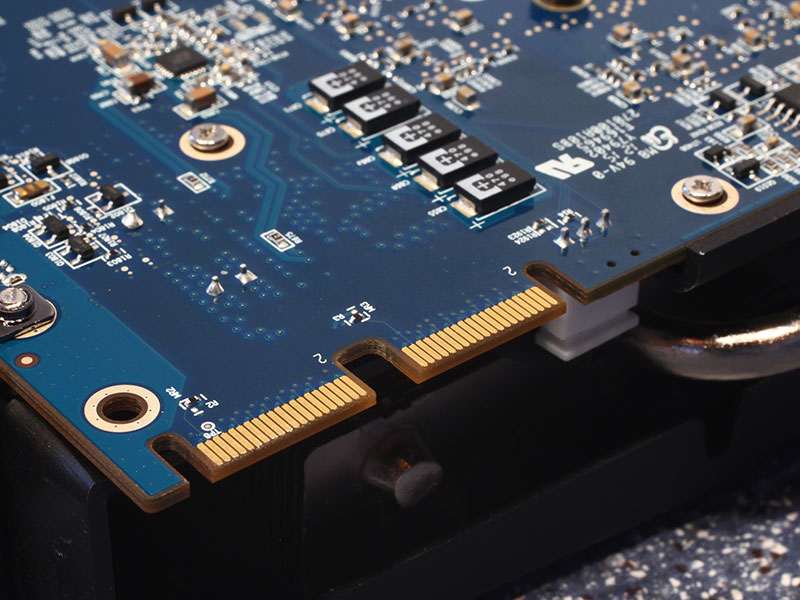
Two CrossFire connectors are available, so you may combine this card with up to three other HD 7970s for improved performance.
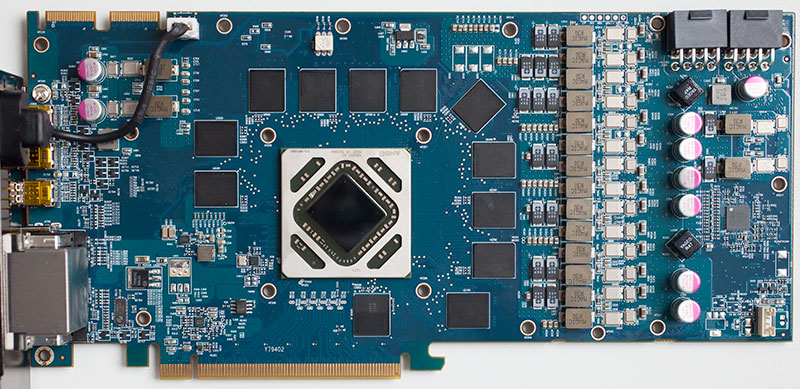
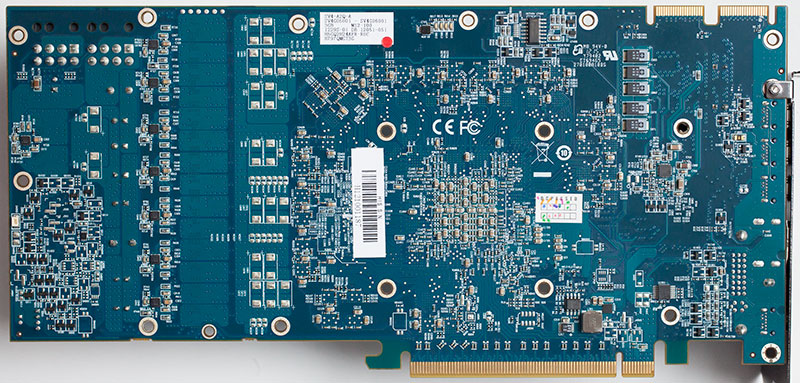
Pictured above are the front and back, showing the disassembled board. High-res versions are also available (front, back). If you choose to use these images for voltmods, etc., please include a link back to this site, or let us post your article.
Our Patreon Silver Supporters can read articles in single-page format.
Nov 15th, 2026 02:40 CST
change timezone
Latest GPU Drivers
New Forum Posts
- "Legacy Control Panel" won't install (2)
- Honestly, do you care about GTA VI? (42)
- Ryzen Owners Zen Garden (8558)
- Optical Disc Drive owners club (212)
- WarpCoreBench scores! (46)
- Bought MAX-P495 - Which model? (32)
- Tell me about your favourite graphics card (84)
- Planning for Prolonged High Prices and Maintaining What You Already Have (72)
- What can the FX 8320 do today? Here is the answer. (47)
- Recommendations Wanted - Affordable Enterprise SSD for Boot (3)
Popular Reviews
- AMD Zen 6 Technical Deep Dive
- ASUS ROG Strix B850-I Gaming Wi-Fi7 W Review
- Corsair HX1000i Shift Crystal Review
- Upcoming Hardware Launches 2027 (Updated Nov 2026)
- Montech King 95 3D PRO Review
- NZXT C1200 Platinum Review
- NZXT H7 RGB+ Review
- NZXT H5 Review
- Phantom Blade Zero Performance Benchmark Review - 35 GPUs Tested
- AMD Ryzen 7 9800X3D Review - The Best Gaming Processor
TPU on YouTube
Controversial News Posts
- NVIDIA Co-Founder and CEO Jensen Huang Officially Resigns (408)
- OpenAI CEO Argues Home PCs Waste the World's Limited DRAM Supply (152)
- NVIDIA Launches Investigation Into Jensen Huang's Relationship With Suspected Chinese Spy (136)
- Intel "Raptor Lake Next" 16-Core and 20-Core CPUs Surface (130)
- Legendary Game Studio BioWare Shuts Down Following EA Layoffs (104)
- Dell CEO Says the Memory Shortage Will Get Worse in 2027 (95)
- NVIDIA GeForce RTX 50-Series Scheduled for up to $500 Price Hike This Week (89)
- Modder Fits RTX 5090 With Four 8-Pin Connectors, Halving Current per Wire (80)