 19
Inno3D GeForce 210 512 MB Review
(19 Comments) »Introduction

NVIDIA recently released their first two 40 nanometer GPUs: the GT216 and GT218. While the GT216 is used on the more powerful GeForce GT 220, the GT218 graphics processor is used for the GeForce 210, the product name is not GeForce G 210, the "G" in G 210 stands for GeForce.
NVIDIA's GeForce 210 is positioned as the new lowest-end graphics accelerator from NVIDIA with specs that will barely suffice for any serious gaming. On the remaining features NVIDIA scores well however. The cards support full Windows Aero acceleration, full HD video decode in the GPU, come with native HDMI output, and are DirectX 10.1 compliant. NVIDIA's favourite technologies CUDA and PhysX are available as well. Only DirectX 11 is missing to complete the list of features, but for the GeForce 210's performance class and at this date DirectX 11 support does not matter much.
Inno3D has taken NVIDIA's reference PCB design and added their own cooler.
| Radeon HD 4350 | Inno3D GeForce 210 | GeForce 9400 GT | Radeon HD 4550 | GeForce 9500 GT | GeForce GT 220 | Radeon HD 4670 | GeForce 9600 GT | |
| Shader units | 80 | 16 | 16 | 80 | 32 | 48 | 320 | 64 |
| ROPs | 4 | 4 | 8 | 4 | 8 | 8 | 8 | 16 |
| GPU | RV710 | GT218 | G96 | RV710 | G96 | GT216 | RV730 | G94 |
| Transistors | 242M | 260M | 314M | 242M | 314M | 486M | 512M | 505M |
| Memory Size | 256 MB | 512 MB | 512M | 512 MB | 256 MB / 512 MB | 512 MB / 1024 MB | 512 MB | 512 MB |
| Memory Bus Width | 64 bit | 64 bit | 128 bit | 64 bit | 128 bit | 128 bit | 128 bit | 256 bit |
| Core Clock | 600 MHz | 589 MHz | 550 MHz | 600 MHz | 550 MHz | 625 MHz | 750 MHz | 650 MHz |
| Memory Clock | 500 MHz | 533 MHz | 400 MHz | 400 MHz | 900 MHz | 790 MHz / 1012 MHz | 1000 MHz | 900 MHz |
| Price | $35 | $49 | $40 | $45 | $45 | $69 - $79 | $67 | $80 |
Packaging


Inno3D uses a fairly compact package, but the package is bigger than just the graphics card itself. For a low-end graphics card, the package size can help make a difference when shipping tens of thousands of graphics cards. The white sticker on the package looks a bit out of place, but it communicates the most important product specs.
Contents

You will receive:
- Graphics card
- Driver CD + Manual
The Card


The most prominent feature of Inno3D's GeForce 210 is that it is a low-profile card, which makes it an excellent choice for small form factor systems and Media PCs.
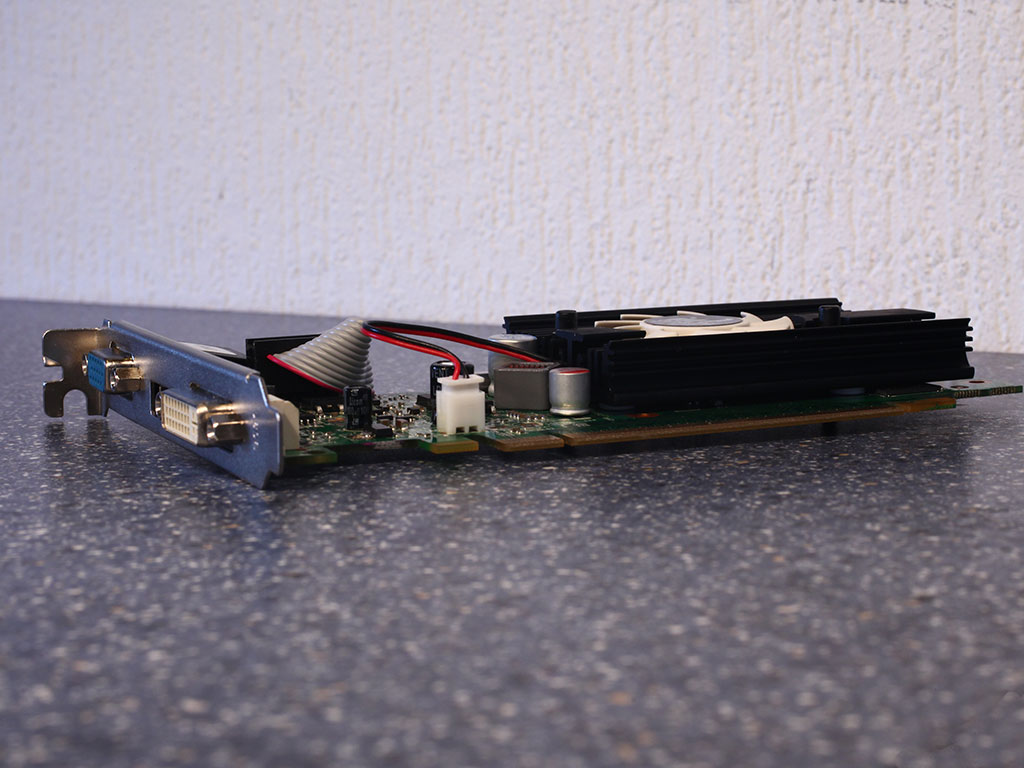
The card is exactly one slot tall.

The card has one analog VGA port, one DVI port and and an HDMI port. For a low-end graphics card, this is a very reasonable output configuration since many low-end PC users still use CRTs. For media PC users, the HDMI output enables an easy way to hook up their graphics cards to the big screens without any adapter cables or converters. Please note that you can remove the slot cover metal and the VGA port to get a truly low-profile graphics card.
As mentioned before, NVIDIA has slightly changed how their HDMI Audio works. Instead of connecting an SPDIF output from your sound card to the graphics card, the driver will route the audio signal from the sound device over the PCI-Express bus into the graphics card. According to NVIDIA "fully uncompressed 7.1 LPCM" is supported, as far as I know the sound card will take care of decoding the audio from other formats into LPCM. Please note that you will still need an onboard sound device or sound card. Unlike ATI graphics cards there is no complete sound device embedded inside the GPU.

While there are no SLI connectors, it is possible to put two of these cards in SLI mode for better performance and data will be transferred via the PCI-Express bus.


Here are the front and the back of the card, high-res versions are also available (front, back). If you choose to use these images for voltmods etc, please include a link back to this site or let us post your article.
Our Patreon Silver Supporters can read articles in single-page format.
Nov 13th, 2026 05:15 PST
change timezone
Latest GPU Drivers
New Forum Posts
- Microsoft Exchange/365 outages? (33)
- To AiO CPU Cooler users? (0)
- Home page search by category (6)
- I won't download games that are larger than 30–40 GB. (104)
- Windows 11 General Discussion (7727)
- Slow SSD read speeds - help! (1)
- Warning for Windows 10 and 11 users running newer AMD GPU drivers (58)
- TPU's Nostalgic Hardware Club (22150)
- DDR5 CL30 SK HYNIX A Die ram overclocking - End goal is CL26 6400, FCLK 2200 if possible (26)
- CPU debug LED stays red on Gigabyte AORUS X870E Elite WiFi 7, system works normally (1)
Popular Reviews
- AMD Zen 6 Technical Deep Dive
- NZXT C1200 Platinum Review
- Corsair HX1000i Shift Crystal Review
- Upcoming Hardware Launches 2027 (Updated Nov 2026)
- Montech King 95 3D PRO Review
- NZXT H7 RGB+ Review
- NZXT H5 Review
- Phantom Blade Zero Performance Benchmark Review - 35 GPUs Tested
- XPG NIMBUS PLUS Review - Mid-range Chair With Strong Competitors
- Gigabyte Z890I Aorus Ultra Review
TPU on YouTube
Controversial News Posts
- NVIDIA Co-Founder and CEO Jensen Huang Officially Resigns (346)
- OpenAI CEO Argues Home PCs Waste the World's Limited DRAM Supply (152)
- NVIDIA Launches Investigation Into Jensen Huang's Relationship With Suspected Chinese Spy (136)
- Intel "Raptor Lake Next" 16-Core and 20-Core CPUs Surface (130)
- Legendary Game Studio BioWare Shuts Down Following EA Layoffs (104)
- Dell CEO Says the Memory Shortage Will Get Worse in 2027 (95)
- NVIDIA GeForce RTX 50-Series Scheduled for up to $500 Price Hike This Week (89)
- Modder Fits RTX 5090 With Four 8-Pin Connectors, Halving Current per Wire (80)