 17
Intel 750 Series PCIe SSD 1.2 TB Review
(17 Comments) »Introduction

Intel really needs no introduction because you are most likely running on an Intel platform with an Intel CPU in your system. The company is one of the forerunners of SSD technology and was one of the first manufacturers of solid-state-disks. In recent times, it has gotten a bit quiet though as price drops and improvements in controller performance have made competing drives from Crucial and Samsung more attractive. Intel has recently also released the DC P3700 for professional datacenter solutions, and it is awesome but way too expensive and not meant for consumers.
Based on that platform, Intel is now entering the enthusiast-consumer-storage market with the Intel 750 Series. The new drives use the PCI-Express interface exclusively; there is no more SATA support. The new disks are available in two form-factors: PCI-Express x4 add-in card or 2.5" drive (not SATA compatible). Both form factors use the NVMe storage protocol instead of the aging AHCI which wasn't really designed for low-latency storage.
Today, we are reviewing the Intel 750 Series PCI-Express version. It is a bit easier to use given the current hardware ecosystem. Intel's 750 Series SSD is available in capacities of 1.2 TB or 400 GB—there is nothing in-between, nothing smaller, which looks as though Intel is testing the waters with an enthusiast drive first because it promises to run into fewer platform incompatibilities.
With pricing of $1200 for the 1.2 TB version and $400 for the 400 GB version, basically $1 per GB, the drives are not cheap, or insanely expensive. However, current consumer SSDs go down as low as 40 cents per GB, so if your focus is on price/performance, those drives are probably a better alternative.
| Specifications: Intel 750 Series PCIe 1.2 TB | |
|---|---|
| Brand: | Intel |
| Model: | SSDPEDMW012T4R5 |
| Controller: | Intel CH29AE41AB0 |
| Flash Type: | Intel, 20 nm MLC 29F16B08LCMFS |
| Form Factor | PCI-Express x4 |
| Card Height | 1/2 Height (Low Profile) |
| Capacity | 1,200 GB (1,117.8 GB usable) 176 GB additional overprovisioning |
| Interface: | PCI-Express x4 3.0 |
| Firmware: | 1.00 |
| TRIM supported: | Yes |
| NCQ supported: | Yes |
| Warranty: | 5 Years |
Packaging
We just received the add-in card from Intel. You will receive additional accessories depending on whether you buy the OEM or retail version.The Drive


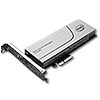
The Intel 750 Series SSD comes as a low-profie PCI-Express add-in card, so it will fit into rack servers or even compact media PCs.

The drive uses the PCI-Express x4 interface with support for up to PCI-Express 3.0. The card will work in longer and shorter slots and with slower PCI-Express interfaces (at reduced performance). Instead of AHCI, which is a decade-old standard for mechanical (high-latency) hard drives, the modern NVMe interface is used, which is optimized for low-latency storage. Please make sure to install the SSD into a x4 3.0 slot that is directly connected to the CPU. Yes, that third x4 slot your motherboard might have is a big no-no if it is routed via the Southbridge, over the DMI, and to the CPU. So in most cases you'll have to sacrifice a PCIe x16 3.0 slot, which might get in the way of multi-GPU setups (on Z97, for example). Intel's X99 enthusiast platform has more lanes available, and here, you will be able to use CrossFire/SLI and up to two 750 Series SSDs.

You will find Intel's own SSD controller and 18 64 GB flash chips on the PCB's front. The back of the card holds another 14 16 GB flash chips. So the whole PCIe card is basically plastered with flash chips all over. Five DDR3-1600 DRAM chips also provide 1.25 GB RAM and cache for the controller.

Intel's own CH29AE41B0 controller is the same as on the DC P3700 SSD. It comes with 18 flash channels, which is more than twice that of traditional client SSDs (these come with up to 8 channels). This 18-channel design is also the foundation behind the huge bandwidth the 750 Series SSD can provide.

The 32 MLC flash chips are produced by Intel-Micron and are built on a 20 nanometer process.
Our Patreon Silver Supporters can read articles in single-page format.
Nov 14th, 2026 15:56 CST
change timezone
Latest GPU Drivers
New Forum Posts
- Show us your collections thread!! (367)
- Recent hardware you've donated? (30)
- WarpCoreBench scores! (32)
- What can the FX 8320 do today? Here is the answer. (40)
- X79 and/or rampage IV OC'ing thread for those of us still left.... (2450)
- Id thank you and just like a moment of your time, what do you think about having to recover the r36s maxes/pros is it just china 5 dollar junk card? (0)
- Ddr4 instead of ddr5 for 9060xt 8 gb over 5060 8 gb (8)
- Tell me about your favourite graphics card (79)
- Your PC ATM (36426)
- Windows 11 General Discussion (7728)
Popular Reviews
- AMD Zen 6 Technical Deep Dive
- ASUS ROG Strix B850-I Gaming Wi-Fi7 W Review
- Corsair HX1000i Shift Crystal Review
- NZXT C1200 Platinum Review
- Upcoming Hardware Launches 2027 (Updated Nov 2026)
- Montech King 95 3D PRO Review
- NZXT H7 RGB+ Review
- NZXT H5 Review
- Phantom Blade Zero Performance Benchmark Review - 35 GPUs Tested
- XPG NIMBUS PLUS Review - Mid-range Chair With Strong Competitors
TPU on YouTube
Controversial News Posts
- NVIDIA Co-Founder and CEO Jensen Huang Officially Resigns (403)
- OpenAI CEO Argues Home PCs Waste the World's Limited DRAM Supply (152)
- NVIDIA Launches Investigation Into Jensen Huang's Relationship With Suspected Chinese Spy (136)
- Intel "Raptor Lake Next" 16-Core and 20-Core CPUs Surface (130)
- Legendary Game Studio BioWare Shuts Down Following EA Layoffs (104)
- Dell CEO Says the Memory Shortage Will Get Worse in 2027 (95)
- NVIDIA GeForce RTX 50-Series Scheduled for up to $500 Price Hike This Week (89)
- Modder Fits RTX 5090 With Four 8-Pin Connectors, Halving Current per Wire (80)