 52
Intel Core i5-9600K Review
(52 Comments) »Introduction

The Intel Core i5-9600K is a mid-range 6-core desktop processor targeted at gamer enthusiasts, a user segment that mainly games on their PC, but has an understanding of hardware tweaking with the want to eke out a little more performance over time. The 2017 introduction of AMD Ryzen kicked Intel out of its decade-long slumber, forcing it to increase CPU core-counts across the board as advancements in silicon fabrication technology grounded to a halt and with it, the introduction of new core designs that could have brought about clock-speed improvements. Not only did the first-generation Ryzen processors force 50–100 percent core-count increases across the board with Intel's 8th generation Core processors, but the second-generation Ryzen chips also packed enough of an improvement to trigger a second round with the 9th generation Core "Coffee Lake Refresh" family.
Interestingly, while the $350-ish Core i7 and new $500 Core i9 LGA1151 segments received 8 cores, the Core i5 extension has been left largely untouched by Intel in terms of core counts. This is probably because the company either feels its 6-core/6-thread setup is sufficient to compete with AMD Ryzen 5 series 6-core/12-thread SKUs or doesn't see the cost benefit in investing a large 177 mm² 8-core silicon for their $190–$260 segment. The 9th generation Core i5 series hence only has a 6-core/6-thread configuration based on a die that physically just has 6 cores and an unchanged 9 MB of shared L3 cache. What's on offer are minor increments to clock speeds, support for up to 128 GB of dual-channel DDR4 memory, and hardware fixes against certain CPU vulnerabilities that haunted computing for the bulk of 2018. In theory, a hardware fix inflicts less of a performance penalty than a firmware fix, which 8th generation Core processors have to make do with.

The Core i5-9600K is clocked at 3.70 GHz with a maximum Turbo Boost frequency of 4.60 GHz, compared to the 3.60 GHz nominal and 4.40 GHz max Turbo speeds of the previous generation i5-8600K. It comes with an unlocked multiplier, making it easy to overclock. AMD's Ryzen 5 2600X is highly competitive with the i5-8600K, to where we had to hand the Ryzen a performance and value edge over the Intel chip. The minor clock-speed bump of the i5-9600K is an exercise in tilting the edge in favor of Intel. Unfortunately, Intel didn't back that effort by pricing this chip aggressively. It still has an MSRP of $259.99, continues to lack a stock cooling solution, and supply issues to the DIY retail channel continue to bludgeon the product's value proposition even as the 2600X can be had for $220 in many places.
In this review, we examine the performance of the Core i5-9600K across our entire suite of CPU-specific and gaming-specific benchmarks to test a hunch we have. Given today's AAA PC games are just beginning to utilize 6 cores, and given this chip's high clock speeds, could gamers potentially save a lot of money over pricier options, such as the i7-9700K or even 2700X, by choosing this chip instead?
| Price | Cores / Threads | Base Clock | Max. Boost | L3 Cache | TDP | Architecture | Process | Socket | |
|---|---|---|---|---|---|---|---|---|---|
| Core i5-7500 | $245 | 4 / 4 | 3.4 GHz | 3.8 GHz | 6 MB | 65 W | Kaby Lake | 14 nm | LGA 1151 |
| Ryzen 5 1600 | $160 | 6 / 12 | 3.2 GHz | 3.6 GHz | 16 MB | 65 W | Zen | 14 nm | AM4 |
| Core i5-8500 | $225 | 6 / 6 | 3.0 GHz | 4.1 GHz | 9 MB | 65 W | Coffee Lake | 14 nm | LGA 1151 |
| Core i5-7600K | $270 | 4 / 4 | 3.8 GHz | 4.2 GHz | 6 MB | 91 W | Kaby Lake | 14 nm | LGA 1151 |
| Core i5-6600K | $225 | 4 / 4 | 3.5 GHz | 3.9 GHz | 8 MB | 91 W | Skylake | 14 nm | LGA 1151 |
| Core i5-8600 | $245 | 6 / 6 | 3.1 GHz | 4.3 GHz | 9 MB | 65 W | Coffee Lake | 14 nm | LGA 1151 |
| Ryzen 5 1600X | $220 | 6 / 12 | 3.6 GHz | 4.0 GHz | 16 MB | 95 W | Zen | 14 nm | AM4 |
| Core i5-8600K | $260 | 6 / 6 | 3.6 GHz | 4.3 GHz | 9 MB | 95 W | Coffee Lake | 14 nm | LGA 1151 |
| Ryzen 5 2600 | $170 | 6 / 12 | 3.4 GHz | 3.9 GHz | 16 MB | 65 W | Zen | 12 nm | AM4 |
| Ryzen 7 1700 | $200 | 8 / 16 | 3.0 GHz | 3.7 GHz | 16 MB | 65 W | Zen | 14 nm | AM4 |
| Core i5-9600K | $280 | 6 / 6 | 3.7 GHz | 4.6 GHz | 9 MB | 95 W | Coffee Lake | 14 nm | LGA 1151 |
| Core i7-6700K | $320 | 4 / 8 | 4.0 GHz | 4.2 GHz | 8 MB | 91 W | Skylake | 14 nm | LGA 1151 |
| Core i7-7700K | $430 | 4 / 8 | 4.2 GHz | 4.5 GHz | 8 MB | 91 W | Kaby Lake | 14 nm | LGA 1151 |
| Core i7-8700 | $330 | 6 / 12 | 3.2 GHz | 4.6 GHz | 12 MB | 65 W | Coffee Lake | 14 nm | LGA 1151 |
| Ryzen 5 2600X | $220 | 6 / 12 | 3.6 GHz | 4.2 GHz | 16 MB | 95 W | Zen | 12 nm | AM4 |
| Ryzen 7 1700X | $230 | 8 / 16 | 3.4 GHz | 3.8 GHz | 16 MB | 95 W | Zen | 14 nm | AM4 |
| Ryzen 7 2700 | $270 | 8 / 16 | 3.2 GHz | 4.1 GHz | 16 MB | 65 W | Zen | 12 nm | AM4 |
| Core i7-8700K | $370 | 6 / 12 | 3.7 GHz | 4.7 GHz | 12 MB | 95 W | Coffee Lake | 14 nm | LGA 1151 |
| Core i7-9700K | $400 | 8 / 8 | 3.6 GHz | 4.9 GHz | 12 MB | 95 W | Coffee Lake | 14 nm | LGA 1151 |
| Ryzen 7 2700X | $305 | 8 / 16 | 3.7 GHz | 4.3 GHz | 16 MB | 105 W | Zen | 12 nm | AM4 |
| Ryzen 7 1800X | $250 | 8 / 16 | 3.6 GHz | 4.0 GHz | 16 MB | 95 W | Zen | 14 nm | AM4 |
| Core i9-9900K | $550 | 8 / 16 | 3.6 GHz | 5.0 GHz | 16 MB | 95 W | Coffee Lake | 14 nm | LGA 1151 |
A Closer Look

Our sample arrived in a chip-only tray package, so we used stock images for the packaging. The Core i5-9600K ships in a simple paperboard box that packs the processor, some documentation, and a case badge. A stock heatsink is not included.


The Core i5-9600K looks just like any other LGA115x-class mainstream desktop processor made in the past nine years. The processor is compatible with LGA1151 motherboards based on the Intel 300-series chipset.

For its mainstream-desktop processors, Intel has maintained a largely uniform package size for the past decade, dating all the way back to Core "Lynnfield" LGA 1156. The cooler mount-hole spacing hasn't changed. You will be spoiled for choice when choosing a compatible cooler; however, make sure it can cope with at least 95 W TDP. Certain low-profile coolers designed for 65 W or 45 W TDP chips are not recommended.
Architecture
Unlike AMD, Intel doesn't manufacture just one kind of die with a large core count to then carve out lower core-count SKUs by disabling cores for the simple reason that its lower core-count SKUs sell in overwhelmingly higher volumes, and it would be a waste to for all 9th generation Core SKUs to be based on the 177 mm² 8-core die. The Core i5-9600K is built on a 6-core "Coffee Lake Refresh" die. The only things we deem to set this die apart from the "Coffee Lake" 6-core die of last year are hardware fixes to certain CPU security vulnerabilities and a refreshed integrated memory controller that now supports up to 128 GB of dual-channel DDR4 memory.
The "Coffee Lake Refresh" silicon driving the Core i5-9600K physically features six CPU cores with 256 KB of dedicated L2 cache per core and 12 MB of shared L3 cache. On the Core i5 "Coffee Lake" series, the L3 cache is reduced to 9 MB, which still keeps up with the 1.5 MB/core configuration of previous-generation Core i5 chips. Intel could maximize this silicon with its full 12 MB cache on certain mobile SKUs. The integrated Gen 9.5 graphics core is physically carried over from the "Kaby Lake" die. Internal communication is handled by a "ring bus" and not the mesh-interconnect Intel deployed on its new Core X "Skylake-X" processors.

Much of the processor's uncore components are clumped into the System Agent, which contains the memory controller, PCI-Express gen 3.0 root-complex, DMI interface, and memory PHY. On the other end of the ringbus is the Gen 9.5 integrated graphics, which has practically been carried over for the past three generations, featuring 24 execution units in the GT2 trim. At best, Intel may give it some software improvements that leverage the additional CPU power on tap. The iGPU is still branded under Intel's Graphics UHD family. Don't expect to play PUBG at 4K on this; the "UHD" moniker only indicates that the IGP can handle 4K Ultra HD displays, features modern connectivity options, such as DP 1.4 and HDMI 2.0, and can playback 4K video in new formats with 10-bpc color and HDR10/Dolby Vision standards.

Between "Skylake" and "Coffee Lake," Intel turned its R&D efforts toward refining the 14 nm process. It met with success on "Kaby Lake," and owing to its significantly higher clock speeds, "Kaby Lake" was able to provide higher performance than "Skylake." With "Coffee Lake," the nominal clock speeds look low, but Turbo Boost frequencies are higher than "Kaby Lake," and refinements in the process allow the chip to sustain elevated boost-clock states better. Between "Coffee Lake" (8th gen) and "Coffee Lake Refresh" (9th gen), the CPU core design has not changed. Intel did implement certain silicon-level fixes against security vulnerabilities.
The Intel Z390 Express Chipset
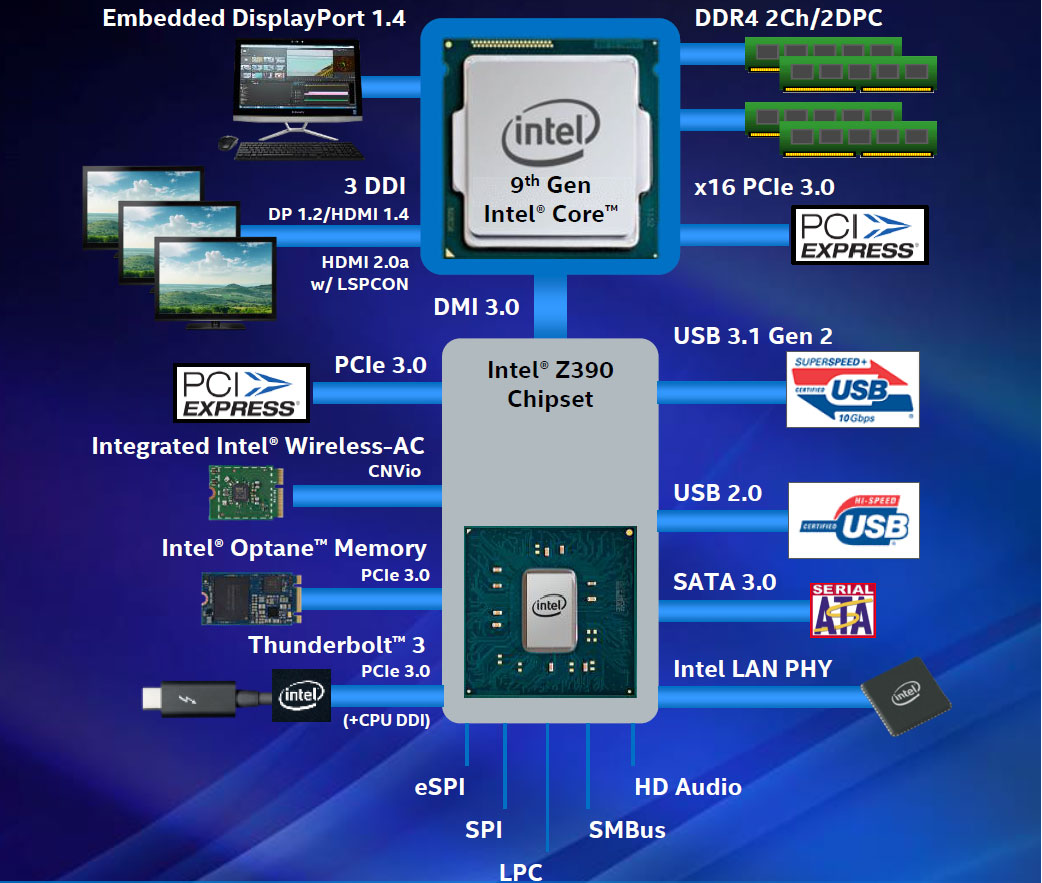
As we mentioned earlier, the only reason Intel appears to have launched the Z390 Express chipset while its existing Z370 chipset supports this processor through BIOS updates is because there could be motherboards with assured out-of-the-box support for 9th generation Core processors. Intel has also reportedly raised the CPU VRM requirements for the Z390, so motherboards based on it can maximize the overclocking headroom of the i9-9900K and i7-9700K. You can still overclock these chips with Z370. In terms of connectivity, the only thing that sets the Z390 apart from the Z370 is integrated 10 Gbps USB 3.1 and an external WLAN controller for 802.11ac.
Our Patreon Silver Supporters can read articles in single-page format.
Nov 15th, 2026 03:12 CST
change timezone
Latest GPU Drivers
New Forum Posts
- Honestly, do you care about GTA VI? (45)
- "Legacy Control Panel" won't install (2)
- Ryzen Owners Zen Garden (8558)
- Optical Disc Drive owners club (212)
- WarpCoreBench scores! (46)
- Bought MAX-P495 - Which model? (32)
- Tell me about your favourite graphics card (84)
- Planning for Prolonged High Prices and Maintaining What You Already Have (72)
- What can the FX 8320 do today? Here is the answer. (47)
- Recommendations Wanted - Affordable Enterprise SSD for Boot (3)
Popular Reviews
- AMD Zen 6 Technical Deep Dive
- ASUS ROG Strix B850-I Gaming Wi-Fi7 W Review
- Corsair HX1000i Shift Crystal Review
- Upcoming Hardware Launches 2027 (Updated Nov 2026)
- Montech King 95 3D PRO Review
- NZXT C1200 Platinum Review
- NZXT H7 RGB+ Review
- NZXT H5 Review
- Phantom Blade Zero Performance Benchmark Review - 35 GPUs Tested
- AMD Ryzen 7 9800X3D Review - The Best Gaming Processor
TPU on YouTube
Controversial News Posts
- NVIDIA Co-Founder and CEO Jensen Huang Officially Resigns (408)
- OpenAI CEO Argues Home PCs Waste the World's Limited DRAM Supply (152)
- NVIDIA Launches Investigation Into Jensen Huang's Relationship With Suspected Chinese Spy (136)
- Intel "Raptor Lake Next" 16-Core and 20-Core CPUs Surface (130)
- Legendary Game Studio BioWare Shuts Down Following EA Layoffs (104)
- Dell CEO Says the Memory Shortage Will Get Worse in 2027 (95)
- NVIDIA GeForce RTX 50-Series Scheduled for up to $500 Price Hike This Week (89)
- Modder Fits RTX 5090 With Four 8-Pin Connectors, Halving Current per Wire (80)