 126
Intel Panther Lake Technical Deep Dive
Cache & Fabric Improvements »Cougar Cove and Darkmont Core Designs


The Cougar Cove performance core succeeds Lion Cove and brings a series of targeted refinements focused on efficiency rather than higher peak clocks. The front end has been reworked to deliver a steadier instruction flow, while the scheduler issues work to the execution units with fewer stalls. Internal structures such as the dispatch and allocation queues have been slightly widened to balance throughput and energy use. Together these adjustments yield roughly five to ten percent higher performance per clock at the same frequency. The result is a core tuned for Intel 18A and PowerVia that maintains throughput under sustained load while using less power. Key cache sizes: 256 KB L1 per core and 3 MB private L2 per Cougar Cove core.

Cougar Cove keeps the same pipeline depth as Lion Cove but is more efficient at keeping its execution units busy. The branch predictor and instruction fusion logic have been refined, and prefetch behavior is more adaptive to mixed workloads. Engineers explained that the design team relied on performance data gathered from earlier client chips to identify where short, bursty workloads were leaving execution units idle. These small refinements make the new P-core more consistent in real-world client workloads, without changing its overall structure.
The reorder buffer and allocation windows have been resized to improve balance between integer and vector operations. The front end is now better at sustaining fetch and decode bandwidth in small instruction loops, reducing wasted cycles in everyday tasks such as web rendering or office applications. Intel described these changes as incremental but meaningful, designed to cut down on "wasted wakeups" and improve the core's steady-state efficiency.

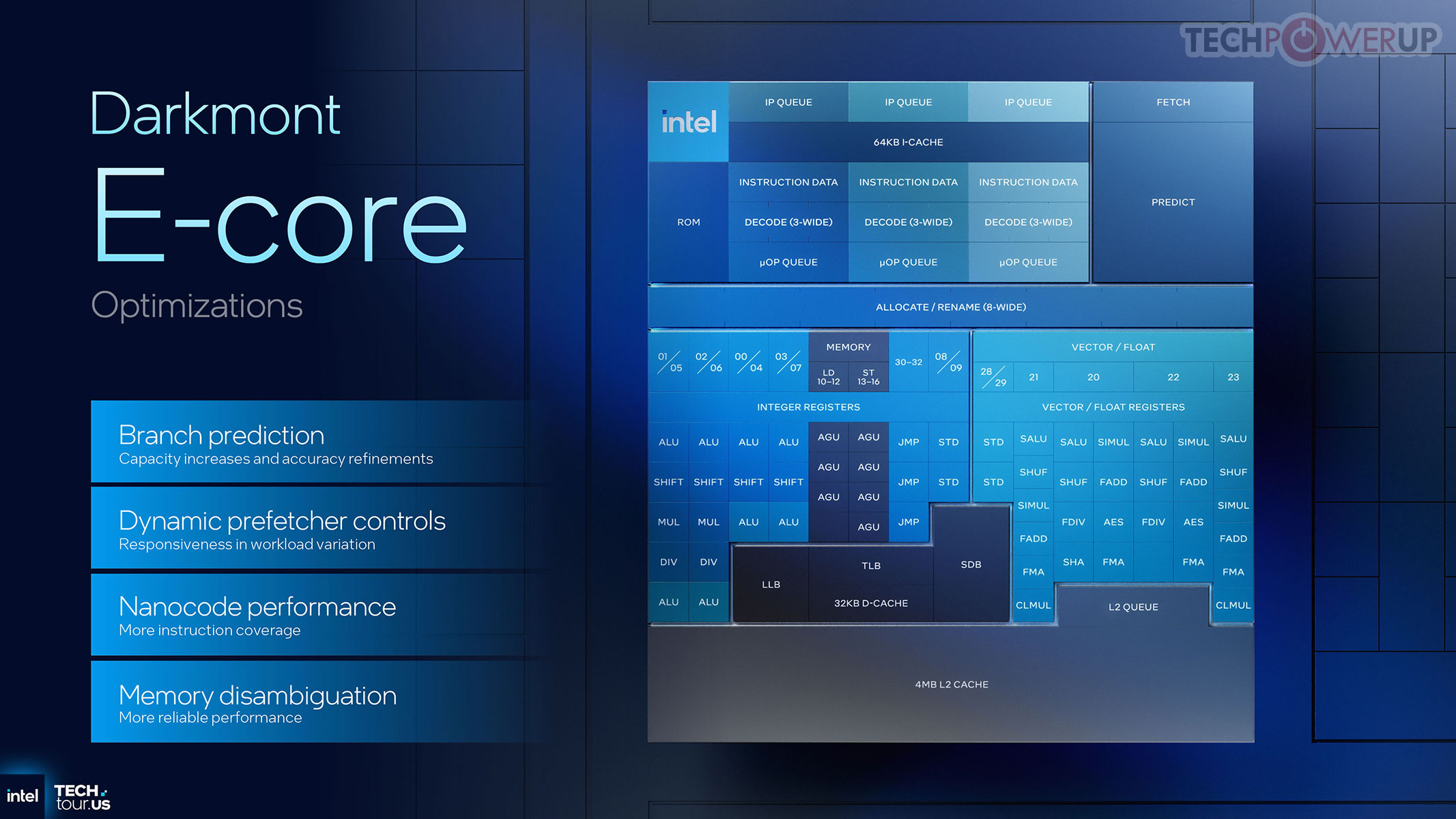
Darkmont replaces Lunar Lakes's Skymont as the efficiency core and brings a more substantial architectural update. It has a wider pipeline, a larger out-of-order window, and faster vector execution units, allowing higher instructions per clock while staying within similar power limits. Memory access latency is lower, and speculative execution has been made more aggressive to handle heavier thread loads. The goal is to reduce the performance gap between the small and large cores so that more workloads can remain on the efficiency cluster without losing responsiveness. Cache details for Darkmont: 96 KB L1 per core and 4 MB L2 per E-core cluster.

The Thread Director has been tuned for the mix of Cougar Cove, Darkmont, and low-power efficiency cores. It provides more granular feedback to the operating system about each thread's latency needs and cache usage, allowing better placement of tasks across core types. Scheduling decisions now consider both responsiveness and energy efficiency, improving behavior in multitasking and AI-assisted workloads.


A new addition to the compute tile is the memory-side cache, which you can find in the image above in the bottom left—dark gray with green "Home Agent" inside. It's 8 MB and can be accessed by all major components of the tile rather than only the CPU cores. It acts as a shared high-speed buffer where hardware blocks can allocate temporary data or exchange information directly. This design helps reduce round trips to system memory and keeps more work local to the tile. One clear example is the image processing unit, which can use this cache when handling webcam video streams, cutting latency and power use. When asked, Intel said the feature is still being tuned and that engineers are exploring where it can deliver measurable gains in performance or energy efficiency.


Across all three core types, the compute tile demonstrates higher performance per watt than Lunar Lake while maintaining similar operating frequencies. Improvements stem from 18A's transistor gains, PowerVia's lower voltage losses, and the refined microarchitectures of Cougar Cove and Darkmont. The design represents a shift toward maximizing sustained performance within mobile power budgets rather than chasing higher peak frequencies, completing Intel's transition to a fully integrated hybrid core architecture.
Nov 23rd, 2026 06:34 CST
change timezone
Latest GPU Drivers
New Forum Posts
- RAM overclock cause worse feeling than JEDEC (4)
- UPS what one to get? (50)
- What are you playing? (26242)
- Increasing Power Limit? (11)
- Battlefield 6 (964)
- Your PC ATM (36461)
- repair an NVIDIA Quadro M4000 (3)
- GTA VI (23)
- Honestly, do you care about GTA VI? (272)
- Youtube channel video downloader, not playlist. (2)
Popular Reviews
- Microsoft Surface Laptop Ultra Review - The Next-gen Arm Laptop
- Corsair RM1200e (Second Generation) Review
- Upcoming Hardware Launches 2027 (Updated Nov 2026)
- Pulsar Office Tour & First Look at P1 Dual-Sensor Mouse
- Ugreen NASync DXP4800 GT Review
- AMD Ryzen 7 9800X3D Review - The Best Gaming Processor
- AMD Zen 6 Technical Deep Dive
- Phantom Blade Zero Performance Benchmark Review - 35 GPUs Tested
- AMD Ryzen 7 5800X3D 10th Anniversary Review
- Biwin Black Opal NV7400 2 TB Review
TPU on YouTube
Controversial News Posts
- NVIDIA Co-Founder and CEO Jensen Huang Officially Resigns (492)
- Report: Jensen Huang Eyes NVIDIA Comeback (266)
- Open Letter Asking NVIDIA to Reinstate Jensen Huang Passes 115,000 Signatures (184)
- OpenAI CEO Argues Home PCs Waste the World's Limited DRAM Supply (152)
- NVIDIA Launches Investigation Into Jensen Huang's Relationship With Suspected Chinese Spy (136)
- Intel "Raptor Lake Next" 16-Core and 20-Core CPUs Surface (130)
- NVIDIA GeForce RTX 50-Series Scheduled for up to $500 Price Hike This Week (89)
- Intel Razor Lake Gets a 12 P-Core bLLC Chip With No E-Cores, Per Leak (86)