 11
Kamrui GK3 Plus Mini-PC Review
AAA Gaming »Storage Performance
Storage performance testing with CrystalDiskMark (CDM) gives a clear picture of how fast a drive can move both large sequential files and smaller random workloads. Using a 4 GiB test file, the results for the Kamrui GK3 Plus were very much in line with what you would expect from a SATA-based SSD, and well behind the NVMe drives found in more expensive systems.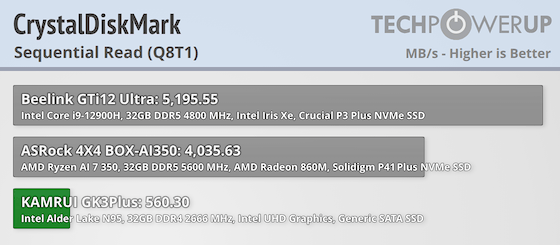
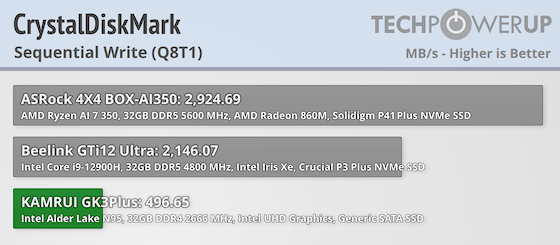
On sequential reads (Q8T1), the GK3 Plus managed 560 MB/s, while sequential writes landed at 497 MB/s. These are basically the ceiling of the SATA interface and perfectly fine for everyday responsiveness, but pale in comparison to the 5,195 MB/s read speed of the NVMe Crucial P3 Plus in the Beelink GTi12 Ultra or the 4,035 MB/s from the Solidigm P41 Plus in the ASRock 4X4 BOX-AI350. The same gap holds true in sequential writes, where the KAMRUI's ~500 MB/s result is dwarfed by the multi-gigabyte numbers of the NVMe competition.
Nov 26th, 2026 11:13 CST
change timezone
Latest GPU Drivers
New Forum Posts
- WarpCoreBench scores! (106)
- Radeon driver death (5)
- Making a game in Godot engine (22)
- Current Sales, Bundles, Giveaways (10452)
- Can you guess Which game it is? (368)
- Free Games Thread (5385)
- What's your main Black Friday / Cyber Monday purchase? (20)
- Post your CrystalDiskMark speeds (659)
- Wireless Internet sharing between PC and router both-ways, is it possible? (24)
- X79 and/or rampage IV OC'ing thread for those of us still left.... (2459)
Popular Reviews
- ASRock X870E Challenger Wi-Fi White Review
- VZMORE AX9 Max Review
- Upcoming Hardware Launches 2027 (Updated Nov 2026)
- Microsoft Surface Laptop Ultra Review - The Next-gen Arm Laptop
- AMD Ryzen 7 9800X3D Review - The Best Gaming Processor
- AMD Zen 6 Technical Deep Dive
- Corsair RM1200e (Second Generation) Review
- Phantom Blade Zero Performance Benchmark Review - 35 GPUs Tested
- Montech CyberFlow ARGB 360 Review
- Pulsar Office Tour & First Look at P1 Dual-Sensor Mouse
TPU on YouTube
Controversial News Posts
- Jensen Huang Reinstated as CEO of NVIDIA (592)
- NVIDIA Co-Founder and CEO Jensen Huang Officially Resigns (492)
- Report: Jensen Huang Eyes NVIDIA Comeback (281)
- Open Letter Asking NVIDIA to Reinstate Jensen Huang Passes 115,000 Signatures (184)
- OpenAI CEO Argues Home PCs Waste the World's Limited DRAM Supply (152)
- NVIDIA Launches Investigation Into Jensen Huang's Relationship With Suspected Chinese Spy (136)
- Intel "Raptor Lake Next" 16-Core and 20-Core CPUs Surface (130)
- Intel Razor Lake Gets a 12 P-Core bLLC Chip With No E-Cores, Per Leak (94)