 11
Kamrui GK3 Plus Mini-PC Review
Value & Conclusion »Power Draw
Looking at longer-term power logging, the KAMRUI GK3 Plus used 338.8 Wh over roughly two days of mixed idle and light activity. To put that in more familiar terms, that's about 0.34 kWh, or just a third of a unit on a household power bill. On an hourly basis the system typically hovered between 6–8 Wh (0.006–0.008 kWh), with short bumps up to 12 Wh during bursts of load. The chart shows how steady the draw remains once Windows is booted, and it rarely strays outside that narrow range. The fan is virtually silent at idle, though it does remain on rather than shutting off completely.At an average of ~7 W, 24/7 operation works out to roughly 5.0 kWh per month. Even at 20 cents per kWh, that means the GK3 Plus adds only about one dollar to a monthly electricity bill, which makes it an extremely frugal little machine to keep on all the time.
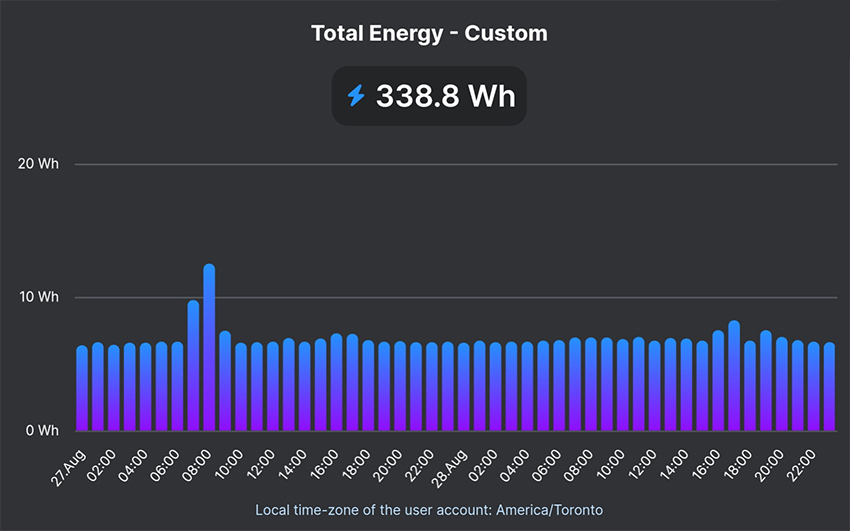
For perspective, this puts the GK3 Plus in the same energy envelope as a smart speaker or LED desk lamp. At an average of just 7 watts, you could leave this machine running 24/7 and only rack up a couple of kilowatt-hours per month (a negligible hit on your power bill). This level of efficiency not only makes it an attractive option for students and remote workers, but also for always-on scenarios like Plex servers, digital signage, or even as a low-cost home lab node.
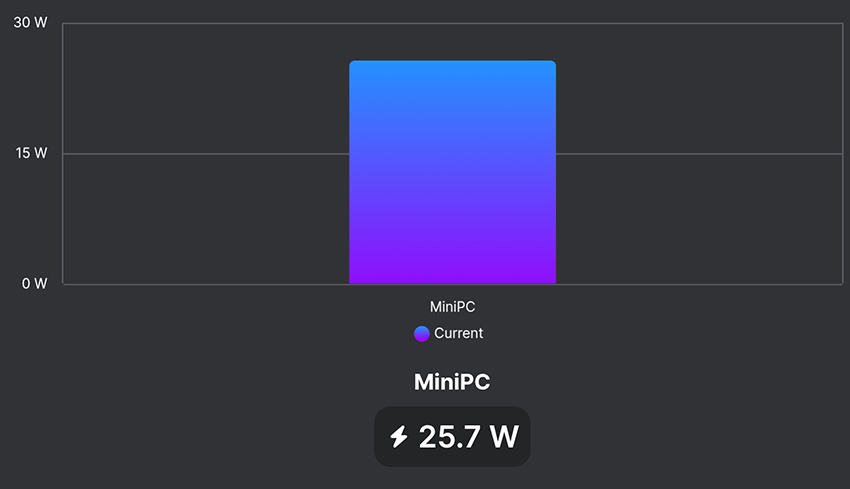
Looking at a shorter term, I ran the AIDA64 stress test for just over 13 minutes, the KAMRUI GK3 Plus peaked at 25.7 watts under full CPU and memory load. That is right on target for the Intel Alder Lake-N95, which carries a 15 W base TDP but often draws a little more when pushed. The important detail here is stability: the system never moved beyond 30 W, showing that it remains efficient and avoids thermal or power delivery concerns even during extended workloads.
For comparison, many entry-level desktops idle at a higher level than this mini PC's maximum draw, making the GK3 Plus, again, an exceptionally inexpensive option for always-on roles like media serving, office use, or even digital signage. In day-to-day use, power tends to hover around 9 to 12 watts, keeping long-term operating costs very low.
Breaking it down further, background activity such as downloading files kept the system between 14.5 and 16.5 watts. Cinebench multicore pushed it into the 21 to 23.6 watt range, showing that even under all-core stress the chip maintains excellent efficiency. Gaming was the most demanding case, with DOTA 2 drawing between 24.4 and 28.7 watts depending on what you were doing.
Even at its highest, the GK3 Plus remains under 30 watts, which makes it both easy to cool and inexpensive to run.
Fan Noise
During full load with the same AIDA64 stress testing, the KAMRUI GK3 Plus held steady at roughly 43 to 44 dB(A), which is impressively quiet for a budget mini PC under maximum strain. This level of noise is closer to the background hum of a fridge or a quiet office, making it very unobtrusive even when the system is pushed to its limits. At idle, the GK3 Plus becomes virtually whisper-quiet, dropping well below noticeable levels in a normal environment.Note: Room noise floor measured 33.4 dB(A) at the mic. Load noise was recorded at 30 cm from the mini-PC.
Nov 28th, 2026 14:27 CST
change timezone
Latest GPU Drivers
New Forum Posts
- Can you guess Which game it is? (378)
- Which new games will you be buying? (363)
- TPU's Nostalgic Hardware Club (22211)
- WarpCoreBench scores! (118)
- RivaTuner / MSI Afterburner OSD with GPU-Z (6)
- What are you playing? (26257)
- Share your CPUZ Benchmarks! (2687)
- What's your main Black Friday / Cyber Monday purchase? (48)
- Your PC ATM (36504)
- Which Xfinity modem/router setup supports network printing/scanning between a wired PC and a Wi-Fi Brother MFC-L8900CDW printer? (1)
Popular Reviews
- Upcoming Hardware Launches 2027 (Updated Nov 2026)
- Moaiplay Ora Pro G1 850 Review
- AMD Ryzen 7 9800X3D Review - The Best Gaming Processor
- VZMORE AX9 Max Review
- Montech CyberFlow ARGB 360 Review
- ASRock X870E Challenger Wi-Fi White Review
- AMD Zen 6 Technical Deep Dive
- ORICO Obook15 AI Review
- Phantom Blade Zero Performance Benchmark Review - 35 GPUs Tested
- Microsoft Surface Laptop Ultra Review - The Next-gen Arm Laptop
TPU on YouTube
Controversial News Posts
- Jensen Huang Reinstated as CEO of NVIDIA (628)
- NVIDIA Co-Founder and CEO Jensen Huang Officially Resigns (492)
- Report: Jensen Huang Eyes NVIDIA Comeback (281)
- Open Letter Asking NVIDIA to Reinstate Jensen Huang Passes 115,000 Signatures (184)
- OpenAI CEO Argues Home PCs Waste the World's Limited DRAM Supply (153)
- NVIDIA Launches Investigation Into Jensen Huang's Relationship With Suspected Chinese Spy (136)
- Intel Razor Lake Gets a 12 P-Core bLLC Chip With No E-Cores, Per Leak (94)
- NVIDIA GeForce RTX 50-Series Scheduled for up to $500 Price Hike This Week (89)