 11
Kamrui GK3 Plus Mini-PC Review
Networking Performance »AI Performance
The UL Procyon AI Computer Vision benchmark is designed to show how well a system can handle modern AI inference tasks, using popular models like MobileNet, ResNet, and YOLO. These tests simulate workloads behind things like image recognition, object detection, and upscaling; jobs that are becoming increasingly relevant as AI seeps into everyday applications.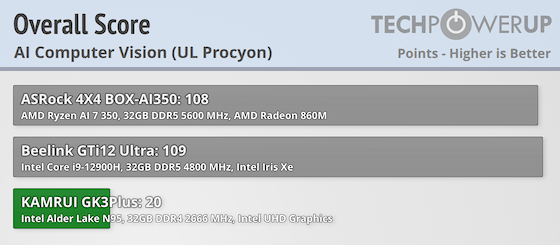
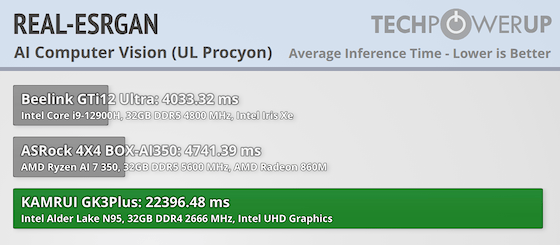
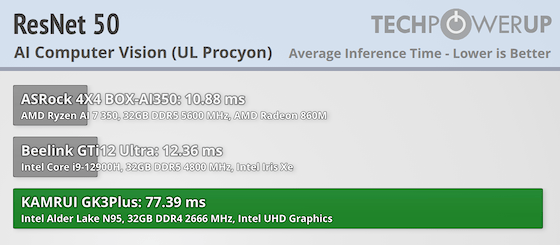
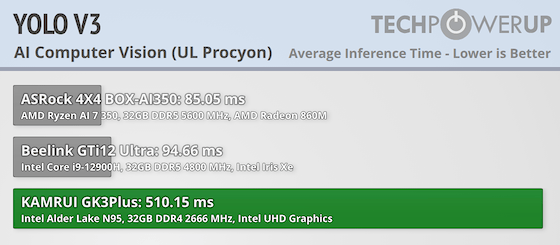
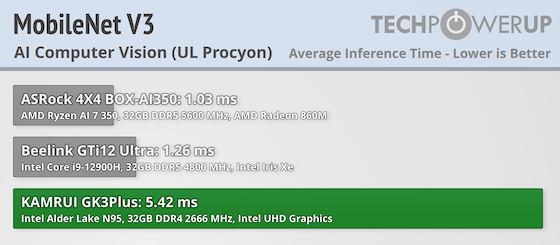
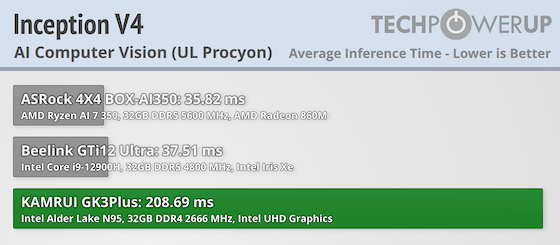
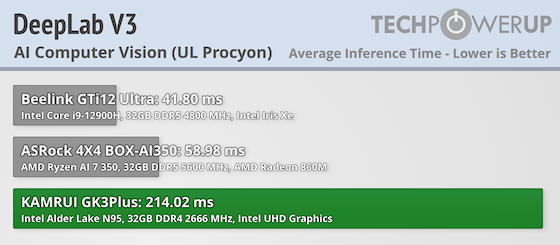
The KAMRUI GK3 Plus had an overall score of just 20 compared to 108 and 109 for the ASRock and Beelink, demonstrating that the N95 chip is simply not built for this kind of work. For individual tests, inference times were dramatically slower than the other two mini-PCs: five times longer on MobileNet, more than six times slower on ResNet, and nearly twenty times slower on YOLO. The REAL-ESRGAN upscaling test was the starkest example, taking over 22 seconds per frame where the others completed in around four to five seconds. In practice, the GK3 Plus isn't built for AI workloads. Whether it's creative upscaling or real-time detection, the hardware can't keep up, which is exactly what you'd expect at this price.
Nov 26th, 2026 10:53 CST
change timezone
Latest GPU Drivers
New Forum Posts
- Can you guess Which game it is? (368)
- Radeon driver death (3)
- Free Games Thread (5385)
- Making a game in Godot engine (21)
- What's your main Black Friday / Cyber Monday purchase? (20)
- Post your CrystalDiskMark speeds (659)
- Wireless Internet sharing between PC and router both-ways, is it possible? (24)
- X79 and/or rampage IV OC'ing thread for those of us still left.... (2459)
- Exploring Local LLMs: Models, Hardware and Setup Experiences (4)
- Linpack Xtreme Released (513)
Popular Reviews
- ASRock X870E Challenger Wi-Fi White Review
- VZMORE AX9 Max Review
- Upcoming Hardware Launches 2027 (Updated Nov 2026)
- Microsoft Surface Laptop Ultra Review - The Next-gen Arm Laptop
- AMD Ryzen 7 9800X3D Review - The Best Gaming Processor
- AMD Zen 6 Technical Deep Dive
- Corsair RM1200e (Second Generation) Review
- Phantom Blade Zero Performance Benchmark Review - 35 GPUs Tested
- Montech CyberFlow ARGB 360 Review
- Pulsar Office Tour & First Look at P1 Dual-Sensor Mouse
TPU on YouTube
Controversial News Posts
- Jensen Huang Reinstated as CEO of NVIDIA (590)
- NVIDIA Co-Founder and CEO Jensen Huang Officially Resigns (492)
- Report: Jensen Huang Eyes NVIDIA Comeback (281)
- Open Letter Asking NVIDIA to Reinstate Jensen Huang Passes 115,000 Signatures (184)
- OpenAI CEO Argues Home PCs Waste the World's Limited DRAM Supply (152)
- NVIDIA Launches Investigation Into Jensen Huang's Relationship With Suspected Chinese Spy (136)
- Intel "Raptor Lake Next" 16-Core and 20-Core CPUs Surface (130)
- Intel Razor Lake Gets a 12 P-Core bLLC Chip With No E-Cores, Per Leak (94)