 22
Kingston Fury Beast DDR5-6000 32 GB CL40 Review
Intel 13900K Frametime Analysis: Counter-Strike 2 »Frametime Analysis
We present a more in-depth analysis than just average FPS to show how the frame rate changes over time, which helps highlight FPS drops. Minimum FPS at both the 95th and 99th percentile are reported in these charts, too. A second chart, a histogram, shows shape and spread for the frametime data—how tightly grouped the measurements are. The "IQR" result is called "Interquartile Range," which is an outlier-resistant statistical value that tells us the range in the middle of the frametime distribution.Location: Baldur's Gate City
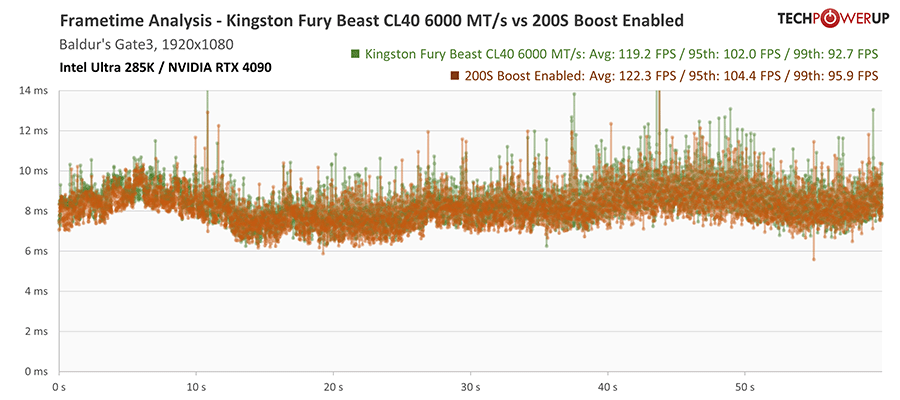
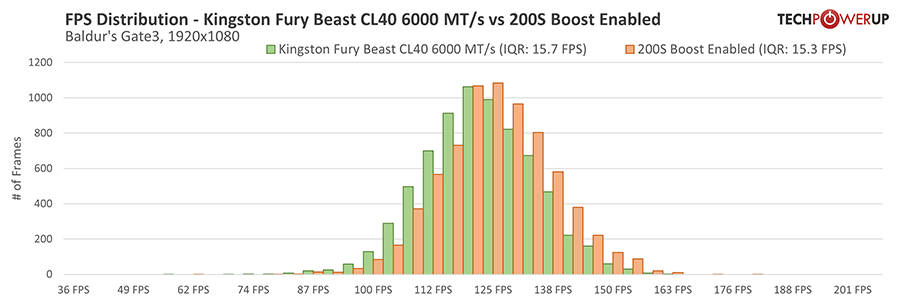
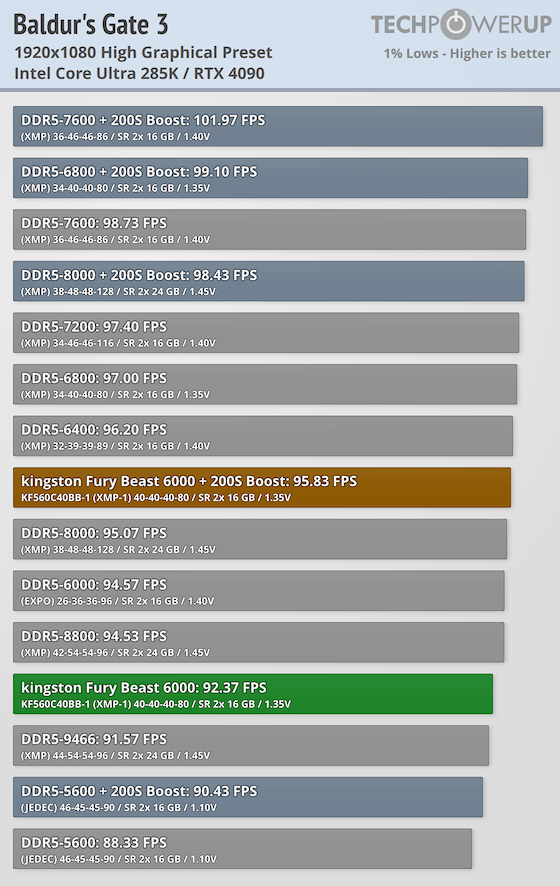
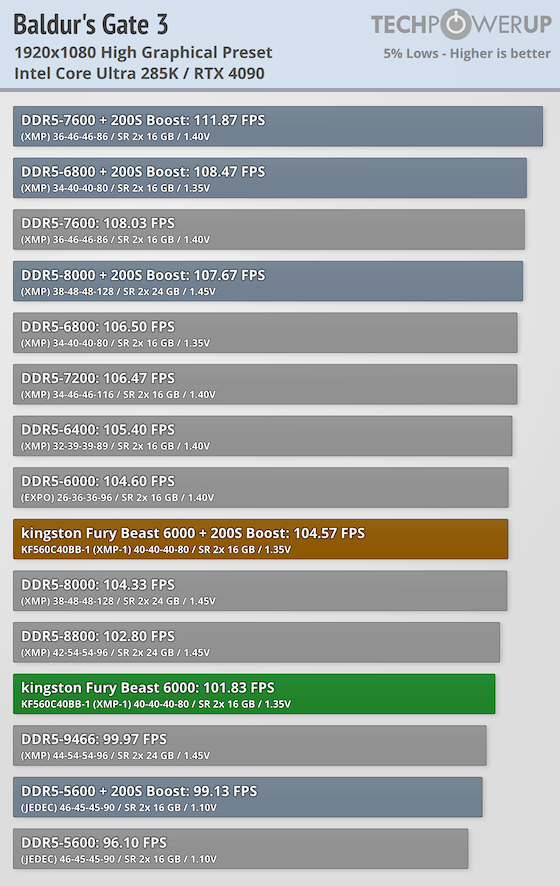
For this benchmark, we used Baldur's Gate City, a highly CPU-intensive location. While Intel traditionally has been less affected by memory latency in gaming, the Arrow lake architectural redesign of the Intel Ultra CPUs has made overall latency a critical factor for higher frame rates; similar to AMD. Testing Baldur's Gate 3 reveals a noticeable performance gap between the XMP and XMP + Intel Boost for some memory kits. Here we see that the biggest gains come from higher speed memory that has Boost Enabled.
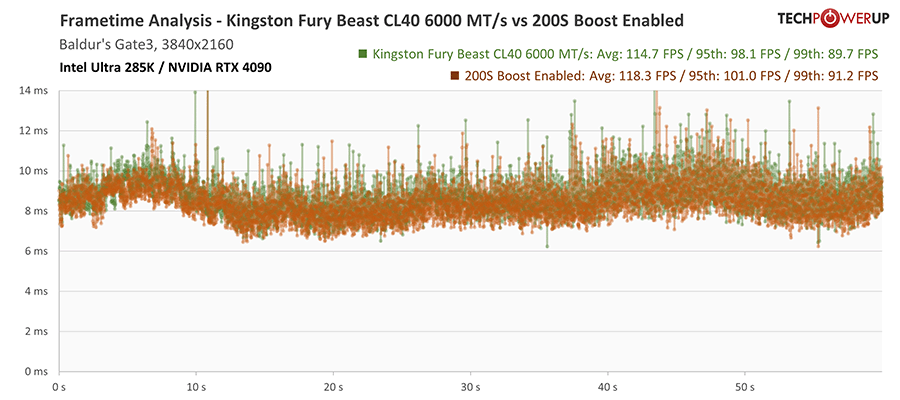
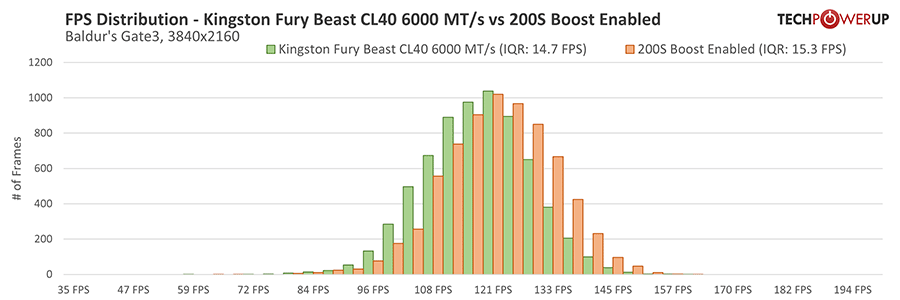
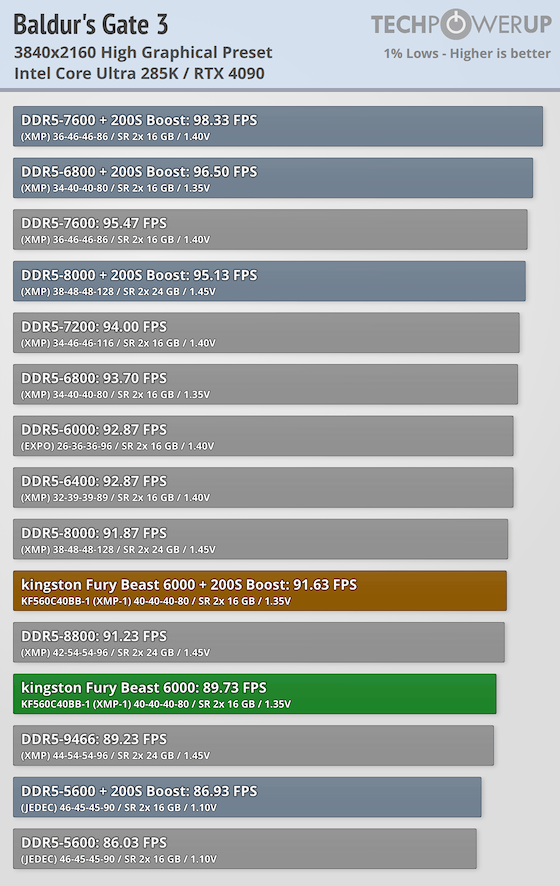
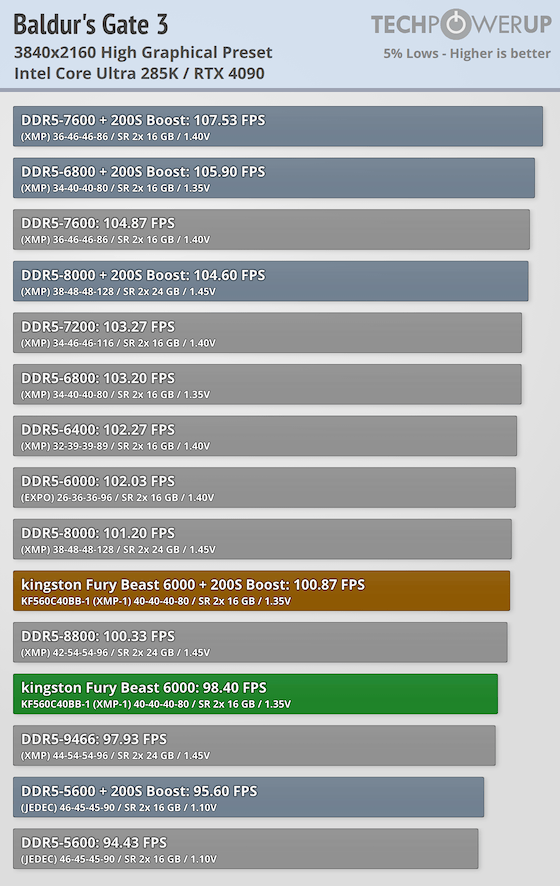
Increasing the resolution results in a noticeable drop in frame rate. While Baldur's Gate 3 is known for being CPU-intensive, memory speed and latency also play a significant role, especially at higher resolutions. The Kingston Fury Beast DDR5-6000 memory kit falls about 7% short of the top performer, even with Intel 200S Boost activated.
Nov 20th, 2026 17:25 PST
change timezone
Latest GPU Drivers
New Forum Posts
- SATA drive 1.4 GBps with Intel X25-E on Windows 98! (36)
- DTS DCH Driver for Realtek HDA [DTS:X APO4 + DTS Interactive] (2816)
- Honestly, do you care about GTA VI? (214)
- Without Jensen, PC gaming will be (51)
- WarpCoreBench scores! (86)
- What's your latest tech Freebie? (80)
- Nvidia GPU undervolting via MVolt+? (0)
- How to prevent OLED burn damage due to PC freezes or power outtages? (49)
- RX 9000 series GPU Owners Club (2249)
- Logitech Headsets Modded Driver — Unlock Dolby in G HUB (23)
Popular Reviews
- Microsoft Surface Laptop Ultra Review - The Next-gen Arm Laptop
- Ugreen NASync DXP4800 GT Review
- Corsair RM1200e (Second Generation) Review
- Pulsar Office Tour & First Look at P1 Dual-Sensor Mouse
- Upcoming Hardware Launches 2027 (Updated Nov 2026)
- Acemagic Retro X3 Review
- Biwin Black Opal NV7400 2 TB Review
- AMD Ryzen 7 9800X3D Review - The Best Gaming Processor
- AMD Zen 6 Technical Deep Dive
- Chieftec Iceberg PRO 360 DARK Review
TPU on YouTube
Controversial News Posts
- NVIDIA Co-Founder and CEO Jensen Huang Officially Resigns (491)
- Report: Jensen Huang Eyes NVIDIA Comeback (256)
- Open Letter Asking NVIDIA to Reinstate Jensen Huang Passes 115,000 Signatures (184)
- OpenAI CEO Argues Home PCs Waste the World's Limited DRAM Supply (152)
- NVIDIA Launches Investigation Into Jensen Huang's Relationship With Suspected Chinese Spy (136)
- Intel "Raptor Lake Next" 16-Core and 20-Core CPUs Surface (130)
- Legendary Game Studio BioWare Shuts Down Following EA Layoffs (104)
- NVIDIA GeForce RTX 50-Series Scheduled for up to $500 Price Hike This Week (89)