 5
LattePanda Mu Ultra Review
Web & Office Productivity »General Performance
AIDA64 Cache & Memory
The AIDA64 memory benchmark measures how quickly data moves between system memory and the CPU's cache hierarchy. It provides a closer look at memory bandwidth, latency, and cache behavior.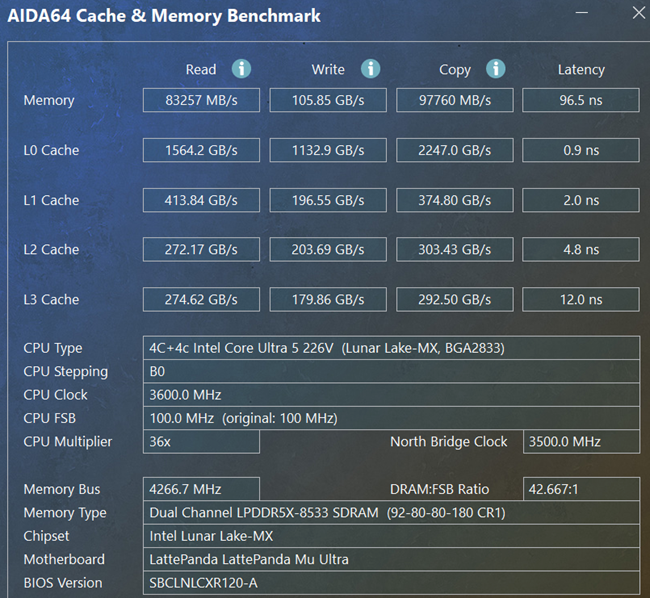
The on-package LPDDR5X-8533 memory delivered 83.26 GB/s reads, 105.85 GB/s writes, and 97.76 GB/s copies in my test, with latency at 96.5 ns. That bandwidth also feeds the Arc 130V iGPU because CPU and graphics share the same 16 GB pool, so memory bandwidth is especially relevant on a compact platform like this.
Cinebench
Cinebench uses Maxon's Cinema 4D engine to measure processor rendering performance across both single-threaded and multithreaded workloads. Comparing both scores shows how well the processor handles lightly threaded tasks and heavier rendering jobs.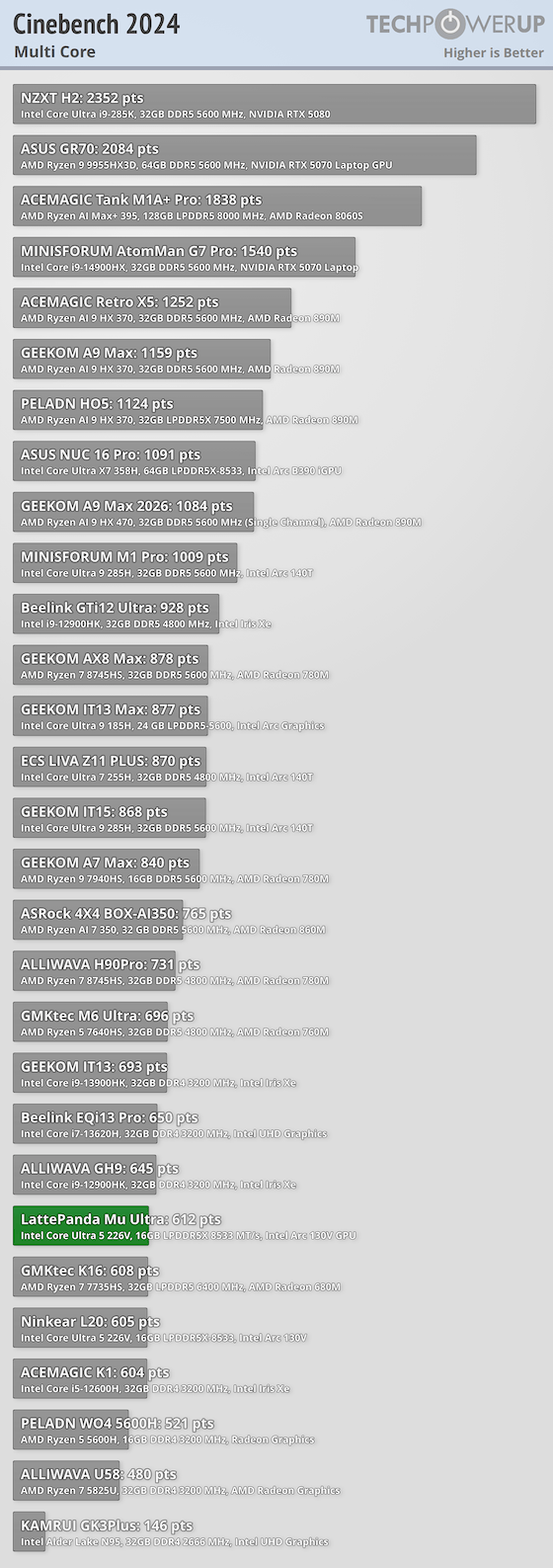
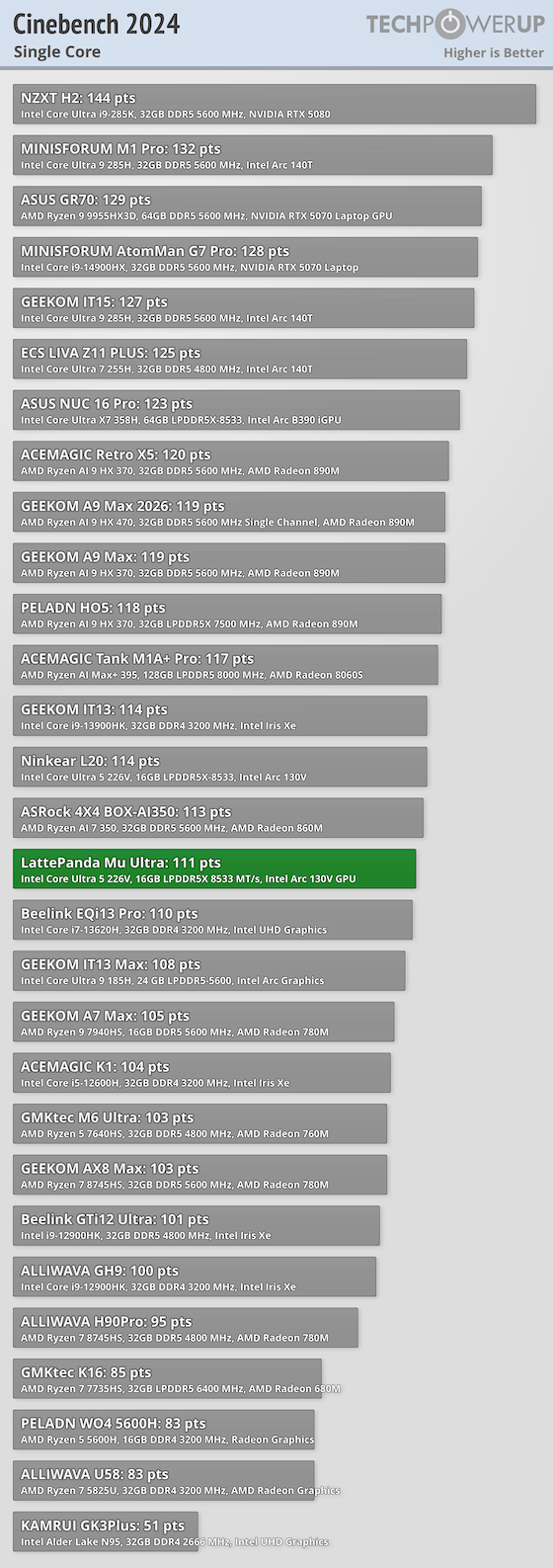
The Core Ultra 5 226V scored 612 points in the multicore test and 111 points in single-core, with the heavier render being the more modest side of this result. The eight-core, eight-thread Lunar Lake design prioritizes efficiency and graphics integration over sustained CPU rendering, so this workload is considerably tougher on the module than normal desktop work.
7-Zip
7-Zip's internal benchmark measures processor performance during both data compression and decompression across a range of dictionary sizes. It covers file-heavy workloads such as packing archives, installing software, or building projects.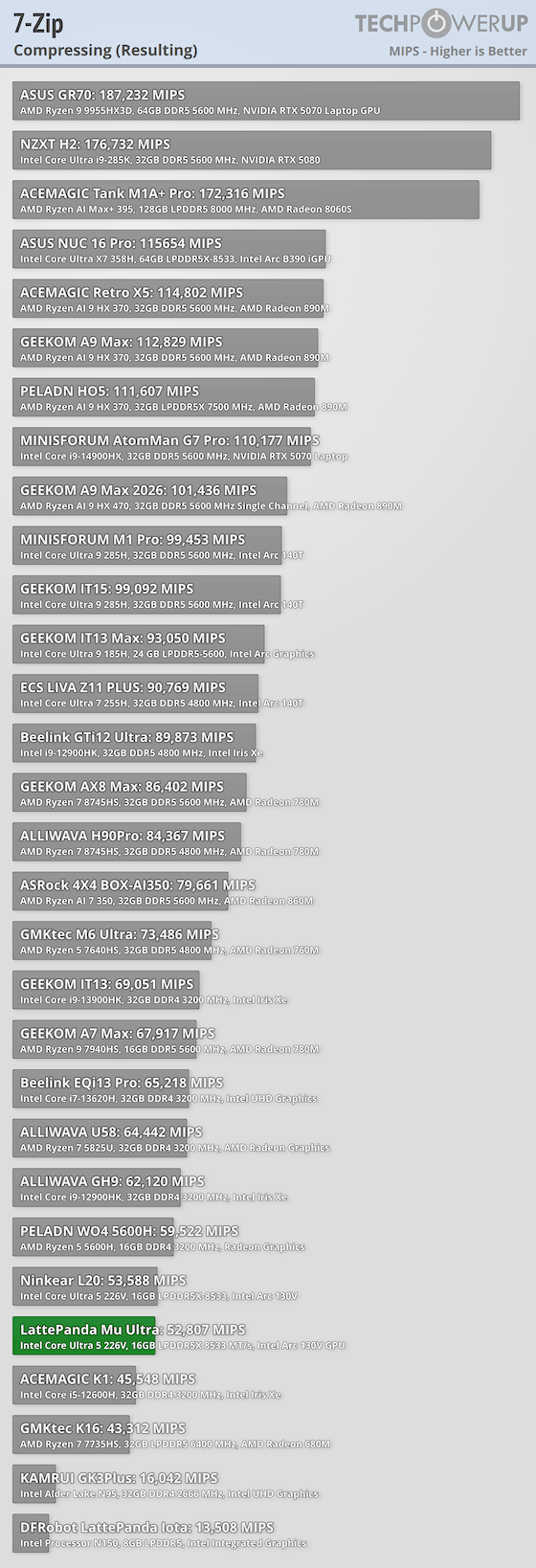
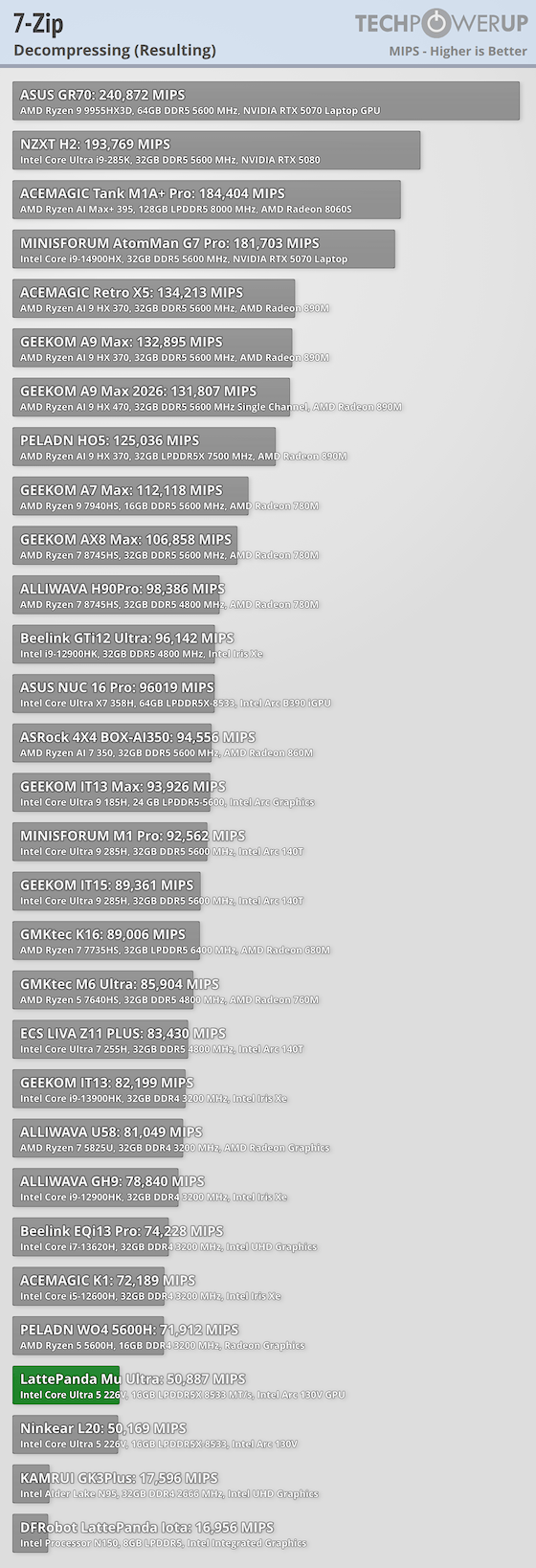
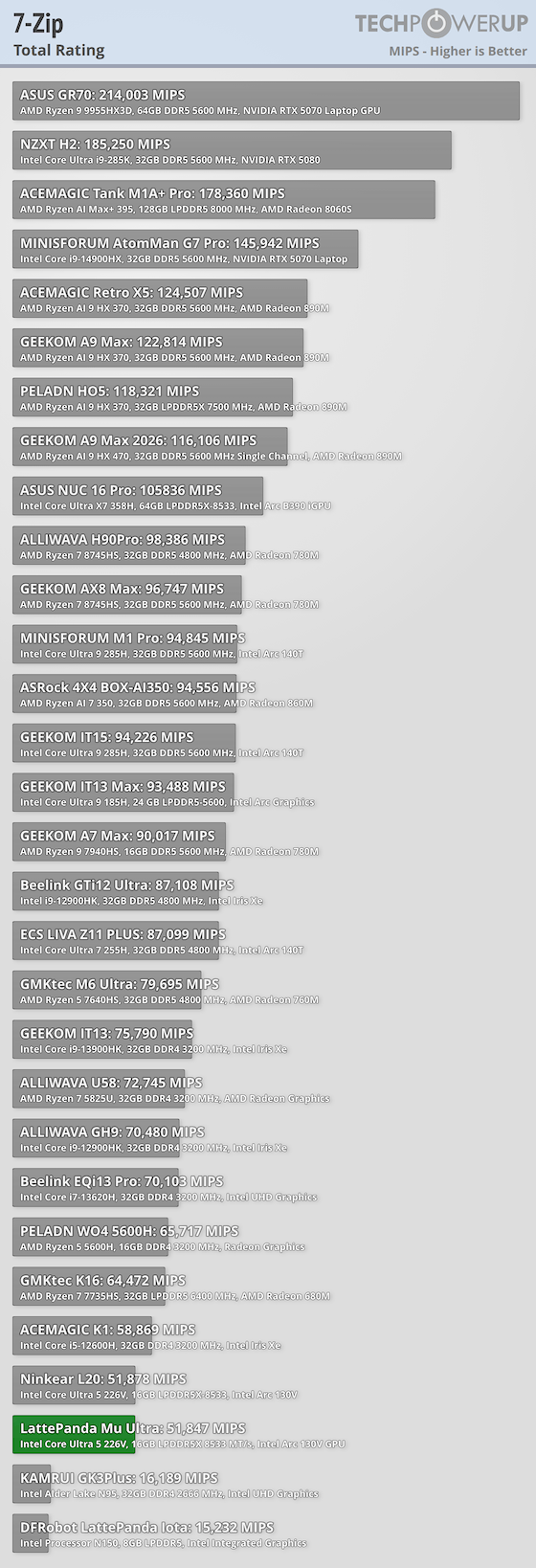
The Mu Ultra reached 52,807 MIPS in compression, 50,887 MIPS in decompression, and 51,847 MIPS overall, with very little separation between the two sides of the test. For an eight-thread processor with a 17 W base power, that gives the board enough CPU throughput for development work and everyday file operations without turning it into a high-power desktop platform.
Y-Cruncher
Y-Cruncher calculates digits of Pi with extreme precision, placing a sustained load on both the CPU and memory. The 2.5-billion-digit test keeps the Mu Ultra working long enough to show how it behaves during a demanding compute workload.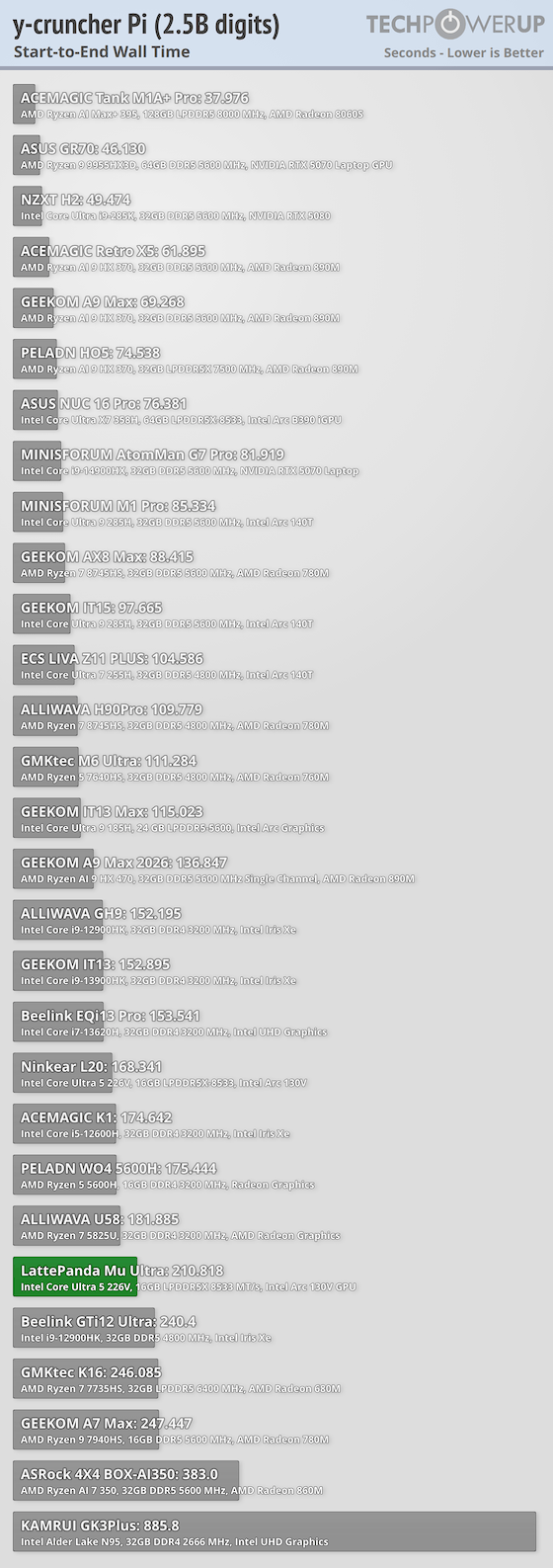
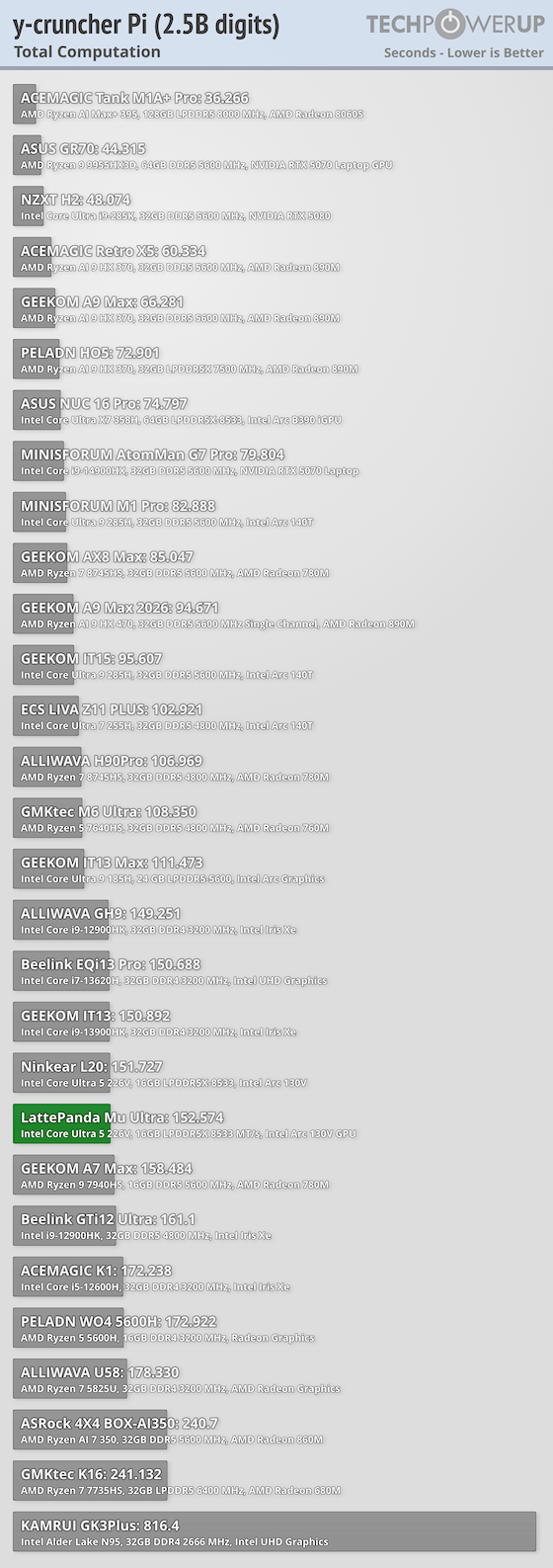
Calculating 2.5 billion digits of Pi took 152.574 seconds of computation time and 210.818 seconds from start to finish on the Mu Ultra. The longer wall-time figure also includes setup and data movement, so it should not be read as CPU-only computation time.
Geekbench
Geekbench tests a wide variety of workloads, from encryption and AI to office productivity and photo editing. It also includes a GPU compute test that measures graphics performance outside of games.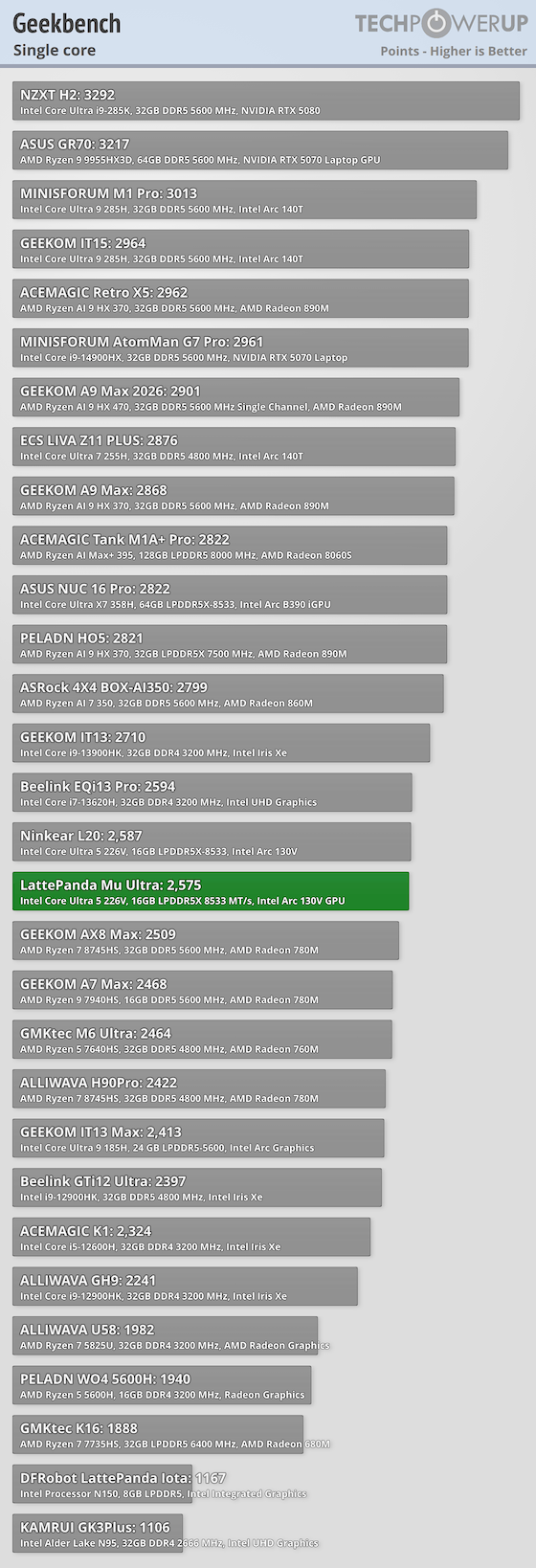
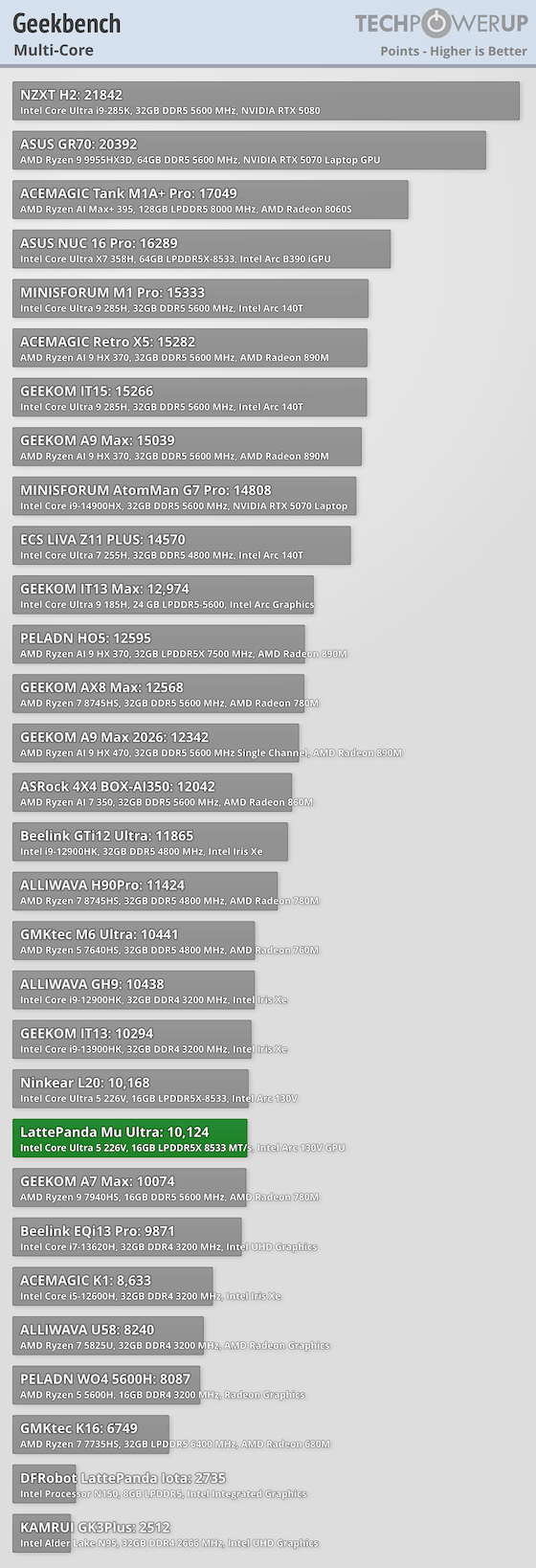
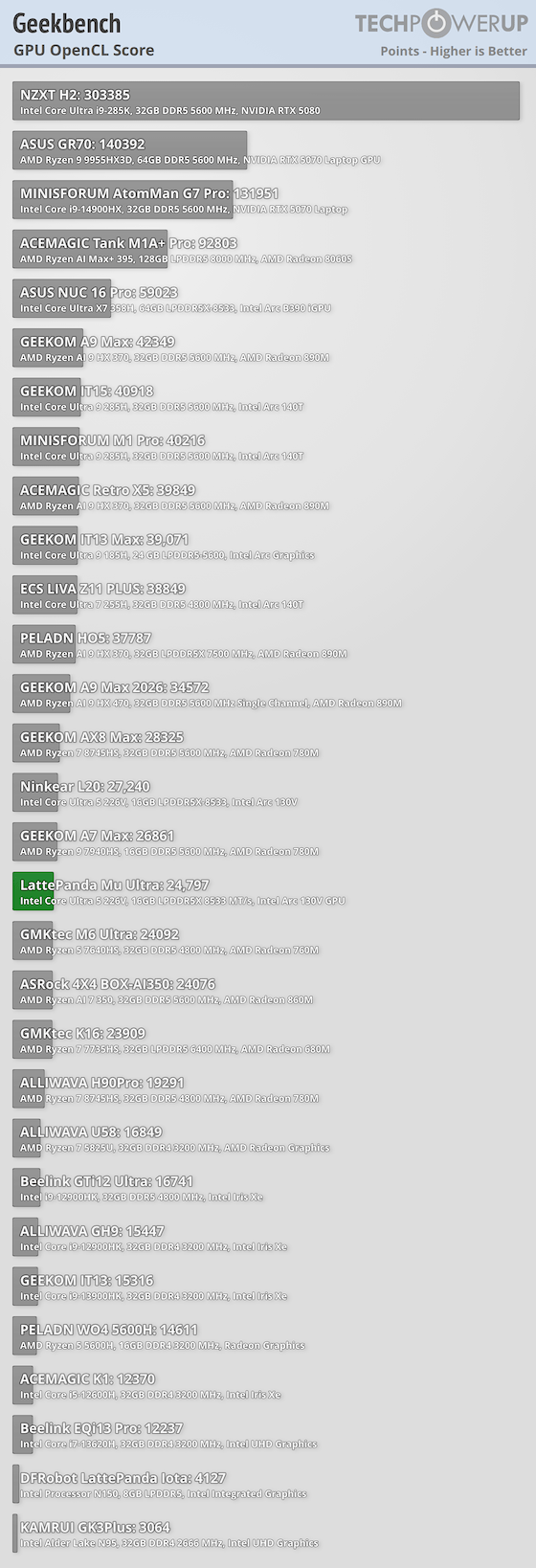
Geekbench produced 2,575 points in single-core and 10,124 points in multicore, while the Arc 130V reached 24,797 points in OpenCL. The single-core score matches how quick Windows and lighter development work felt during testing, while the OpenCL result gives the Arc 130V another compute workload outside gaming.
Nov 28th, 2026 08:44 CST
change timezone
Latest GPU Drivers
New Forum Posts
- Can you guess Which game it is? (372)
- -18C on GPU by moving it to the front of the case. (31)
- What are you playing? (26255)
- Exit Adobe - PDF reader, and PDF editor recommendations (16)
- The End Maybe Near for Adobe? Here is Artcraft (33)
- Mouse Pad advice - Shidenkai out of production? (24)
- really interesting wafer manufacture video, deffo worth a watch (0)
- Forza Horizon 6 discussion thread (64)
- UPS what one to get? (76)
- RX 6700 XT ~2 s screen + cursor freezes with FreeSync: FPO VRAM clock hang, fixed with a longer vblank (MPO stays on) (2)
Popular Reviews
- Upcoming Hardware Launches 2027 (Updated Nov 2026)
- Moaiplay Ora Pro G1 850 Review
- AMD Ryzen 7 9800X3D Review - The Best Gaming Processor
- VZMORE AX9 Max Review
- Montech CyberFlow ARGB 360 Review
- ASRock X870E Challenger Wi-Fi White Review
- AMD Zen 6 Technical Deep Dive
- ORICO Obook15 AI Review
- Microsoft Surface Laptop Ultra Review - The Next-gen Arm Laptop
- Phantom Blade Zero Performance Benchmark Review - 35 GPUs Tested
TPU on YouTube
Controversial News Posts
- Jensen Huang Reinstated as CEO of NVIDIA (627)
- NVIDIA Co-Founder and CEO Jensen Huang Officially Resigns (492)
- Report: Jensen Huang Eyes NVIDIA Comeback (281)
- Open Letter Asking NVIDIA to Reinstate Jensen Huang Passes 115,000 Signatures (184)
- OpenAI CEO Argues Home PCs Waste the World's Limited DRAM Supply (152)
- NVIDIA Launches Investigation Into Jensen Huang's Relationship With Suspected Chinese Spy (136)
- Intel Razor Lake Gets a 12 P-Core bLLC Chip With No E-Cores, Per Leak (94)
- NVIDIA GeForce RTX 50-Series Scheduled for up to $500 Price Hike This Week (89)