 20
Memblaze PBlaze7 7940 30.72 TB Review
Value & Conclusion »Power Consumption
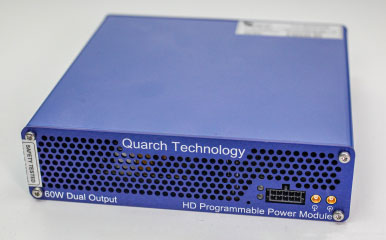
For the SSD power consumption tests, a Quarch QTL1999 programmable power module is used, alongside the proper fixture for the SSD. This method allows for the monitoring of a drive's power usage profile with microsecond precision in our custom workloads. Data is pulled into our processing pipeline over Ethernet, on a separate machine, ensuring that measurements do not affect the SSD being tested. All measurements are drive power only, not full system.
Max Power Draw
During our power consumption test sequence, the peak value is recorded.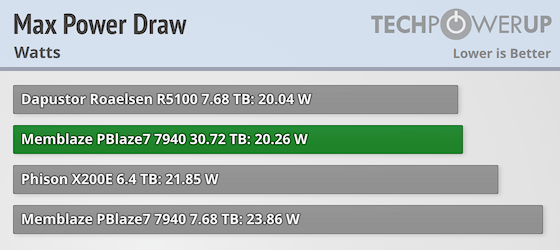
During this test, the 30.72 TB SSD showed slightly lower power consumption compared to the 7.68 TB unit, mainly due to its slightly reduced performance. In theory, its power draw should have been higher given the increased capacity, but because the drive is tightly constrained to stay within the 25 W power envelope, both its sequential and random speeds instead ended up slightly lower as a result.
Average Power Draw
During the benchmark, we also recorded the average power consumption throughout the entire duration of the test.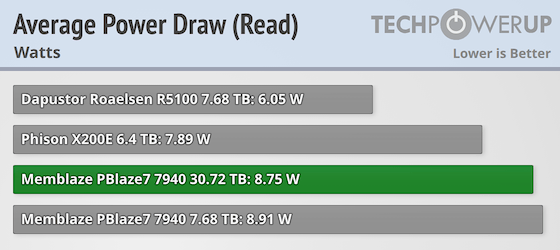
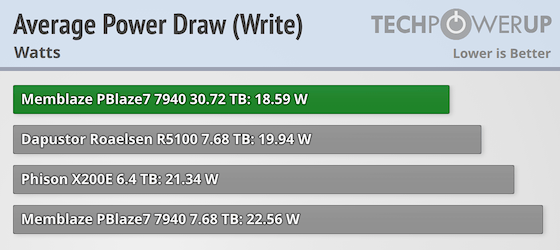
Once again, the difference between both units is quite small. However, since the 30.72 TB SSD stays just under 10 GB/s, while the 7.68 TB model exceeds 10.4 GB/s, this slight performance gap results in a small variation in power consumption.
Idle Power
We will now test the SSD while idle on the desktop for 15 minutes to check its average power consumption. It's important to note that the test was conducted without enabling the L1 ASPM setting, which is designed to activate power-saving modes for peripherals and devices using the PCIe bus.L1 ASPM was disabled to reflect a more realistic server or workstation environment, where power-saving features are often turned off to prioritize stability and performance. Allowing us to measure the SSD's idle power consumption without the influence of aggressive power management
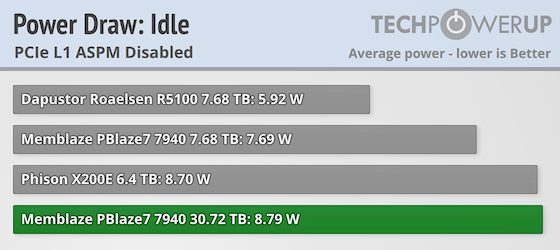
In idle, due to its higher density, the SSD has no way around it—its power consumption will naturally be higher than lower-capacity models. Still, the results are expected and perfectly acceptable, especially considering that drives like this aren't designed to operate under idle or light workloads, unlike consumer-grade SSDs.
Energy Efficiency
Finally, we have the power efficiency test, with data collected from both the read and write speed benchmarks.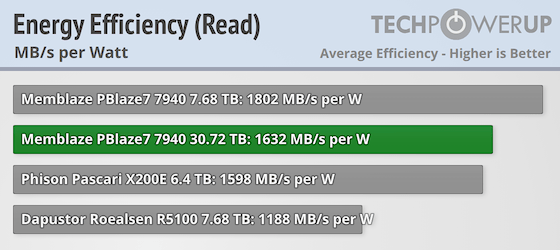
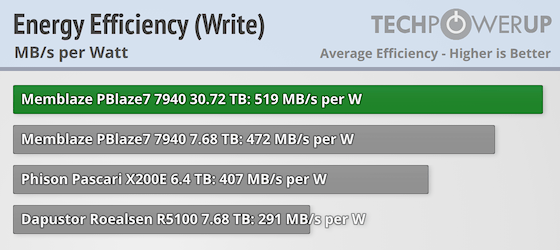
This new Memblaze SKU managed to impress with its efficiency. Although its speeds were slightly lower than the 7.68 TB unit, overall power consumption was also lower—resulting in better efficiency in both read and write operations.
Nov 25th, 2026 20:00 CST
change timezone
Latest GPU Drivers
New Forum Posts
- Smokin Hot Lappy (10)
- Gacha Games - Discussions, Pulls, Updates, etc. (1165)
- Linpack Xtreme Released (511)
- Sexy Hardware Close-Up Pic Clubhouse. (10345)
- AAF Optimus Modded Driver For Windows 10 & 11 - Only for HDAUDIO Chips [WINDOWS 11 RECOMMENDED] (1155)
- Which ryzen am5 cpu ? (219)
- {NA} 2026 Black November prices / deal (7)
- TPU's Nostalgic Hardware Club (22208)
- UPS what one to get? (74)
- More Nova Lake specs (5)
Popular Reviews
- ASRock X870E Challenger Wi-Fi White Review
- VZMORE AX9 Max Review
- Upcoming Hardware Launches 2027 (Updated Nov 2026)
- Microsoft Surface Laptop Ultra Review - The Next-gen Arm Laptop
- AMD Ryzen 7 9800X3D Review - The Best Gaming Processor
- AMD Zen 6 Technical Deep Dive
- Corsair RM1200e (Second Generation) Review
- Phantom Blade Zero Performance Benchmark Review - 35 GPUs Tested
- Pulsar Office Tour & First Look at P1 Dual-Sensor Mouse
- Ocypus lota P1000 Review
TPU on YouTube
Controversial News Posts
- Jensen Huang Reinstated as CEO of NVIDIA (573)
- NVIDIA Co-Founder and CEO Jensen Huang Officially Resigns (492)
- Report: Jensen Huang Eyes NVIDIA Comeback (281)
- Open Letter Asking NVIDIA to Reinstate Jensen Huang Passes 115,000 Signatures (184)
- OpenAI CEO Argues Home PCs Waste the World's Limited DRAM Supply (152)
- NVIDIA Launches Investigation Into Jensen Huang's Relationship With Suspected Chinese Spy (136)
- Intel "Raptor Lake Next" 16-Core and 20-Core CPUs Surface (130)
- Intel Razor Lake Gets a 12 P-Core bLLC Chip With No E-Cores, Per Leak (94)