 12
Memblaze PBlaze7 7A46 6.4 TB Review - Random Write King
Value & Conclusion »Power Consumption
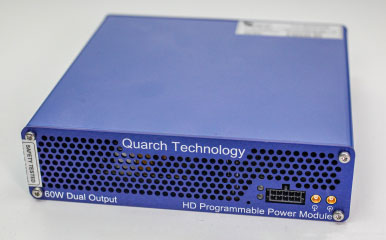
For the SSD power consumption tests, a Quarch QTL1999 programmable power module is used, alongside the proper fixture for the SSD. This method allows for the monitoring of a drive's power usage profile with microsecond precision in our custom workloads. Data is pulled into our processing pipeline over Ethernet, on a separate machine, ensuring that measurements do not affect the SSD being tested. All measurements are drive power only, not full system
Max Power Draw
During our power consumption test sequence, the peak value is recorded.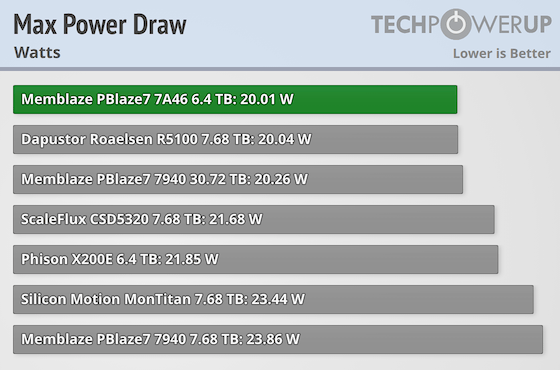
During this test, the Memblaze SSD proved to be highly efficient, showing the lowest power consumption among all the drives tested, even outperforming Memblaze's own 7940 lineup, which uses a Marvell controller paired with Micron NAND.
Average Power Draw
During the benchmark, we also recorded the average power consumption throughout the entire duration of the test.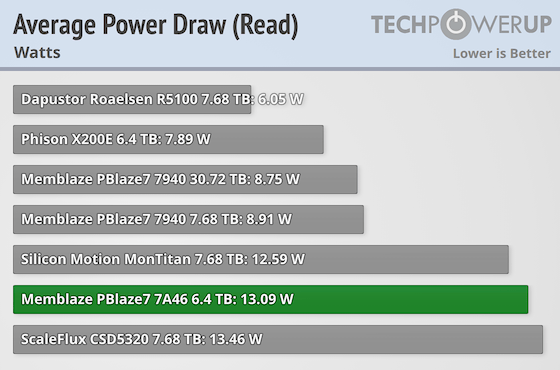
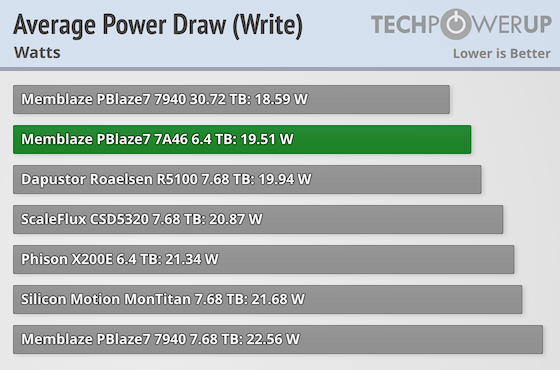
Our 7A46, equipped with its new controller and NAND, delivered low power consumption in write workloads, coming close to the Memblaze 7940 we tested previously, still an excellent result overall. In read operations, however, it showed slightly higher power consumption, performing better only than the ScaleFlux drive we tested earlier.
Idle Power
We will now test the SSD while idle on the desktop for 15 minutes to check its average power consumption. It's important to note that the test was conducted without enabling the L1 ASPM setting, which is designed to activate power-saving modes for peripherals and devices using the PCIe bus.L1 ASPM was disabled to reflect a more realistic server or workstation environment, where power-saving features are often turned off to prioritize stability and performance, allowing us to measure the SSD's idle power consumption without the influence of aggressive power management.
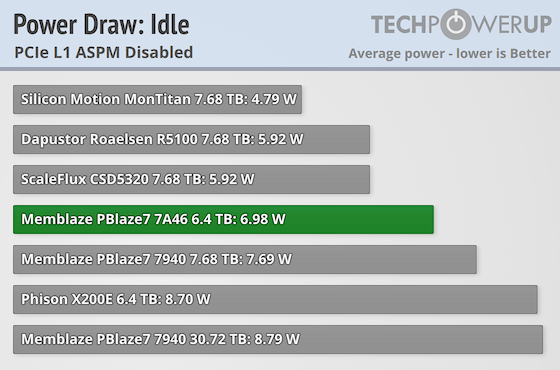
At idle, it once again delivered a solid result, drawing around 7 W of power, lower than the 7940 drives and once again close to the ScaleFlux.
Power Draw at Fixed IOPS
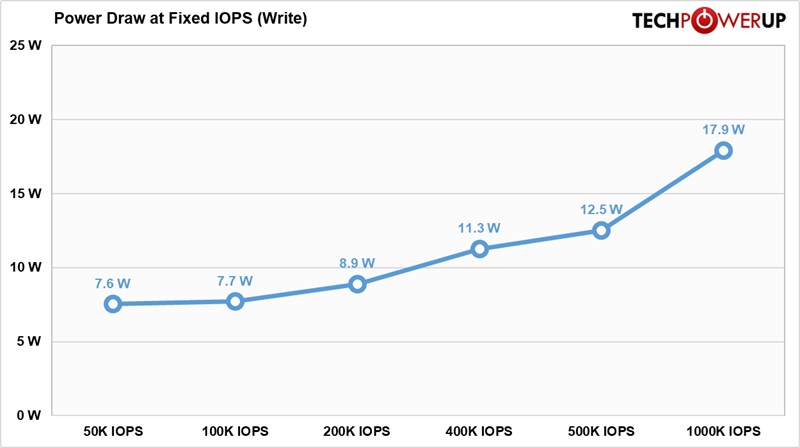
Using FIO, we measure the SSD's power consumption while operating at predefined fixed IOPS targets across both read and write workloads. This method allows us to evaluate how efficiently the drive scales power as performance increases, providing a clearer view of real-world efficiency behavior rather than only measuring peak power consumption.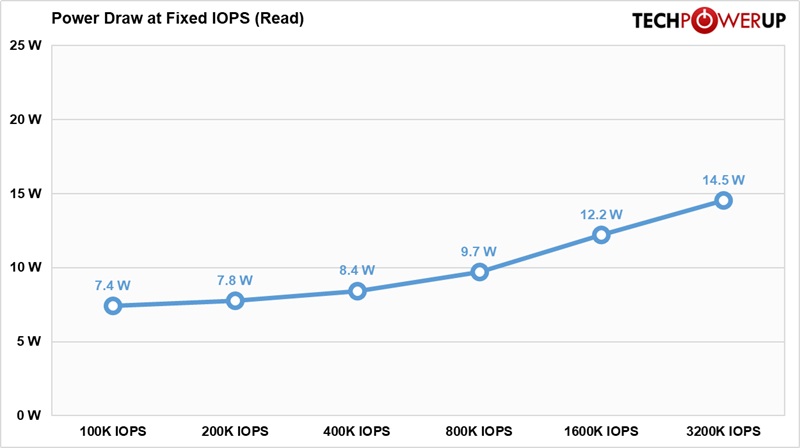
Energy Efficiency
Finally, we have the power efficiency test, with data collected from both the read and write speed benchmarks.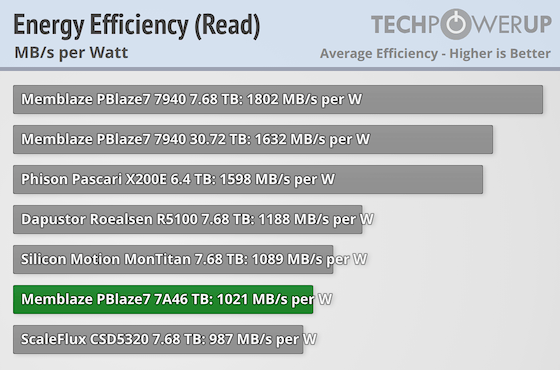
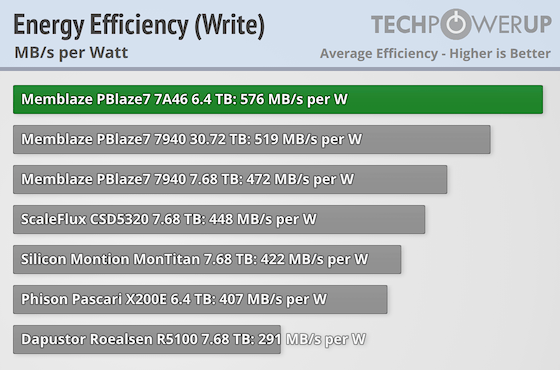
This new Memblaze design proved to be highly efficient, especially in write workloads, where it maintained relatively low power consumption while delivering strong performance. Its read efficiency was solid, but it did not quite rank among the most efficient SSDs in the comparison.
Nov 20th, 2026 16:23 PST
change timezone
Latest GPU Drivers
New Forum Posts
- Without Jensen, PC gaming will be (51)
- WarpCoreBench scores! (86)
- Honestly, do you care about GTA VI? (213)
- What's your latest tech Freebie? (80)
- Nvidia GPU undervolting via MVolt+? (0)
- How to prevent OLED burn damage due to PC freezes or power outtages? (49)
- RX 9000 series GPU Owners Club (2249)
- Logitech Headsets Modded Driver — Unlock Dolby in G HUB (23)
- 1 - 5 person file storage server equivalent accasible from anywhere + general VM server. (1)
- When you could finally run Crysis maxed out? (63)
Popular Reviews
- Microsoft Surface Laptop Ultra Review - The Next-gen Arm Laptop
- Ugreen NASync DXP4800 GT Review
- Corsair RM1200e (Second Generation) Review
- Pulsar Office Tour & First Look at P1 Dual-Sensor Mouse
- Upcoming Hardware Launches 2027 (Updated Nov 2026)
- Acemagic Retro X3 Review
- Biwin Black Opal NV7400 2 TB Review
- AMD Ryzen 7 9800X3D Review - The Best Gaming Processor
- AMD Zen 6 Technical Deep Dive
- Chieftec Iceberg PRO 360 DARK Review
TPU on YouTube
Controversial News Posts
- NVIDIA Co-Founder and CEO Jensen Huang Officially Resigns (491)
- Report: Jensen Huang Eyes NVIDIA Comeback (256)
- Open Letter Asking NVIDIA to Reinstate Jensen Huang Passes 115,000 Signatures (184)
- OpenAI CEO Argues Home PCs Waste the World's Limited DRAM Supply (152)
- NVIDIA Launches Investigation Into Jensen Huang's Relationship With Suspected Chinese Spy (136)
- Intel "Raptor Lake Next" 16-Core and 20-Core CPUs Surface (130)
- Legendary Game Studio BioWare Shuts Down Following EA Layoffs (104)
- Dell CEO Says the Memory Shortage Will Get Worse in 2027 (95)