 3
Microsoft Surface Laptop Ultra Review - The Next-gen Arm Laptop
NVIDIA RTX Spark Architecture »Introduction

For years, a Surface laptop meant one thing: a beautifully built Windows machine for people who answer emails, write documents, and maybe edit a photo or two. Gaming and heavy GPU work were always somebody else's job. The Surface Laptop Ultra intends to change that. It's the first Surface with NVIDIA inside, and not just a discrete graphics card bolted next to an Intel chip, but NVIDIA's brand-new RTX Spark platform, where the Arm CPU and the Blackwell GPU live in one package and share a single pool of memory.
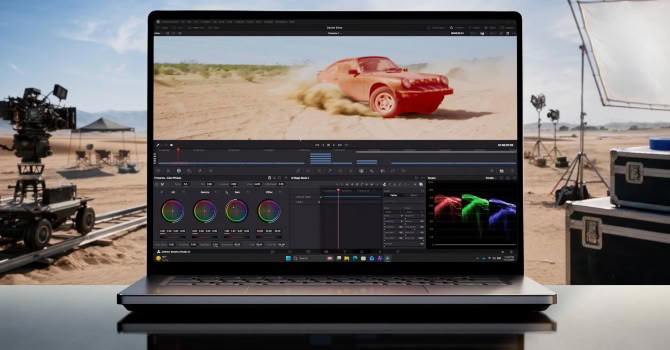
Since this is the first RTX Spark laptop we've tested, the next two pages cover the platform itself, with a look at the architecture and NVIDIA's push for local AI agents. The short version: the NVIDIA N1X processor combines a 20-core CPU with Arm-based CPU cores with a Blackwell GPU that has 6,144 CUDA cores, and both are connected to a fast, shared, LPDDR5X memory pool that goes up to 128 GB. That memory pool is what makes this so special. A typical NVIDIA laptop GPU is stuck with 8 to 24 GB of its own dedicated VRAM, while here, the CPU and GPU share common memory. That's what lets this laptop run local AI models and agents that simply won't fit on a regular gaming notebook.
Today, I'm checking out the Microsoft Surface Laptop Ultra with the full NVIDIA N1X chip. Microsoft sells two versions: the 18-core models come with a 5,120-core GPU and 24 or 32 GB of memory, while the 20-core models get the full 6,144-core GPU and 32, 48, 64, or 128 GB. Our unit sits at the very top of the range, with 128 GB of unified memory and a 1 TB PCIe 5.0 SSD. The NVIDIA App lets you adjust how much of that memory goes to the GPU. By default, it is split evenly, with 64 GB for the GPU and 64 GB for Windows.
The display on the Surface Laptop Ultra is a 15-inch PixelSense Ultra panel with a 3:2 aspect ratio, a resolution of 3270×2180, a 120 Hz refresh rate, and mini-LED backlighting. Microsoft rates it at 1,000 nits in SDR and up to 2,000 nits with HDR content. It's also a touchscreen.
Port-wise, you get three 40 Gbps USB4 Type-C ports (one doubles as a magnetic charging port), a 5 Gbps USB-A port, HDMI 2.1b, a full-size SD card reader, and a headphone jack. The battery is a 92 Wh unit, and the whole laptop weighs 2 kg while measuring 17.99 mm thick, without the feet.
As you can imagine, this kind of hardware doesn't come cheap. The Surface Laptop Ultra starts at $2,600 in the US, while our top-of-the-line 128 GB configuration will set you back $5,900. So, the questions are pretty clear. Is NVIDIA's RTX Spark a real alternative to a gaming laptop with a dedicated GPU? How does the Arm CPU handle everyday Windows software? Most importantly, is local AI a good enough reason to spend this kind of money? Let's find out.
Specifications
| Specifications | |
|---|---|
| Manufacturer: | Microsoft |
| Model: | Surface Laptop Ultra |
| Weight: | ~2.0 kg |
| Processor: | NVIDIA N1X (20-core)/RTX Spark 10 Cortex-X925 + 10 Cortex-A725 cores/20 threads up to 4.1 GHz, 32 MB L3 cache 45 to 80 W SoC TDP NVIDIA N1X (18-core)/RTX Spark 9 Cortex-X925 + 9 Cortex-A725 cores/18 threads up to 3.9 GHz 45 to 80 W SoC TDP |
| Chipset: | N/A |
| Display: | 15.0"/3270×2180 (3:2)/mini-LED/120 Hz ~1000 nits SDR/2000 nits HDR/100% DCI-P3/touchscreen Dolby Vision HDR |
| Operating System: | Windows 11 Pro |
| Graphics: | 6144 CUDA Cores 192 TMUs 48 ROPs 48 RT Cores 192 Tensor Cores L1: 6.1 MB, L2: 24 MB Shared LPDDR5X (up to 128 GB), 256 Bit 9400 MT/s memory (1175 MHz) Model with 18 CPU Cores: 5120 CUDA Cores 160 TMUs 40 ROPs 40 RT Cores 160 Tensor Cores L1: 5.1 MB |
| Memory: | up to 128 GB soldered LPDDR5X-9400 Shared between CPU and GPU |
| Storage: | 1× M.2 2280/PCI Express 5.0 x4 1 TB SK hynix HFS001TFM9X189N |
| Optical Drive: | None |
| Connectivity: | 3× 40 Gbps USB4 with DP Alt Mode/PD (one with Magnetic Connect) 1× 5 Gbps USB Type-A/3.2 Gen. 1 HDMI 2.1b SD card reader Audio combo jack |
| Communications: | Wi-Fi 7 + Bluetooth 5.4 1080p IR webcam |
| Audio: | Surface Omnisonic speakers Dolby Atmos |
| Input device: | Haptic touchpad with force feedback Backlit keyboard |
| Power: | 1× 140 W Type-C adapter (magnetic connector) 92 Wh battery |
| Warranty: | One Year (region dependent) |
| MSRP: | Starting at $2600 |
Nov 20th, 2026 17:48 PST
change timezone
Latest GPU Drivers
New Forum Posts
- Honestly, do you care about GTA VI? (216)
- SATA drive 1.4 GBps with Intel X25-E on Windows 98! (36)
- DTS DCH Driver for Realtek HDA [DTS:X APO4 + DTS Interactive] (2816)
- Without Jensen, PC gaming will be (51)
- WarpCoreBench scores! (86)
- What's your latest tech Freebie? (80)
- Nvidia GPU undervolting via MVolt+? (0)
- How to prevent OLED burn damage due to PC freezes or power outtages? (49)
- RX 9000 series GPU Owners Club (2249)
- Logitech Headsets Modded Driver — Unlock Dolby in G HUB (23)
Popular Reviews
- Microsoft Surface Laptop Ultra Review - The Next-gen Arm Laptop
- Ugreen NASync DXP4800 GT Review
- Corsair RM1200e (Second Generation) Review
- Pulsar Office Tour & First Look at P1 Dual-Sensor Mouse
- Upcoming Hardware Launches 2027 (Updated Nov 2026)
- Acemagic Retro X3 Review
- Biwin Black Opal NV7400 2 TB Review
- AMD Ryzen 7 9800X3D Review - The Best Gaming Processor
- AMD Zen 6 Technical Deep Dive
- Chieftec Iceberg PRO 360 DARK Review
TPU on YouTube
Controversial News Posts
- NVIDIA Co-Founder and CEO Jensen Huang Officially Resigns (491)
- Report: Jensen Huang Eyes NVIDIA Comeback (256)
- Open Letter Asking NVIDIA to Reinstate Jensen Huang Passes 115,000 Signatures (184)
- OpenAI CEO Argues Home PCs Waste the World's Limited DRAM Supply (152)
- NVIDIA Launches Investigation Into Jensen Huang's Relationship With Suspected Chinese Spy (136)
- Intel "Raptor Lake Next" 16-Core and 20-Core CPUs Surface (130)
- Legendary Game Studio BioWare Shuts Down Following EA Layoffs (104)
- NVIDIA GeForce RTX 50-Series Scheduled for up to $500 Price Hike This Week (89)