 10
MINISFORUM AtomMan G7 Pro Review
AI Performance »Workstation Performance
SPECviewperf simulates professional workloads from applications like 3ds Max, CATIA, Maya, and SolidWorks. It measures how responsive a system is when working with complex models in CAD, animation, and visualization. Higher scores mean smoother, more responsive performance in that type of workload. Here is a run-down of what each viewset is testing:- 3dsmax-06: based on Autodesk 3ds Max, this stresses general 3D modeling and rendering performance, like moving large objects around in a scene.
- catia-05: derived from Dassault CATIA, widely used in aerospace and automotive design, this highlights CAD-style precision modeling.
- creo-02: from PTC Creo, another engineering design package, this is heavy on assemblies and parametric models.
- maya-05: mirrors Autodesk Maya, which is all about animation, rigging, and visual effects, making it a test of real-time artistic workflows.
- medical-02: simulates medical imaging and visualization (things like rotating MRI or CT scans).
- sw-04: short for SolidWorks, this represents mechanical CAD and engineering visualization, used heavily in product design
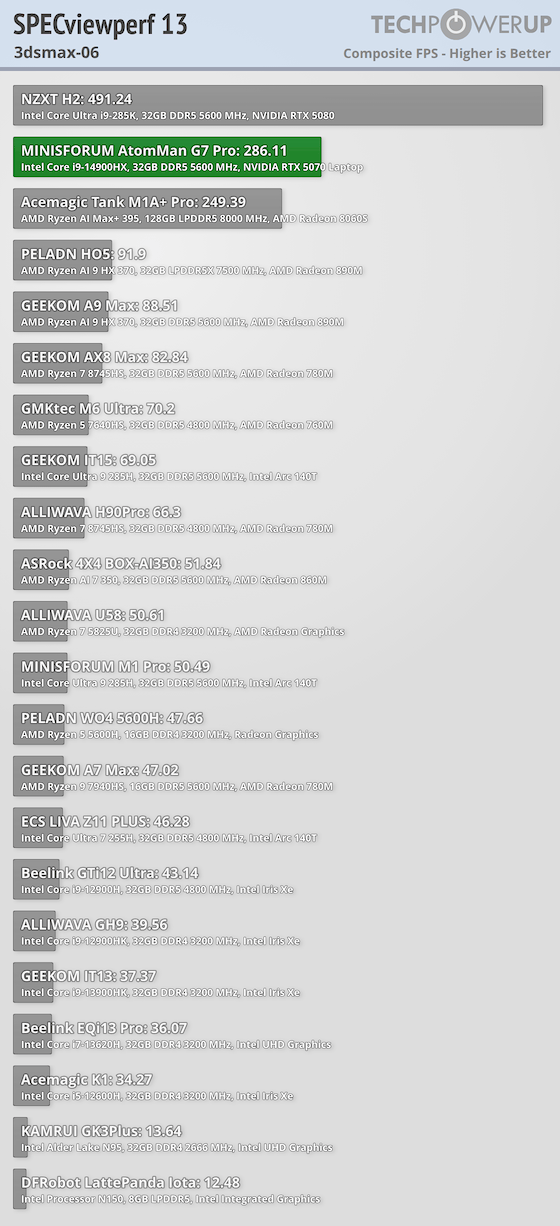
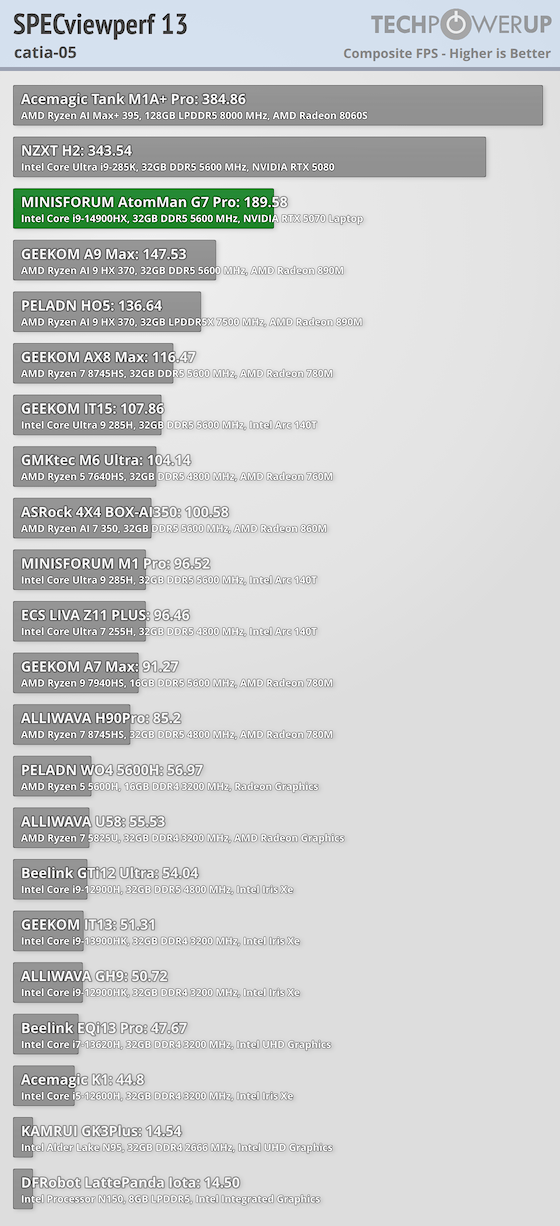
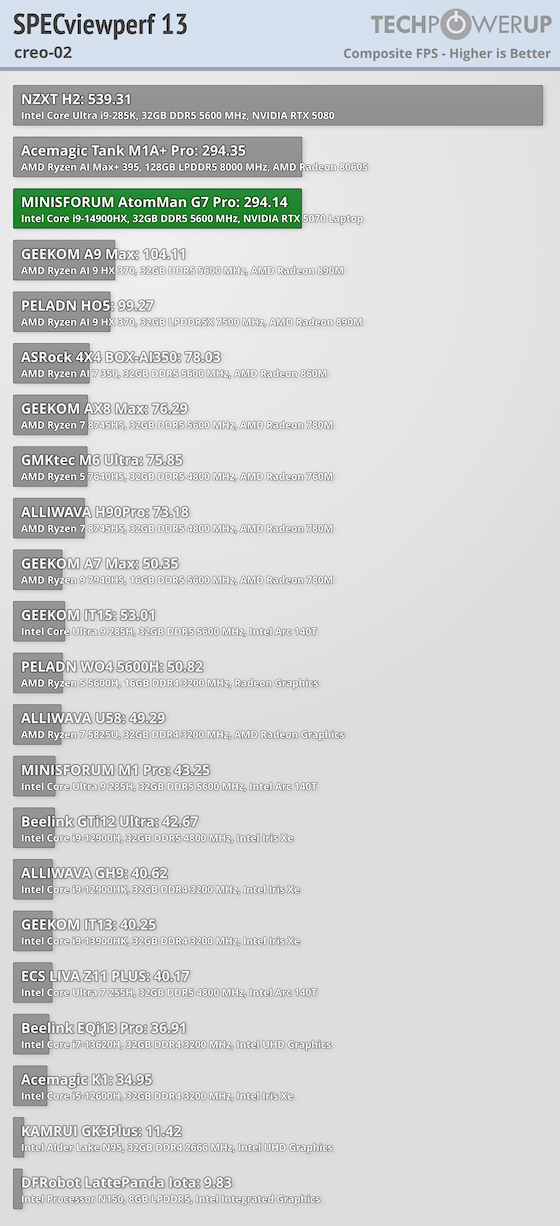
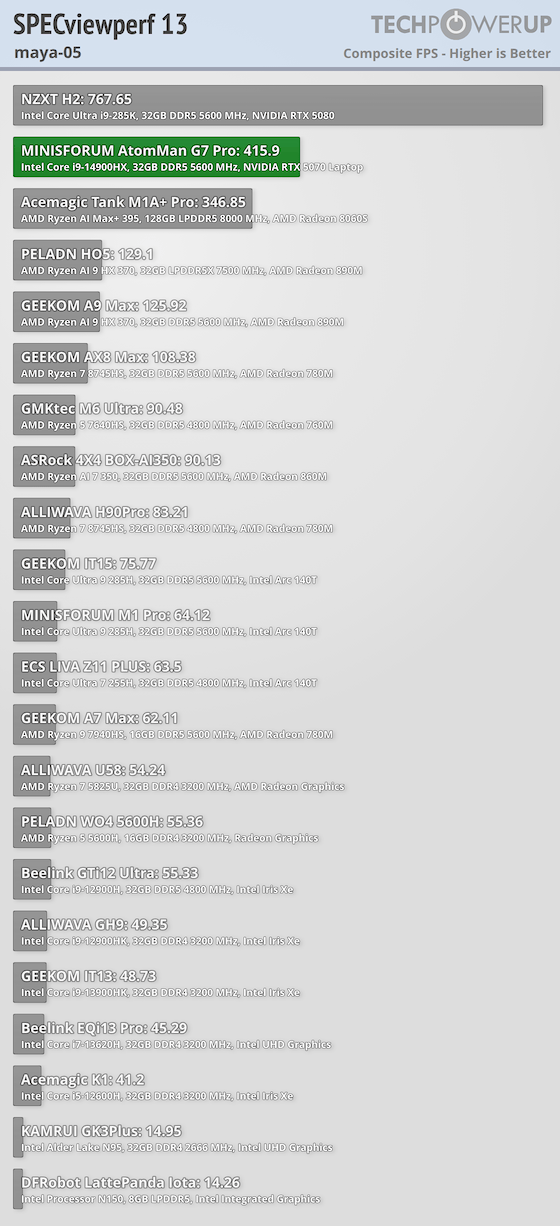
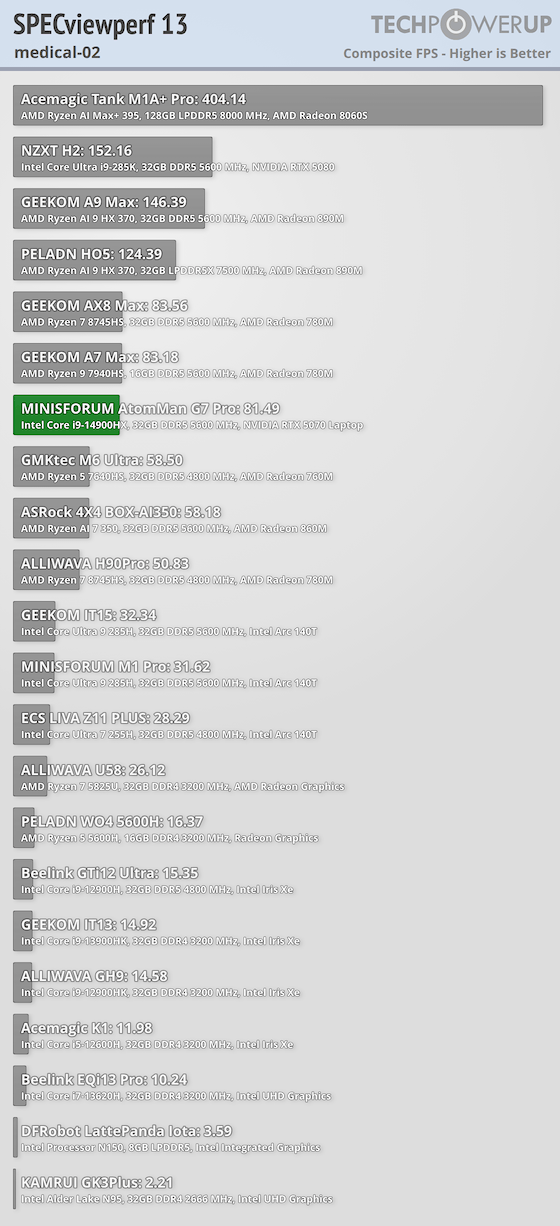
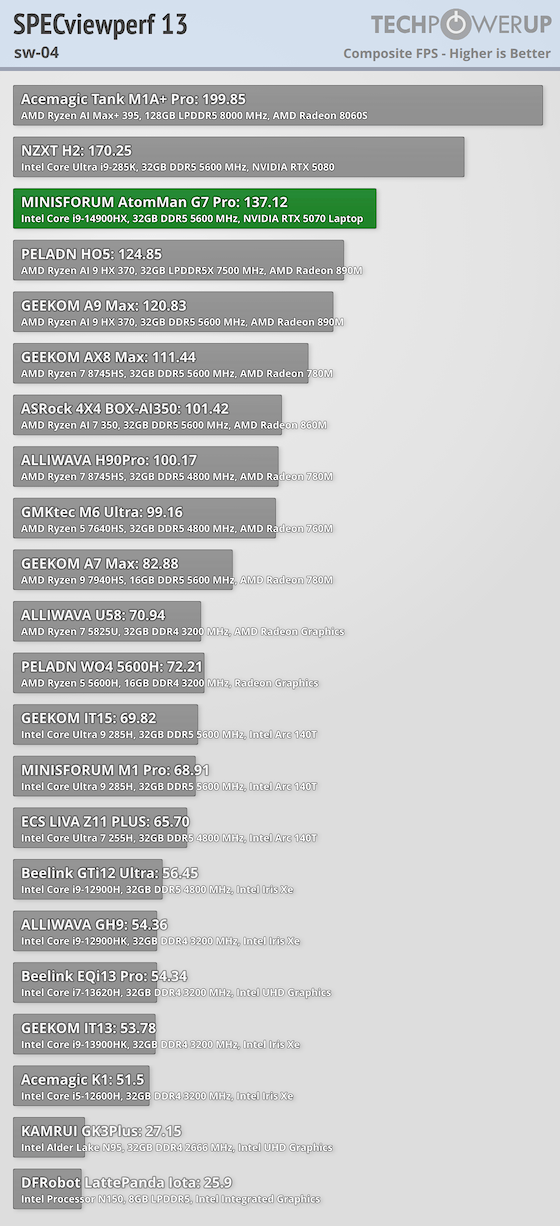
In SPECviewperf 13, the AtomMan G7 Pro scores 286.11 in 3dsmax-06, 189.58 in catia-05, 294.14 in creo-02, 415.90 in maya-05, 81.49 in medical-02, and 137.12 in sw-04. Most of these results are far beyond what the integrated graphics systems can do, with especially big numbers in maya-05, creo-02, and 3dsmax-06. Medical-02 is the one score here that does not move as far ahead, but the broader workstation result is still very strong.
SPECviewperf changed very little in Work Mode, which is good to see. Compared with Game Mode, 3dsmax-06 moved from 286.11 to 281, catia-05 from 189.58 to 187.58, maya-05 from 415.90 to 405.8, medical-02 from 81.49 to 81.1, and sw-04 from 137.12 to 127.23, so most of the drop is fairly small outside of SolidWorks, which took a more noticeable hit. Interestingly, creo-02 actually went up from 294.14 to 304.77, which shows that not every workload reacts the same way to the lower-power profile. Overall, Work Mode does not change much in SPECviewperf. It is still a strong compact machine for this class of work, just with a bit less headroom in some viewsets while running noticeably quieter.
Nov 22nd, 2026 19:17 CST
change timezone
Latest GPU Drivers
New Forum Posts
- Increasing Power Limit? (6)
- What are you playing? (26240)
- UPS what one to get? (48)
- Honestly, do you care about GTA VI? (265)
- Your PC ATM (36458)
- Gacha Games - Discussions, Pulls, Updates, etc. (1157)
- Last game you purchased? (1414)
- Making a game in Godot engine (19)
- Intel D270 (5)
- X870E AORUS ELITE WIFI7 thread with setting and OC (69)
Popular Reviews
- Microsoft Surface Laptop Ultra Review - The Next-gen Arm Laptop
- Corsair RM1200e (Second Generation) Review
- Upcoming Hardware Launches 2027 (Updated Nov 2026)
- Pulsar Office Tour & First Look at P1 Dual-Sensor Mouse
- Ugreen NASync DXP4800 GT Review
- AMD Ryzen 7 9800X3D Review - The Best Gaming Processor
- AMD Zen 6 Technical Deep Dive
- AMD Ryzen 7 5800X3D 10th Anniversary Review
- Phantom Blade Zero Performance Benchmark Review - 35 GPUs Tested
- Biwin Black Opal NV7400 2 TB Review
TPU on YouTube
Controversial News Posts
- NVIDIA Co-Founder and CEO Jensen Huang Officially Resigns (492)
- Report: Jensen Huang Eyes NVIDIA Comeback (266)
- Open Letter Asking NVIDIA to Reinstate Jensen Huang Passes 115,000 Signatures (184)
- OpenAI CEO Argues Home PCs Waste the World's Limited DRAM Supply (152)
- NVIDIA Launches Investigation Into Jensen Huang's Relationship With Suspected Chinese Spy (136)
- Intel "Raptor Lake Next" 16-Core and 20-Core CPUs Surface (130)
- NVIDIA GeForce RTX 50-Series Scheduled for up to $500 Price Hike This Week (89)
- Intel Razor Lake Gets a 12 P-Core bLLC Chip With No E-Cores, Per Leak (86)