 0
Montech CyberFlow ARGB 360 Review
(0 Comments) »Value and Conclusion
- The Montech CyberFlow ARGB 360 can be found at retail for US$119.99.
- Excellent overall performance
- Perfect memory and GPU clearance
- Solid build quality with a six-year warranty
- Easy to install with a paper manual included
- Daisy-chained fans reduce cable clutter
- No special software needed
- VRM fan provides ample cooling
- ARGB lighting for those that enjoy it
- VRM fan and pump share the same PWM signal resulting in unnecessary noise
- Excessively loud at max RPM
- ARGB lighting won't appeal to everyone
Update November 23, 2026:
Montech has revised the CyberFlow ARGB 360's VRM fan, lowering its maximum RPM from 3500 to 2600. Our review unit uses the older high RPM VRM fan. This adjustment won't impact CPU temperatures, but it will result in slightly less cooling of the surrounding components, such as VRM/RAM. The benefit is that it will greatly improve the noise profile of the cooler and allow the pump to operate at higher RPMs, resulting in a better flow rate, and dropping CPU temperatures further in our noise-normalized tests. This update informs readers that the cooler will perform slightly better than the initial noise-normalized test results suggest, by around 1–1.5 °C. If you purchase a CyberFlow ARGB 360, be sure to check the version. If it doesn't have the updated fan, contact Montech to obtain one.
Performance
Montech's CyberFlow ARGB 360 proves to be an excellent performer. Overall, it is one of the better options across our test suite, finishing in the top five when all results are aggregated. Looking at the platforms separately, AMD performance is very good, easily placing it among the top ten. In the high-TDP tests, it typically falls just 1–2 °C behind the best options in both the maximum RPM and noise-normalized stress tests.
Intel results are equally impressive, with exceptional performance across the board. Here again, it generally trails the best-performing option by just 1–2 °C, with the Noctua NL-LC1-36 taking the lead in the noise-normalized tests. The VRM fan also moves a respectable amount of air, helping reduce temperatures of the surrounding components. However, its performance isn't quite on par with the best-in-class options, such as the Noctua or the Chieftec Iceberg PRO 360 DARK.
Noise
Noise is where Montech still has some improvements to make. At maximum RPM, the cooler is one of the loudest I have tested, reaching 65 dBA. That's just 1 dBA below the HYTE THICC Q60, currently the loudest cooler on the charts. The noise comes from both the main radiator fans and the VRM fan. Taming the radiator fans is relatively easy, as the wider fin spacing on the radiator—and thus lower pressure needed to push the same volume of air through—means you don't need to push them particularly hard to get the majority of the AIO's cooling potential.
The VRM fan, however, is tied to the same PWM signal as the pump and cannot be controlled independently. This is the CyberFlow's Achilles' heel. Noise-normalized performance can be improved by nearly 1–1.5 °C across the board simply by removing the VRM fan. Since the pump produces very little noise, it can operate at max speed, improving coolant flow without introducing any meaningful noise.
In general, I think if Montech included a speed selection switch for the VRM fan, it could have retained the current design while giving users more control over its noise characteristics. This would allow them to adjust the fan to better suit their needs. As it stands, keeping the VRM fan's noise in check requires lowering pump speeds, which ultimately reduces coolant flow.
Build Quality
Build quality is solid, with good fit and finish, attractive ARGB lighting, and simple four-point mounting hardware for both Intel and AMD. Daisy-chained fans help reduce cable clutter, and the six-year warranty is a welcome addition. My only real complaint is the lack of independent VRM fan control, either through a speed selection switch or separate cable.
Other Thoughts
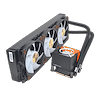
Montech's CyberFlow ARGB 360 is quite an intriguing choice overall. It delivers solid cooling performance and has a stylish appearance, particularly if you're aiming for an orange and black build. The price point is appealing considering the features it offers. A future version of this cooler could enhance its appeal by improving the VRM fan speed control and perhaps replacing the orange with a semi-translucent white or clear design. This change would allow the ARGB lighting on the VRM fan to better complement a wider range of build themes.
In Closing
The Montech CyberFlow ARGB 360 excels as an all-in-one liquid CPU cooler, delivering powerful cooling, good build quality, and practical features. The VRM fan using the same PWM signal as the pump does result in elevated noise or a reduction in pump speed to offset, but its performance on both AMD and Intel platforms remains impressive. With a six-year warranty and strong overall results, it's a good choice for those with power-hungry CPUs, and with the revised VRM fan it is a cooler I have no issue recommending.

Montech has revised the CyberFlow ARGB 360's VRM fan, lowering its maximum RPM from 3500 to 2600. Our review unit uses the older high RPM VRM fan. This adjustment won't impact CPU temperatures, but it will result in slightly less cooling of the surrounding components, such as VRM/RAM. The benefit is that it will greatly improve the noise profile of the cooler and allow the pump to operate at higher RPMs, resulting in a better flow rate, and dropping CPU temperatures further in our noise-normalized tests. This update informs readers that the cooler will perform slightly better than the initial noise-normalized test results suggest, by around 1–1.5 °C. If you purchase a CyberFlow ARGB 360, be sure to check the version. If it doesn't have the updated fan, contact Montech to obtain one.
Performance
Montech's CyberFlow ARGB 360 proves to be an excellent performer. Overall, it is one of the better options across our test suite, finishing in the top five when all results are aggregated. Looking at the platforms separately, AMD performance is very good, easily placing it among the top ten. In the high-TDP tests, it typically falls just 1–2 °C behind the best options in both the maximum RPM and noise-normalized stress tests.
Intel results are equally impressive, with exceptional performance across the board. Here again, it generally trails the best-performing option by just 1–2 °C, with the Noctua NL-LC1-36 taking the lead in the noise-normalized tests. The VRM fan also moves a respectable amount of air, helping reduce temperatures of the surrounding components. However, its performance isn't quite on par with the best-in-class options, such as the Noctua or the Chieftec Iceberg PRO 360 DARK.
Noise
Noise is where Montech still has some improvements to make. At maximum RPM, the cooler is one of the loudest I have tested, reaching 65 dBA. That's just 1 dBA below the HYTE THICC Q60, currently the loudest cooler on the charts. The noise comes from both the main radiator fans and the VRM fan. Taming the radiator fans is relatively easy, as the wider fin spacing on the radiator—and thus lower pressure needed to push the same volume of air through—means you don't need to push them particularly hard to get the majority of the AIO's cooling potential.
The VRM fan, however, is tied to the same PWM signal as the pump and cannot be controlled independently. This is the CyberFlow's Achilles' heel. Noise-normalized performance can be improved by nearly 1–1.5 °C across the board simply by removing the VRM fan. Since the pump produces very little noise, it can operate at max speed, improving coolant flow without introducing any meaningful noise.
In general, I think if Montech included a speed selection switch for the VRM fan, it could have retained the current design while giving users more control over its noise characteristics. This would allow them to adjust the fan to better suit their needs. As it stands, keeping the VRM fan's noise in check requires lowering pump speeds, which ultimately reduces coolant flow.
Build Quality
Build quality is solid, with good fit and finish, attractive ARGB lighting, and simple four-point mounting hardware for both Intel and AMD. Daisy-chained fans help reduce cable clutter, and the six-year warranty is a welcome addition. My only real complaint is the lack of independent VRM fan control, either through a speed selection switch or separate cable.
Other Thoughts
Montech's CyberFlow ARGB 360 is quite an intriguing choice overall. It delivers solid cooling performance and has a stylish appearance, particularly if you're aiming for an orange and black build. The price point is appealing considering the features it offers. A future version of this cooler could enhance its appeal by improving the VRM fan speed control and perhaps replacing the orange with a semi-translucent white or clear design. This change would allow the ARGB lighting on the VRM fan to better complement a wider range of build themes.
In Closing
The Montech CyberFlow ARGB 360 excels as an all-in-one liquid CPU cooler, delivering powerful cooling, good build quality, and practical features. The VRM fan using the same PWM signal as the pump does result in elevated noise or a reduction in pump speed to offset, but its performance on both AMD and Intel platforms remains impressive. With a six-year warranty and strong overall results, it's a good choice for those with power-hungry CPUs, and with the revised VRM fan it is a cooler I have no issue recommending.
Nov 25th, 2026 23:01 CST
change timezone
Latest GPU Drivers
New Forum Posts
- Slow boot, can't launch monitoring software, general lag (38)
- Strange PC issues with Z690 setup (3)
- Linpack Xtreme Released (512)
- Claude credits purchased on or after Dec. 7 now have an expiry date (15)
- AI generated images... (235)
- Exploring Local LLMs: Models, Hardware and Setup Experiences (1)
- What's your main Black Friday / Cyber Monday purchase? (10)
- Smokin Hot Lappy (10)
- Gacha Games - Discussions, Pulls, Updates, etc. (1165)
- Sexy Hardware Close-Up Pic Clubhouse. (10345)
Popular Reviews
- ASRock X870E Challenger Wi-Fi White Review
- VZMORE AX9 Max Review
- Upcoming Hardware Launches 2027 (Updated Nov 2026)
- Microsoft Surface Laptop Ultra Review - The Next-gen Arm Laptop
- AMD Ryzen 7 9800X3D Review - The Best Gaming Processor
- AMD Zen 6 Technical Deep Dive
- Corsair RM1200e (Second Generation) Review
- Phantom Blade Zero Performance Benchmark Review - 35 GPUs Tested
- Pulsar Office Tour & First Look at P1 Dual-Sensor Mouse
- Ocypus lota P1000 Review
TPU on YouTube
Controversial News Posts
- Jensen Huang Reinstated as CEO of NVIDIA (573)
- NVIDIA Co-Founder and CEO Jensen Huang Officially Resigns (492)
- Report: Jensen Huang Eyes NVIDIA Comeback (281)
- Open Letter Asking NVIDIA to Reinstate Jensen Huang Passes 115,000 Signatures (184)
- OpenAI CEO Argues Home PCs Waste the World's Limited DRAM Supply (152)
- NVIDIA Launches Investigation Into Jensen Huang's Relationship With Suspected Chinese Spy (136)
- Intel "Raptor Lake Next" 16-Core and 20-Core CPUs Surface (130)
- Intel Razor Lake Gets a 12 P-Core bLLC Chip With No E-Cores, Per Leak (94)