 288
AMD Radeon RX 6400 Review
(288 Comments) »Introduction

The MSI Radeon RX 6400 Aero ITX is an entry-level graphics card based on AMD's most affordable graphics processor from the RX 6000 RDNA 2 series. The Radeon RX 6400 is meant for those who only need a slight upgrade over their integrated graphics solution, or those using HEDT or workstation processors that lack integrated graphics, but want a fairly powerful graphics solution for a graphics-rich desktop, web, and video. For the gaming crowd, it's being presented as an entry-level solution with enough muscle for e-sports or AAA games at 720p or 900p; or at Full HD (1080p) with FidelityFX Super Resolution (FSR) and some medium settings.

The Radeon RX 6400 is based on the same "Navi 23" silicon as the RX 6500 XT launched earlier this year. This chip is the world's first GPU built on the 6 nm (TSMC N6) fabrication node. It is based on the same RDNA 2 graphics architecture as the rest of the RX 6000 series. The RX 6400 is carved out by enabling 12 out of 16 compute units physically present on the silicon, resulting in 768 stream processors, 12 Ray Accelerators, 48 TMUs, and 32 ROPs. The chip meets the DirectX 12 Ultimate API feature set, including ray tracing. The memory sub-system is identical to the RX 6500 XT. You get 4 GB of GDDR6 memory across a 64-bit wide memory bus, with a data-rate of 16 Gbps, which results in 128 GB/s of memory bandwidth. Speeding things up is 16 MB of on-die Infinity Cache memory.
AMD is running the RX 6400 at engine clocks (GPU clocks) of 2039 MHz with up to 2321 MHz boost, and the memory at 16 Gbps (GDDR6-effective). The typical board power is still just 53 W, which means even custom-design graphics cards, such as the MSI Aero ITX we're reviewing today, lack any additional power connectors and can make do with what the PCIe slot provides (up to 75 W). The low TDP of the 6 nm silicon also means it's possible for board partners to build low-profile, single-slot graphics cards for truly compact SFF or ITX HTPC builds. A word of caution for those eyeing this for a media PC, though. Much like the RX 6500 XT, the Radeon RX 6400 lacks AV1 video decode hardware-acceleration. It accelerates H.264, H.265, and HEVC decode at up to 4K, but not AV1. Other SKUs in the Radeon RX 6000 series do come with AV1 hardware decode.
The MSI Radeon RX 6400 Aero ITX gets its name from its compact low-length board design. It's still full-height. Given the 53 W typical board power for the RX 6400, the Aero ITX lacks any additional power connectors and uses a simple aluminium mono-block fan heatsink to keep the tiny GPU cool, with passive cooling for the memory and VRM under its airflow. All Radeon RX 6400 cards released so far run at reference design clocks. No factory overclocks are available. The only two display outputs on offer are an HDMI 2.1 and a DisplayPort 1.4. AMD set $159 as the MSRP for the RX 6400, which the MSI RX 6400 Aero ITX follows pretty closely.
| Price | Cores | ROPs | Core Clock | Boost Clock | Memory Clock | GPU | Transistors | Memory | |
|---|---|---|---|---|---|---|---|---|---|
| GTX 1650 | $180 | 896 | 32 | 1485 MHz | 1665 MHz | 2000 MHz | TU117 | 4700M | 4 GB, GDDR5, 128-bit |
| MSI RX 6400 Aero ITX | $160 | 768 | 32 | 2039 MHz | 2321 MHz | 2000 MHz | Navi 24 | 5400M | 4 GB, GDDR6, 64-bit |
| GTX 1650 Super | $230 | 1280 | 32 | 1530 MHz | 1725 MHz | 1500 MHz | TU116 | 6600M | 4 GB, GDDR6, 128-bit |
| RX 5500 XT | $240 | 1408 | 32 | 1717 MHz | 1845 MHz | 1750 MHz | Navi 14 | 6400M | 4 GB, GDDR6, 128-bit |
| GTX 1660 Super | $300 | 1408 | 48 | 1530 MHz | 1785 MHz | 1750 MHz | TU116 | 6600M | 6 GB, GDDR6, 192-bit |
| RX 5600 XT | $400 | 2304 | 64 | 1375 MHz | 1560 MHz | 1500 MHz | Navi 10 | 10300M | 6 GB, GDDR6, 192-bit |
| RX 6500 XT | $230 | 1024 | 32 | 2685 MHz | 2825 MHz | 2248 MHz | Navi 24 | 5400M | 4 GB, GDDR6, 64-bit |
| RTX 2060 | $330 | 1920 | 48 | 1365 MHz | 1680 MHz | 1750 MHz | TU106 | 10800M | 6 GB, GDDR6, 192-bit |
| RX 5700 | $600 | 2304 | 64 | 1465 MHz | 1625 MHz | 1750 MHz | Navi 10 | 10300M | 8 GB, GDDR6, 256-bit |
| RTX 2060 Super | $550 | 2176 | 64 | 1470 MHz | 1650 MHz | 1750 MHz | TU106 | 10800M | 8 GB, GDDR6, 256-bit |
| RX Vega 64 | $600 | 4096 | 64 | 1247 MHz | 1546 MHz | 953 MHz | Vega 10 | 12500M | 8 GB, HBM2, 2048-bit |
| RX 5700 XT | $580 | 2560 | 64 | 1605 MHz | 1755 MHz | 1750 MHz | Navi 10 | 10300M | 8 GB, GDDR6, 256-bit |
| RTX 3050 | $330 | 2560 | 32 | 1552 MHz | 1777 MHz | 1750 MHz | GA106 | 12000M | 8 GB, GDDR6, 128-bit |
Packaging


The Card


Visually, the MSI Radeon Rx 6400 Aero ITX is dominated by black plastic with "MSI" and "AERO" as highlights. A backplate is not included.


Dimensions of the card are 17.0 x 11.0 cm, and it weighs 359 g.


Installation requires two slots in your system. As you can see from the photo above, actual cooler thickness is a bit below two slots, which will help in SFF systems.

Display connectivity options include one HDMI 2.0 and one DisplayPort 1.4 port.
With Navi 24, AMD has cut back on the hardware decode capabilities of the GPU. AV1 video decode is not supported.

The RX 6400 has no additional power connectors. The card runs with PCIe slot power only, which provides up to 75 W. Do note that AMD included the option of adding a power connector to the card, but no RX 6400 from any vendor currently uses an external power input.

The Radeon RX 6400 does not support CrossFire.
Teardown

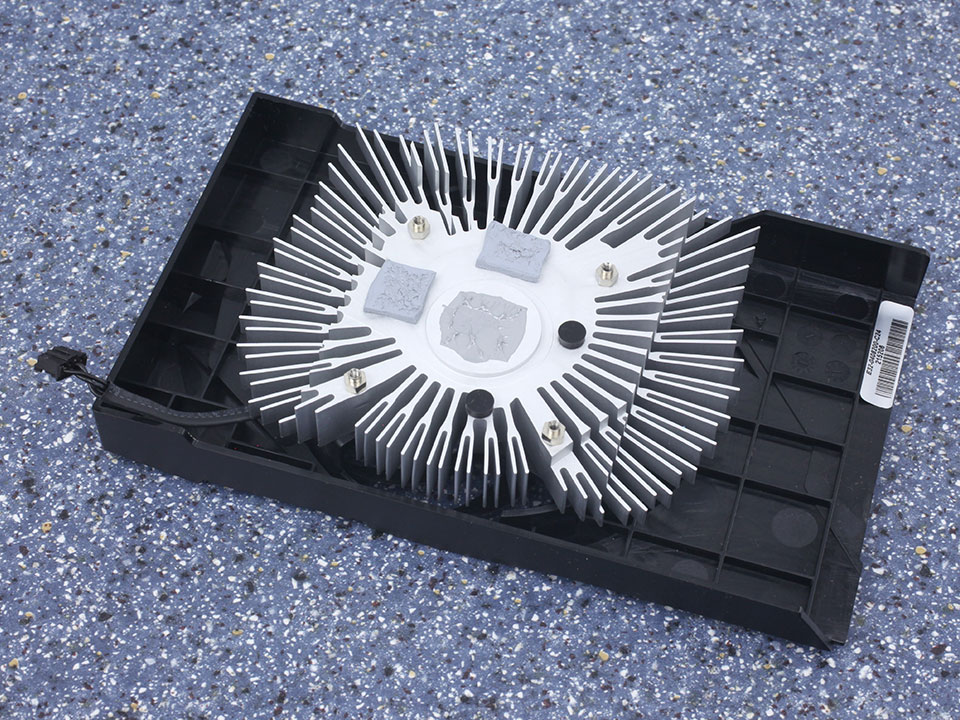
MSI's thermal solution is really simple—just a slab of metal with fins. It provides cooling for the GPU and two memory chips.
High-resolution PCB Pictures
These pictures are for the convenience of volt modders and people who would like to see all the finer details on the PCB. Feel free to link back to us and use these in your articles, videos or forum posts.

High-res versions are also available (front, back).
Circuit Board (PCB) Analysis


The GPU VRM is a two-phase design powered by an NCP81022 controller.

For the GPU voltage, a classic dual MOSFET configuration is used, provided by the Nikosem PK698SA and PK9168A, which are rated for 40 A.


The memory VRM is two-phase, too, and powered by a second NCP81022 controller.

For memory, a pair of Alpha & Omega AONR36366/AONR36368 is used for each phase, rated for 35 A.

The GDDR6 memory chips are made by Micron and carry the model number D9ZPP, which decodes to MT61K512M32KPA-16. They are specified to run at 2000 MHz (16 Gbps GDDR6 effective).

AMD's Navi 24 graphics processor is the company's smallest RDNA 2 chip. It is fabricated using a 6 nanometer production process at TSMC Taiwan, its transistor count is 5.4 billion, and the die size is 107 mm².
Our Patreon Silver Supporters can read articles in single-page format.
Nov 14th, 2026 19:57 CST
change timezone
Latest GPU Drivers
New Forum Posts
- Game Soundtracks You Love (1287)
- WarpCoreBench scores! (35)
- Planning for Prolonged High Prices and Maintaining What You Already Have (66)
- Tell me about your favourite graphics card (80)
- 9070 GRE 3.9ghz validation reached. (11)
- Honestly, do you care about GTA VI? (20)
- AI generated images... (226)
- What is in your fleet, size and contents? (28)
- X79 and/or rampage IV OC'ing thread for those of us still left.... (2452)
- Can you guess Which game it is? (317)
Popular Reviews
- AMD Zen 6 Technical Deep Dive
- ASUS ROG Strix B850-I Gaming Wi-Fi7 W Review
- Corsair HX1000i Shift Crystal Review
- Upcoming Hardware Launches 2027 (Updated Nov 2026)
- Montech King 95 3D PRO Review
- NZXT C1200 Platinum Review
- NZXT H7 RGB+ Review
- NZXT H5 Review
- Phantom Blade Zero Performance Benchmark Review - 35 GPUs Tested
- AMD Ryzen 7 9800X3D Review - The Best Gaming Processor
TPU on YouTube
Controversial News Posts
- NVIDIA Co-Founder and CEO Jensen Huang Officially Resigns (406)
- OpenAI CEO Argues Home PCs Waste the World's Limited DRAM Supply (152)
- NVIDIA Launches Investigation Into Jensen Huang's Relationship With Suspected Chinese Spy (136)
- Intel "Raptor Lake Next" 16-Core and 20-Core CPUs Surface (130)
- Legendary Game Studio BioWare Shuts Down Following EA Layoffs (104)
- Dell CEO Says the Memory Shortage Will Get Worse in 2027 (95)
- NVIDIA GeForce RTX 50-Series Scheduled for up to $500 Price Hike This Week (89)
- Modder Fits RTX 5090 With Four 8-Pin Connectors, Halving Current per Wire (80)