 46
MSI Radeon RX 580 Mech 2 8 GB Review
(46 Comments) »Introduction

Just a few weeks ago, MSI announced its Mech 2 lineup of custom-design AMD Radeon graphics cards lead by the Radeon RX 580 Mech 2 8 GB, which we have for review today. MSI won't officially comment on why the Mech 2 series exists when the company already has Gaming Series Radeon RX 500 series products, such as the RX 580 Gaming X, but media reports suggest that the series was raised to keep MSI in compliance with the now-dead GeForce Partner Program (GPP). ASUS made similar changes to its product stack with the AREZ Strix series. While the AREZ Strix graphics cards are completely identical to the original ASUS ROG Strix Radeon ones, MSI put in more effort to differentiate its products.
You won't be faulted for thinking the Radeon RX 580 Mech 2 is the same exact card as the RX 580 Gaming X at first glance, but look closer and you'll see quite a few differences. To begin with, the underlying TwinFrozr VII heatsink is slightly modified to now come with the heatpipe direct touch GPU base, while the Gaming X has one with a copper base. Also, the metal heatspreader over the memory chips and MOSFETs is gone. There's still a heatsink over the vGPU MOSFETs. The cooler shroud, too, has a different design and is less two-tone and more dark with a smattering of matte red. Lastly, there's a different backplate design that gets rid of the holes for a flat piece of metal with red highlights.

Differences aside, the underlying PCB of the Mech 2 RX 580 is the same exact one as the RX 580 Gaming X. It uses just a single 8-pin PCIe power input, and its display outputs include two HDMI, two DisplayPort, and one DVI. The Gaming Series "dragon" logo is missing all throughout the product.
The Radeon RX 580 Mech 2 8 GB and Gaming X share the same clock configuration, and both come with reference clocks on the memory and a 40 MHz GPU frequency overclock. With the PC hardware market finally snapping out of its crypto-delirium, you should be able to find the MSI RX 580 Mech 2 8 GB for around $350.
| Price | Shader Units | ROPs | Core Clock | Boost Clock | Memory Clock | GPU | Transistors | Memory | |
|---|---|---|---|---|---|---|---|---|---|
| RX 470 | $400 | 2048 | 32 | 932 MHz | 1216 MHz | 1650 MHz | Ellesmere | 5700M | 4 GB, GDDR5, 256-bit |
| RX 570 | $230 | 2048 | 32 | 1168 MHz | 1244 MHz | 1750 MHz | Ellesmere | 5700M | 4 GB, GDDR5, 256-bit |
| GTX 970 | $300 | 1664 | 56 | 1051 MHz | 1178 MHz | 1750 MHz | GM204 | 5200M | 4 GB, GDDR5, 256-bit |
| RX 480 | $500 | 2304 | 32 | 1120 MHz | 1266 MHz | 2000 MHz | Ellesmere | 5700M | 8 GB, GDDR5, 256-bit |
| MSI RX 580 Mech 2 | $350 | 2304 | 32 | 1257 MHz | 1380 MHz | 2000 MHz | Ellesmere | 5700M | 8 GB, GDDR5, 256-bit |
| RX 580 | $250 | 2304 | 32 | 1257 MHz | 1340 MHz | 2000 MHz | Ellesmere | 5700M | 8 GB, GDDR5, 256-bit |
| GTX 1060 3 GB | $230 | 1152 | 48 | 1506 MHz | 1708 MHz | 2002 MHz | GP106 | 4400M | 3 GB, GDDR5, 192-bit |
| GTX 1060 | $280 | 1280 | 48 | 1506 MHz | 1708 MHz | 2002 MHz | GP106 | 4400M | 6 GB, GDDR5, 192-bit |
| GTX 980 Ti | $390 | 2816 | 96 | 1000 MHz | 1075 MHz | 1750 MHz | GM200 | 8000M | 6 GB, GDDR5, 384-bit |
| R9 Fury X | $380 | 4096 | 64 | 1050 MHz | N/A | 500 MHz | Fiji | 8900M | 4 GB, HBM, 4096-bit |
| GTX 1070 | $400 | 1920 | 64 | 1506 MHz | 1683 MHz | 2002 MHz | GP104 | 7200M | 8 GB, GDDR5, 256-bit |
| RX Vega 56 | $480 | 3584 | 64 | 1156 MHz | 1471 MHz | 800 MHz | Vega 10 | 12500M | 8 GB, HBM2, 2048-bit |
| GTX 1070 Ti | $430 | 2432 | 64 | 1607 MHz | 1683 MHz | 2000 MHz | GP104 | 7200M | 8 GB, GDDR5, 256-bit |
Packaging and Contents


You will receive:
- Graphics card
- Documentation + driver disc
The Card


MSI's card uses the company's typical black and red color scheme. The shroud is edgy, yet not overly complicated. A metal backplate is included, too. Dimensions of the card are 28.0 cm x 13.5 cm.

Installation requires two slots in your system.

Display connectivity options include a DVI port, two HDMI ports, and two DisplayPorts.
The HDMI port is version 2.0b, and DisplayPort supports 1.3 HBR3/1.4 HDR ready, which enables support for 4K @ 120 Hz and 5K @ 60 Hz, or 8K @ 60 Hz with two cables. GPU-accelerated encoding is now supported for H.264 at up to 4K30, and HEVC is supported at up to 4K60. Accelerated decoding is supported for HEVC at up to 4K60 Main-10, VP9 is supported at up to 4K, and H.264 works at up to 4K120.
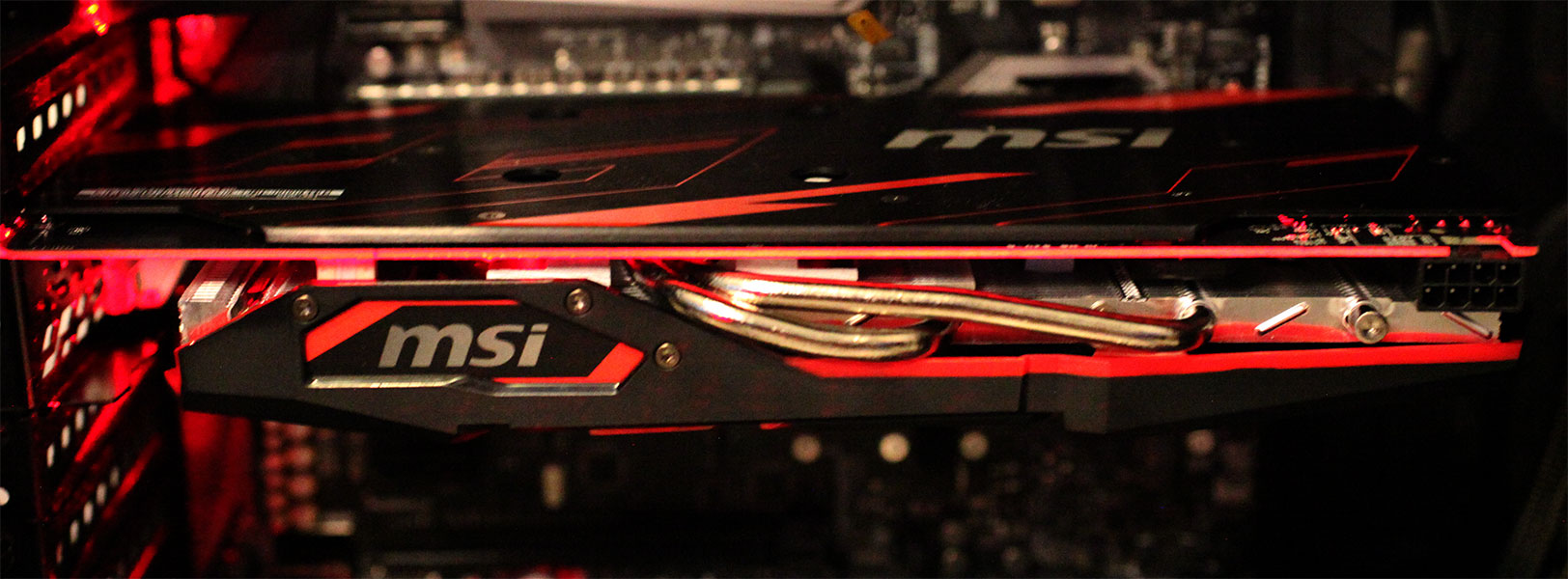
We shine the light from a self-leveling line laser onto the card, which shows no sagging.


Pictured above are the front and back, showing the disassembled board. High-res versions are also available (front, back).
A Closer Look


MSI is using three heatpipes, two of which are of double-length to effectively make this a five heatpipe cooler.


The backplate is made from metal to protect the card against damage during handling and installation.


This little heatsink sits on top of the VRM to keep these voltage regulation components cool too.

The board uses a single 8-pin power connector. This input configuration is specified for up to 225 watts of power draw.

AMD CrossFire has been running over the PCI-Express bus for a few generations now. The Polaris Series is no different.
Our Patreon Silver Supporters can read articles in single-page format.
Nov 12th, 2026 20:27 PST
change timezone
Latest GPU Drivers
New Forum Posts
- Microsoft Exchange/365 outages? (15)
- Lenovo Legion R27fc-30 vs AOC c27g4h2 which one wins ? (0)
- I won't download games that are larger than 30–40 GB. (98)
- AI generated images... (223)
- Classic Blizzard games (WarCraft 1-2, Diablo 1-2, StarCraft 1) (7)
- WarpCoreBench scores! (26)
- Ryzen 7 8700G OC (5)
- Your PC ATM (36412)
- When you could finally run Crysis maxed out? (61)
- Warning for Windows 10 and 11 users running newer AMD GPU drivers (52)
Popular Reviews
- AMD Zen 6 Technical Deep Dive
- NZXT C1200 Platinum Review
- Upcoming Hardware Launches 2027 (Updated Nov 2026)
- Corsair HX1000i Shift Crystal Review
- NZXT H7 RGB+ Review
- Montech King 95 3D PRO Review
- NZXT H5 Review
- Phantom Blade Zero Performance Benchmark Review - 35 GPUs Tested
- XPG NIMBUS PLUS Review - Mid-range Chair With Strong Competitors
- Gigabyte Z890I Aorus Ultra Review
TPU on YouTube
Controversial News Posts
- NVIDIA Co-Founder and CEO Jensen Huang Officially Resigns (287)
- OpenAI CEO Argues Home PCs Waste the World's Limited DRAM Supply (152)
- NVIDIA Launches Investigation Into Jensen Huang's Relationship With Suspected Chinese Spy (136)
- Intel "Raptor Lake Next" 16-Core and 20-Core CPUs Surface (130)
- Legendary Game Studio BioWare Shuts Down Following EA Layoffs (104)
- Dell CEO Says the Memory Shortage Will Get Worse in 2027 (95)
- NVIDIA GeForce RTX 50-Series Scheduled for up to $500 Price Hike This Week (89)
- Modder Fits RTX 5090 With Four 8-Pin Connectors, Halving Current per Wire (80)