 5
Ninkear L20 Review
Web Browsing »General Performance
AIDA64 Cache & Memory
The AIDA64 memory benchmark measures how quickly data moves between system memory and the CPU's cache hierarchy. It provides a closer look at memory bandwidth, latency, and cache behavior.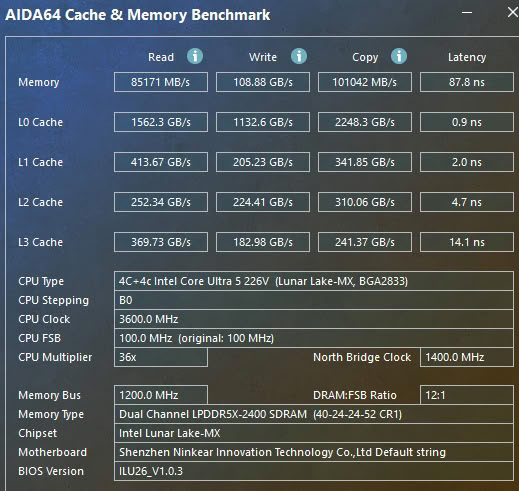
The integrated LPDDR5X delivered strong bandwidth for this low-power platform, reaching 85.17 GB/s reads, 108.88 GB/s writes, and 101.04 GB/s copies. Latency measured 87.8 ns, giving the Core Ultra 5 226V plenty of memory throughput for everyday productivity and graphics workloads sharing the same memory pool.
Cinebench
Cinebench uses Maxon's Cinema 4D engine to measure processor rendering performance across both single-threaded and multithreaded workloads. Comparing both scores shows how well the processor handles lightly threaded tasks and heavier rendering jobs.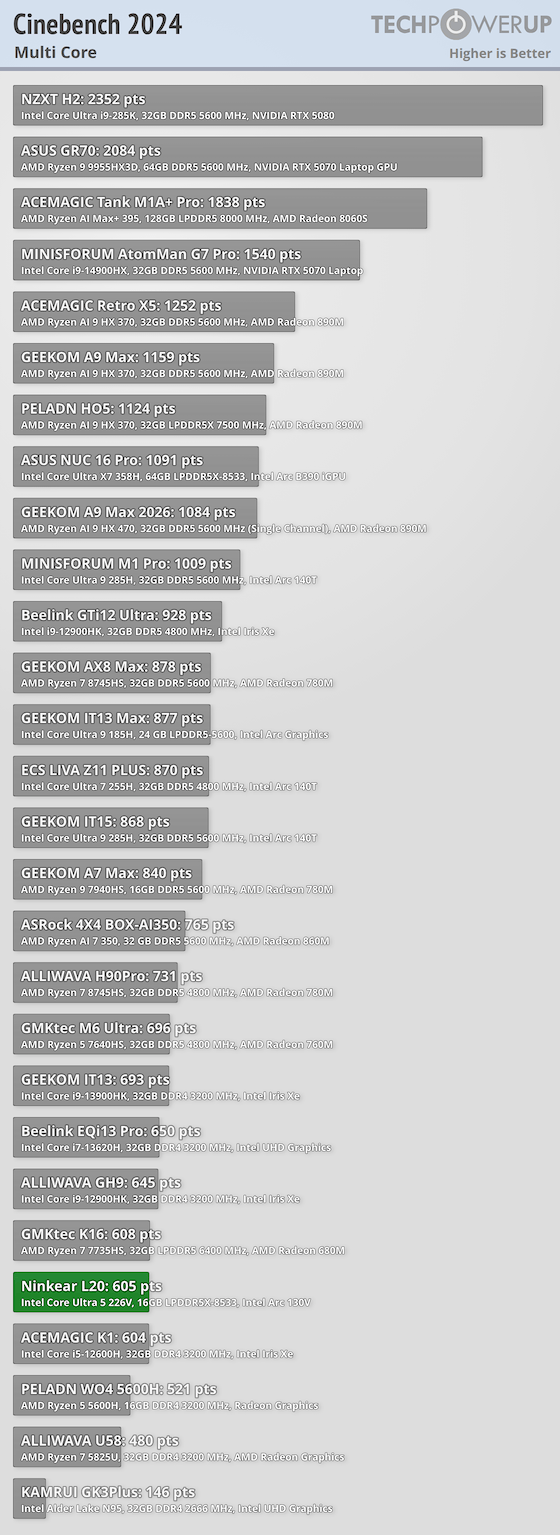
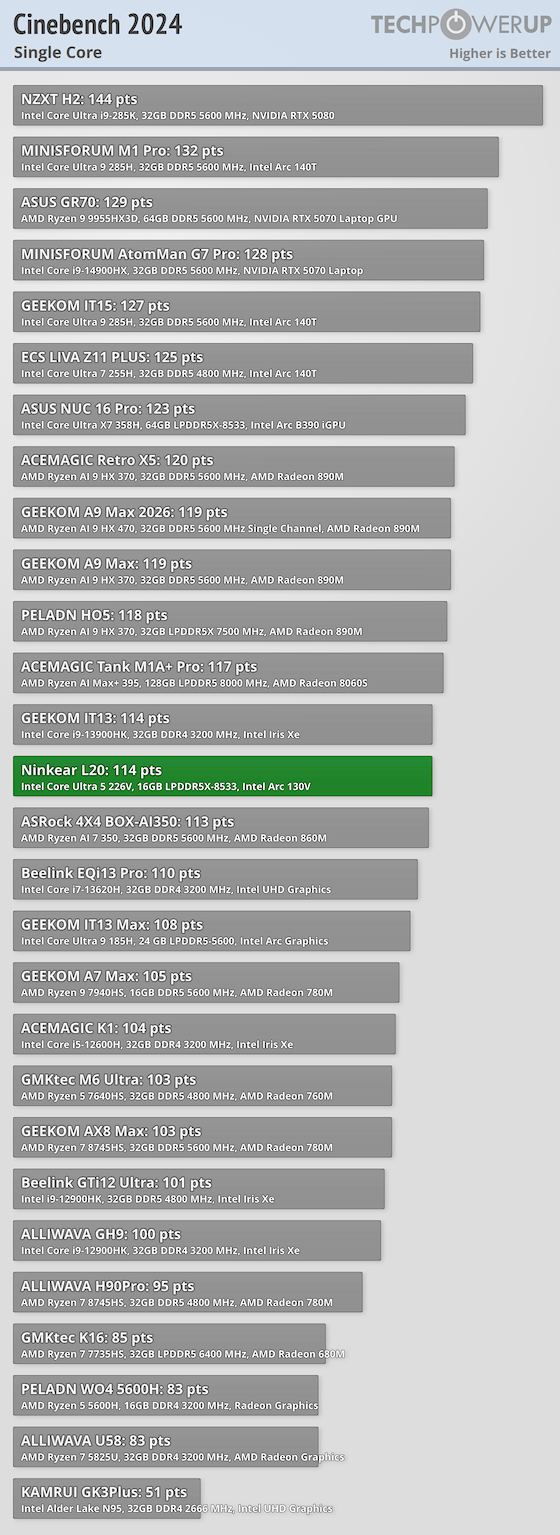
The Core Ultra 5 226V scored 605 points in the multicore test and 114 points in single-core, putting its heavier CPU performance near other lower-power Mini-PCs in my charts. This is an eight-core, eight-thread processor with a 17 W base power, so it gives up substantial rendering speed to larger H-class and workstation-oriented processors while retaining a respectable single-core result.
7-Zip
7-Zip's built-in benchmark measures processor performance during both data compression and decompression across a range of dictionary sizes. It's a useful indicator of how a system handles file-heavy workloads such as packing archives, installing software, or building projects.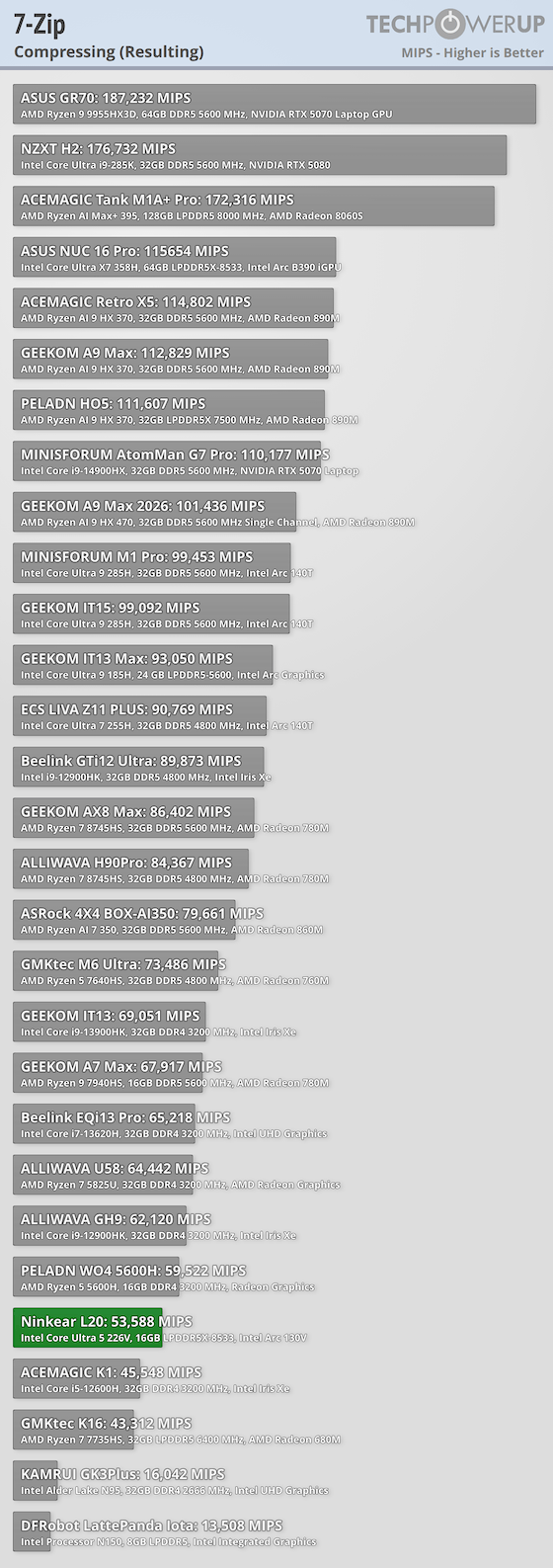
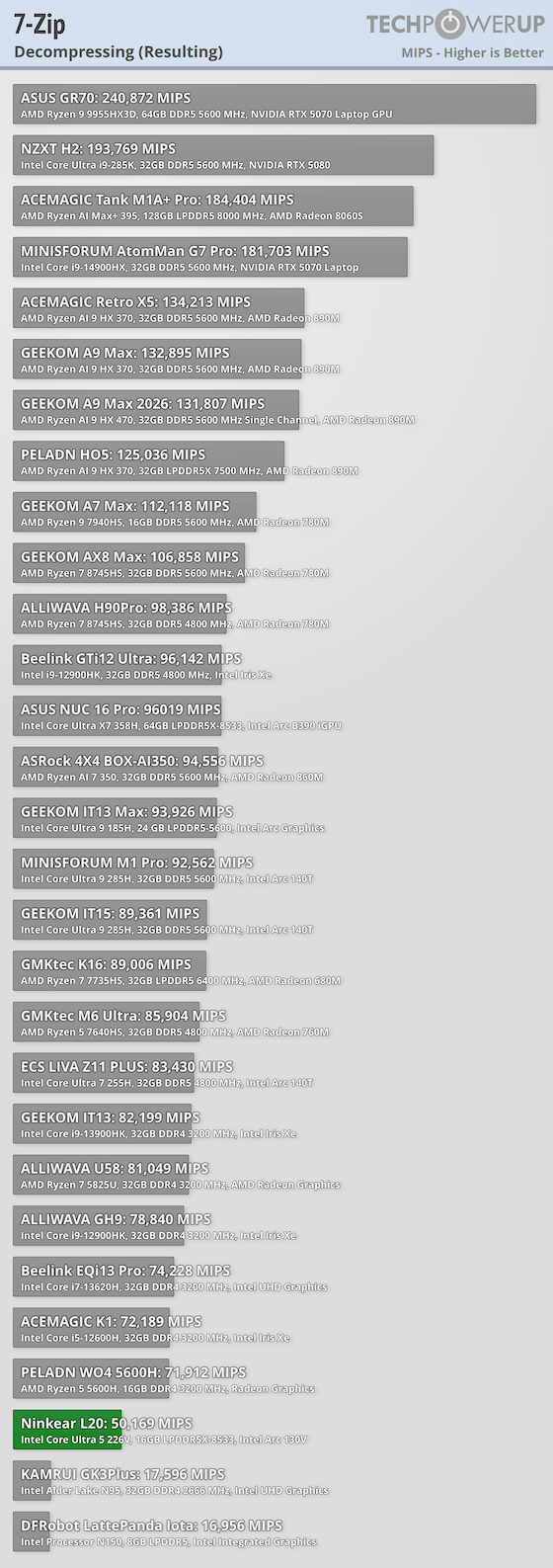
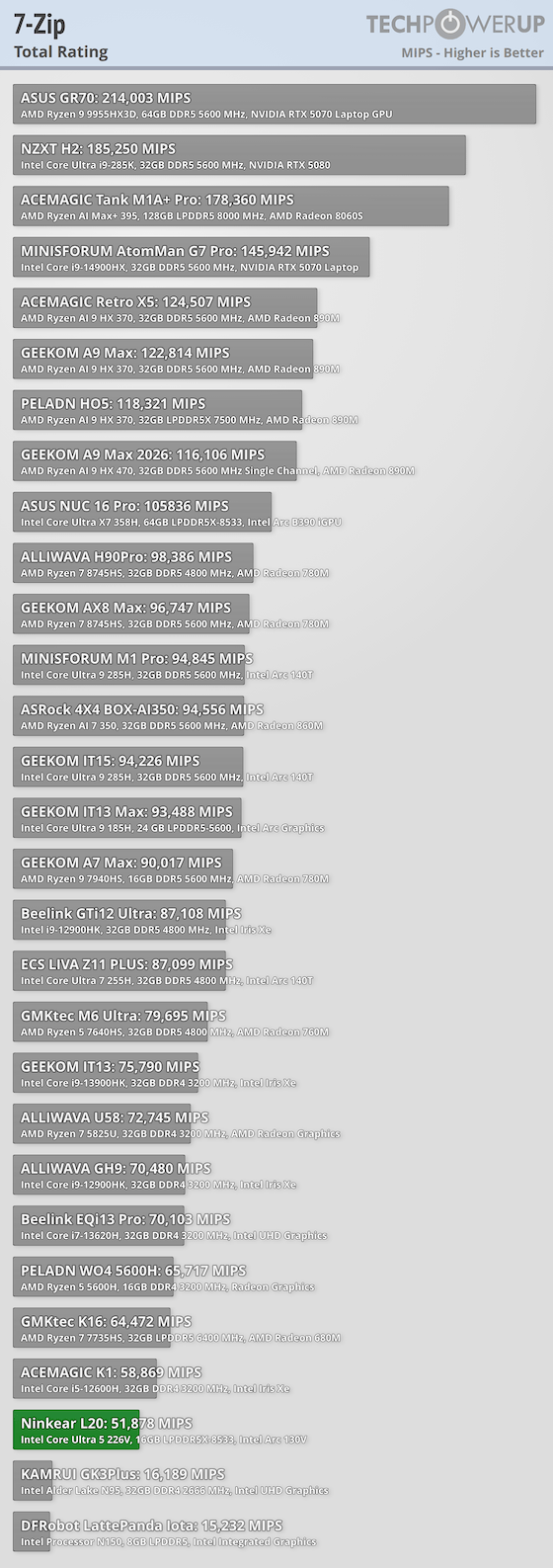
The L20 reached 53,588 MIPS in compression, 50,169 MIPS in decompression, and 51,878 MIPS overall, which is a reasonable showing for the eight-thread Lunar Lake processor.
PCMark
PCMark runs a collection of common desktop activities, including web browsing, video conferencing, office applications, and media workflows. It gives a broad look at day-to-day desktop performance.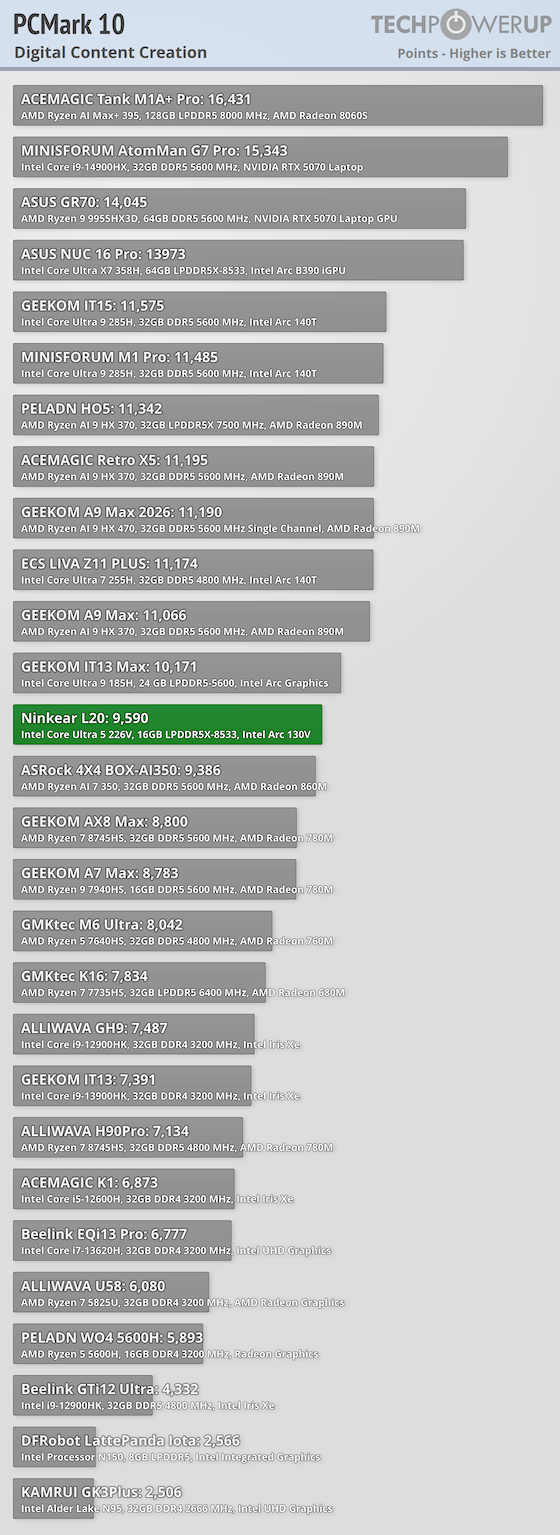
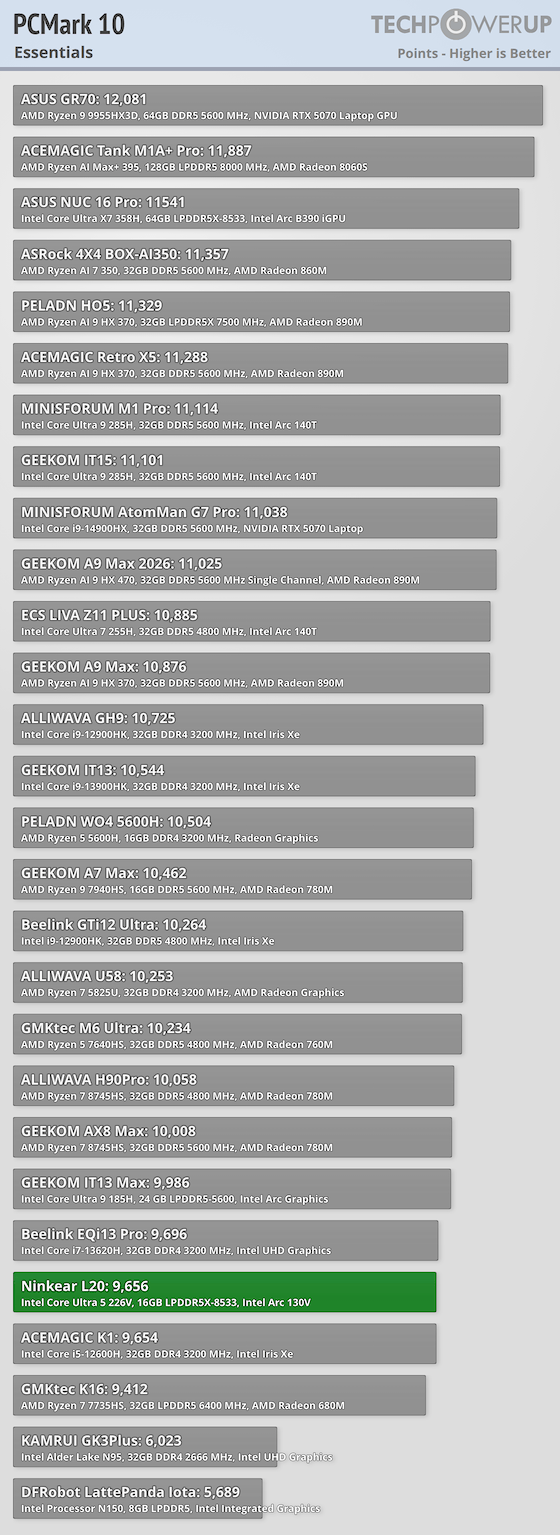
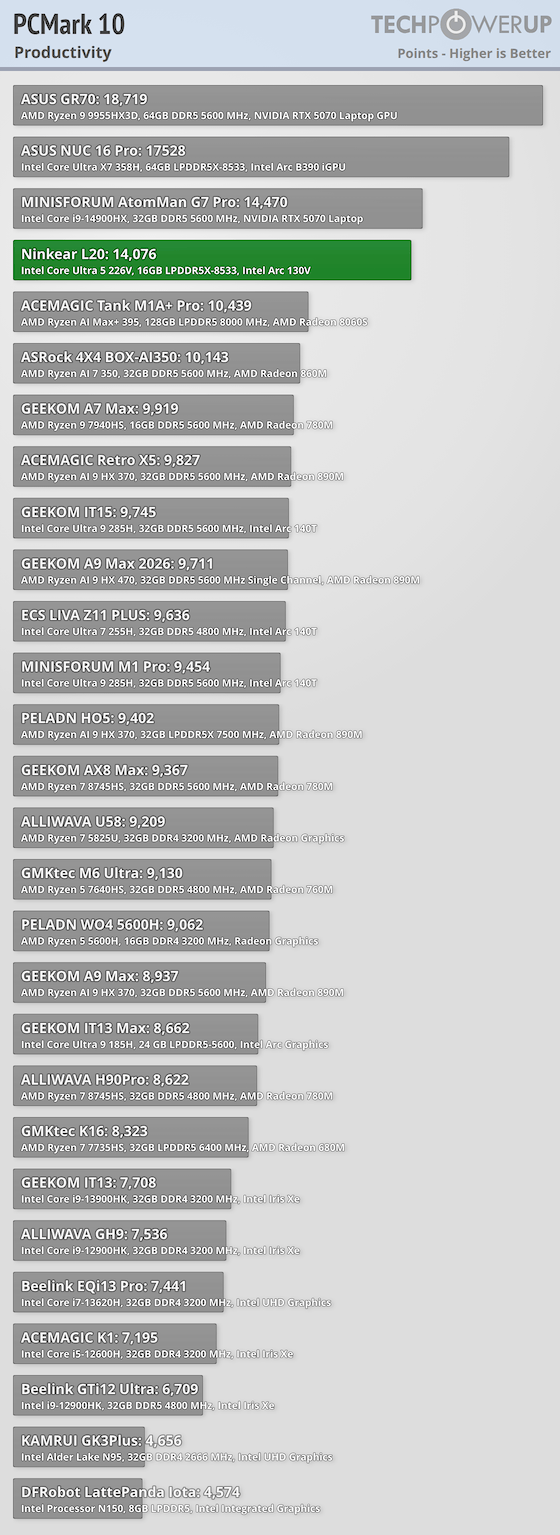
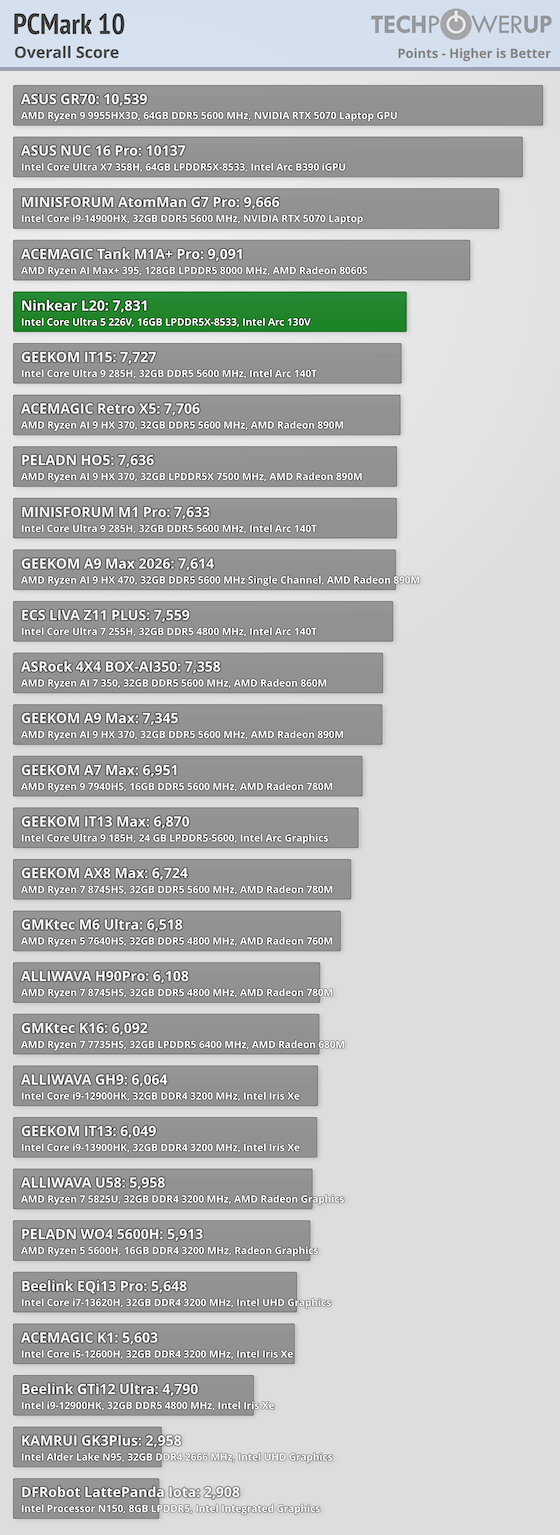
The L20 performed much better in PCMark than its modest Cinebench multicore score might lead you to expect, finishing at 7,831 points overall. Productivity was especially strong at 14,076 points, with Essentials at 9,656 and Digital Content Creation at 9,590.
Y-Cruncher
Y-Cruncher calculates digits of Pi with extreme precision, placing an extreme load on both CPU and memory. It's useful for gauging raw compute ability and stability under heavy math workloads.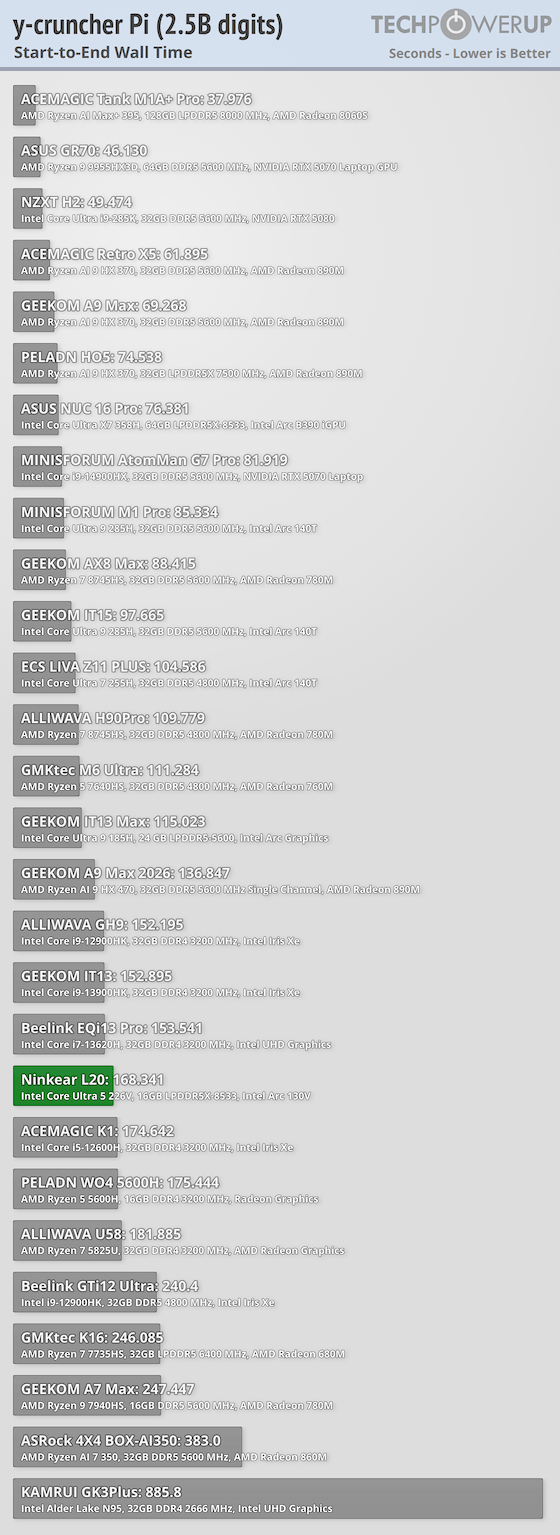
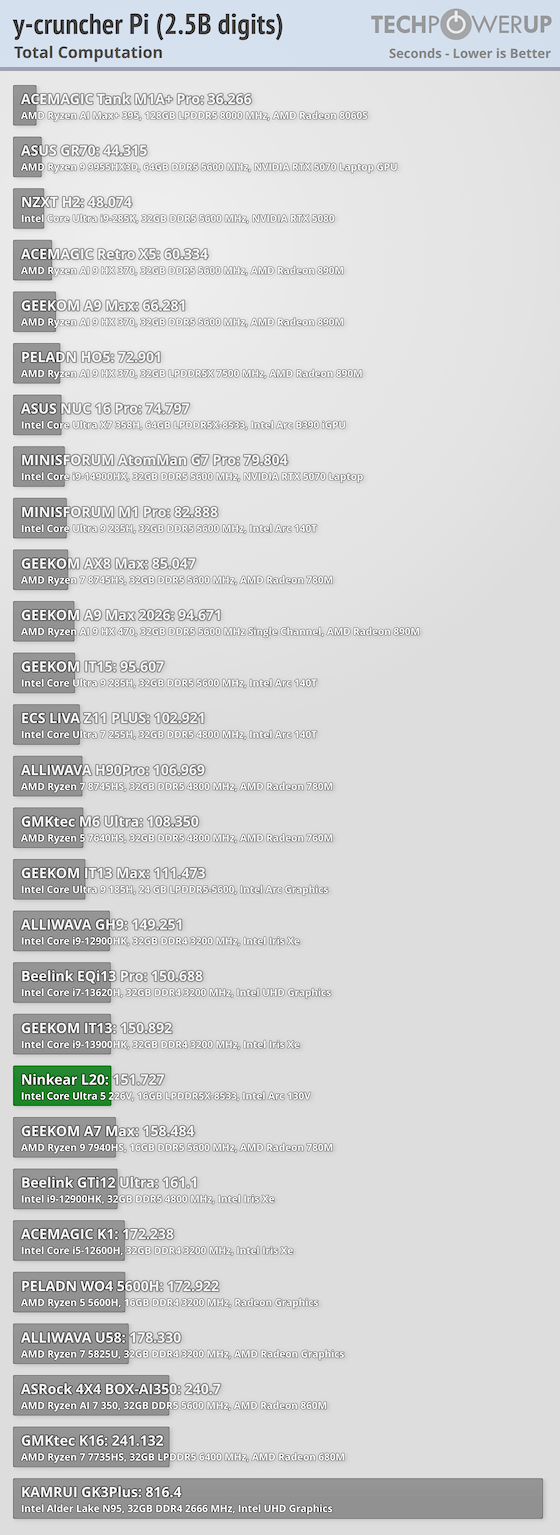
Calculating 2.5 billion digits of Pi required 151.727 seconds of computation time and 168.341 seconds from start to finish on the L20. The result is noticeably slower than higher-power Mini-PCs with more CPU threads, but it also gives the 226 V a sustained workload that goes well beyond ordinary office use.
Geekbench
Geekbench tests a wide variety of workloads, from encryption and AI to office productivity and photo editing. It also includes a GPU compute test, which provides a useful look at graphics performance outside of games.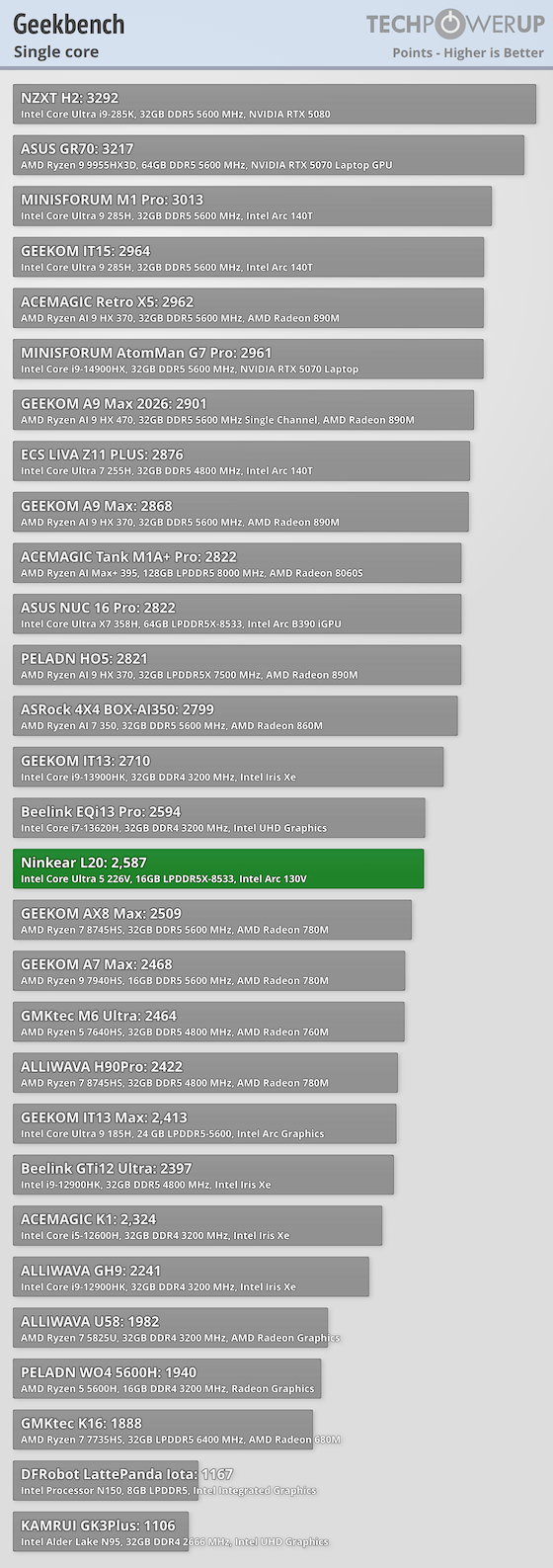
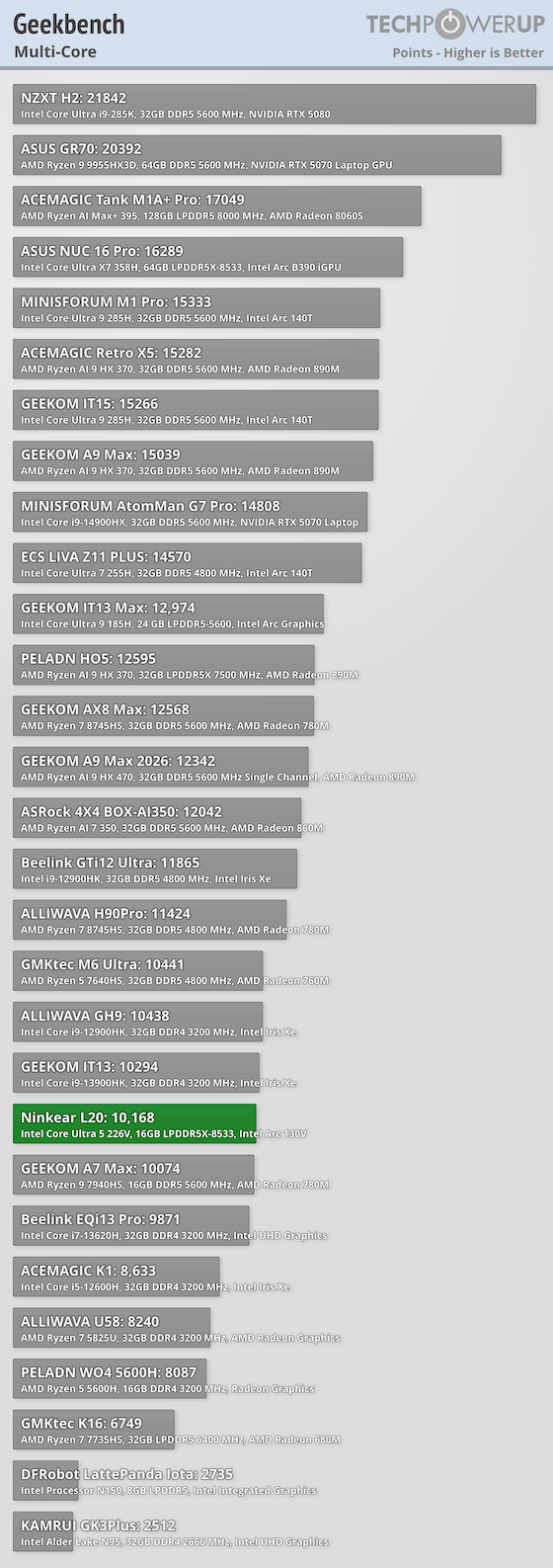
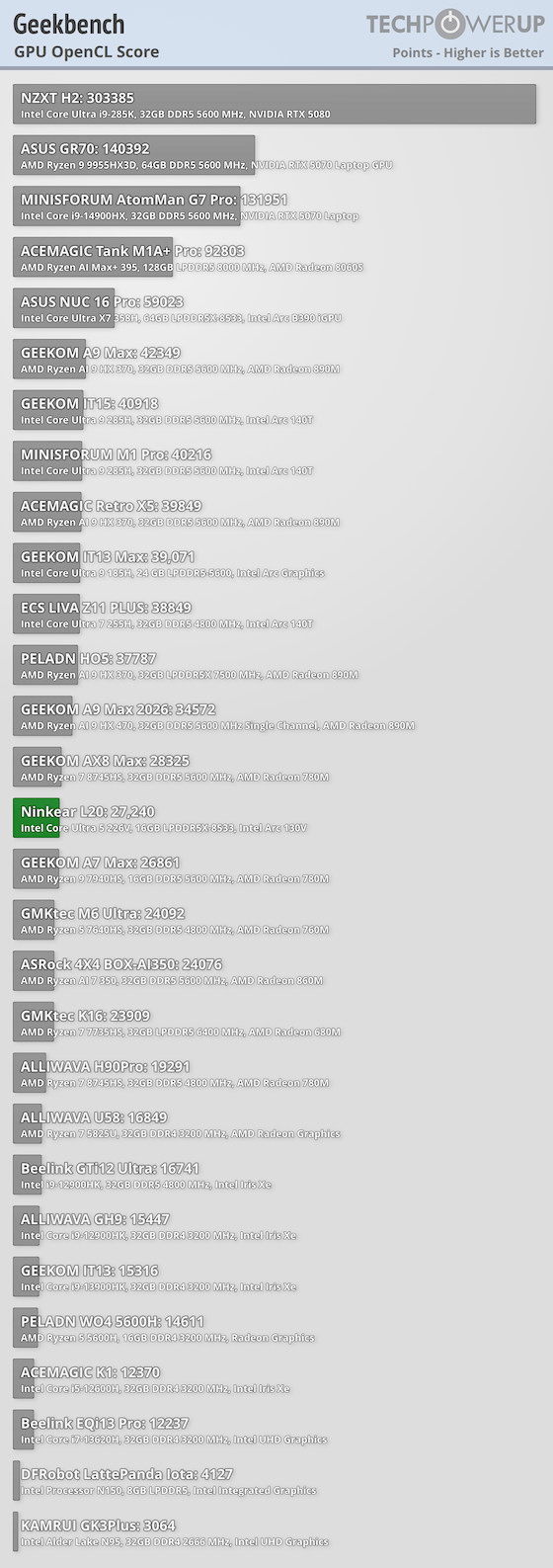
Geekbench came in at 2,587 points in single-core and 10,168 points in multicore, while the Arc 130V scored 27,240 points in OpenCL. The CPU results fit what I saw elsewhere, with the L20 doing particularly well in lighter, lightly threaded work. The OpenCL score also shows that the Arc 130V has enough GPU compute performance to be useful in applications that can take advantage of Intel graphics.
Nov 22nd, 2026 20:51 CST
change timezone
Latest GPU Drivers
New Forum Posts
- Increasing Power Limit? (8)
- DTS DCH Driver for Realtek HDA [DTS:X APO4 + DTS Interactive] (2818)
- Honestly, do you care about GTA VI? (266)
- What are you playing? (26240)
- UPS what one to get? (48)
- Your PC ATM (36458)
- Gacha Games - Discussions, Pulls, Updates, etc. (1157)
- Last game you purchased? (1414)
- Making a game in Godot engine (19)
- Intel D270 (5)
Popular Reviews
- Microsoft Surface Laptop Ultra Review - The Next-gen Arm Laptop
- Corsair RM1200e (Second Generation) Review
- Upcoming Hardware Launches 2027 (Updated Nov 2026)
- Pulsar Office Tour & First Look at P1 Dual-Sensor Mouse
- Ugreen NASync DXP4800 GT Review
- AMD Ryzen 7 9800X3D Review - The Best Gaming Processor
- AMD Zen 6 Technical Deep Dive
- AMD Ryzen 7 5800X3D 10th Anniversary Review
- Phantom Blade Zero Performance Benchmark Review - 35 GPUs Tested
- Biwin Black Opal NV7400 2 TB Review
TPU on YouTube
Controversial News Posts
- NVIDIA Co-Founder and CEO Jensen Huang Officially Resigns (492)
- Report: Jensen Huang Eyes NVIDIA Comeback (266)
- Open Letter Asking NVIDIA to Reinstate Jensen Huang Passes 115,000 Signatures (184)
- OpenAI CEO Argues Home PCs Waste the World's Limited DRAM Supply (152)
- NVIDIA Launches Investigation Into Jensen Huang's Relationship With Suspected Chinese Spy (136)
- Intel "Raptor Lake Next" 16-Core and 20-Core CPUs Surface (130)
- NVIDIA GeForce RTX 50-Series Scheduled for up to $500 Price Hike This Week (89)
- Intel Razor Lake Gets a 12 P-Core bLLC Chip With No E-Cores, Per Leak (86)