 50
NVIDIA GeForce RTX 5060 Ti PCI-Express x8 Scaling
(50 Comments) »Introduction

NVIDIA today launched the GeForce RTX 5060 Ti, the latest entry to its performance-segment lineup. You can read all about the card and how it performs in our main review of the card. This card is a direct successor to the RTX 4060 Ti and the RTX 3060 Ti before it. The RTX 3060 Ti and its sibling, the RTX 3060, came with PCI-Express 4.0 x16 host interfaces, giving them the same host bandwidth as the flagship RTX 3090 graphics card from that generation. Then, with its RTX 40-series, NVIDIA changed its mid-range GPUs such that the AD106 silicon driving the RTX 4060 Ti comes with a PCI-Express 4.0 x8 host interface.

When NVIDIA chose to give the RTX 4060 Ti and the AD106 silicon driving it a PCI-Express 4.0 x8 interface, it justified the move by pointing out PCIe Gen 4 being prevalent with desktop platforms going all the way back to the 11th Gen Core Rocket Lake and Ryzen 3000 Zen 2—platforms from 2018 and 2019. With the new RTX 50-series Blackwell generation, NVIDIA is implementing PCI-Express Gen 5, which doubles bandwidth over Gen 4, and chose to give the RTX 5060 Ti and the GB206 silicon driving it a PCI-Express 5.0 x8 host interface.
PCI-Express 5.0 x8 provides the same amount of host interface bandwidth as PCI-Express 4.0 x16, which should be taken as great news, but there's a slight wrinkle. While it's true that processors with PCIe Gen 5 have been around since 2021, starting with 12th Gen Core Alder Lake on the Intel side and Ryzen 7000 Zen 4 from AMD, not all Socket LGA1700 or Socket AM5 motherboards provide Gen 5 PCI-Express Graphics (PEG) x16 slots. Many of the mid-range motherboards based on mid-tier chipsets, such as the AMD B650, and Intel B660/760 provide Gen 4 x16 slots despite the processors supporting Gen 5, to save on PCIe Gen 5 redrivers and other onboard components. It raises the question on how PCI-Express 4.0 x8 bandwidth could affect the performance of the RTX 5060 Ti compared to its native PCI-Express 5.0 x8.
Our main review sees the RTX 5060 Ti run on a high-end motherboard with a native PCI-Express 5.0 x16 slot, and so the GPU is in its element. In this review, we will subject it to PCI-Express 4.0 x8 and PCI-Express 3.0 x8, to see how the change in host interface bandwidth affects performance. This is particularly important because mid-range and entry-level motherboards tend to lack Gen 5-capable x16 PEG slots, and users from these platforms are likely to opt for a GPU of the price and performance of the RTX 5060 Ti.
To enable PCIe Gen 4 and Gen 3, we used controls in the UEFI BIOS setup program of our MSI MPG X870E Carbon Wi-Fi motherboard. Gen 5 x8 performance numbers, intended to be seen as base data are carried over from our main review. Gen 4 x8 is comparable bandwidth to Gen 3 x16 and yet half the bandwidth of the GPU's original specification. Lastly, Gen 3 x8 is a quarter of the native bandwidth of the RTX 5060 Ti.
Test System
| Test System - GPU 2025.2 | |
|---|---|
| Processor: | AMD Ryzen 7 9800X3D Zen 5, 5.2 GHz, 8 cores / 16 threads |
| Motherboard: | MSI X870E Carbon Wi-Fi BIOS 7E49v1A3 |
| Resizable BAR: | Enabled on all supported cards (NVIDIA, AMD & Intel) |
| Memory: | Thermaltake TOUGHRAM XG 2x 16 GB DDR5-6200 28-36-36-76 UCLK 1:1 |
| Cooling: | Arctic Liquid Freezer III 280 mm AIO |
| Thermal Paste: | Arctic MX-6 |
| Storage: | 4 TB M.2 NVMe SSD |
| Power Supply: | Seasonic Focus GX 1000 W ATX 3.0 / 16-pin 12VHPWR |
| Case: | darkFlash DY470 |
| Operating System: | Windows 11 Professional 64-bit 24H2 VBS enabled (Windows 11 default) |
| Drivers: | RTX 5060 Ti: 575.94 Press Driver Other NVIDIA cards: 572.83 WHQL AMD: 25.3.2 Beta Intel: 101.6732 Beta Date of Retest |


- All games and cards are tested with the drivers listed above—no performance results were recycled between test systems. Only this exact system with exactly the same configuration is used for all results in this review.
- All graphics cards are tested using the same game version.
- All games are set to their highest quality setting unless indicated otherwise.
- All games are running at their native resolution without upscaling (no DLSS or FSR), except for the results on the "DLSS 4" page where we specifically look into that feature's performance
- All games have ray tracing disabled, except for testing on the "Ray Tracing" and "Path Tracing" pages
- AA and AF are applied via in-game settings, not via the driver's control panel.
- Before starting measurements, we heat up the card for each test to ensure a steady state is tested. This ensures that the card won't boost to unrealistically high clocks for only a few seconds until it heats up, as that doesn't represent prolonged gameplay.
- For better real-life applicability, all game tests use custom in-game test scenes, not the integrated benchmarks
- All cards used for comparison are reference designs. When a reference design does not exist, we go the extra mile and buy the closest possible match, which has reference clocks and default power limit.
- 1920x1080: Most popular monitor resolution.
- 2560x1440: Intermediary resolution between Full HD and 4K, with reasonable performance requirements.
- 3840x2160: 4K Ultra HD resolution, available on high-end monitors.
Date of Retest
We retest all our comparison cards every few months, with the latest drivers, new games, patches and OS updates.- 2025-04-01: Arc A770 16 GB
- 2025-04-01: Arc B580 16 GB
- 2025-04-01: RTX 3060 12 GB
- 2025-04-02: RTX 3070 8 GB
- 2025-04-02: RTX 3080 10 GB
- 2025-04-02: RTX 3090 Ti 24 GB
- 2025-04-03: RTX 4060 8 GB
- 2025-04-03: RTX 4060 Ti 8 GB
- 2025-04-03: RTX 4060 Ti 16 GB
- 2025-04-04: RTX 4070 12 GB
- 2025-04-04: RTX 4070 Super 12 GB
- 2025-04-04: RTX 4070 Ti 12 GB
- 2025-04-05: RTX 4070 Ti Super 16 GB
- 2025-04-05: RTX 4080 16 GB
- 2025-04-05: RTX 4080 Super 16 GB
- 2025-04-05: RTX 4090 24 GB
- 2025-04-06: RTX 5070 12 GB
- 2025-04-06: RTX 5070 Ti 16 GB
- 2025-04-06: RTX 5080 16 GB
- 2025-04-07: RTX 5090 32 GB
- 2025-04-07: RX 6800 XT 16 GB
- 2025-04-07: RX 6900 XT 16 GB
- 2025-04-08: RX 7600 8 GB
- 2025-04-08: RX 7600 XT 16 GB
- 2025-04-08: RX 7700 XT 12 GB
- 2025-04-09: RX 7800 XT 16 GB
- 2025-04-09: RX 7900 GRE 16 GB
- 2025-04-09: RX 7900 XT 20 GB
- 2025-04-09: RX 7900 XTX 24 GB
- 2025-04-10: RX 9070 16 GB
- 2025-04-10: RX 9070 XT 16 GB
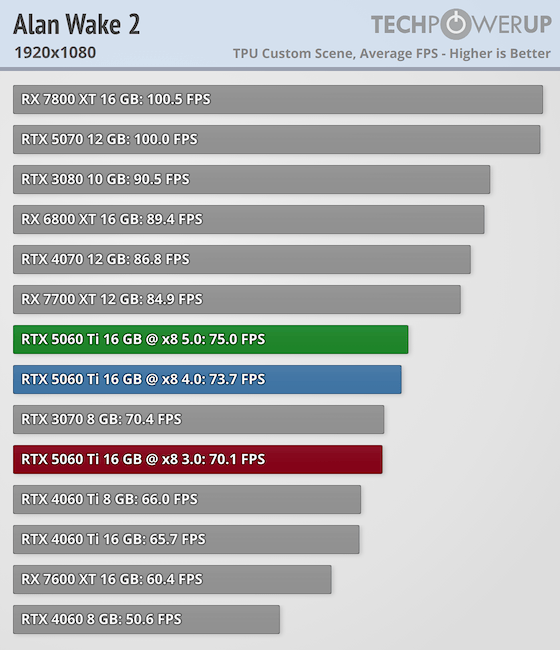
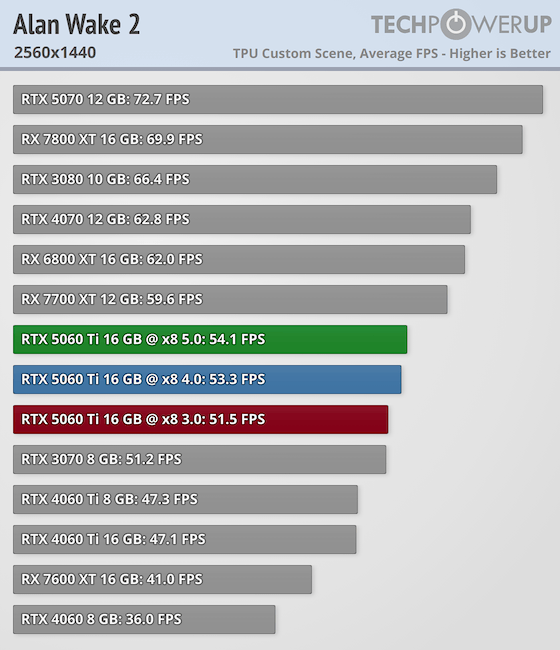
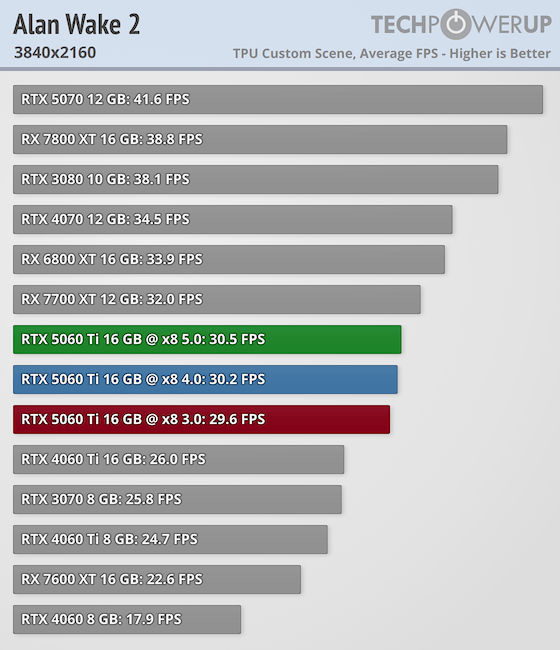
Alan Wake 2

Released: 2023 — API: DirectX 12 — Engine: Northlight
Alan Wake II, a survival horror sequel set 13 years after the original, follows FBI agent Saga Anderson investigating ritualistic murders in Bright Falls, Washington. Trapped in an alternate dimension, novelist Alan Wake crafts a horror narrative for escape, involving Saga. Players switch between Saga and Alan, balancing resources like batteries and ammunition. New features include detective elements, a dialogue tree system, and the "Mind Place" for investigation.
Our Patreon Silver Supporters can read articles in single-page format.
Nov 14th, 2026 21:27 CST
change timezone
Latest GPU Drivers
New Forum Posts
- Tell me about your favourite graphics card (81)
- Planning for Prolonged High Prices and Maintaining What You Already Have (70)
- What can the FX 8320 do today? Here is the answer. (45)
- Recommendations Wanted - Affordable Enterprise SSD for Boot (2)
- WarpCoreBench scores! (37)
- [INTEL]-How To Update Your Microcode for Intel HX 13/14th Gen. CPUs Laptops/Mobile Easily. (260)
- [Intel AX1xx/AX2xx/AX4xx/AX16xx/BE2xx/BE17xx] Intel Modded Wi-Fi Driver with Intel® Killer™ Features (632)
- Optical Disc Drive owners club (208)
- Game Soundtracks You Love (1287)
- 9070 GRE 3.9ghz validation reached. (11)
Popular Reviews
- AMD Zen 6 Technical Deep Dive
- ASUS ROG Strix B850-I Gaming Wi-Fi7 W Review
- Corsair HX1000i Shift Crystal Review
- Upcoming Hardware Launches 2027 (Updated Nov 2026)
- Montech King 95 3D PRO Review
- NZXT C1200 Platinum Review
- NZXT H7 RGB+ Review
- NZXT H5 Review
- Phantom Blade Zero Performance Benchmark Review - 35 GPUs Tested
- AMD Ryzen 7 9800X3D Review - The Best Gaming Processor
TPU on YouTube
Controversial News Posts
- NVIDIA Co-Founder and CEO Jensen Huang Officially Resigns (407)
- OpenAI CEO Argues Home PCs Waste the World's Limited DRAM Supply (152)
- NVIDIA Launches Investigation Into Jensen Huang's Relationship With Suspected Chinese Spy (136)
- Intel "Raptor Lake Next" 16-Core and 20-Core CPUs Surface (130)
- Legendary Game Studio BioWare Shuts Down Following EA Layoffs (104)
- Dell CEO Says the Memory Shortage Will Get Worse in 2027 (95)
- NVIDIA GeForce RTX 50-Series Scheduled for up to $500 Price Hike This Week (89)
- Modder Fits RTX 5090 With Four 8-Pin Connectors, Halving Current per Wire (80)