 9
NZXT H2 Mini PC Review
Web & Office Productivity »General Performance
AIDA64 Cache & Memory
The AIDA64 memory benchmark measures how quickly data moves between system memory and the CPU's cache hierarchy. It provides insight into bandwidth (read/write/copy speeds) and latency, which directly affect responsiveness in everyday computing and the performance of integrated graphics that share system memory.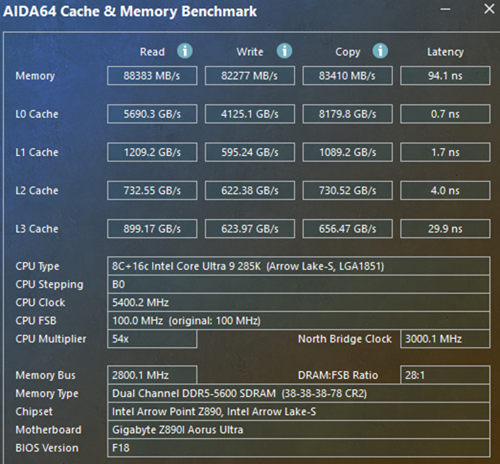
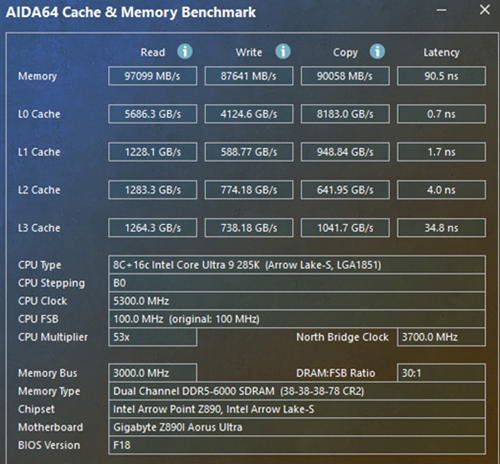
With XMP disabled, the memory is running at DDR5-5600 (2800 MHz): 88,383 MB/s read, 82,277 MB/s write, and 83,410 MB/s copy, with latency at 94.1 ns. That is already solid desktop-class bandwidth, but once XMP is enabled and the kit moves up to DDR5-6000 (3000 MHz), the gains are immediate and measurable. Read climbs to 97,099 MB/s, write to 87,641 MB/s, and copy to 90,058 MB/s, while latency drops to 90.5 ns. That is roughly a 9–10% increase in read throughput and a noticeable reduction in memory access delay, which helps in CPU-heavy workloads and improves overall system responsiveness under multithreaded load. That said, for stability purposes, XMP will be disabled throughout the testing. Note that the Arrow Lake Ultra 9 285K is rated for 6400 MT memory, and Intel 200S Boost brings that to 8000 MT, so 6000 MT memory is a little slow for this platform.
Cinebench
Cinebench is a CPU rendering benchmark based on Maxon's Cinema 4D engine. It evaluates both single-threaded and multithreaded workloads, giving a clear picture of how a processor handles everyday tasks as well as heavier rendering scenarios.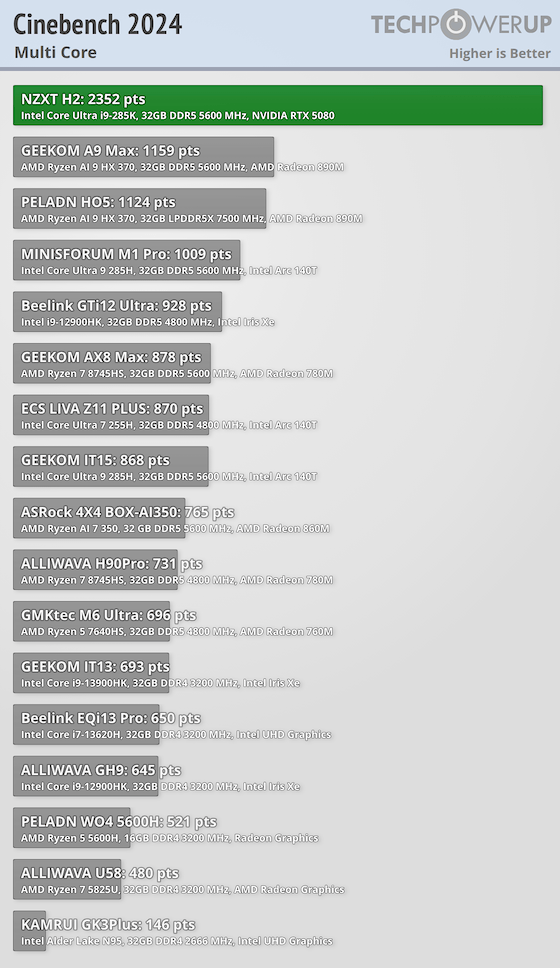
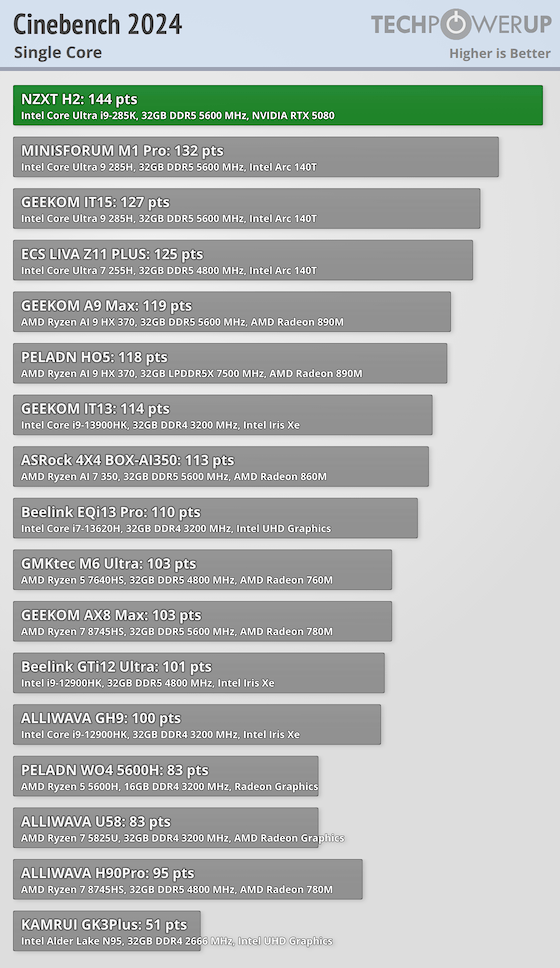
Cinebench 2024 posts 2,352 points multicore and 144 single-core. Those are proper desktop numbers, and the run behavior looks stable. Multithreaded rendering scales cleanly across all cores, with no sharp drop-off that would suggest aggressive power limits or thermal throttling.
Single-core performance is equally important, as many real-world applications still lean heavily on lightly threaded bursts, and the H2 maintains strong responsiveness even when background workloads are active.
7-Zip
7-Zip's built-in benchmark measures CPU performance when compressing and decompressing data. It's a good indicator of how a system handles file-heavy workloads such as packing archives, installing software, or building projects.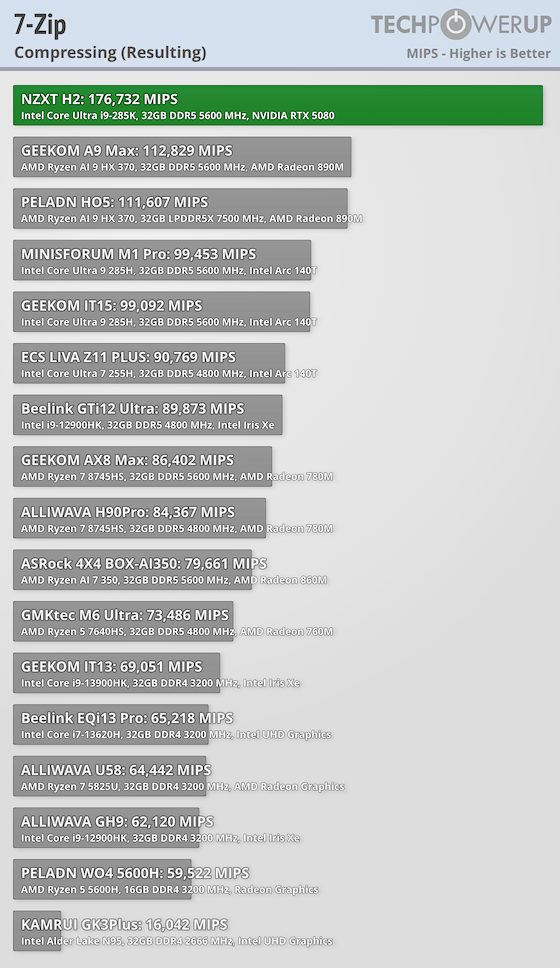
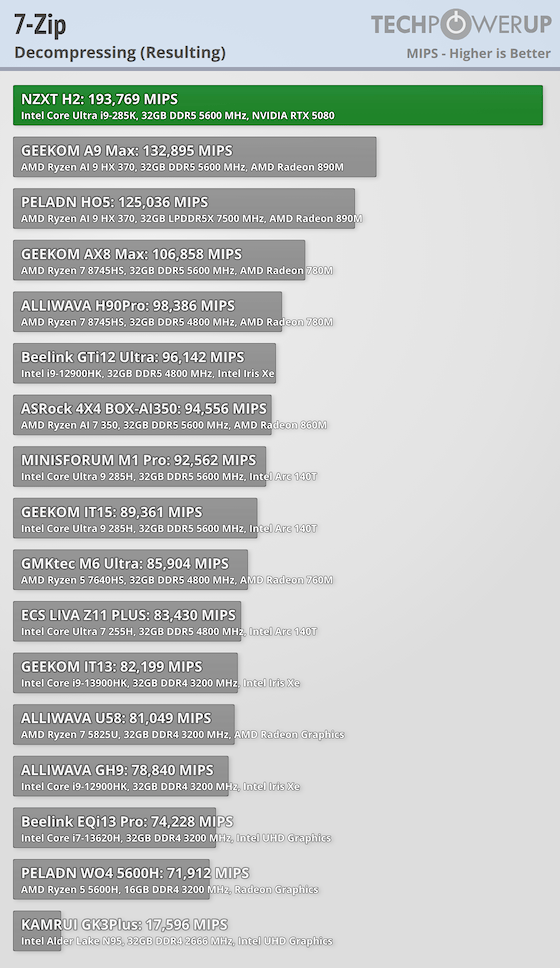
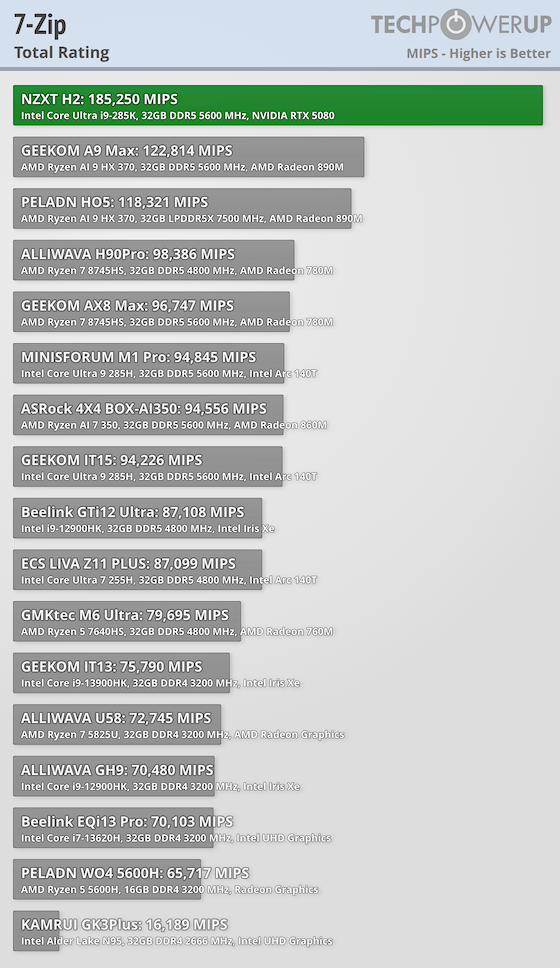
Compression reaches 176,732 MIPS, decompression hits 193,769 MIPS, and the total rating scored 185,250. These are high throughput figures that show the CPU and memory working together efficiently. In real-world terms, large project archives, game asset packs, or software builds will complete noticeably faster than on lower-power systems on this leaderboard. Decompression performance in particular is strong, which benefits installation times and unpacking large downloads.
Y-Cruncher
Y-Cruncher calculates digits of Pi with extreme precision, pushing both CPU and memory to their limits. It's useful for gauging raw compute ability and stability under heavy math workloads.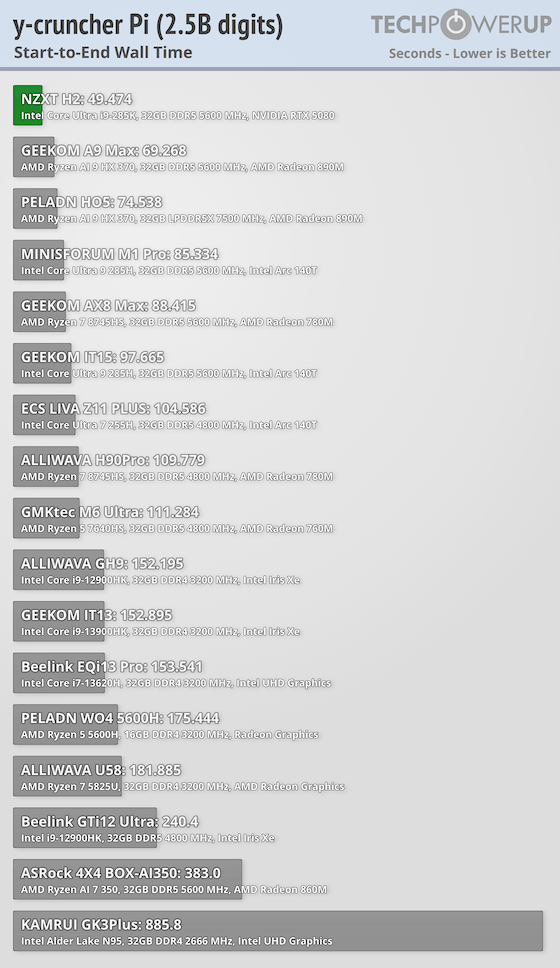
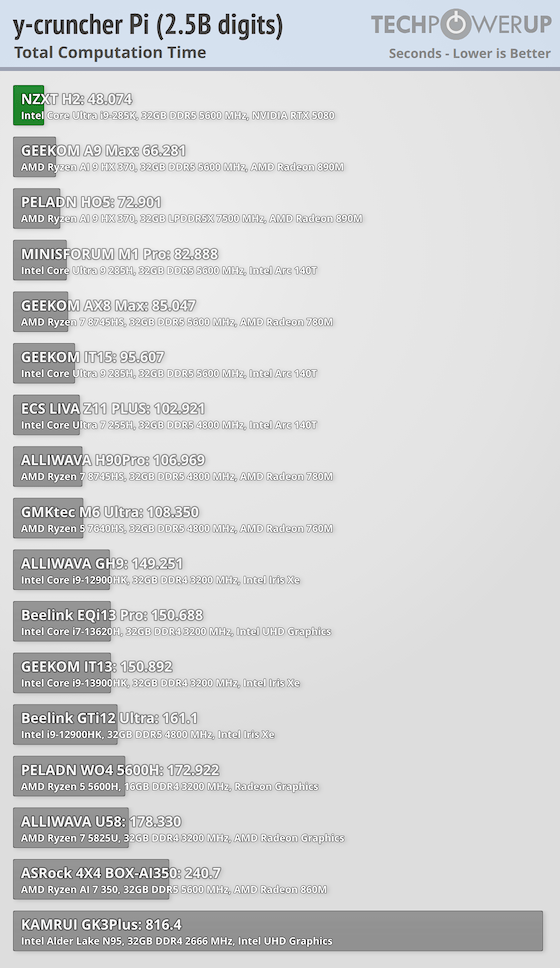
The 2.5B digit run completes in 48.07 seconds compute time and 49.47 seconds wall time. For a Core Ultra 9 285K operating at proper desktop power levels, that is right where it should be. It confirms that the CPU is not being artificially constrained inside this chassis. Performance remains consistent across the full run, showing that cooling and power delivery are keeping up with sustained all-core workloads.
Geekbench
Geekbench tests a wide variety of workloads, from encryption and machine learning to office productivity and photo editing. It also includes GPU acceleration, giving a broader view of system capability.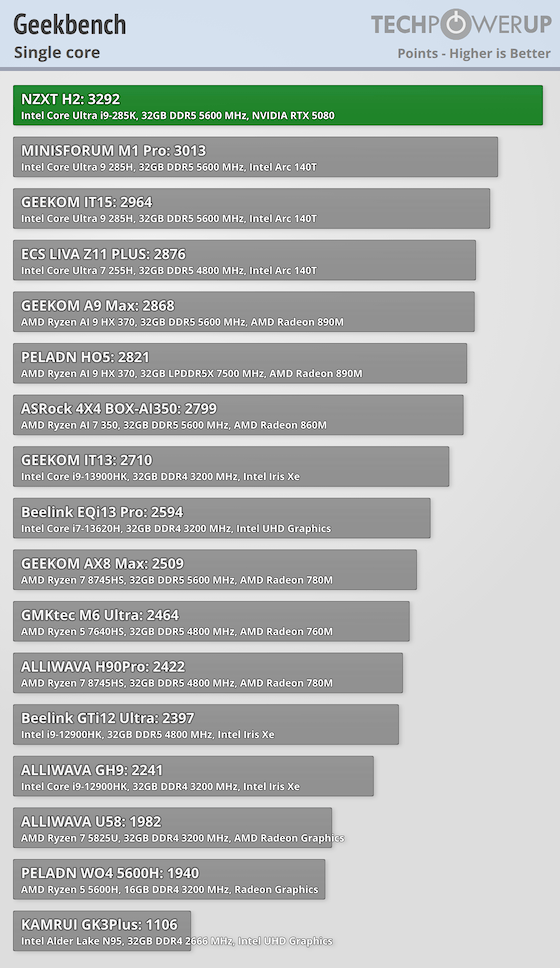
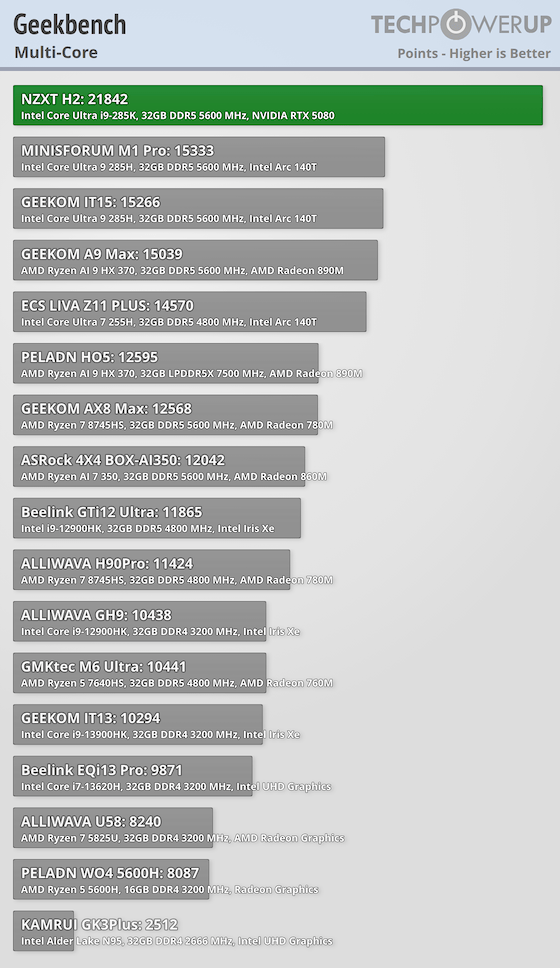
Geekbench scores 3,292 single-core and 21,842 multicore, which are strong showings.
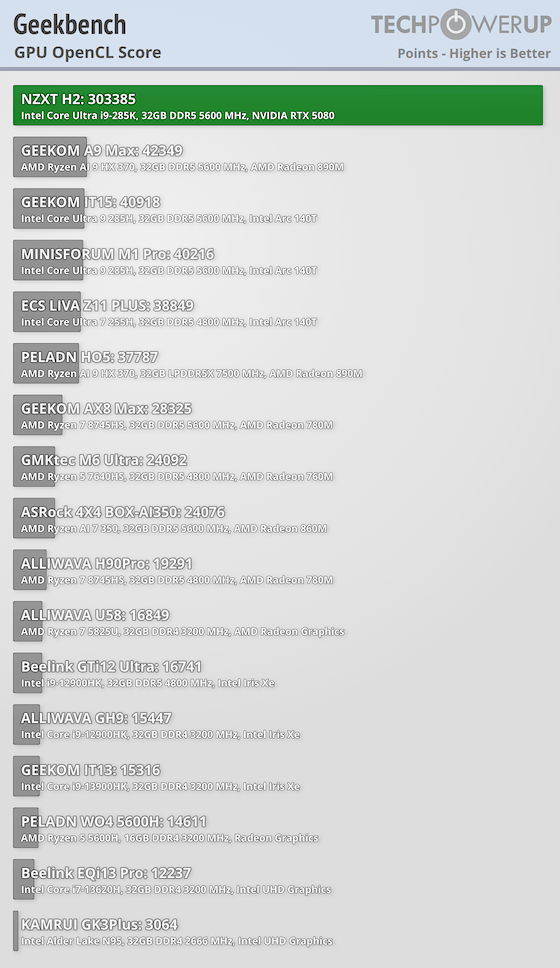
The OpenCL score of 303,385 is an outstanding result and lines up with a flagship GPU at the helm.
Nov 23rd, 2026 00:28 CST
change timezone
Latest GPU Drivers
New Forum Posts
- Honestly, do you care about GTA VI? (268)
- Last game you purchased? (1416)
- Anker SOLIX C2000 Gen 2 + PS400 Solarpanel (1)
- What are you playing? (26241)
- Increasing Power Limit? (9)
- DTS DCH Driver for Realtek HDA [DTS:X APO4 + DTS Interactive] (2818)
- UPS what one to get? (48)
- Your PC ATM (36458)
- Gacha Games - Discussions, Pulls, Updates, etc. (1157)
- Making a game in Godot engine (19)
Popular Reviews
- Microsoft Surface Laptop Ultra Review - The Next-gen Arm Laptop
- Corsair RM1200e (Second Generation) Review
- Upcoming Hardware Launches 2027 (Updated Nov 2026)
- Pulsar Office Tour & First Look at P1 Dual-Sensor Mouse
- Ugreen NASync DXP4800 GT Review
- AMD Ryzen 7 9800X3D Review - The Best Gaming Processor
- AMD Zen 6 Technical Deep Dive
- AMD Ryzen 7 5800X3D 10th Anniversary Review
- Phantom Blade Zero Performance Benchmark Review - 35 GPUs Tested
- Biwin Black Opal NV7400 2 TB Review
TPU on YouTube
Controversial News Posts
- NVIDIA Co-Founder and CEO Jensen Huang Officially Resigns (492)
- Report: Jensen Huang Eyes NVIDIA Comeback (266)
- Open Letter Asking NVIDIA to Reinstate Jensen Huang Passes 115,000 Signatures (184)
- OpenAI CEO Argues Home PCs Waste the World's Limited DRAM Supply (152)
- NVIDIA Launches Investigation Into Jensen Huang's Relationship With Suspected Chinese Spy (136)
- Intel "Raptor Lake Next" 16-Core and 20-Core CPUs Surface (130)
- NVIDIA GeForce RTX 50-Series Scheduled for up to $500 Price Hike This Week (89)
- Intel Razor Lake Gets a 12 P-Core bLLC Chip With No E-Cores, Per Leak (86)