 13
Patriot Viper Elite 5 RGB DDR5-7000 32 GB CL38 Review
Intel 13900K Frametime Analysis: Counter-Strike 2 »Frametime Analysis
We present a more in-depth analysis than just average FPS to show how the frame rate changes over time, which helps highlight FPS drops. Minimum FPS at both the 95th and 99th percentile are reported in these charts, too. A second chart, a histogram, shows shape and spread for the frametime data—how tightly grouped the measurements are. The "IQR" result is called "Interquartile Range," which is an outlier-resistant statistical value that tells us the range in the middle of the frametime distribution.Location: Baldur's Gate City
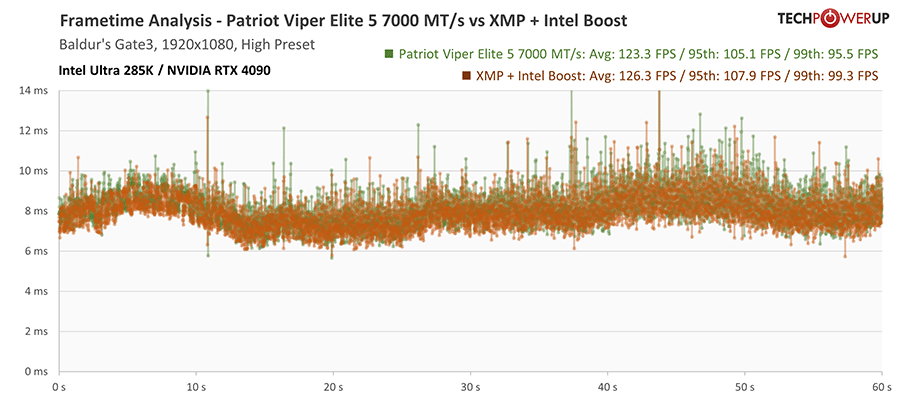
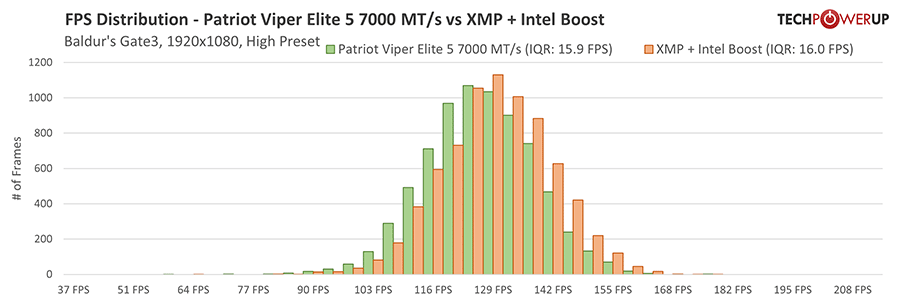
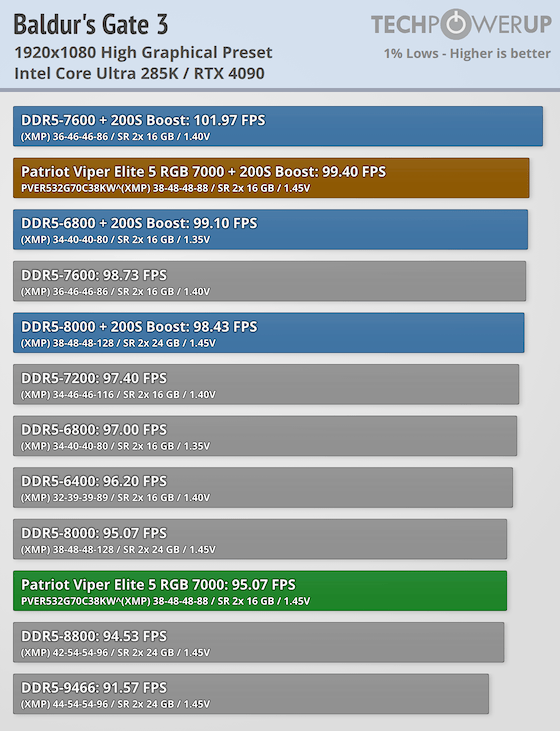
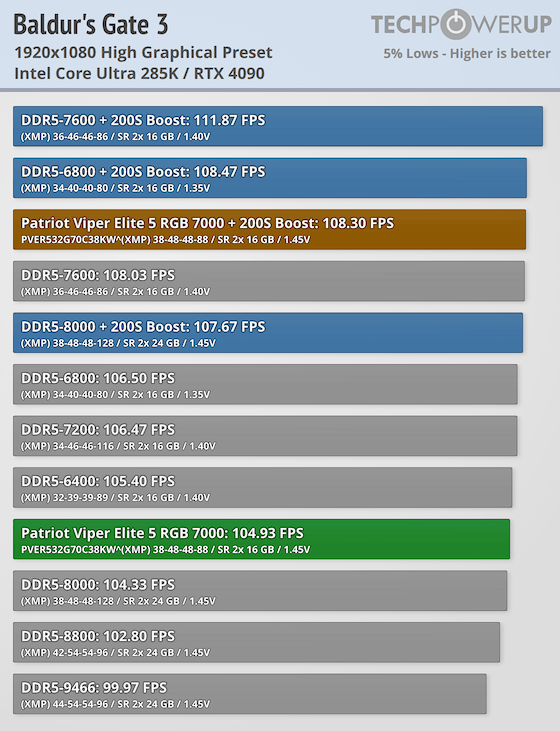
For this benchmark, we used Baldur's Gate City, a highly CPU-intensive location. While Intel traditionally has been less affected by memory latency in gaming, the Arrow lake architectural redesign of the Intel Ultra CPUs has made overall latency a critical factor for higher frame rates; similar to AMD. Testing Baldur's Gate 3 reveals a noticeable performance gap between the XMP and XMP + Intel Boost, as the Boosted memory is once again a top contender.
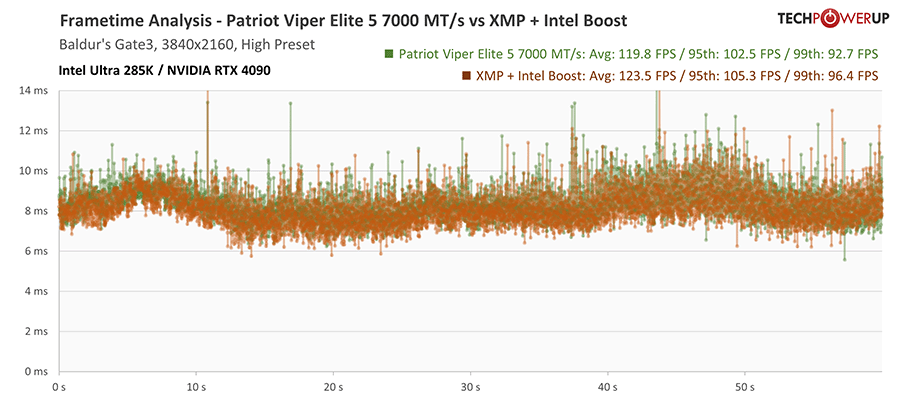
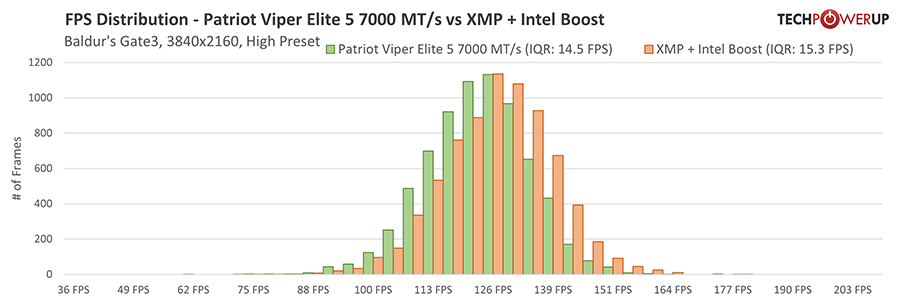
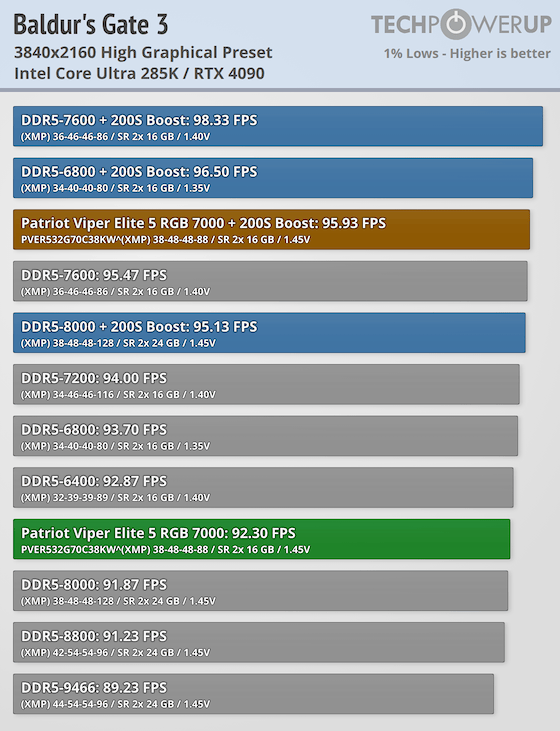
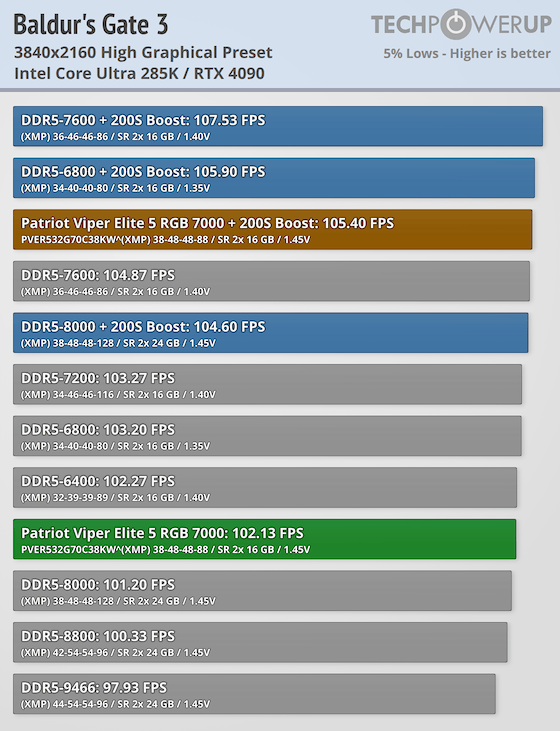
By increasing the resolution, the frame rate drops. Baldur's Gate 3 may be a CPU-intense game, but memory speed and latency does have quite the impact even at higher resolutions, with the Patriot Viper Elite 5 RGB DDR5-7000 memory kit trailing a bit behind the Intel 200S Boosted results. This is primarily due to the 200S Boost profile offering lower internal CPU latency.
Nov 19th, 2026 16:44 CST
change timezone
Latest GPU Drivers
New Forum Posts
- Dell Workstation Owners Club (3517)
- Making a game in Godot engine (6)
- Honestly, do you care about GTA VI? (166)
- Introducing DST Bench : one of the most advanced disk benchmark and storage analyzer real-time software (6)
- Windows 11 General Discussion (7736)
- Current Sales, Bundles, Giveaways (10448)
- Last game you purchased? (1409)
- WarpCoreBench scores! (76)
- Got the EOL 32GB TridentZ 6000 CL26 1.4V (12)
- DTS DCH Driver for Realtek HDA [DTS:X APO4 + DTS Interactive] (2815)
Popular Reviews
- Acemagic Retro X3 Review
- Ugreen NASync DXP4800 GT Review
- Upcoming Hardware Launches 2027 (Updated Nov 2026)
- Pulsar Office Tour & First Look at P1 Dual-Sensor Mouse
- AMD Zen 6 Technical Deep Dive
- Biwin Black Opal NV7400 2 TB Review
- Sapphire Radeon RX 7700 XT Pure Review
- Sapphire Radeon RX 7700 XT Pulse Review
- AMD Ryzen 7 9800X3D Review - The Best Gaming Processor
- Chieftec Iceberg PRO 360 DARK Review
TPU on YouTube
Controversial News Posts
- NVIDIA Co-Founder and CEO Jensen Huang Officially Resigns (489)
- Report: Jensen Huang Eyes NVIDIA Comeback (223)
- Open Letter Asking NVIDIA to Reinstate Jensen Huang Passes 115,000 Signatures (184)
- OpenAI CEO Argues Home PCs Waste the World's Limited DRAM Supply (152)
- NVIDIA Launches Investigation Into Jensen Huang's Relationship With Suspected Chinese Spy (136)
- Intel "Raptor Lake Next" 16-Core and 20-Core CPUs Surface (130)
- Legendary Game Studio BioWare Shuts Down Following EA Layoffs (104)
- Dell CEO Says the Memory Shortage Will Get Worse in 2027 (95)