 14
Patriot Viper Elite 5 Ultra RGB DDR5-8000 48 GB CL36 Review
Intel 13900K Frametime Analysis: Baldur's Gate 3 »Frametime Analysis
We present a more in-depth analysis than just average FPS to show how the framerate changes over time, which helps highlight FPS drops. Minimum FPS at both the 95th and 99th percentile are reported in these charts, too. A second chart, a histogram, shows shape and spread for the frametime data—how tightly grouped the measurements are. The "IQR" result is called "Interquartile Range," which is an outlier-resistant statistical value that tells us the range in the middle of the frametime distribution.In the following charts, we are comparing two retail memory kits. By doing so, the game benchmarks reveal where the limits lie for a top of the line AMD or Intel computer in 2025. For both memory kits, the respective EXPO/XMP profiles are loaded, and all sub-timings are based on those individual profiles. These are not adjusted further.
Tests are conducted with the following components:
CPU: Intel Core i9-13900K (Locked P-core 5.5 GHz, E-cores 4.3 GHz)
GPU: PNY GeForce RTX 4090 XLR8 VERTO
Memory (1): Patriot Viper Elite 5 Ultra 8000 VEUR548G8036K (36-52-52-126-192) (XMP-1)
Memory (2): DDR5-7200 32 GB (34-46-46-116) (XMP)
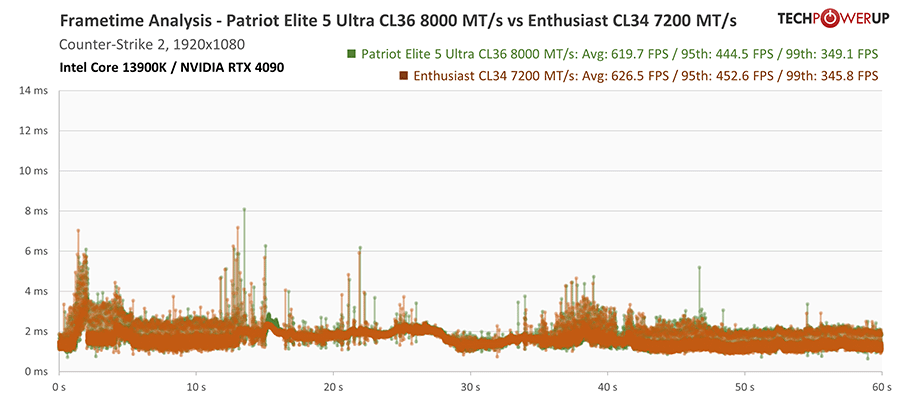
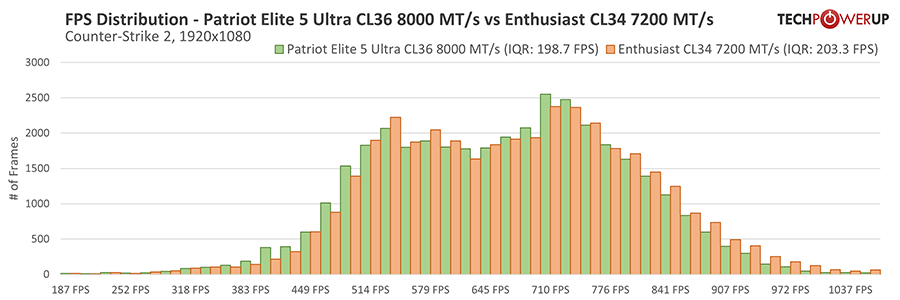
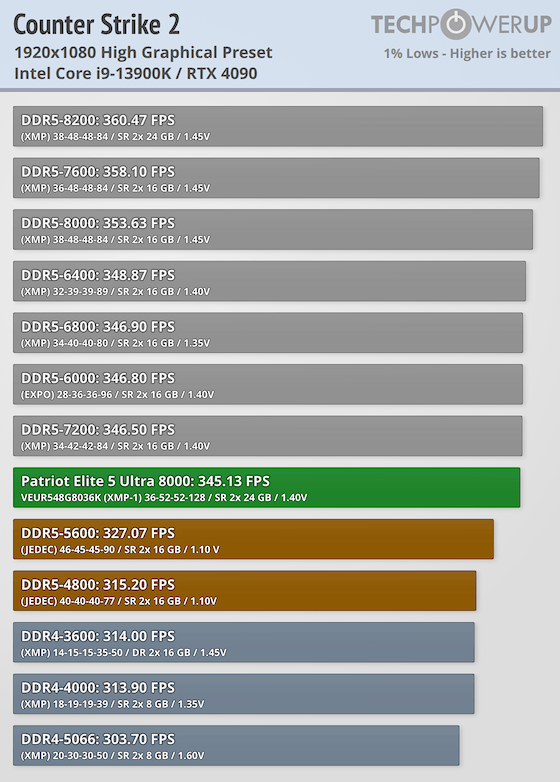
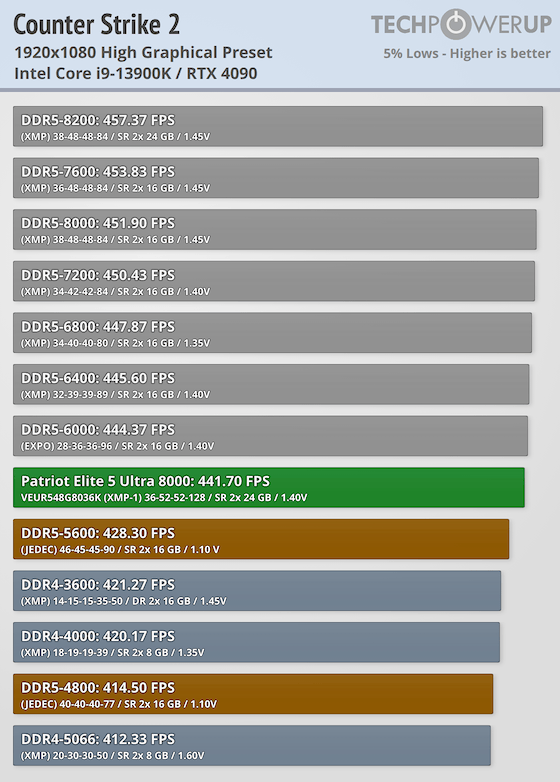
Counter-Strike 2 benefits significantly from the higher bandwidth available on the Intel (Socket 1700) platform, with average frame rates showing resilience to high latency. However, there are notable exceptions. The use of 24 Gbit ICs, which have a higher tRFC refresh time, can significantly impact the 1% Lows. The standout performer in the charts is the 8200 MT/s 2× 24 GB kit, which takes first place by bending the rules a bit. It uses the same tRFC refresh cycles as a 32 GB kit and is not JEDEC compliant, providing an advantage in memory latency and bandwidth, exactly what this game thrives on.
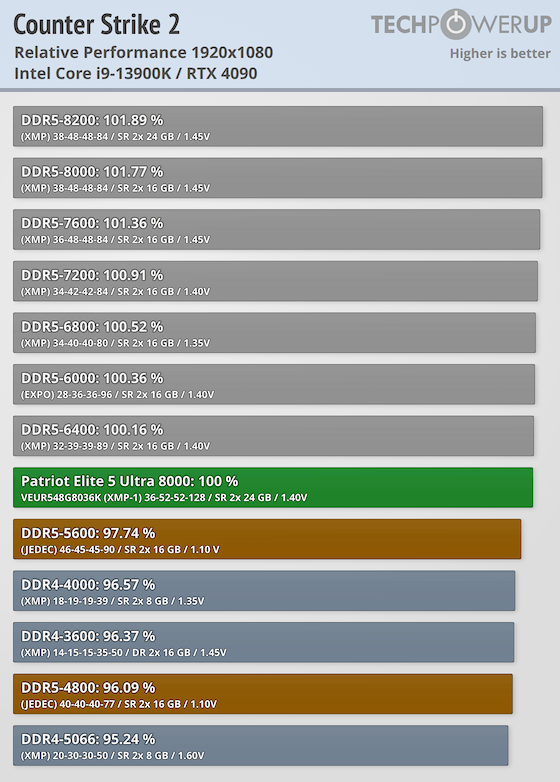
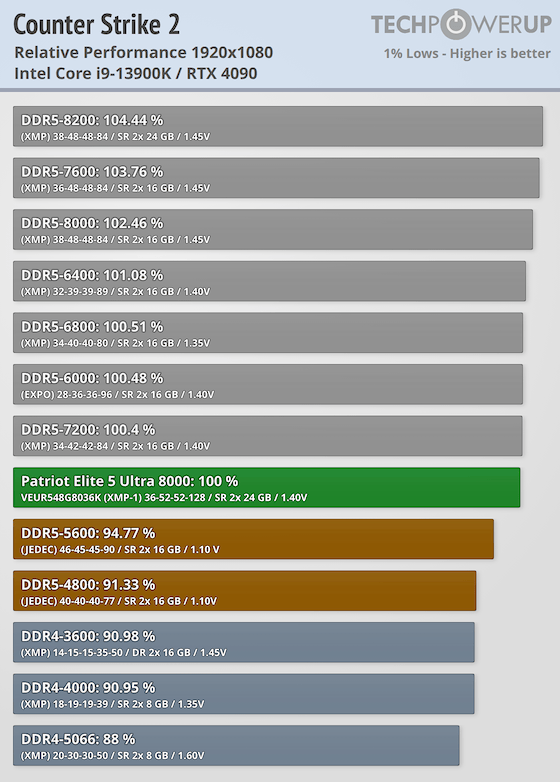
In Counter-Strike 2 on the Intel Core i9-13900K, the Patriot Elite 5 Ultra 8000 establishes itself as the baseline at 100%, occupying a particularly interesting spot. Above it, every DDR5 XMP kit clusters tightly within a 100.16% to 101.89% range in Average FPS. In contrast, kits below it experience a steeper decline, with DDR5-5600 JEDEC dropping to 97.74%, and DDR4 and DDR5-4800 JEDEC configurations plummeting to the 95–96% range. The 1% Lows chart accentuates this divide even more, with the Patriot kit at 100% positioned above a significant drop-off: DDR5-5600 falls to 94.77%, DDR5-4800 to 91.33%, and DDR4 configurations sink as low as 88%, illustrating a 12% deficit that highlights how demanding CS2 can be on slower memory in terms of frame timing consistency. On the Raptor Lake platform, unlike AMD, higher frequencies more directly correlate with improved performance, avoiding the 2:1 fabric penalty entirely as all DDR5 is running in Gear 2 mode. This is why DDR5-8200 and DDR5-8000 16 GB kits top the chart at 101.89% and 104.44% in 1% Lows, respectively. The Patriot's 24 GB tRFC penalty compared to those 16 GB DDR5-8000 and DDR5-8200 kits is the main reason it ranks just below them, despite operating at the same or higher frequency.
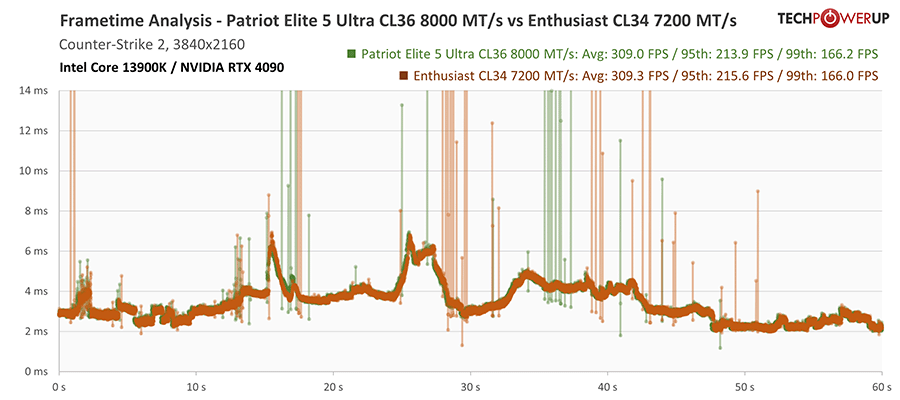
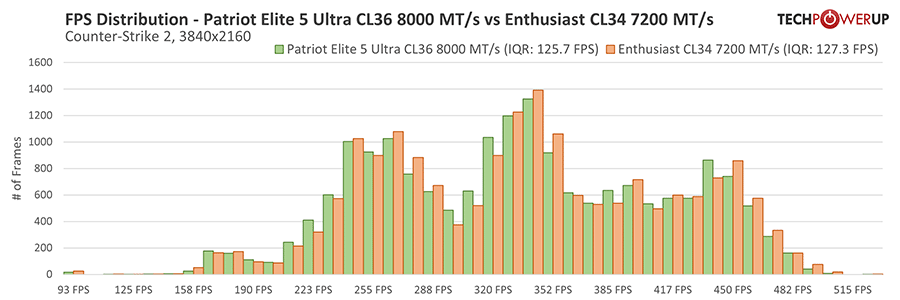
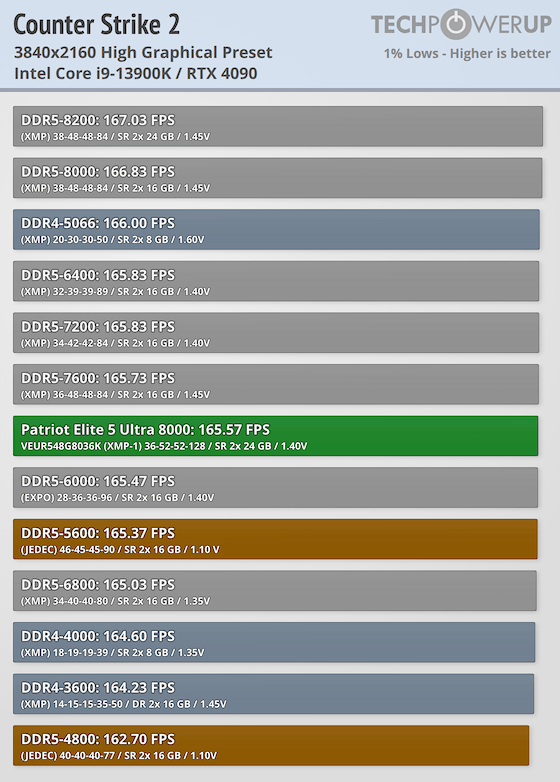
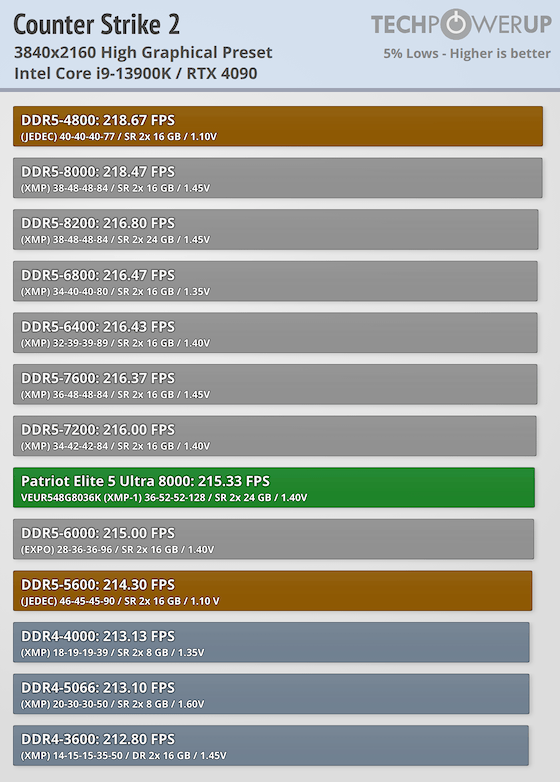
Lastly, at 4K, we start to become GPU-bound, putting all the memory kits within margin of error.
Nov 22nd, 2026 20:37 CST
change timezone
Latest GPU Drivers
New Forum Posts
- Increasing Power Limit? (8)
- DTS DCH Driver for Realtek HDA [DTS:X APO4 + DTS Interactive] (2818)
- Honestly, do you care about GTA VI? (266)
- What are you playing? (26240)
- UPS what one to get? (48)
- Your PC ATM (36458)
- Gacha Games - Discussions, Pulls, Updates, etc. (1157)
- Last game you purchased? (1414)
- Making a game in Godot engine (19)
- Intel D270 (5)
Popular Reviews
- Microsoft Surface Laptop Ultra Review - The Next-gen Arm Laptop
- Corsair RM1200e (Second Generation) Review
- Upcoming Hardware Launches 2027 (Updated Nov 2026)
- Pulsar Office Tour & First Look at P1 Dual-Sensor Mouse
- Ugreen NASync DXP4800 GT Review
- AMD Ryzen 7 9800X3D Review - The Best Gaming Processor
- AMD Zen 6 Technical Deep Dive
- AMD Ryzen 7 5800X3D 10th Anniversary Review
- Phantom Blade Zero Performance Benchmark Review - 35 GPUs Tested
- Biwin Black Opal NV7400 2 TB Review
TPU on YouTube
Controversial News Posts
- NVIDIA Co-Founder and CEO Jensen Huang Officially Resigns (492)
- Report: Jensen Huang Eyes NVIDIA Comeback (266)
- Open Letter Asking NVIDIA to Reinstate Jensen Huang Passes 115,000 Signatures (184)
- OpenAI CEO Argues Home PCs Waste the World's Limited DRAM Supply (152)
- NVIDIA Launches Investigation Into Jensen Huang's Relationship With Suspected Chinese Spy (136)
- Intel "Raptor Lake Next" 16-Core and 20-Core CPUs Surface (130)
- NVIDIA GeForce RTX 50-Series Scheduled for up to $500 Price Hike This Week (89)
- Intel Razor Lake Gets a 12 P-Core bLLC Chip With No E-Cores, Per Leak (86)