 60
PCI-Express 4.0 NVMe SSD Performance on Ryzen 3000 & X570
(60 Comments) »Introduction

Launched just last Sunday, AMD's 3rd generation Ryzen processor platform has quickly taken over the hardware enthusiast world as THE topic being talked about. Besides our individual processor reviews for the Ryzen 7 3700X and the Ryzen 9 3900X, we have, through separate feature reviews, made a case for saving money by pairing these new processors with cost-effective AMD 400-series chipset motherboards instead of shelling out at least $170 for X570. The X470 + Ryzen 3000 review showed that CPU and memory performance isn't all that different between X570 and X470. We even paired the Ryzen 9 3900X with a cheap B350 chipset motherboard, the results of which pleasantly surprised us. We then set out to explore whether the new Radeon RX 5700 XT graphics card, which debuts PCI-Express 4.0 x16, shows any performance difference on older generations of PCIe, which it doesn't. Last but not least, we looked at how DDR4 memory scales on Zen 2, with results confirming that you don't really need to spend a ton of money on fast memory for the Ryzen 3000 platform.

The above test cases leave us with only one compelling argument for X570 at this time—the NVMe SSD upgrade path. AMD's Zen 2 Ryzen 3000 processors are the world's first client desktop CPUs to support the PCI-Express version 4.0 interface, which once again doubles bandwidth over PCIe 3.0. This results in a per-lane speed of 16 Gbit/s, or 2 GB/s, bringing the four-lane interface speed limit for M.2 NVMe SSDs to 8 gigabytes per second. At Computex 2019, we saw many new M.2 NVMe SSDs from popular brands which support PCI-Express 4.0, offering sequential transfer rates reaching 5,000 MB/s or above. Such performance numbers are beyond PCIe gen 3.0 x4, which has a theoretical limit of 4 GB/s when a x4 interface is used, with the reality being closer to 3.5 GB/s. Growth in SSD transfer rates is always welcome as storage continues to be one of the slower components in the modern PC.
We hence set out to test one of the recently announced M.2 NVMe SSDs that offer PCI-Express 4.0 on our Ryzen 3000 test system. The SSD in question is the GIGABYTE AORUS NVMe SSD Gen4, an M.2-2280 drive that combines a Phison PS5015-E16 controller with Toshiba-made 3D TLC NAND flash memory and DRAM cache. On paper, this drive offers up to 5000 MB/s reads and up to 4400 MB/s writes. Interestingly, every client-segment PCIe 4.0 drive launched so far appears to be based on this controller.
In this review, we test the GIGABYTE AORUS NVMe Gen4 SSD on our ASRock X570 Taichi motherboard using the current AMD Ryzen 9 3900X flagship processor, and investigate how real-life performance scales at PCIe 4.0, 3.0, and 2.0. We specifically focus on real-life tests as we don't want to just run a program that can spit out the more eye-pleasing sequential transfer-rate numbers. The test suite is the exact same as in our 2019 SSD Review Test Suite, ported to the AMD system of course.
As an additional data point we tested the ADATA SX8200 Pro on the AMD system using PCI-Express 3.0, as that's as fast as it can go. These numbers will show how performance looks when an older Gen 3 SSD with a different controller is used (Silicon Motion SM2262ENG).
If you are looking for the flashy synthetic numbers, find them below. These also serve as validation that PCI-Express 4.0 is indeed running great on our system and that speeds scale accordingly when adjusting the PCI-Express version.

The Drive
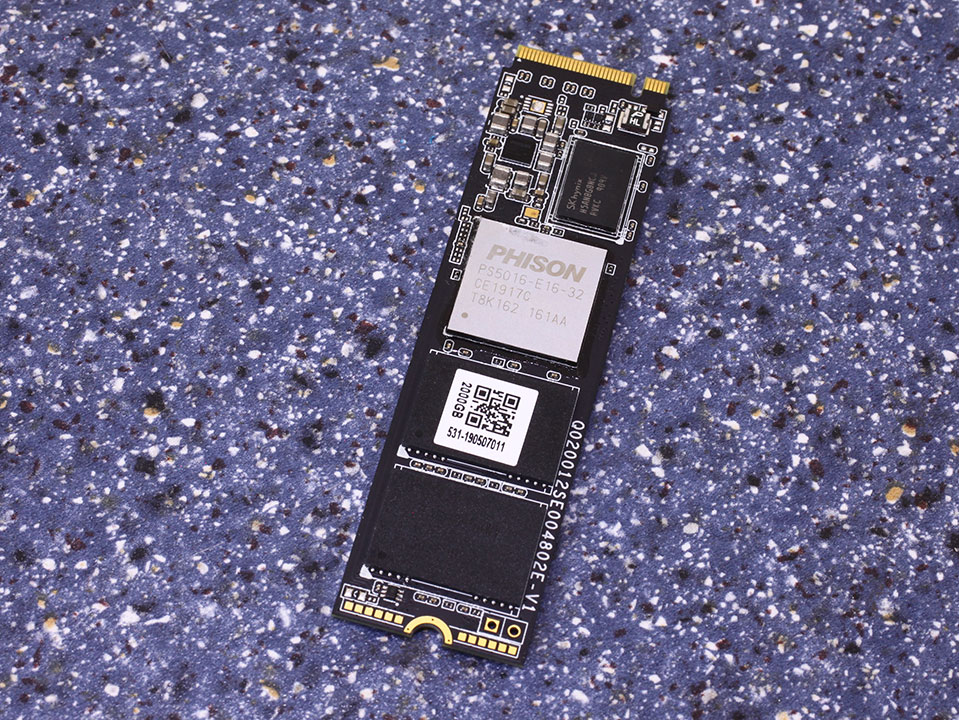

The Gigabyte Aorus NVMe Gen4 SSD uses four flash chips and two DRAM chips, which all feed data into a Phison SSD controller.


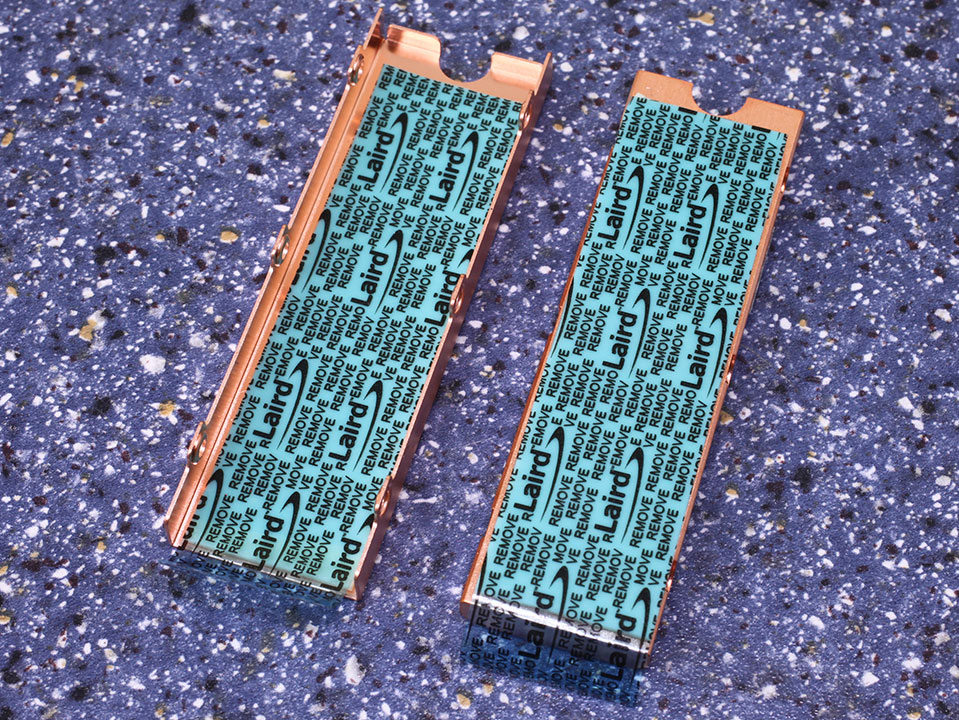

Gigabyte includes a large heatsink with their drive, which is surprisingly heavy due to generous amounts of copper. Unlike other heatsinks, it completely enshrouds the drive, providing cooling from top and bottom.

The Phison PS5016-E16-32 is a brand-new eight-channel SSD controller that was first shown at Computex Taiwan this year. Internally, it uses a dual-core ARM controller paired with two "CO-X processor cores", which seem to be some kind of Phison-proprietary acceleration unit.

Toshiba's TABHG65AWV flash chips are BiCS4 3D TLC NAND, using 96 layers.
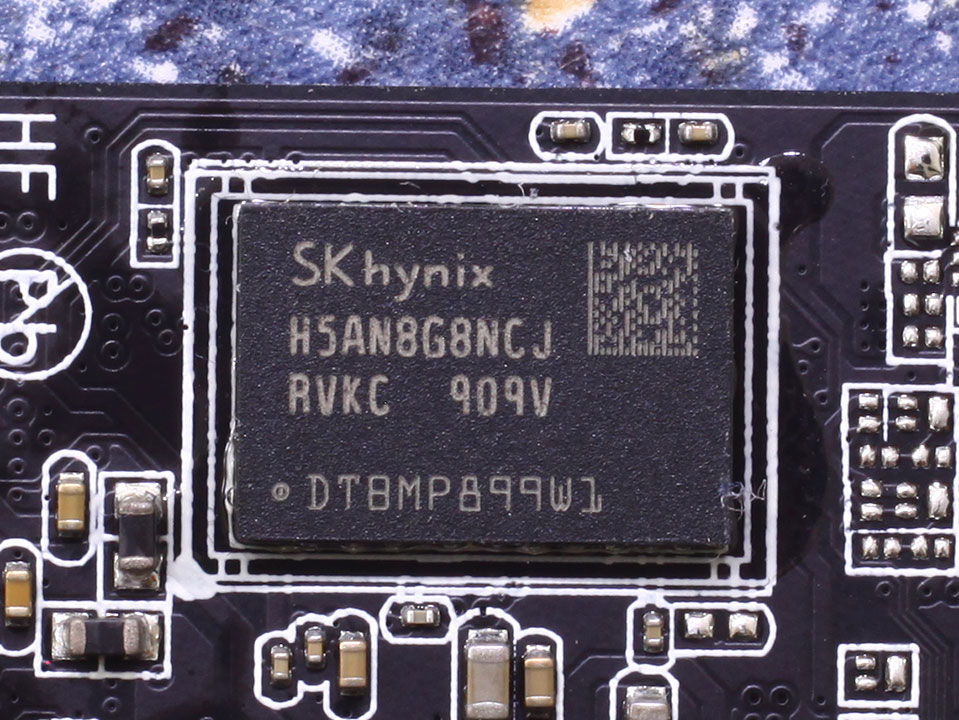
Two of these SKhynix H5AN8GNCJRVKC DDR4-2133 DRAM chips provide 2 GB of fast memory for the controller's mapping tables.
Test System
| Test System | |
|---|---|
| Processor: | AMD Ryzen 9 3900X (12-cores / 24 threads) Zen 2, 3.8 GHz to 4.6 GHz |
| Motherboard: | ASRock X570 Taichi AMD X570, BIOS v1.30 |
| Memory: | 2x 8 GB G.SKILL Flare X DDR4 DDR4-3200 14-14-14-34 |
| Graphics: | EVGA GeForce RTX 2080 Ti FTW3 Ultra |
| Storage: | Gigabyte Aorus M.2 NVMe Gen4 SSD 2 TB |
| Power Supply: | Seasonic SS-860XP |
| Software: | Windows 10 Professional 64-bit Version 1809 (October 2018 Update) |
| Drivers: | NVIDIA GeForce 430.63 WHQL AMD Chipset 1.07.07.0725 |
Our Patreon Silver Supporters can read articles in single-page format.
Nov 20th, 2026 03:19 PST
change timezone
Latest GPU Drivers
New Forum Posts
- Windows 11 General Discussion (7738)
- Honestly, do you care about GTA VI? (179)
- Making a game in Godot engine (8)
- Anime Nation (13188)
- Folding Pie and Milestones!! (10207)
- RX 7600 + Ryzen 5 5600GT getting the same FPS as my old RX 6500 XT – What am I missing? (12)
- GTA VI (13)
- Intel Core Ultra 5 processor 250K Plus (1)
- How to prevent OLED burn damage due to PC freezes or power outtages? (41)
- WarpCoreBench scores! (79)
Popular Reviews
- AMD Zen 6 Technical Deep Dive
- Ugreen NASync DXP4800 GT Review
- Acemagic Retro X3 Review
- Corsair RM1200e (Second Generation) Review
- Upcoming Hardware Launches 2027 (Updated Nov 2026)
- Pulsar Office Tour & First Look at P1 Dual-Sensor Mouse
- Biwin Black Opal NV7400 2 TB Review
- Chieftec Iceberg PRO 360 DARK Review
- AMD Ryzen 7 9800X3D Memory Performance Scaling
- AMD Ryzen 7 9800X3D Review - The Best Gaming Processor
TPU on YouTube
Controversial News Posts
- NVIDIA Co-Founder and CEO Jensen Huang Officially Resigns (490)
- Report: Jensen Huang Eyes NVIDIA Comeback (226)
- Open Letter Asking NVIDIA to Reinstate Jensen Huang Passes 115,000 Signatures (184)
- OpenAI CEO Argues Home PCs Waste the World's Limited DRAM Supply (152)
- NVIDIA Launches Investigation Into Jensen Huang's Relationship With Suspected Chinese Spy (136)
- Intel "Raptor Lake Next" 16-Core and 20-Core CPUs Surface (130)
- Legendary Game Studio BioWare Shuts Down Following EA Layoffs (104)
- Dell CEO Says the Memory Shortage Will Get Worse in 2027 (95)