 12
PELADN WO4 Review
(12 Comments) »Value and Conclusion
- The PELADN WO4 5600H (Ryzen 5 5600H, 16 GB RAM, 512 GB SSD) typically sells around $280 USD for this configuration.
- Unique front-plate design with a retro look
- Good everyday performance from the Ryzen 5 5600H
- Runs light creative work and productivity apps well for its class
- Very consistent and predictable power draw across all workloads
- Quiet, even during heavy use
- Great price per performance
- Upgrades require removing the motherboard completely
- Ships with only 16 GB of RAM and a 512 GB drive
- Single NVMe slot, supports only PCIe 3.0
- Vega graphics limit modern gaming performance
- USB-C does not support video output
Technology & Positioning
The PELADN WO4 is built around AMD's Ryzen 5 5600H, which shows that it still holds up well for general computing. It is essentially in a performance tier where browsers, Office apps, meetings, and multitasking feel responsive enough, and it handles heavier loads like encoding or Blender work at a decent pace for a budget mini. It falls behind newer Ryzen AI and Meteor Lake systems in raw throughput, but at this price point, the WO4 targets users who want a low-cost mini for everyday use. As a compact daily machine, the performance level fits its purpose well.
Gaming Performance
Radeon Vega graphics are getting old at this point, so expectations were pretty modest going into testing. In eSports titles like Dota 2 and Counter Strike 2, the WO4 does fine once you dial settings back, especially at 720p. At 1080p, lighter games remain playable, but modern AAA titles struggle hard even on the lowest presets. The system is best suited for casual gaming, older or retro-style titles, and anything that isn't too demanding. That lines up with the WO4's place in the market as a budget-focused mini PC, so its gaming results make sense for what it is.
Real-World Performance
Daily work feels consistent and responsive for something in this price bracket. For example, the PCMark and Procyon results sit above many low-end Alder Lake N-series minis and close to Ryzen 7 5825U systems, which shows the advantage of the higher power envelope on the 5600H. Encoding in HandBrake finishes in reasonable times, and 7-Zip performance is stronger than expected for this class. The unit stays reasonably quiet even during sustained workloads, while its power draw looked well-controlled across all our test scenarios. Overall, the WO4 ends up performing better than I expected.
Storage Performance
The included PCIe 3.0 NVMe SSD lands around 3,300 MB/s reads and 2,600 MB/s writes, which is about what you expect from a mid-tier Gen 3 drive. The system boots quickly and everyday tasks feel responsive, but large transfers or sustained writes show the limits of a budget SSD. The WO4 only provides a single NVMe slot along with a 2.5 inch SATA bay, so expansion is limited to one extra drive rather than additional high-speed storage. Reaching the NVMe slot requires removing the cooling fan and lifting the entire motherboard, which adds time to what would normally be a quick upgrade. Most users buying a system at this price point will likely outgrow the stock 512 GB SSD, so storage is one of the first components worth replacing if you need more space.
Connectivity and I/O
The WO4 offers the usual set of ports for a budget mini, including USB 3.2 and USB 3.0 ports, HDMI 2.0, DisplayPort 1.4, dual Ethernet, and a front USB-C port. The USB-C port is data only, so all video output comes from the HDMI and DisplayPort connectors on the back. This still gives you a proper dual-monitor setup at 4K60, which is more than enough for office work, coding, media, and most productivity layouts. Users who want to run three displays or rely on USB-C video will hit a limit here, but for the typical home or small-office workload, the available outputs cover the essentials without feeling restrictive.
Build Quality
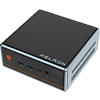
Even with its plastic build, the front plate gives it a distinct, almost retro style that stands out from the usual square minis. Inside, the layout is a bit unusual. A large fan covers most of the motherboard, and you have to remove the entire thing (screws and all) to reach the RAM and NVMe slot on the other side. So, upgrades take more steps than they should, and it's clear this system is meant for only occasional tinkering rather than frequent hardware swaps.
Pricing and Alternatives
The WO4 sits far below the pricing of newer Ryzen AI or Intel Ultra minis. The WO4 fills the budget-friendly slot very well, offering more performance than entry-level systems without moving into the premium category.
The WO4 5600H is in a similar price range as the ALLIWAVA U58, but the performance gap between them certainly varies. The WO4's 6-core 45 W processor handles heavier workloads, multitasking, and encoding jobs far better than the U58's low-power chip. If you need real CPU strength or plan to run anything beyond basic office tasks, the WO4 gives you more speed for roughly the same money.
The U58 is still fine for light browsing, media, or simple productivity, but its performance ceiling is much lower. For buyers who want more headroom and longer usefulness before upgrading again, the WO4 delivers stronger performance per dollar.
Bottom Line
The PELADN WO4 is a small, budget-friendly mini PC that easily handles day-to-day computing, all with a unique look and feel. It runs productivity apps smoothly, can take on light creative tasks, and stays quiet under typical loads. While its gaming performance is minimal and upgrades require more effort than on most systems, the WO4 offers great value for the price.

The PELADN WO4 is built around AMD's Ryzen 5 5600H, which shows that it still holds up well for general computing. It is essentially in a performance tier where browsers, Office apps, meetings, and multitasking feel responsive enough, and it handles heavier loads like encoding or Blender work at a decent pace for a budget mini. It falls behind newer Ryzen AI and Meteor Lake systems in raw throughput, but at this price point, the WO4 targets users who want a low-cost mini for everyday use. As a compact daily machine, the performance level fits its purpose well.
Gaming Performance
Radeon Vega graphics are getting old at this point, so expectations were pretty modest going into testing. In eSports titles like Dota 2 and Counter Strike 2, the WO4 does fine once you dial settings back, especially at 720p. At 1080p, lighter games remain playable, but modern AAA titles struggle hard even on the lowest presets. The system is best suited for casual gaming, older or retro-style titles, and anything that isn't too demanding. That lines up with the WO4's place in the market as a budget-focused mini PC, so its gaming results make sense for what it is.
Real-World Performance
Daily work feels consistent and responsive for something in this price bracket. For example, the PCMark and Procyon results sit above many low-end Alder Lake N-series minis and close to Ryzen 7 5825U systems, which shows the advantage of the higher power envelope on the 5600H. Encoding in HandBrake finishes in reasonable times, and 7-Zip performance is stronger than expected for this class. The unit stays reasonably quiet even during sustained workloads, while its power draw looked well-controlled across all our test scenarios. Overall, the WO4 ends up performing better than I expected.
Storage Performance
The included PCIe 3.0 NVMe SSD lands around 3,300 MB/s reads and 2,600 MB/s writes, which is about what you expect from a mid-tier Gen 3 drive. The system boots quickly and everyday tasks feel responsive, but large transfers or sustained writes show the limits of a budget SSD. The WO4 only provides a single NVMe slot along with a 2.5 inch SATA bay, so expansion is limited to one extra drive rather than additional high-speed storage. Reaching the NVMe slot requires removing the cooling fan and lifting the entire motherboard, which adds time to what would normally be a quick upgrade. Most users buying a system at this price point will likely outgrow the stock 512 GB SSD, so storage is one of the first components worth replacing if you need more space.
Connectivity and I/O
The WO4 offers the usual set of ports for a budget mini, including USB 3.2 and USB 3.0 ports, HDMI 2.0, DisplayPort 1.4, dual Ethernet, and a front USB-C port. The USB-C port is data only, so all video output comes from the HDMI and DisplayPort connectors on the back. This still gives you a proper dual-monitor setup at 4K60, which is more than enough for office work, coding, media, and most productivity layouts. Users who want to run three displays or rely on USB-C video will hit a limit here, but for the typical home or small-office workload, the available outputs cover the essentials without feeling restrictive.
Build Quality
Even with its plastic build, the front plate gives it a distinct, almost retro style that stands out from the usual square minis. Inside, the layout is a bit unusual. A large fan covers most of the motherboard, and you have to remove the entire thing (screws and all) to reach the RAM and NVMe slot on the other side. So, upgrades take more steps than they should, and it's clear this system is meant for only occasional tinkering rather than frequent hardware swaps.
Pricing and Alternatives
The WO4 sits far below the pricing of newer Ryzen AI or Intel Ultra minis. The WO4 fills the budget-friendly slot very well, offering more performance than entry-level systems without moving into the premium category.
The WO4 5600H is in a similar price range as the ALLIWAVA U58, but the performance gap between them certainly varies. The WO4's 6-core 45 W processor handles heavier workloads, multitasking, and encoding jobs far better than the U58's low-power chip. If you need real CPU strength or plan to run anything beyond basic office tasks, the WO4 gives you more speed for roughly the same money.
The U58 is still fine for light browsing, media, or simple productivity, but its performance ceiling is much lower. For buyers who want more headroom and longer usefulness before upgrading again, the WO4 delivers stronger performance per dollar.
Bottom Line
The PELADN WO4 is a small, budget-friendly mini PC that easily handles day-to-day computing, all with a unique look and feel. It runs productivity apps smoothly, can take on light creative tasks, and stays quiet under typical loads. While its gaming performance is minimal and upgrades require more effort than on most systems, the WO4 offers great value for the price.
Nov 26th, 2026 11:57 CST
change timezone
Latest GPU Drivers
New Forum Posts
- ASUS Prime 5060 ti 16gb x4 instead of x8 PCIe (2)
- TPU's WCG/BOINC Team (34806)
- What's your main Black Friday / Cyber Monday purchase? (22)
- WarpCoreBench scores! (108)
- Radeon driver death (5)
- Making a game in Godot engine (22)
- Current Sales, Bundles, Giveaways (10452)
- Can you guess Which game it is? (368)
- Free Games Thread (5385)
- Post your CrystalDiskMark speeds (659)
Popular Reviews
- ASRock X870E Challenger Wi-Fi White Review
- VZMORE AX9 Max Review
- Upcoming Hardware Launches 2027 (Updated Nov 2026)
- Microsoft Surface Laptop Ultra Review - The Next-gen Arm Laptop
- AMD Ryzen 7 9800X3D Review - The Best Gaming Processor
- AMD Zen 6 Technical Deep Dive
- Corsair RM1200e (Second Generation) Review
- Phantom Blade Zero Performance Benchmark Review - 35 GPUs Tested
- Montech CyberFlow ARGB 360 Review
- Pulsar Office Tour & First Look at P1 Dual-Sensor Mouse
TPU on YouTube
Controversial News Posts
- Jensen Huang Reinstated as CEO of NVIDIA (596)
- NVIDIA Co-Founder and CEO Jensen Huang Officially Resigns (492)
- Report: Jensen Huang Eyes NVIDIA Comeback (281)
- Open Letter Asking NVIDIA to Reinstate Jensen Huang Passes 115,000 Signatures (184)
- OpenAI CEO Argues Home PCs Waste the World's Limited DRAM Supply (152)
- NVIDIA Launches Investigation Into Jensen Huang's Relationship With Suspected Chinese Spy (136)
- Intel "Raptor Lake Next" 16-Core and 20-Core CPUs Surface (130)
- Intel Razor Lake Gets a 12 P-Core bLLC Chip With No E-Cores, Per Leak (94)