 12
PELADN WO4 Review
Web & Office Productivity »General Performance
AIDA64 Cache and Memory
First up in our performance analysis is AIDA64's memory benchmark. This test gives a clear picture of how quickly the CPU and memory subsystem can move data. Since the Radeon iGPU relies on system RAM, bandwidth and latency play a direct role in both everyday responsiveness and graphics performance.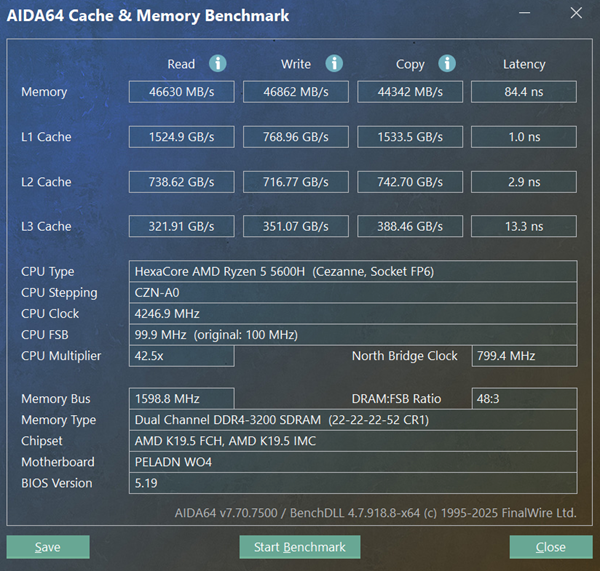
The AIDA64 memory test shows the WO4 performing as expected for a dual-channel DDR4-3200 setup. It reached 46,630 MB/s read, 46,862 MB/s write, and 44,342 MB/s copy, with 84.4 ns latency. These numbers aren't anywhere near DDR5 systems, but they are normal for Zen 3 paired with DDR4 and give the 5600H enough bandwidth for everyday use and lightweight multitasking. L1 and L2 cache results fall in line with other 5600H systems we have tested before.
Cinebench
Cinebench measures how well the CPU handles both single-threaded and multithreaded rendering. It is a simple way to compare real compute performance across systems.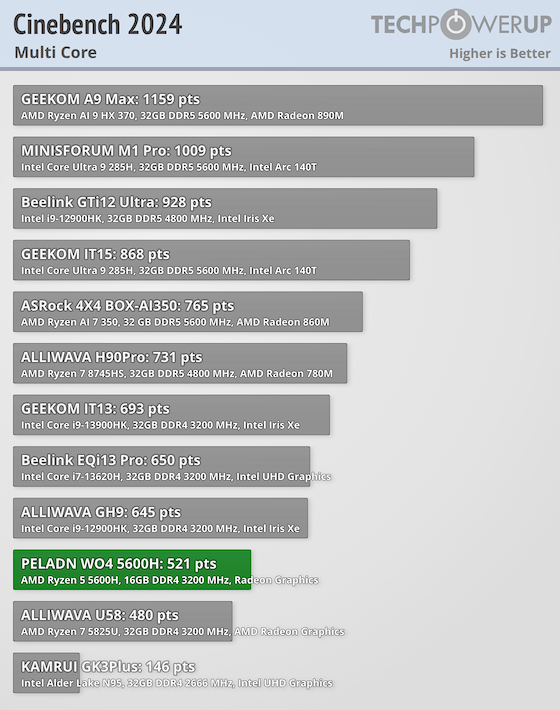
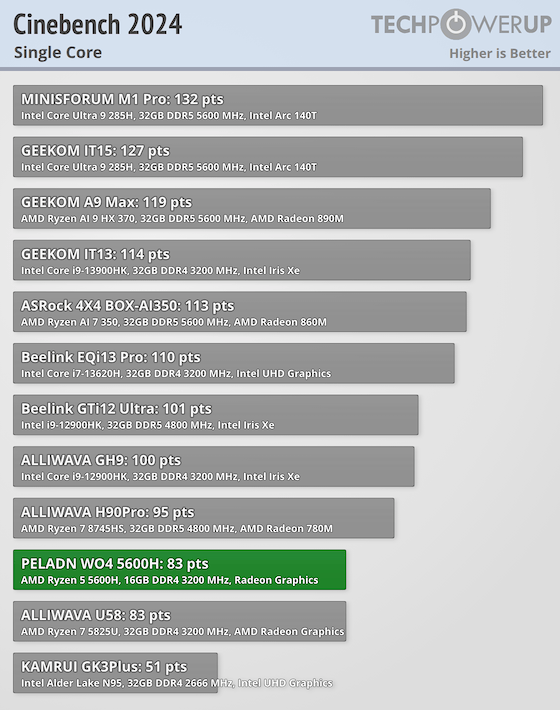
Results tell us that the Ryzen 5 5600H is definitely in the entry-level range for modern minis. It scored 521 multicore and 83 single-core, which puts it well behind newer Ryzen 7000/8000 and modern Intel chips but still ahead of low-power N-series units. For everyday tasks and office work, the CPU feels responsive, but it won't keep up with heavier rendering or export workloads.
7-Zip
7-Zip's internal benchmark stresses compression and decompression, which shows how the CPU handles file-heavy tasks like installs, archiving, and packaging.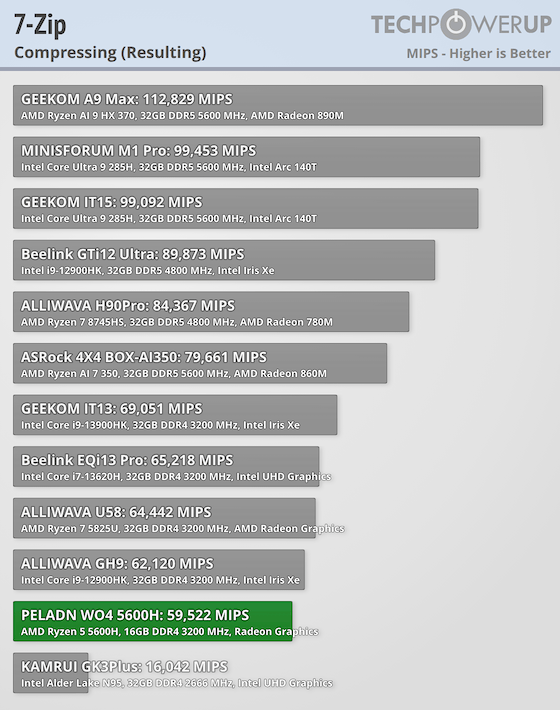
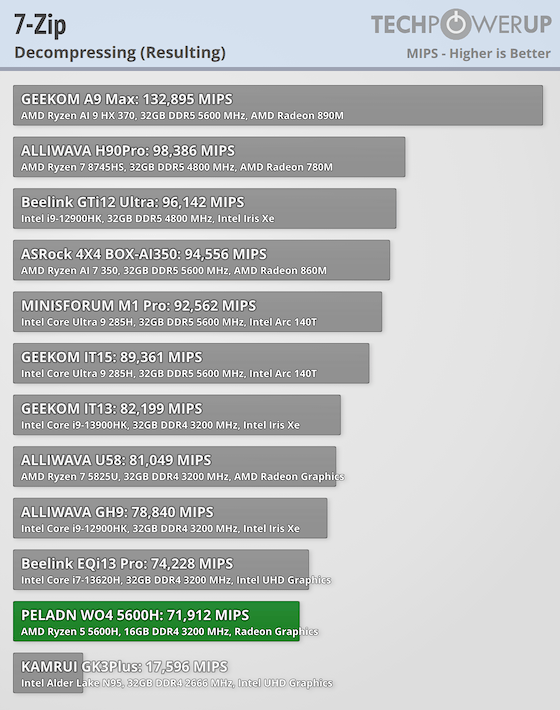
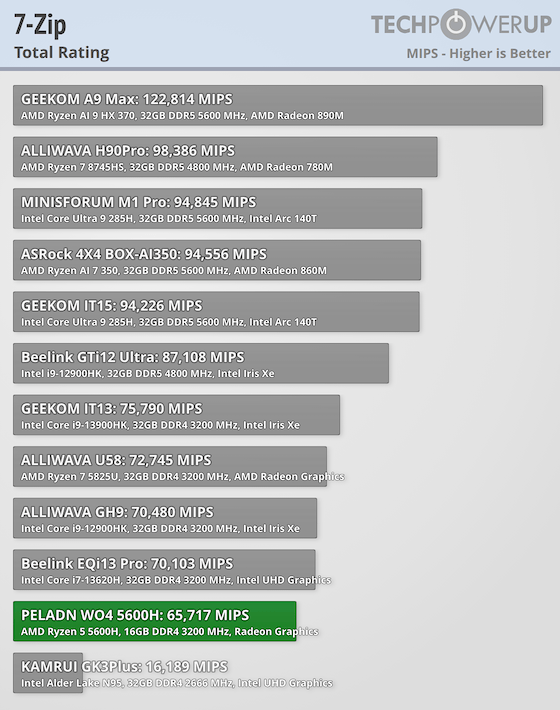
Compression lands at 59,522 MIPS, decompression at 71,912 MIPS, and the total score comes in at 65,717. These numbers reflect the efficiency of Zen 3 and give the WO4 enough strength for steady file handling, software installs, and large archive work. While these results are modest, it stays well ahead of some other entry-level minis.
PCMark 10
PCMark simulates real PC use through web browsing, video calls, spreadsheets, and lightweight content creation.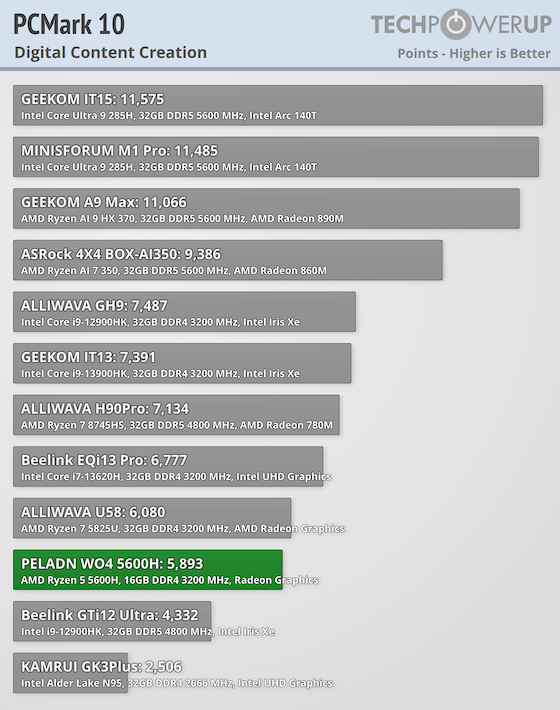
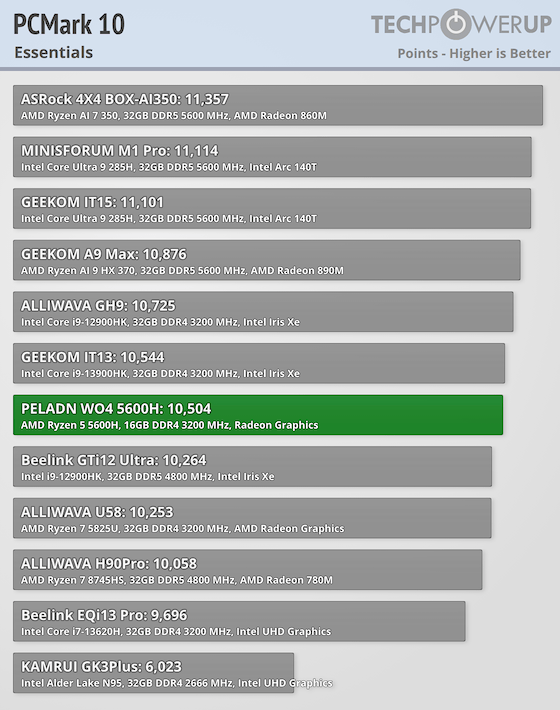
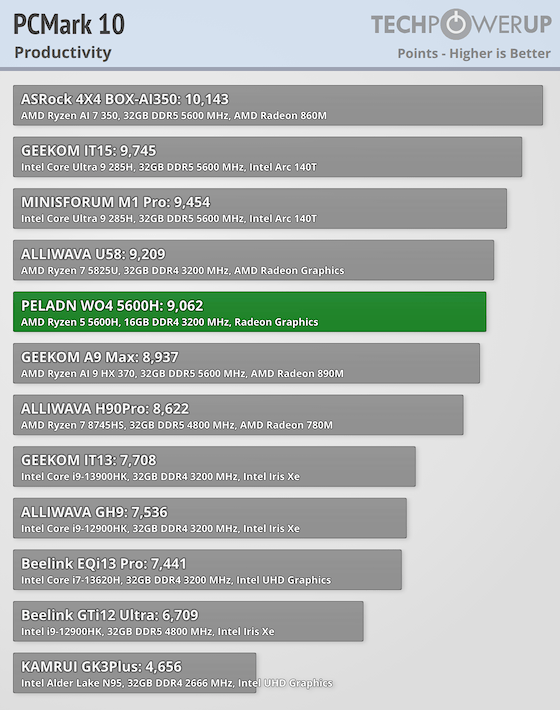
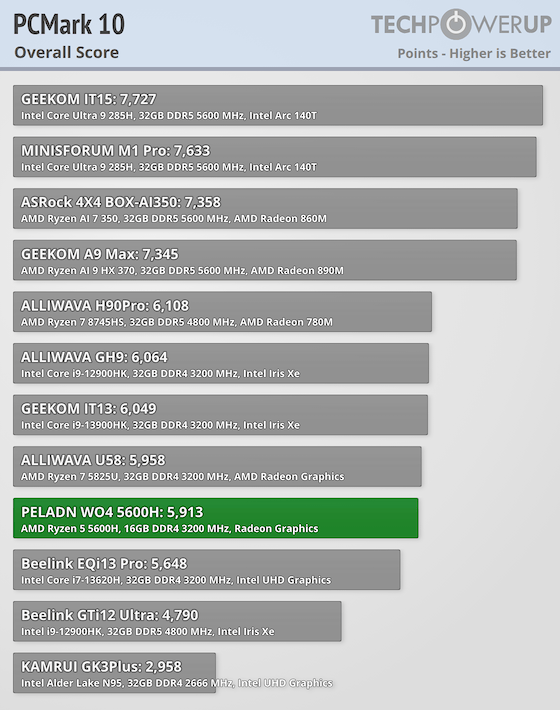
PCMark gives a good look at real-world mixed workloads, and the WO4 landed right where a 5600H system should. It scored 10,504 in Essentials, 9,062 in Productivity, 5,893 in Digital Content Creation, and 5,913 overall. Browsing, conferencing, document editing, and multi-app workflows all feel smooth, though content creation workloads that rely on GPU acceleration or heavy multithreading show the limitations of Vega graphics and DDR4.
Y-Cruncher
Y-Cruncher stresses the CPU with an extremely heavy math workload, making it a good stress test for stability and raw compute.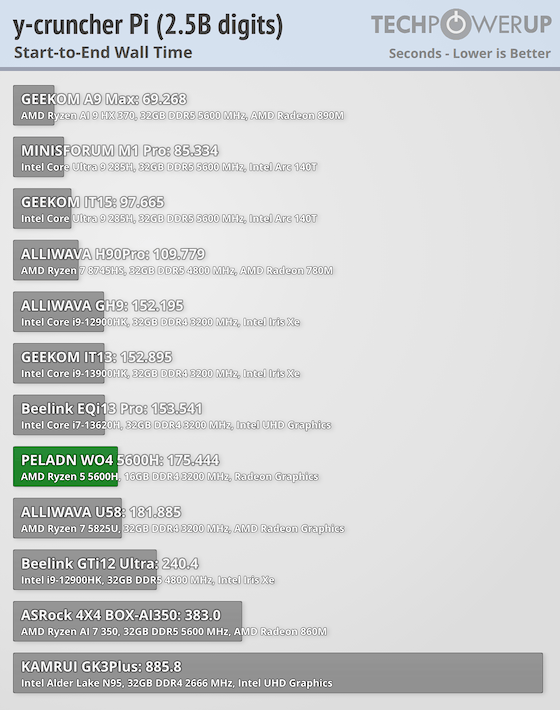
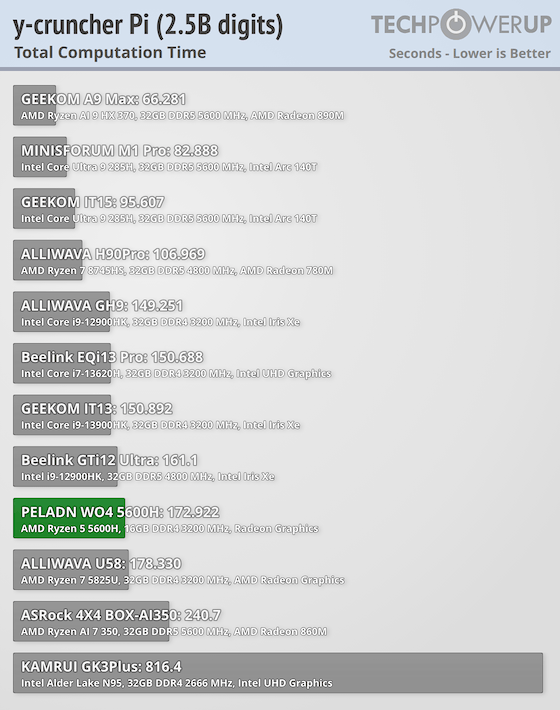
The WO4 completes the 2.5B Pi run in 172.922 seconds with a 175.444 second wall time. These times show that the CPU can handle sustained workloads without major drops, but the platform's DDR4 memory does limit throughput.
Geekbench
Geekbench covers a wide range of real workloads and gives a balanced look at CPU strength.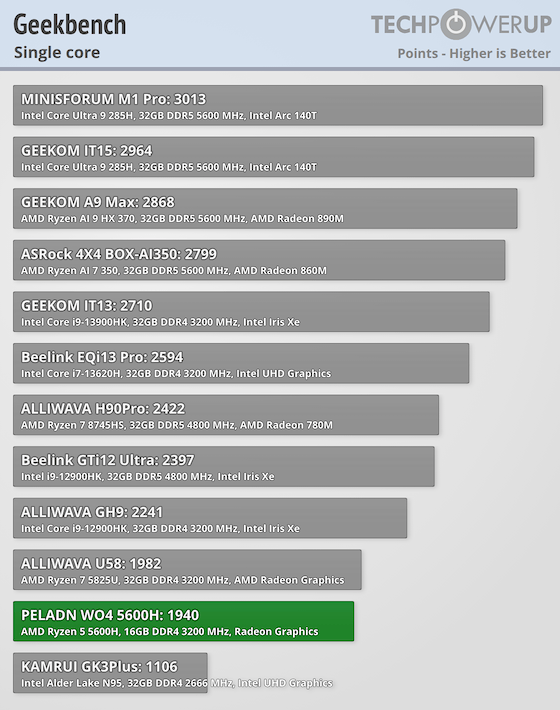
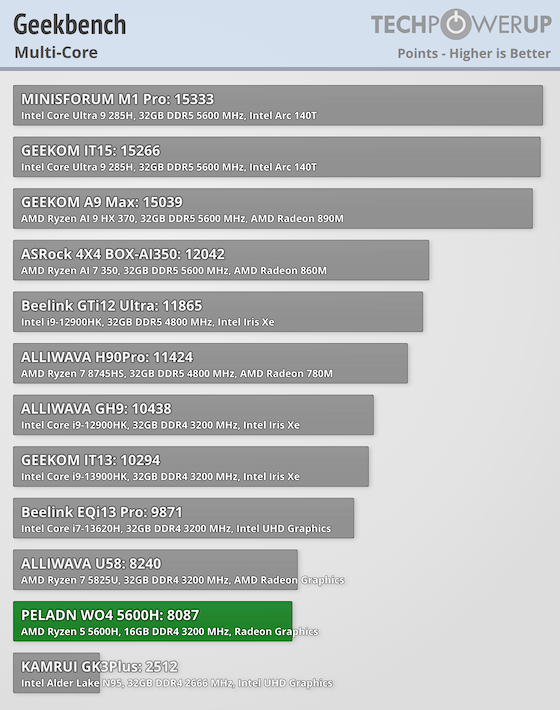
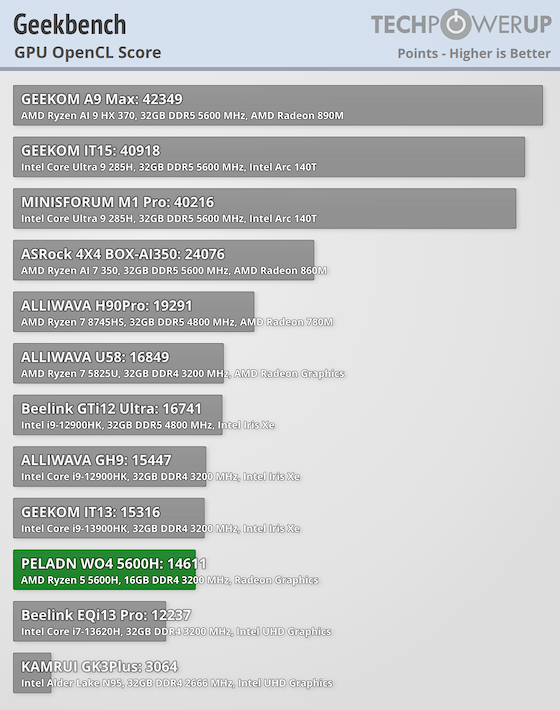
The system posts 1,940 in single-core and 8,087 in multicore, which lines up with what we expect from a 5600H with DDR4 RAM. Everyday tasks feel quick, and multithreaded workloads make good use of the six cores. The 14,611 OpenCL score shows that Vega can still help with light compute workloads, though it really can't touch modern iGPUs.
Nov 26th, 2026 10:07 CST
change timezone
Latest GPU Drivers
New Forum Posts
- What's your main Black Friday / Cyber Monday purchase? (18)
- Wireless Internet sharing between PC and router both-ways, is it possible? (24)
- Can you guess Which game it is? (366)
- Post your CrystalDiskMark speeds (658)
- Making a game in Godot engine (20)
- X79 and/or rampage IV OC'ing thread for those of us still left.... (2459)
- Exploring Local LLMs: Models, Hardware and Setup Experiences (4)
- Linpack Xtreme Released (513)
- Claude credits purchased on or after Dec. 7 now have an expiry date (20)
- Acer TravelMate P414-51 (i5-1135G7): CPU stuck at x4 / ~200 MHz effective under 100% load, no throttle flags. How to find who's clamping it? (1)
Popular Reviews
- ASRock X870E Challenger Wi-Fi White Review
- VZMORE AX9 Max Review
- Upcoming Hardware Launches 2027 (Updated Nov 2026)
- Microsoft Surface Laptop Ultra Review - The Next-gen Arm Laptop
- AMD Ryzen 7 9800X3D Review - The Best Gaming Processor
- AMD Zen 6 Technical Deep Dive
- Corsair RM1200e (Second Generation) Review
- Phantom Blade Zero Performance Benchmark Review - 35 GPUs Tested
- Montech CyberFlow ARGB 360 Review
- Pulsar Office Tour & First Look at P1 Dual-Sensor Mouse
TPU on YouTube
Controversial News Posts
- Jensen Huang Reinstated as CEO of NVIDIA (586)
- NVIDIA Co-Founder and CEO Jensen Huang Officially Resigns (492)
- Report: Jensen Huang Eyes NVIDIA Comeback (281)
- Open Letter Asking NVIDIA to Reinstate Jensen Huang Passes 115,000 Signatures (184)
- OpenAI CEO Argues Home PCs Waste the World's Limited DRAM Supply (152)
- NVIDIA Launches Investigation Into Jensen Huang's Relationship With Suspected Chinese Spy (136)
- Intel "Raptor Lake Next" 16-Core and 20-Core CPUs Surface (130)
- Intel Razor Lake Gets a 12 P-Core bLLC Chip With No E-Cores, Per Leak (94)