 4
PowerColor ALPHYN AM10 Review
Value & Conclusion »Software
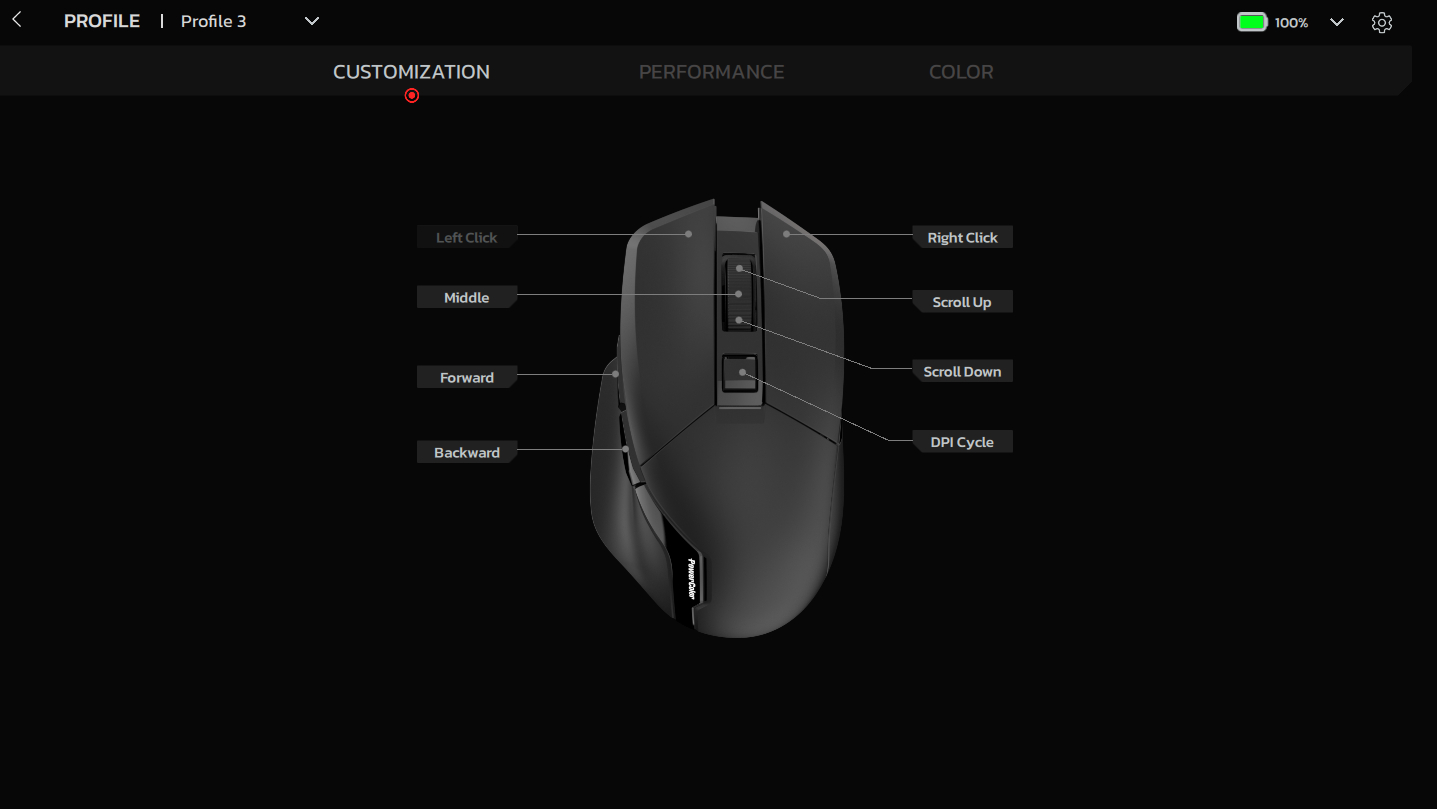


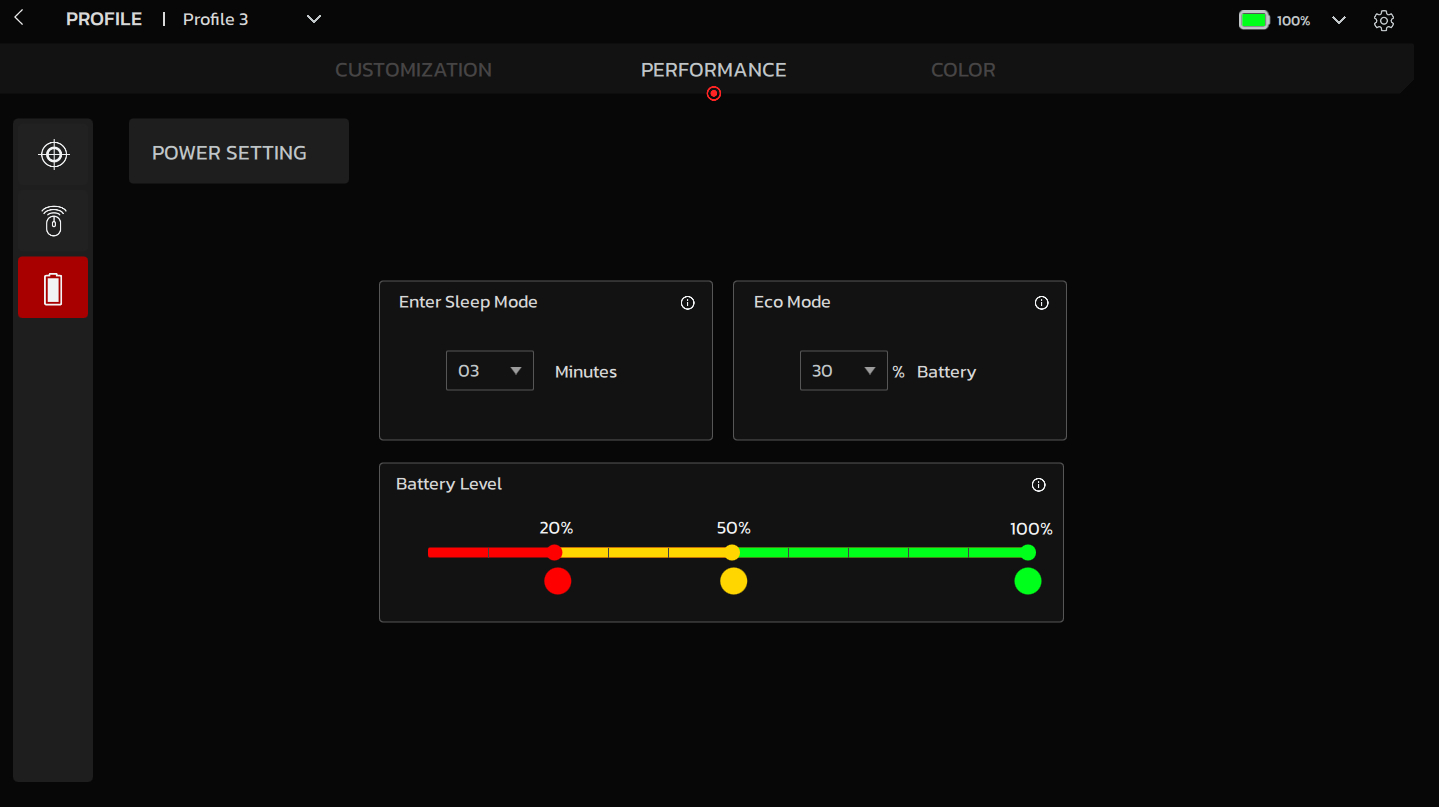

The ALPHYN AM10 is compatible with PowerColor KeyStone, which also supports multiple other PowerColor devices. Upon the initial launch, settings were either not displayed at all or incorrectly, which could only be rectified by resetting to default. This faulty state resurfaced at later points, too. On subsequent launches, the software frequently crashed, eventually launching after multiple attempts.
All options are accessible through three different tabs. The first page allows for button remapping to mouse, keyboard, media, and macro functions for all but the left button. The second page houses CPI adjustment settings for up to five color-coded levels, ranging from 100 to 26,000 CPI, in increments of 50 CPI and independently for the x- and y-axis. Non-native values can be entered manually but will not be truncated to native ones, yet only native values are actually put into effect. Lift-off distance may be set to 1 or 2 mm, or a manual calibration may be performed. Polling rate may be set to 250, 500, 1000, 2000, 4000, or 8000 Hz in wired operation, and 250, 500, or 1000 Hz in wireless operation. Furthermore, the idle time needed to pass before sleep mode is entered may be configured, the battery charge percentage at which illumination is disabled and polling rate lowered, and the battery charge stages corresponding to display colors. The third page includes lighting options and is detailed below. Profile management is present as well, though often won't work correctly.
All settings changes are saved to the on-board memory, so the software does not need to be running (or even installed) all the time. On my system, the software had a RAM footprint of roughly 120 MB on average when running in the foreground, which doesn't change when minimized to the system tray. Upon exiting the application, all processes are terminated, as they should be.
Lighting
The ALPHYN AM10 has three physical lighting zones: the scroll wheel, front, and a lighting accent at the back. Within the software, eight different lighting effects are available: Single Color, Breathing, Double Blink, Color Shift, Meteor, Ripple, Blink, and Rainbow. Colors, brightness, and transition speed may be adjusted, and by lowering brightness to zero, the lighting can be disabled altogether.Color accuracy and vibrancy are excellent throughout. In this short demonstration video I go through the Breathing, Color Shift, and Rainbow lighting effects. Please note that brightness has been set to 100%:
Battery Life
PowerColor cites up to 50 hours of battery life. No indication is made whether this applies to 2.4 GHz wireless or Bluetooth, with or without illumination. The software features a percentage-based battery life indicator, although it only utilizes increments of 10%. After more than five hours of usage with RGB lighting set to 100% brightness, the battery life indicator still did not drop to 90%. Arithmetically, we therefore can surmise that a battery life of at least 50 hours even with full illumination might be expected.Sleep mode is entered after three minutes of inactivity by default, but this can be adjusted within the software.
Using the included USB Type-A to Type-C charging cable, I measured the charging speed during the constant current stage, which sits at 0.460 A when lifted and 0.445 A when not lifted. The battery has a capacity of 500 mAh and utilizes a 3-pin JST connector.
Nov 21st, 2026 07:08 PST
change timezone
Latest GPU Drivers
New Forum Posts
- Cpu waterblock water shows some tinting = Bad? (18)
- GeekMagic Ultra Smart WiFi Weather Station (9)
- What's your latest tech Freebie? (87)
- UPS what one to get? (3)
- Differences i might've missed between these ultrawides to decide which to buy during BF. (0)
- Honestly, do you care about GTA VI? (220)
- Anthrophics IPO (31)
- Without Jensen, PC gaming will be (53)
- WarpCoreBench scores! (88)
- TPU's Nostalgic Hardware Club (22179)
Popular Reviews
- Microsoft Surface Laptop Ultra Review - The Next-gen Arm Laptop
- Ugreen NASync DXP4800 GT Review
- Corsair RM1200e (Second Generation) Review
- Pulsar Office Tour & First Look at P1 Dual-Sensor Mouse
- Upcoming Hardware Launches 2027 (Updated Nov 2026)
- Acemagic Retro X3 Review
- Biwin Black Opal NV7400 2 TB Review
- AMD Ryzen 7 9800X3D Review - The Best Gaming Processor
- AMD Zen 6 Technical Deep Dive
- Chieftec Iceberg PRO 360 DARK Review
TPU on YouTube
Controversial News Posts
- NVIDIA Co-Founder and CEO Jensen Huang Officially Resigns (491)
- Report: Jensen Huang Eyes NVIDIA Comeback (258)
- Open Letter Asking NVIDIA to Reinstate Jensen Huang Passes 115,000 Signatures (184)
- OpenAI CEO Argues Home PCs Waste the World's Limited DRAM Supply (152)
- NVIDIA Launches Investigation Into Jensen Huang's Relationship With Suspected Chinese Spy (136)
- Intel "Raptor Lake Next" 16-Core and 20-Core CPUs Surface (130)
- Legendary Game Studio BioWare Shuts Down Following EA Layoffs (104)
- NVIDIA GeForce RTX 50-Series Scheduled for up to $500 Price Hike This Week (89)