 2
Quick Look: EcoFlow RIVER Pro Portable Power Station
(2 Comments) »EcoFlow RIVER Pro

Our recent coverage of a large BLUETTI power station mostly came about because I was curious about the material science behind LiFePO4 as it pertains to electrodes, and that then led to my colleague covering more such power stations from the likes of Jackery and CTECHI. My own curiosity was sated, but we were then contacted by a Europe-based PR rep for EcoFlow, which meant I had to step back into the saddle. The original plan was to do a similar review of a large power station for a direct comparison to the many such entries popping up everywhere, but they all seem to be taking the crowdfunding route, which takes a while, so I offered to do a quick-look article of another of the company's products in the interim.

EcoFlow has two product lines of portable power stations split into the so-called DELTA and RIVER series. The DELTA series accommodates the larger, less portable units, similar to what has been covered on TechPowerUp before, and the RIVER series is far smaller in size with the largest unit—the RIVER Pro—maxing out at 720 Wh, compared to the smallest DELTA unit at 882 Wh. I have the RIVER Pro here, which has a few nifty features, such as internet connectivity and a mobile app to make these far more user friendly on the go. It's a ~7.5 kg unit, which makes it easier to pick up and take with you, with a great use case being camping trips in a car. Let's dig deeper into the EcoFlow RIVER Pro now, and thanks to the EcoFlow for arranging a review sample for TechPowerUp.
Packaging & Accessories


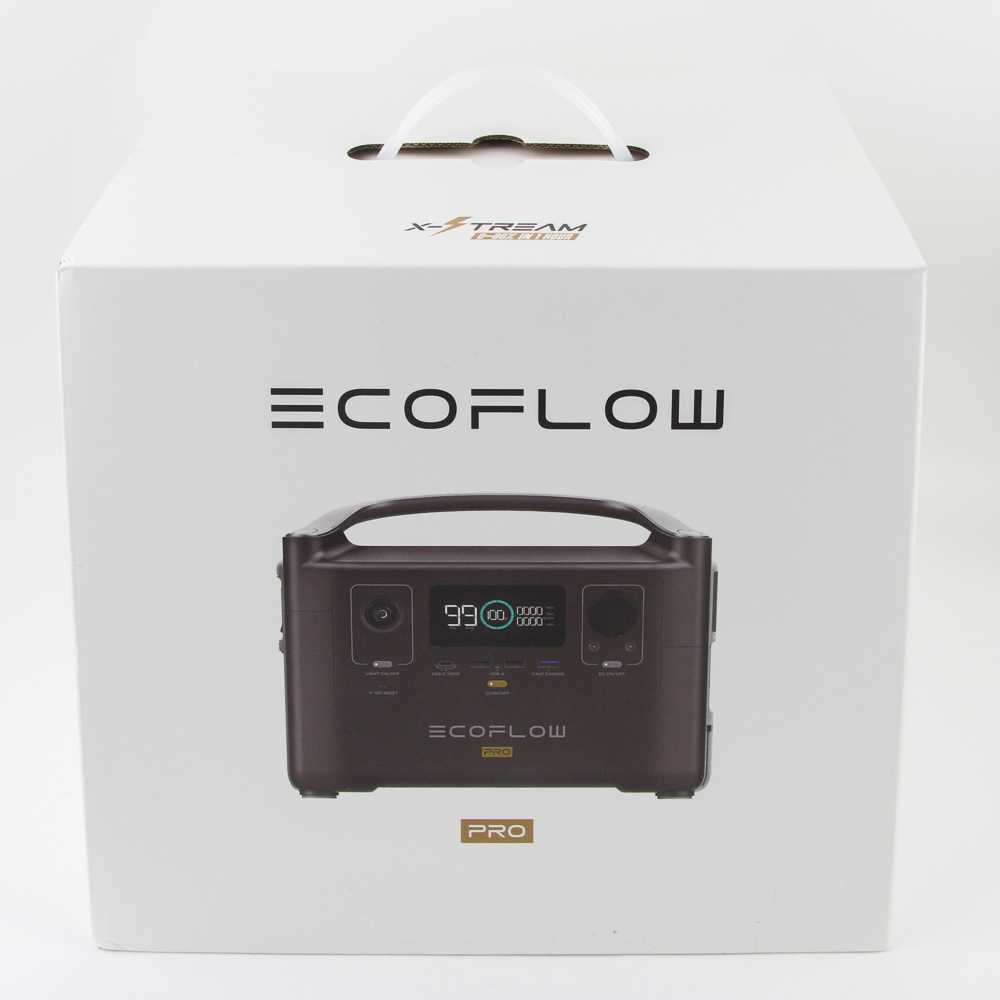


EcoFlow operates a web shop in the various regions it has a presence, including the UK, which is where this sample shipped from. We see the use of a thick cardboard shipment with the company logo and applicable warnings about the batteries inside. Opening this outer packaging reveals the product box, which is predominantly white with a carry handle to move it around. There is the company logo and product name on the front, along with a large render of the RIVER Pro, and a sticker on the back confirms the exact SKU inside. A double flap on the side keeps the contents in place during transit, and opening the box reveals lots of foam all around the items for added protection. This includes an accessory box above the power station placed between machined, thick foam sheets.
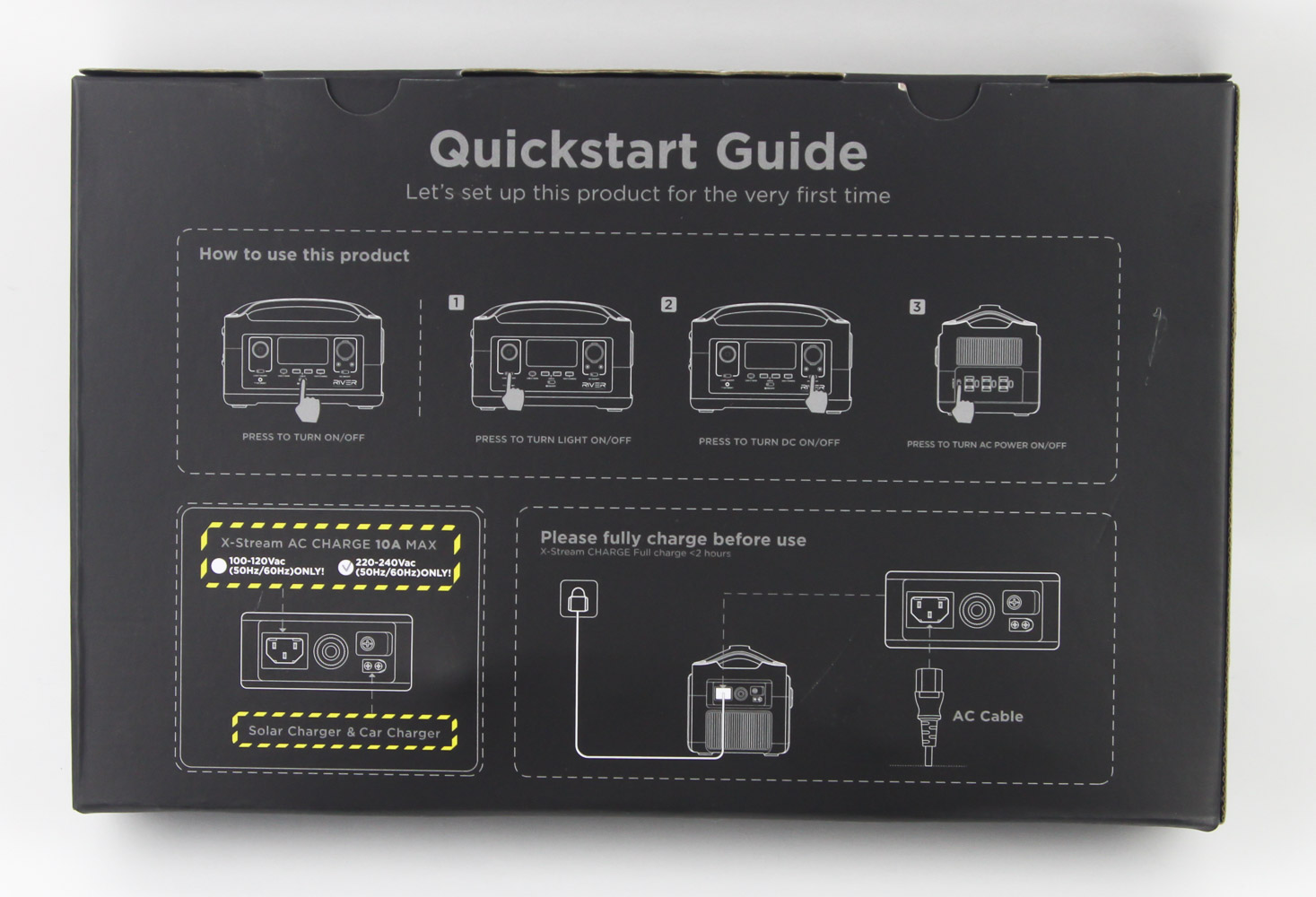
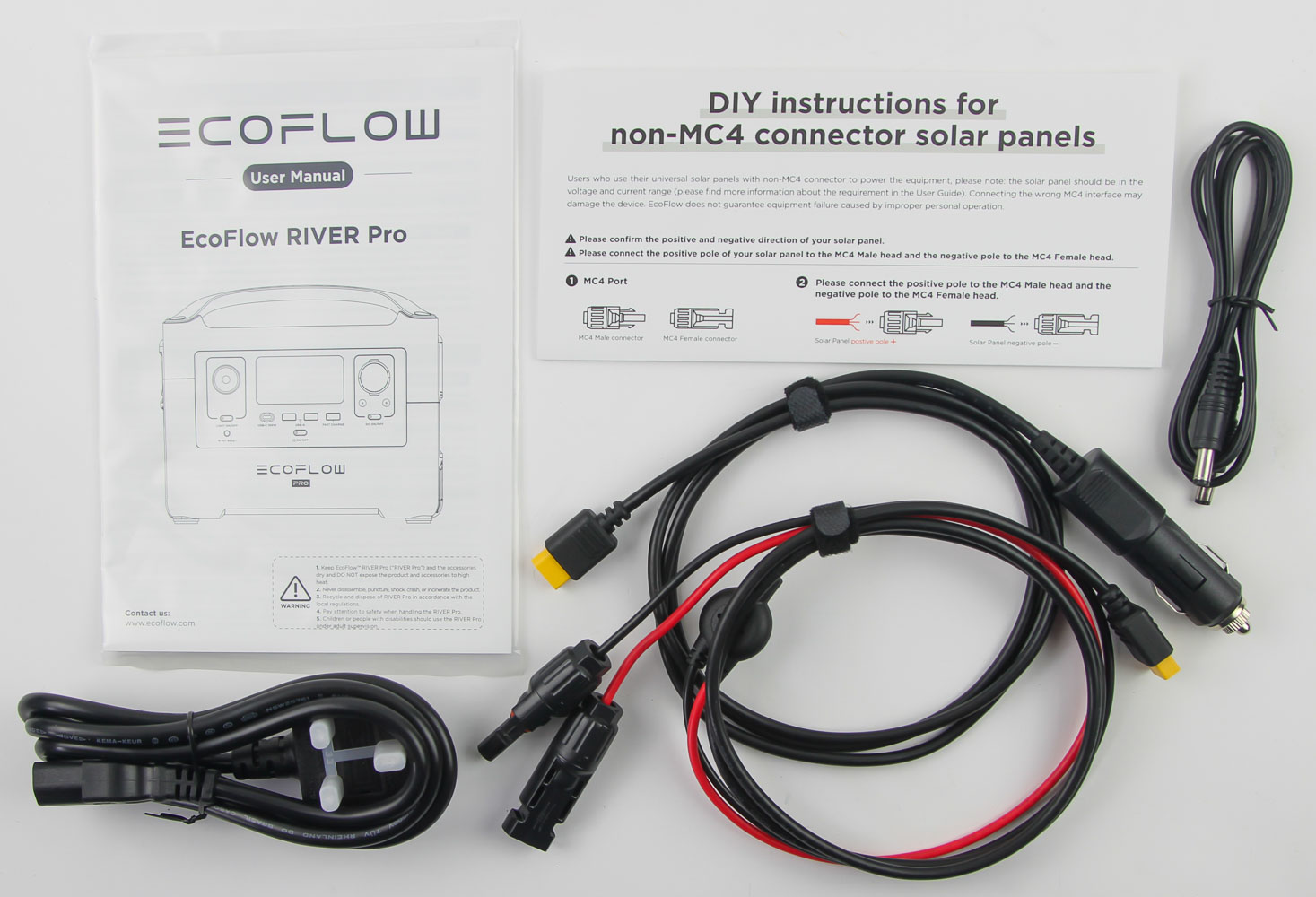


I appreciate the quick-start guide on the back of the accessory box, which is all you need to use around 90% of the capabilities of the RIVER Pro. This box contains a multi-language user manual (online copy here) that walks you through setup, charging, and various discharge/use options. It also reminds you to download and install the first-party mobile app for more control over the RIVER Pro power station. Such products tend to support solar charging with standard solar panels with MC4 connectors, but there is even a guide for when you have non-MC4 solar panels for whatever reason. As such, we also have 1.5 m adapter cables that go from dual MC4 (one positive, one negative) connectors to an XT60 connector, which no doubt goes to the power station itself. This XT60 connector is also on the 12 VDC cigarette lighter power cable used to charge the internal battery. EcoFlow also provides a DC5521 to DC5525 extension power jack cable, as well as an AC mains wall power adapter cable. I have the UK version characterized by its over-built and large UK power plug.
Closer Look


EcoFlow's RIVER series is for on-the-go auxiliary power, with this RIVER Pro being the largest of the lot with a battery capacity of 720 Wh, output of 600 W continuous and 1200 W peak, dimensions of 29x18x23.5 cm, and weight of ~7.5 kg. It's certainly not pocketable as with small power banks, but instead between power banks and larger power stations for capacity and size. The feature set is closer to the latter thus, at least with this model, making it a portable power station after all. The substantial handle on top helps move it around easily, at least if you can handle the weight. The color scheme is gray on the handles and black elsewhere, with a predominantly plastic composition that uses metal where critical.
The front houses a multi-colored LCD display without touch controls, which is about par the course for such devices, as it is only useful indoors or in cloudy external conditions—good luck making anything out in direct sunlight. It is large enough and clear enough to do its job of showing various status indicators, some of which we will see soon. The right side hosts the AC outputs, which on this UK model are placed sideways not to interfere with each other, along with a dedicated on/off button and covered expansion port to connect this to another add-on battery unit for more power if needed. Notice the fan behind the vents here, with more vents on the left cooling the unit along with the charging inputs (AC/M60) underneath a plastic latch. The bottom has four rubber pads for friction; not that this unit will move anywhere by itself. The specification/certification label is in the middle.


The front is likely where most of your time will be spent even outside of the LCD display, with an LED light adding a new feature I didn't see on the other power station I covered. There are three modes: bright, brighter, and a flashing "SOS" mode. The LEDs light up white as seen above. The display has no menus; instead, that screen is all you see, with various indicators popping up when relevant and some large UI elements permanently present, such as the remaining time in hours for charging and discharging, current battery level, and current input and output in watts. The various DC outputs are seen as well, including three USB Type-A ports (12 W x2, 18 W x1), a Type-C port (5/9/12/15/20 V for 100 W max), car charger output (136 W max), and dedicated DC output on/off switch with an associated tiny LED indicator light. A WiFi/IOT button and reset button we will get to shortly are present as well.

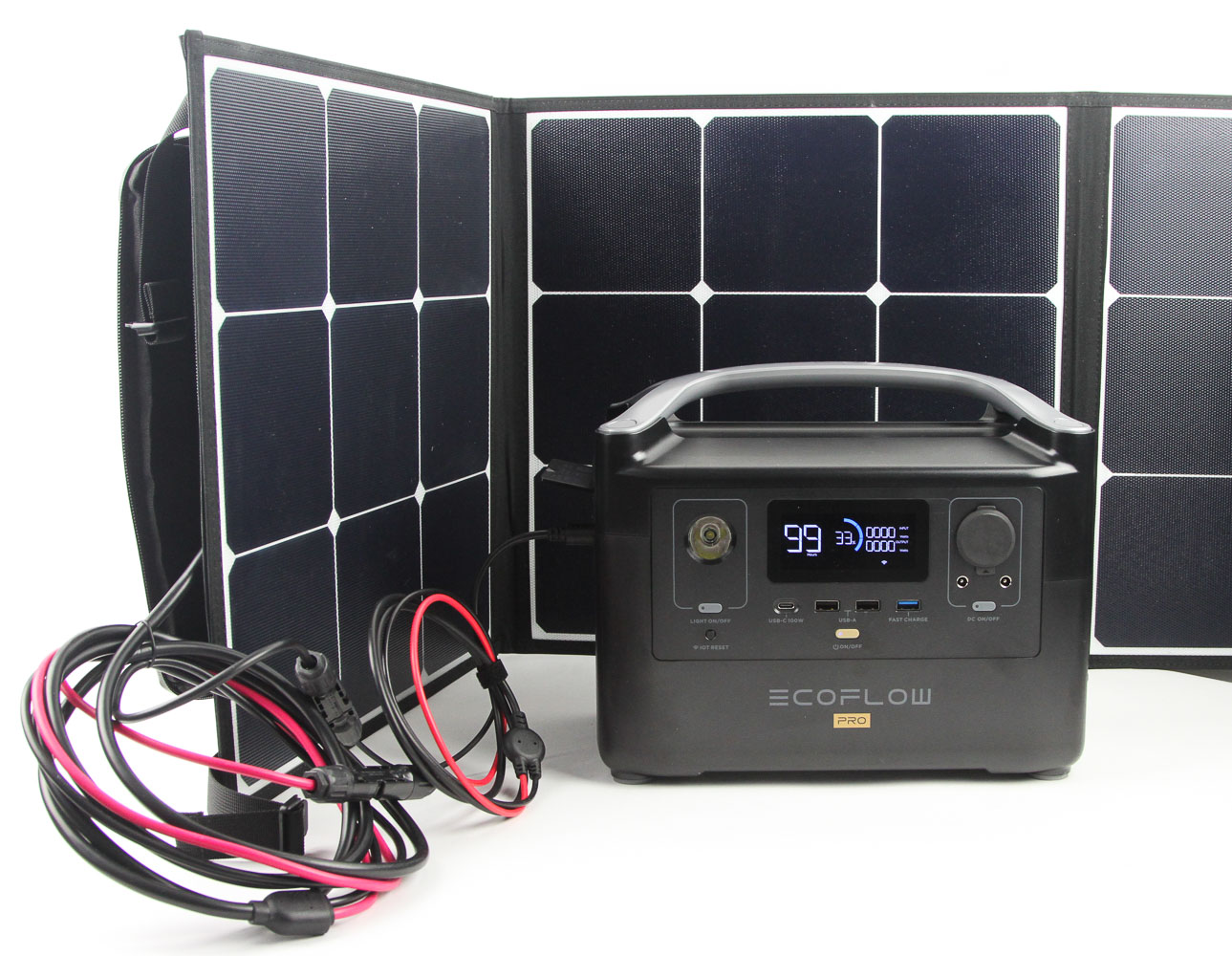

It was easier to actually charge than it was to unlock that unnecessarily tight plastic latch, with the provided AC mains cable allowing for up to 660 W and solar input maxing out at 200 W (10-25 V), with the optional car charger input faring slightly worse—but far more consistently—at 8 A max over the 12 V rail for 96 W. You can combine both types of inputs to make the RIVER Pro charge to full in under an hour easily, or you can stare at 2–3 day charge times with a single solar panel in the British winter I currently am experiencing.
Our Patreon Silver Supporters can read articles in single-page format.
Nov 22nd, 2026 11:19 CST
change timezone
Latest GPU Drivers
New Forum Posts
- Honestly, do you care about GTA VI? (253)
- Zen 3 IF/IMC degradation (245)
- Ryzen or Intel system (21)
- Your PC ATM (36452)
- The TPU UK Clubhouse (27291)
- Can you guess Which game it is? (346)
- Making a game in Godot engine (17)
- TPU's Nostalgic Hardware Club (22197)
- Intel D270 (1)
- Gigabyte AORUS RTX 5080 MASTER – Up to 30°C GPU Hotspot Delta! Is This Normal, a Cooling Defect, or Should I RMA? (14)
Popular Reviews
- Microsoft Surface Laptop Ultra Review - The Next-gen Arm Laptop
- Corsair RM1200e (Second Generation) Review
- Pulsar Office Tour & First Look at P1 Dual-Sensor Mouse
- Upcoming Hardware Launches 2027 (Updated Nov 2026)
- Ugreen NASync DXP4800 GT Review
- AMD Ryzen 7 9800X3D Review - The Best Gaming Processor
- Biwin Black Opal NV7400 2 TB Review
- AMD Zen 6 Technical Deep Dive
- Phantom Blade Zero Performance Benchmark Review - 35 GPUs Tested
- AMD Ryzen 7 5800X3D 10th Anniversary Review
TPU on YouTube
Controversial News Posts
- NVIDIA Co-Founder and CEO Jensen Huang Officially Resigns (492)
- Report: Jensen Huang Eyes NVIDIA Comeback (263)
- Open Letter Asking NVIDIA to Reinstate Jensen Huang Passes 115,000 Signatures (184)
- OpenAI CEO Argues Home PCs Waste the World's Limited DRAM Supply (152)
- NVIDIA Launches Investigation Into Jensen Huang's Relationship With Suspected Chinese Spy (136)
- Intel "Raptor Lake Next" 16-Core and 20-Core CPUs Surface (130)
- NVIDIA GeForce RTX 50-Series Scheduled for up to $500 Price Hike This Week (89)
- Intel Razor Lake Gets a 12 P-Core bLLC Chip With No E-Cores, Per Leak (86)