 18
Razer Viper V4 Pro Review
Packaging, Weight, Cable & Feet »Introduction

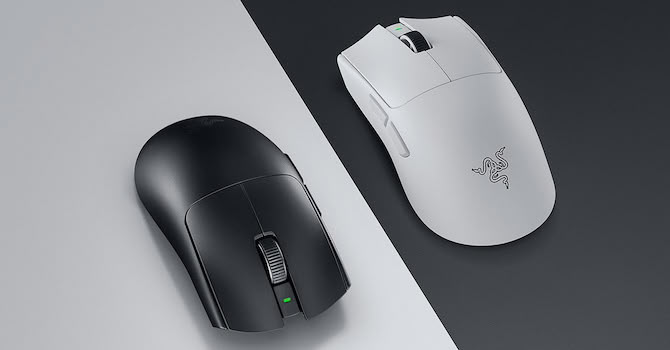
Founded in 1998, Razer is a US-based peripherals and gaming equipment company. The Viper V4 Pro improves on the Viper V3 Pro in many ways. Whereas the sensors of the Viper V3 Pro and DeathAdder V4 Pro largely iterated on PixArt's PAW3950, the Focus Pro 50K Gen-3 capable of 50,000 CPI found in the Viper V4 Pro is fundamentally new, with two major advancements. The first one is FrameSync, which essentially is a refinement of MotionSync. Whereas MotionSync synchronizes the timing of SPI reads and USB polls, FrameSync goes one step further and also includes sensor framerate in the synchronization. As there are basically no "excess" frames, battery life benefits from FrameSync as well. The second advancement is vastly improved jitter handling at higher CPI steps. Other features known from previous sensors, such as CPI adjustment in increment of 1 and asymmetric lift-off, continue to be around. The main switches are still Razer's Optical Mouse Switches Gen-4, and the scroll wheel utilizes an optical encoder from Razer, both of which are familiar from the DeathAdder V4. Though still called "Razer HyperSpeed Wireless Gen-2," seemingly matching the DeathAdder V4 Pro, the Viper V4 Pro has also been revised in this regard, featuring a different MCU and further improvements to latency and efficiency. As a result of these improvements, the Viper V4 Pro manages a cited battery life of up to 180 hours at 1000 Hz and up to 45 hours at 8000 Hz. 8000 Hz polling is supported in both wired and wireless operation. Further improvements to the structural design allow the Viper V4 Pro to weigh only 49 g, which is 4 g less than the Viper V3 Pro. Lastly, the Viper V4 Pro is the first Razer mouse in history compatible with Synapse Web, which is Razer's newly conceived web driver, along with Synapse 4.
Specifications
| Razer Viper V4 Pro | |
|---|---|
| Size: | 127.1 mm × 63.9 mm × 39.9 mm |
| Size (inches): | 5.00" × 2.52" × 1.57" |
| Ambidextrous: | Partially (side buttons on left side only) |
| Weight: | 49 g |
| Number of Buttons: | 5+1 (including wheel click) |
| Main Switches: | Razer Optical Mouse Switches Gen-4 (100 M) |
| Wheel Encoder: | Razer Optical, 6 mm |
| Sensor: | Focus Pro 50K Optical Sensor Gen-3 |
| Resolution: | 100–50,000 CPI |
| Microcontroller Unit: | Airoha AB1623MN |
| Polling Rate: | 125/500/1000/2000/4000/8000 Hz |
| Cable: | 1.80 m, braided |
| Software: | Yes |
| Price: | $159.99 |
| Warranty: | Two years |
Nov 24th, 2026 13:17 CST
change timezone
Latest GPU Drivers
New Forum Posts
- Your PC ATM (36493)
- Gacha Games - Discussions, Pulls, Updates, etc. (1164)
- GTA VI (37)
- When you could finally run Crysis maxed out? (64)
- How to prevent OLED burn damage due to PC freezes or power outtages? (65)
- Increasing Power Limit? (33)
- UPS what one to get? (60)
- Last game you purchased? (1420)
- AMD ULL settings tinkering thread - post settings and Zen pics (88)
- Games at first startup always worse why? (1)
Popular Reviews
- Microsoft Surface Laptop Ultra Review - The Next-gen Arm Laptop
- ASRock X870E Challenger Wi-Fi White Review
- Upcoming Hardware Launches 2027 (Updated Nov 2026)
- Corsair RM1200e (Second Generation) Review
- AMD Ryzen 7 9800X3D Review - The Best Gaming Processor
- AMD Zen 6 Technical Deep Dive
- AMD Ryzen 7 7700X3D Review
- Pulsar Office Tour & First Look at P1 Dual-Sensor Mouse
- Phantom Blade Zero Performance Benchmark Review - 35 GPUs Tested
- Ugreen NASync DXP4800 GT Review
TPU on YouTube
Controversial News Posts
- NVIDIA Co-Founder and CEO Jensen Huang Officially Resigns (492)
- Jensen Huang Reinstated as CEO of NVIDIA (488)
- Report: Jensen Huang Eyes NVIDIA Comeback (281)
- Open Letter Asking NVIDIA to Reinstate Jensen Huang Passes 115,000 Signatures (184)
- OpenAI CEO Argues Home PCs Waste the World's Limited DRAM Supply (152)
- NVIDIA Launches Investigation Into Jensen Huang's Relationship With Suspected Chinese Spy (136)
- Intel "Raptor Lake Next" 16-Core and 20-Core CPUs Surface (130)
- Intel Razor Lake Gets a 12 P-Core bLLC Chip With No E-Cores, Per Leak (91)