 18
Samsung Odyssey OLED G6 G60SD Review - A Matte Twist
The Package »Introduction

The Samsung Odyssey OLED G6 G60SD is a 27-inch gaming monitor built around a third-generation QD-OLED panel with a native resolution of 2560×1440 pixels and a maximum refresh rate of 360 Hz. The same panel—manufactured by Samsung Display—is used in several other monitors with nearly identical specifications, including the recently reviewed ASUS ROG Strix OLED XG27ACDNG. Samsung differentiates its implementation by opting for a matte anti-reflection coating instead of the glossy finish found on most QD-OLED monitors. This may appear to be a small change, but it has a direct impact on everyday usability.
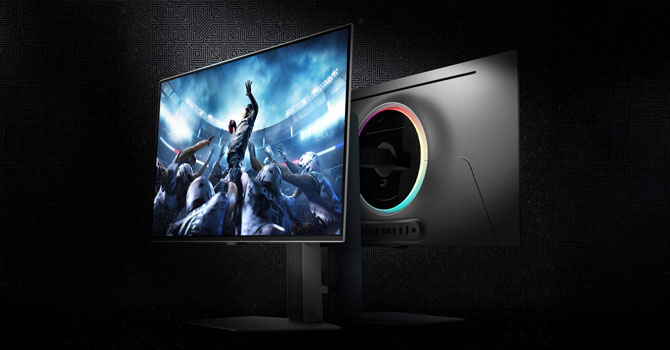
Glossy QD-OLED panels can deliver slightly higher perceived contrast and more vivid color reproduction, but their mirror-like surface often becomes problematic in environments with uncontrolled lighting. A bright room with natural or artificial light will quickly expose this drawback. In such conditions, a matte panel is far more practical. The coating is not the only noteworthy feature of the Odyssey OLED G6, however. It retains all the hallmarks of a high-end gaming display: a 360 Hz refresh rate, OLED's near-instantaneous response times, AMD FreeSync Premium Pro adaptive synchronization, along with several other interesting features. Among them is a passive cooling solution based on a heat pipe, which replaces the graphite sheet approach used by most competitors.
The Odyssey OLED G6 is also consistently positioned as one of the more affordable 27-inch 360 Hz QD-OLED monitors, with current pricing around $650. The cost has dropped since its launch last year, and although the 27-inch 1440p monitor segment is already shifting to fourth-generation QD-OLED panels capable of 500 Hz refresh rate, among other improvements, there remains strong demand for 360 Hz models. For the vast majority of users, including esports professionals, this level of performance is regarded as more than sufficient.
Specifications
| Samsung Odyssey OLED G6 G60SD | |
|---|---|
| Screen Size | 26.5" (marketed as 27") |
| Native Resolution | 2560×1440 (16:9), ~111 PPI |
| Panel Technology | QD-OLED (3rd generation), 10-bit |
| Refresh Rate | 360 Hz |
| Curvature | No |
| Screen Coating | Matte (anti-glare) |
| Supported Adaptive Synchronization | AMD FreeSync Premium Pro, NVIDIA G-SYNC Compatible |
| Brightness | 1,000 cd/m² peak (HDR, small window), ~250 cd/m² SDR full-screen |
| Contrast | 1,500,000:1 (static, OLED native) |
| Viewing Angles | 178°/178° (horizontal / vertical) |
| Response Time | 0.03 ms GtG (specified) |
| HDR | HDR10 |
| Adjustability | Height, tilt, swivel, pivot |
| Video Inputs | 1× DisplayPort 1.4, 2× HDMI 2.1 |
| USB-C | No |
| USB Hub | 2× USB 3.0 Type-A |
| Audio | 1× 3.5 mm headphone jack |
| Speakers | No |
| VESA Mounting | 100×100 mm |
| Dimensions & Weight | 611.7×554.2×263.5 mm (with stand), ~6.9 kg (with stand) |
| Extras | Virtual crosshairs, OLED Safeguard+, Dynamic Cooling System, CoreSync RGB lighting |
Nov 18th, 2026 15:39 PST
change timezone
Latest GPU Drivers
New Forum Posts
- Got a new laptop! What should I do with it? (4)
- Dell Workstation Owners Club (3514)
- Making a game in Godot engine (2)
- [Poll] 12V-2x6 Connector Protection: What Are You Using? (WireView / Ampinel / Equalizer / Other / Nothing) (39)
- Last game you purchased? (1406)
- Time to upgrade CPU and MOBO (34)
- Can i play GTA 6 now? (Joke) (7)
- Honestly, do you care about GTA VI? (146)
- What are you playing? (26234)
- Very unusual two gaming-pc scenarios. (12)
Popular Reviews
- Acemagic Retro X3 Review
- Upcoming Hardware Launches 2027 (Updated Nov 2026)
- AMD Zen 6 Technical Deep Dive
- ASUS ROG Strix B850-I Gaming Wi-Fi7 W Review
- Corsair HX1000i Shift Crystal Review
- Ugreen NASync DXP4800 GT Review
- Biwin Black Opal NV7400 2 TB Review
- Pulsar Office Tour & First Look at P1 Dual-Sensor Mouse
- AMD Ryzen 7 9800X3D Review - The Best Gaming Processor
- Chieftec Iceberg PRO 360 DARK Review
TPU on YouTube
Controversial News Posts
- NVIDIA Co-Founder and CEO Jensen Huang Officially Resigns (478)
- Report: Jensen Huang Eyes NVIDIA Comeback (192)
- Open Letter Asking NVIDIA to Reinstate Jensen Huang Passes 115,000 Signatures (184)
- OpenAI CEO Argues Home PCs Waste the World's Limited DRAM Supply (152)
- NVIDIA Launches Investigation Into Jensen Huang's Relationship With Suspected Chinese Spy (136)
- Intel "Raptor Lake Next" 16-Core and 20-Core CPUs Surface (130)
- Legendary Game Studio BioWare Shuts Down Following EA Layoffs (104)
- Dell CEO Says the Memory Shortage Will Get Worse in 2027 (95)