 18
Samsung Odyssey OLED G6 G60SD Review - A Matte Twist
(18 Comments) »Value and Conclusion
- The Samsung Odyssey OLED G6 G60SD is available online for $650. It comes with a three-year warranty which includes burn-in.
- Excellent overall picture quality with vivid colors and deep blacks
- Accurate sRGB mode
- Superb gaming performance with 360 Hz refresh rate, low input lag and rapid pixel transitions
- Matte anti-glare coating greatly improves usability in bright rooms
- Strong luminance and color uniformity
- Fully adjustable stand (great ergonomics) and solid overall build quality
- Three-year warranty with burn-in coverage
- No USB-C input or USB PD support
- Matte coating slightly reduces perceived contrast versus glossy OLEDs
- External power brick adds cable clutter
- Raised black levels in bright rooms
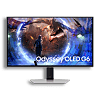
Despite being technically superseded by monitors built around fourth-generation QD-OLED panels, the Samsung Odyssey OLED G6 G60SD offers performance that leaves little to be desired for both competitive gaming and everyday use. Samsung's decision to use a matte anti-reflection coating instead of the glossy finish seen on most rivals has a real impact on usability. The matte coating trades a small amount of perceived contrast and "pop" for drastically reduced reflections, which you'll greatly appreciate when using the monitor in less-than-ideal environments. That alone makes the Odyssey OLED G6 far more versatile than glossy QD-OLED models, which tend to excel in dim, controlled spaces.
In terms of panel capability, the Odyssey OLED G6 has plenty to offer. The 26.5-inch QD-OLED panel offers 2560×1440 pixels at a refresh rate of 360 Hz. Response behavior is outstanding across the board. Combined with the instantaneous pixel switching and no perceptible input lag, the result is a blur-free and exceptionally responsive gaming experience that even casuals will quickly grow to love.
When it comes to image quality, the Odyssey OLED G6 performs at a high level once its settings are optimized. Out of the box, the factory "Eco" preset oversaturates colors and leans slightly warm, with average color error (ΔE 4.76) too high for color-critical work. Switching the color space to "Auto" clamps the panel to the sRGB gamut, reducing the average ΔE to an excellent 0.61 with nearly perfect grayscale and gamma tracking. Users who prefer the panel's native wide-gamut output can correct RGB gain manually; doing so yields balanced grayscale with average ΔE ~1.1 and gamma near the 2.2 reference, though color accuracy naturally falls when feeding sRGB content to a wide-gamut panel. The takeaway is that both accurate and vivid configurations are possible: the first for photo and web work, the second for gaming and entertainment.
HDR performance is another area where the Odyssey G6 delivers. With HDR10 and HDR10+ support, it reaches a measured 1,012 cd/m² on a 1-percent window, while maintaining excellent tone stability up to a 25-percent window. Samsung's "HDR Tone Mapping" control allows users to choose between Static and Active behavior. Static adheres closely to the HDR10 mastering intent but can clip highlights in exceptionally bright scenes. Active applies frame-adaptive mapping, boosting mid-tones and preserving highlight detail for a punchier, more cinematic appearance. The difference is subtle but meaningful: Static favors accuracy, Active favors visual impact. Either way, HDR reproduction on the Odyssey OLED G6 is vibrant and detailed, with deep blacks that only OLED panels can achieve. Automatic brightness limiting is well tuned and rarely noticeable, avoiding the distracting dimming seen in early-generation OLEDs.
Uniformity is excellent. Luminance variation across the screen stays within ±5 percent, and color deviations (ΔE ≤ 1.7) are imperceptible in practice. This consistency benefits not only games but also creative work such as photo editing or video grading, where even minor deviations can be distracting.
Design quality is also worth mentioning. The stand feels solid and offers full ergonomic adjustment—height, tilt, swivel, and pivot. Assembly requires no tools and takes seconds. The rear lighting ring, labeled "Infinity Core Lighting" is modest in brightness but adds a subtle decorative accent. Connectivity includes DisplayPort 1.4 and dual HDMI 2.1 inputs, plus a two-port USB 3.0 hub. The main omission is a USB-C input, which would have improved compatibility with laptops and simplified single-cable setups. Build quality feels excellent, and the display footprint is relatively small given the 27-inch diagonal, aided by the compact base. The matte coating, while more practical, also contributes to a professional aesthetic: this monitor looks at home in both gaming and work setups.
At the current $650 price point, the Odyssey OLED G6 G60SD undercuts several competing 27-inch 360 Hz 3rd-gen QD-OLED monitors. Considering the overall performance, Samsung's pricing feels competitive. For users seeking a high-refresh OLED monitor without paying through their teeth, the Odyssey OLED G6 strikes me as one of the most sensible choices on the market currently—especially if you can live without USB-C.

In terms of panel capability, the Odyssey OLED G6 has plenty to offer. The 26.5-inch QD-OLED panel offers 2560×1440 pixels at a refresh rate of 360 Hz. Response behavior is outstanding across the board. Combined with the instantaneous pixel switching and no perceptible input lag, the result is a blur-free and exceptionally responsive gaming experience that even casuals will quickly grow to love.
When it comes to image quality, the Odyssey OLED G6 performs at a high level once its settings are optimized. Out of the box, the factory "Eco" preset oversaturates colors and leans slightly warm, with average color error (ΔE 4.76) too high for color-critical work. Switching the color space to "Auto" clamps the panel to the sRGB gamut, reducing the average ΔE to an excellent 0.61 with nearly perfect grayscale and gamma tracking. Users who prefer the panel's native wide-gamut output can correct RGB gain manually; doing so yields balanced grayscale with average ΔE ~1.1 and gamma near the 2.2 reference, though color accuracy naturally falls when feeding sRGB content to a wide-gamut panel. The takeaway is that both accurate and vivid configurations are possible: the first for photo and web work, the second for gaming and entertainment.
HDR performance is another area where the Odyssey G6 delivers. With HDR10 and HDR10+ support, it reaches a measured 1,012 cd/m² on a 1-percent window, while maintaining excellent tone stability up to a 25-percent window. Samsung's "HDR Tone Mapping" control allows users to choose between Static and Active behavior. Static adheres closely to the HDR10 mastering intent but can clip highlights in exceptionally bright scenes. Active applies frame-adaptive mapping, boosting mid-tones and preserving highlight detail for a punchier, more cinematic appearance. The difference is subtle but meaningful: Static favors accuracy, Active favors visual impact. Either way, HDR reproduction on the Odyssey OLED G6 is vibrant and detailed, with deep blacks that only OLED panels can achieve. Automatic brightness limiting is well tuned and rarely noticeable, avoiding the distracting dimming seen in early-generation OLEDs.
Uniformity is excellent. Luminance variation across the screen stays within ±5 percent, and color deviations (ΔE ≤ 1.7) are imperceptible in practice. This consistency benefits not only games but also creative work such as photo editing or video grading, where even minor deviations can be distracting.
Design quality is also worth mentioning. The stand feels solid and offers full ergonomic adjustment—height, tilt, swivel, and pivot. Assembly requires no tools and takes seconds. The rear lighting ring, labeled "Infinity Core Lighting" is modest in brightness but adds a subtle decorative accent. Connectivity includes DisplayPort 1.4 and dual HDMI 2.1 inputs, plus a two-port USB 3.0 hub. The main omission is a USB-C input, which would have improved compatibility with laptops and simplified single-cable setups. Build quality feels excellent, and the display footprint is relatively small given the 27-inch diagonal, aided by the compact base. The matte coating, while more practical, also contributes to a professional aesthetic: this monitor looks at home in both gaming and work setups.
At the current $650 price point, the Odyssey OLED G6 G60SD undercuts several competing 27-inch 360 Hz 3rd-gen QD-OLED monitors. Considering the overall performance, Samsung's pricing feels competitive. For users seeking a high-refresh OLED monitor without paying through their teeth, the Odyssey OLED G6 strikes me as one of the most sensible choices on the market currently—especially if you can live without USB-C.
Nov 18th, 2026 16:47 PST
change timezone
Latest GPU Drivers
New Forum Posts
- Got a new laptop! What should I do with it? (6)
- What are you playing? (26235)
- Time to upgrade CPU and MOBO (35)
- Can i play GTA 6 now? (Joke) (8)
- Honestly, do you care about GTA VI? (147)
- Dell Workstation Owners Club (3514)
- Making a game in Godot engine (2)
- [Poll] 12V-2x6 Connector Protection: What Are You Using? (WireView / Ampinel / Equalizer / Other / Nothing) (39)
- Last game you purchased? (1406)
- Very unusual two gaming-pc scenarios. (12)
Popular Reviews
- Acemagic Retro X3 Review
- Upcoming Hardware Launches 2027 (Updated Nov 2026)
- AMD Zen 6 Technical Deep Dive
- Ugreen NASync DXP4800 GT Review
- Pulsar Office Tour & First Look at P1 Dual-Sensor Mouse
- Biwin Black Opal NV7400 2 TB Review
- Chieftec Iceberg PRO 360 DARK Review
- Sapphire Radeon RX 7700 XT Pure Review
- ASUS ROG Strix B850-I Gaming Wi-Fi7 W Review
- Sapphire Radeon RX 7700 XT Pulse Review
TPU on YouTube
Controversial News Posts
- NVIDIA Co-Founder and CEO Jensen Huang Officially Resigns (479)
- Report: Jensen Huang Eyes NVIDIA Comeback (196)
- Open Letter Asking NVIDIA to Reinstate Jensen Huang Passes 115,000 Signatures (184)
- OpenAI CEO Argues Home PCs Waste the World's Limited DRAM Supply (152)
- NVIDIA Launches Investigation Into Jensen Huang's Relationship With Suspected Chinese Spy (136)
- Intel "Raptor Lake Next" 16-Core and 20-Core CPUs Surface (130)
- Legendary Game Studio BioWare Shuts Down Following EA Layoffs (104)
- Dell CEO Says the Memory Shortage Will Get Worse in 2027 (95)