 10
Sandisk DC SN861 7.68 TB Review
(10 Comments) »Introduction

Sandisk is one of the most established names in the NAND flash industry, with decades of experience developing storage technologies for both consumer and enterprise markets. Leveraging its long-standing partnership with Kioxia and its advanced BiCS NAND technology, the company continues to deliver high-performance SSD solutions that combine strong reliability, efficient power consumption, and competitive performance for modern datacenter workloads.
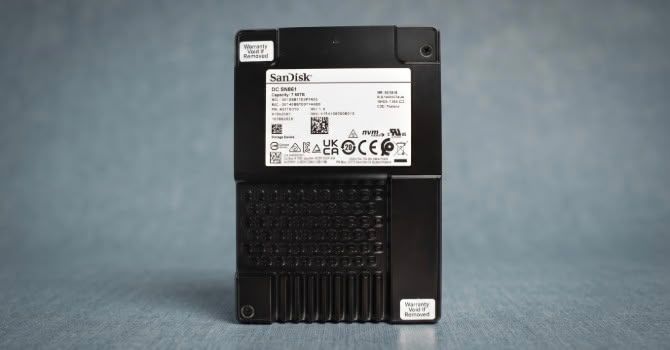
The Sandisk SN861 series represents the company's high-performance PCIe 5.0 x4 enterprise SSD lineup, available in both 1-DWPD and 3-DWPD endurance variants under the same SN861 family. This generation is built around FADU's FC5161 controller and Sandisk's own NAND flash, utilizing 512 Gb Sandisk BiCS6 TLC (FXZ5 512G) dies rather than the company's newer BiCS8 TLC 512 Gbit or 1 Tbit generation. Despite using an earlier NAND architecture, the SN861 is designed to deliver the high performance, low latency, and reliability expected from modern datacenter SSDs.
Sandisk introduced ago the SN862 a few weeks ago, a refresh of the same enterprise compute platform that incorporates newer BiCS8 NAND and DDR5 DRAM. According to Sandisk, the SN862 maintains the same level of performance as the SN861 while providing improved power efficiency, with the newer NAND contributing to these gains. The SN862 was showcased at the Future of Memory & Storage event.
The SN861 lineup is currently available in several capacities and form factors, split across both endurance classes. The 1-DWPD models are offered in 1.92 TB, 3.84 TB, and 7.68 TB in the U.2 form factor, while the 3-DWPD variants are available in 1.6 TB, 3.2 TB, and 6.4 TB capacities. The SN861 is also available in E1.S and E3.S form factors, although these variants are offered exclusively in the 1-DWPD configuration. The E1.S models range from 0.96 TB to 15.36 TB, with 0.96 TB, 1.92 TB, 3.84 TB, 7.68 TB, and 15.36 TB capacities, while the E3.S models are available in 1.92 TB, 3.84 TB, 7.68 TB, and 15.36 TB capacities. Unfortunately, obtaining accurate pricing for enterprise SSDs such as the SN861 remains extremely challenging due to the strong demand within the datacenter market. As a result, manufacturers are often unable to provide stable retail pricing, and publicly available listings vary widely, ranging from approximately $3,900 to as much as $8,000, depending on the seller and configuration. However, enterprise customers purchasing directly from the manufacturer or placing large-volume B2B orders can typically secure significantly lower pricing per unit.
As expected, the 1-DWPD models are rated for 3,504 TB, 7,008 TB, and 14,016 TB of total bytes written (TBW) for the 1.92 TB, 3.84 TB, and 7.68 TB capacities, respectively. Meanwhile, the 3-DWPD variants offer substantially higher endurance ratings of 8,760 TB, 17,520 TB, and 35,040 TB, making them better suited for write-intensive enterprise workloads. Naturally, these higher-endurance models also command a higher MSRP due to the additional over-provisioning and increased write durability.
| Specifications: Sandisk DC SN861 7.68 TB SSD | |
|---|---|
| Brand: | Sandisk |
| Model: | SDS6BA176PSP9X1 |
| Capacity: | 7680 GB (7152 GB usable) 7% overprovisioning |
| Controller: | Fadu FC5161 |
| Flash: | Sandisk 3D eTLC BiCS6 512 Gbit 162-Layer (FXZ5 512G) 023503 1T00 4331DGD |
| DRAM: | 8 GB (4× 2 GB) DDR4-3200 CL-22 Micron MT40A2G8SA-062E:F (D8CJV) (F-Die) |
| Sequential Read Speeds: | 13,700 MB/s |
| Sequential Write Speeds: | 7,500 MB/s |
| Random Read Speeds: | 3,300 K IOPS |
| Random Write Speeds: | 430 K IOPS |
| Endurance: | 14,016 TBW - 1.0 DWPD |
| MTBF: | 2.5 Million |
| Form Factor: | U.2 15 mm |
| Interface: | PCIe Gen 5 x4, NVMe 2.0 |
| Firmware: | RH110017 |
| Warranty: | Five-years |
| Price at Time of Review: | ~$3,900 |
Packaging

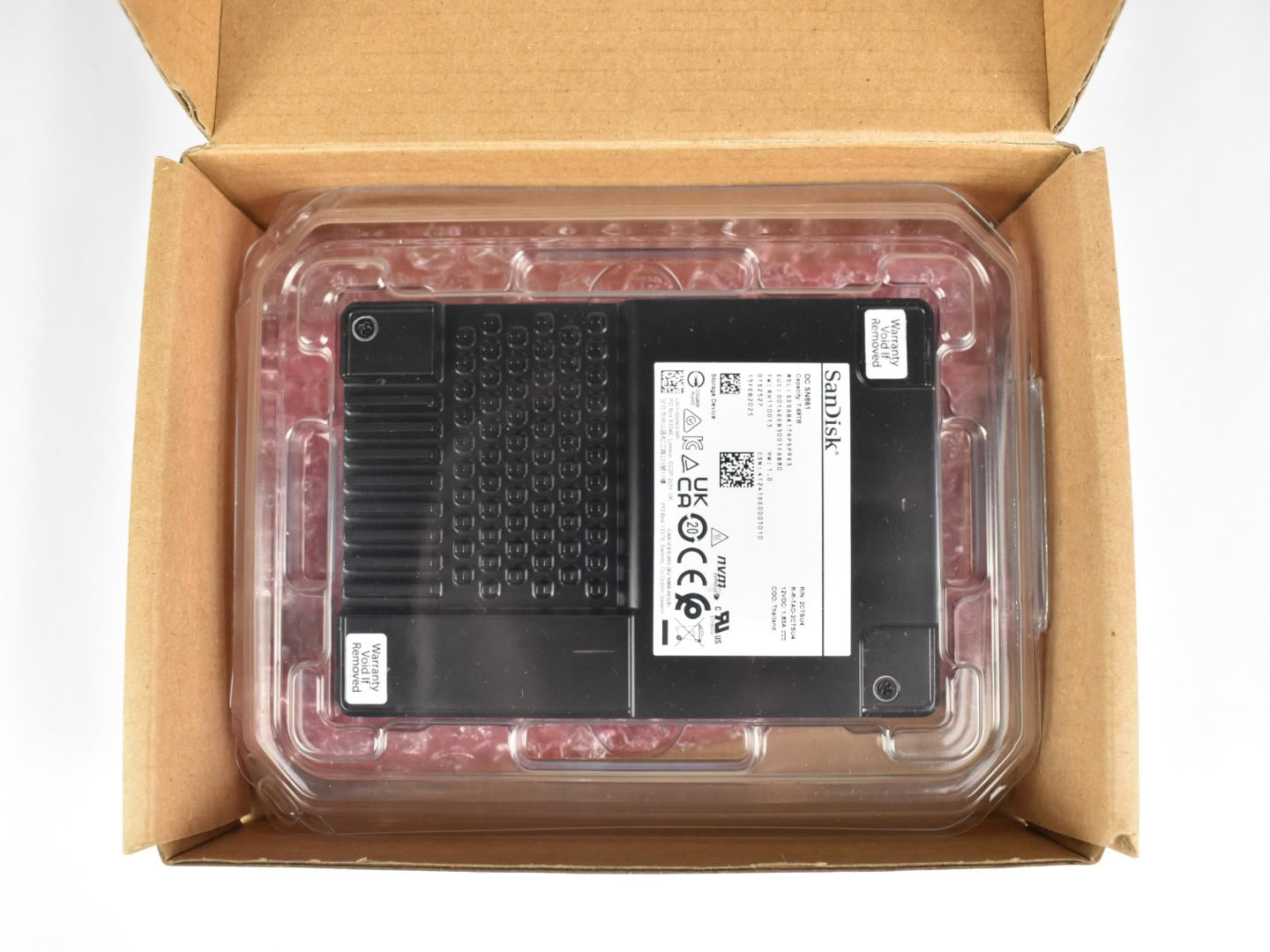
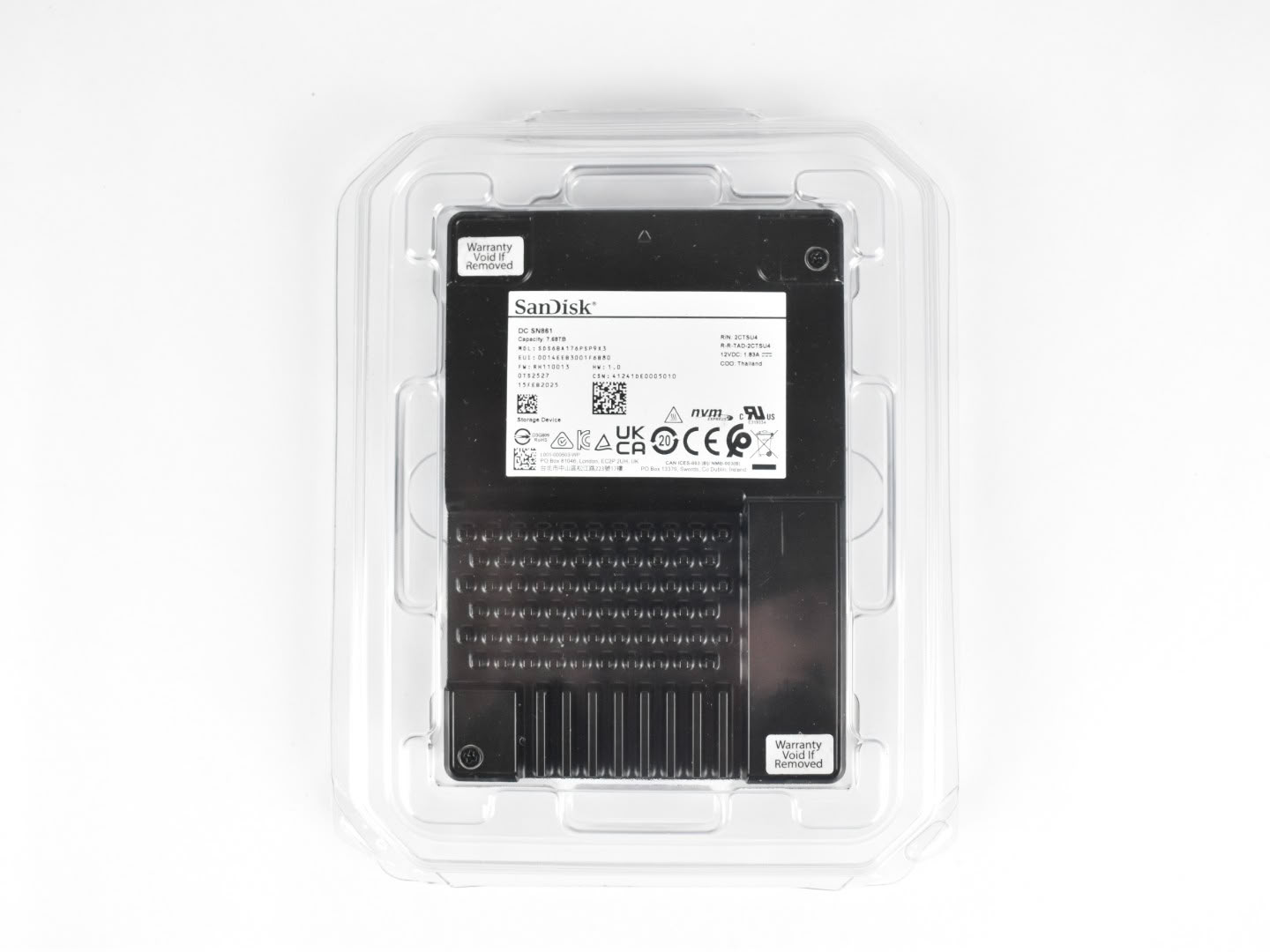
The SSD comes packaged in a very simple cardboard box with no markings. Once opened, the drive is secured inside a plastic blister to prevent damage during transport.
The Drive
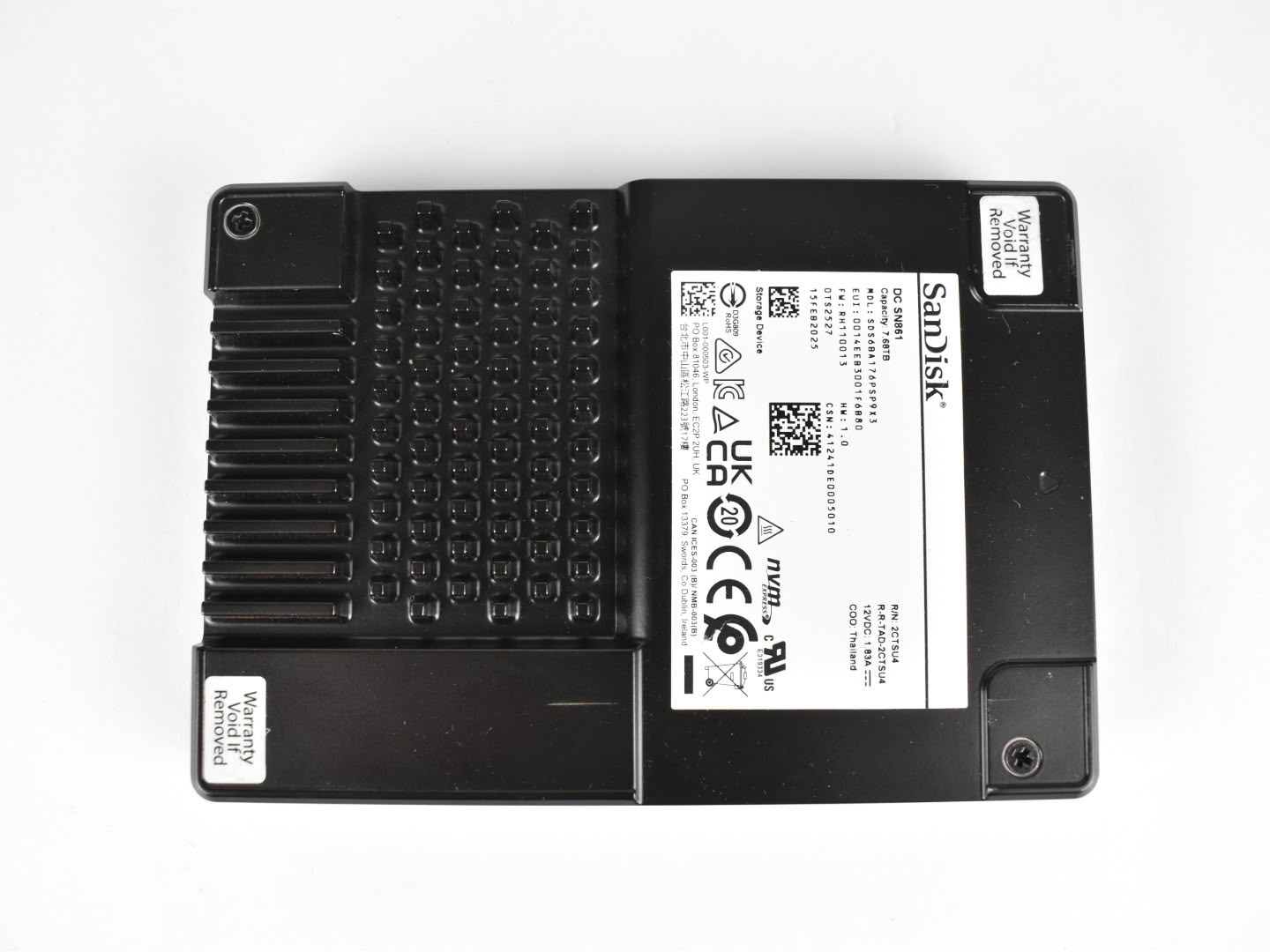
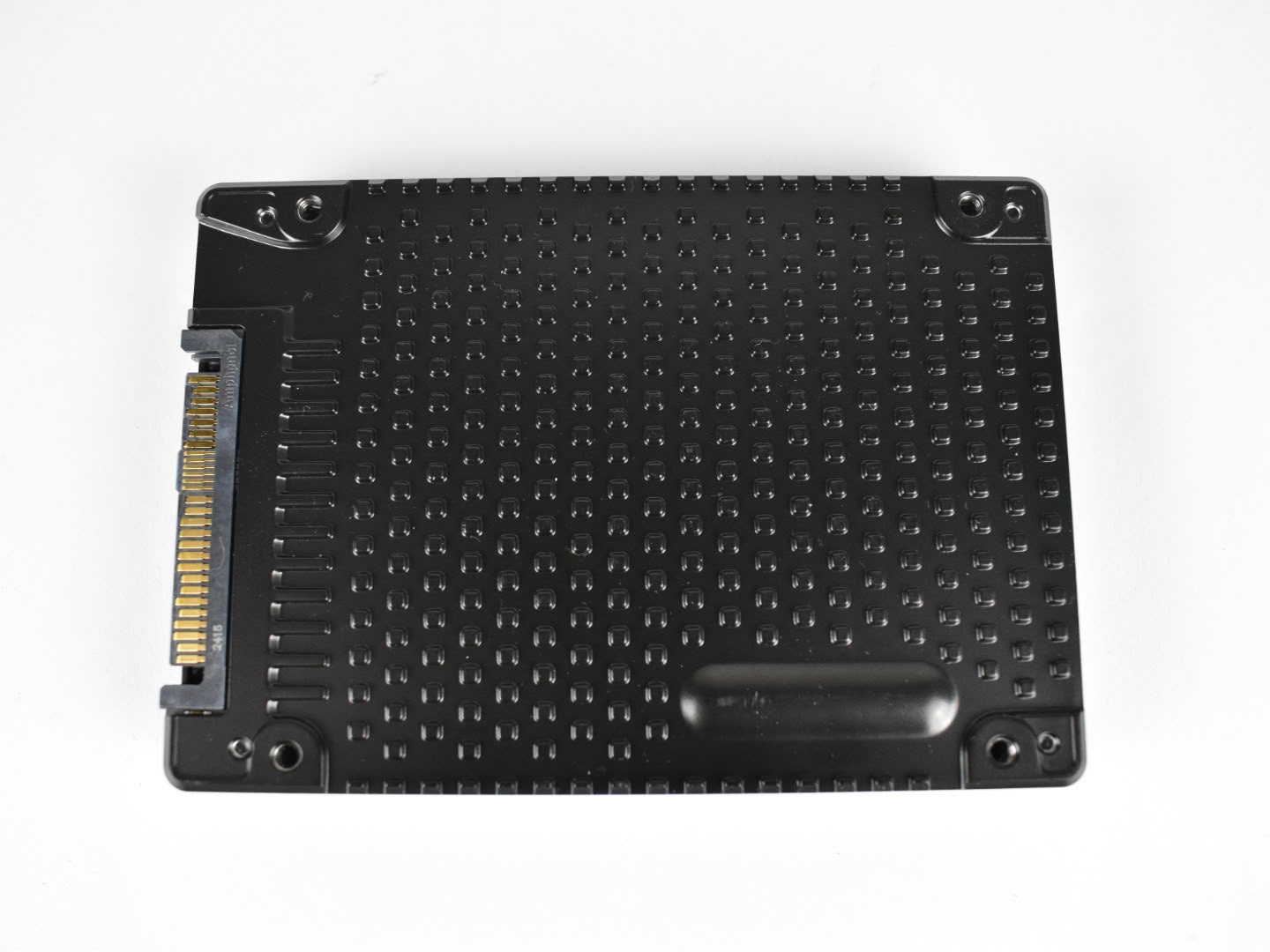
The unit we received uses the U.2 15 mm format with the SFF-8639 connector, since this lineup is only available in this form factor. On the front side, there's a label displaying product details such as the model, serial number, barcodes, and even the factory-installed firmware version. The back of the PCB, on the other hand, is entirely clean, designed with airflow optimization in mind.
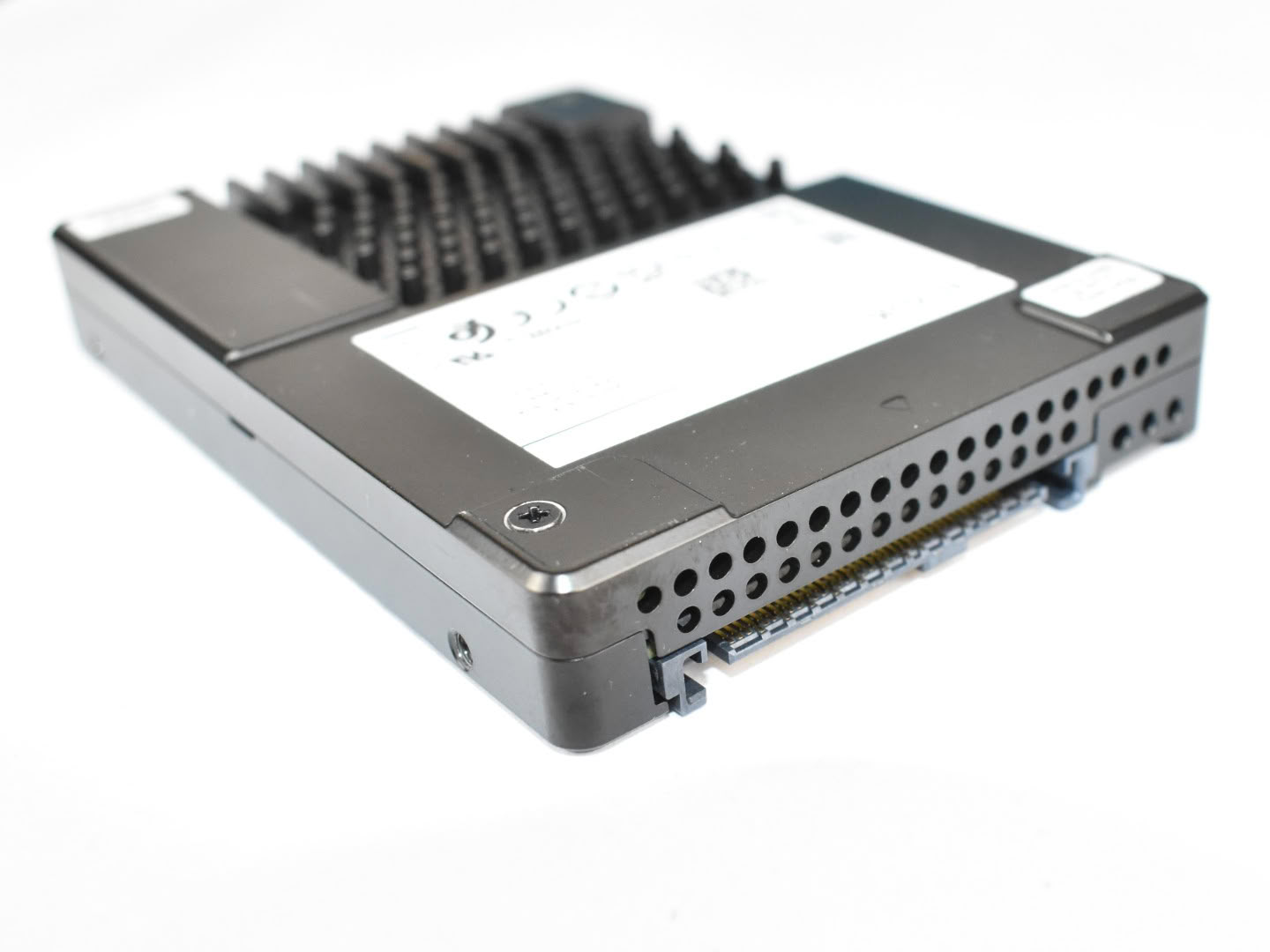
PCI-Express 5.0 x4 is used as the host interface to the rest of the system, alongside the NVMe 2.0 protocol.
Teardown
Upon opening the SSD, we see that it's secured with four Phillips T-6 screws. Once removed, the back side of the PCB is revealed, firmly attached to the metal housing via several thermal pads that help dissipate heat from key components.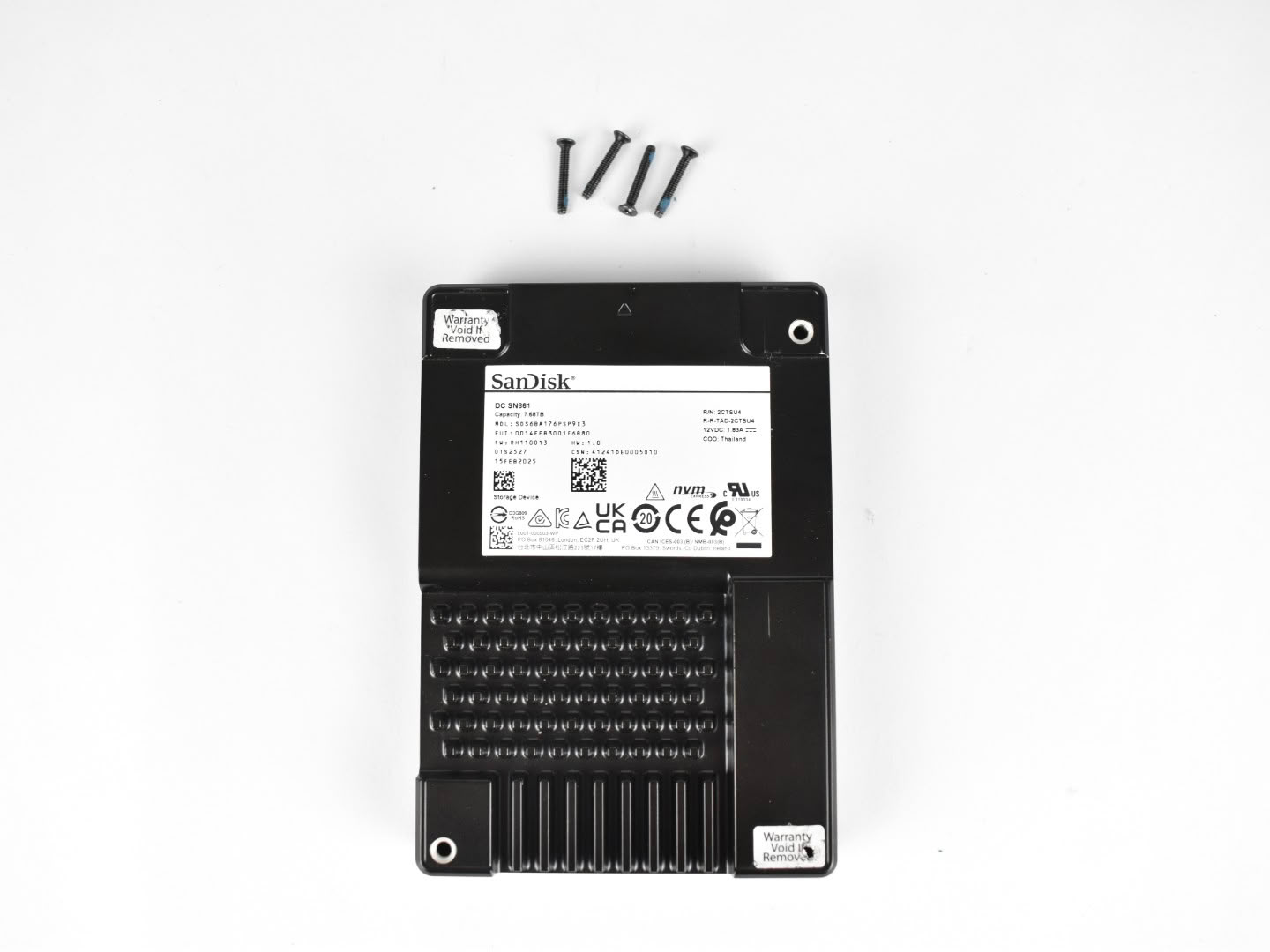
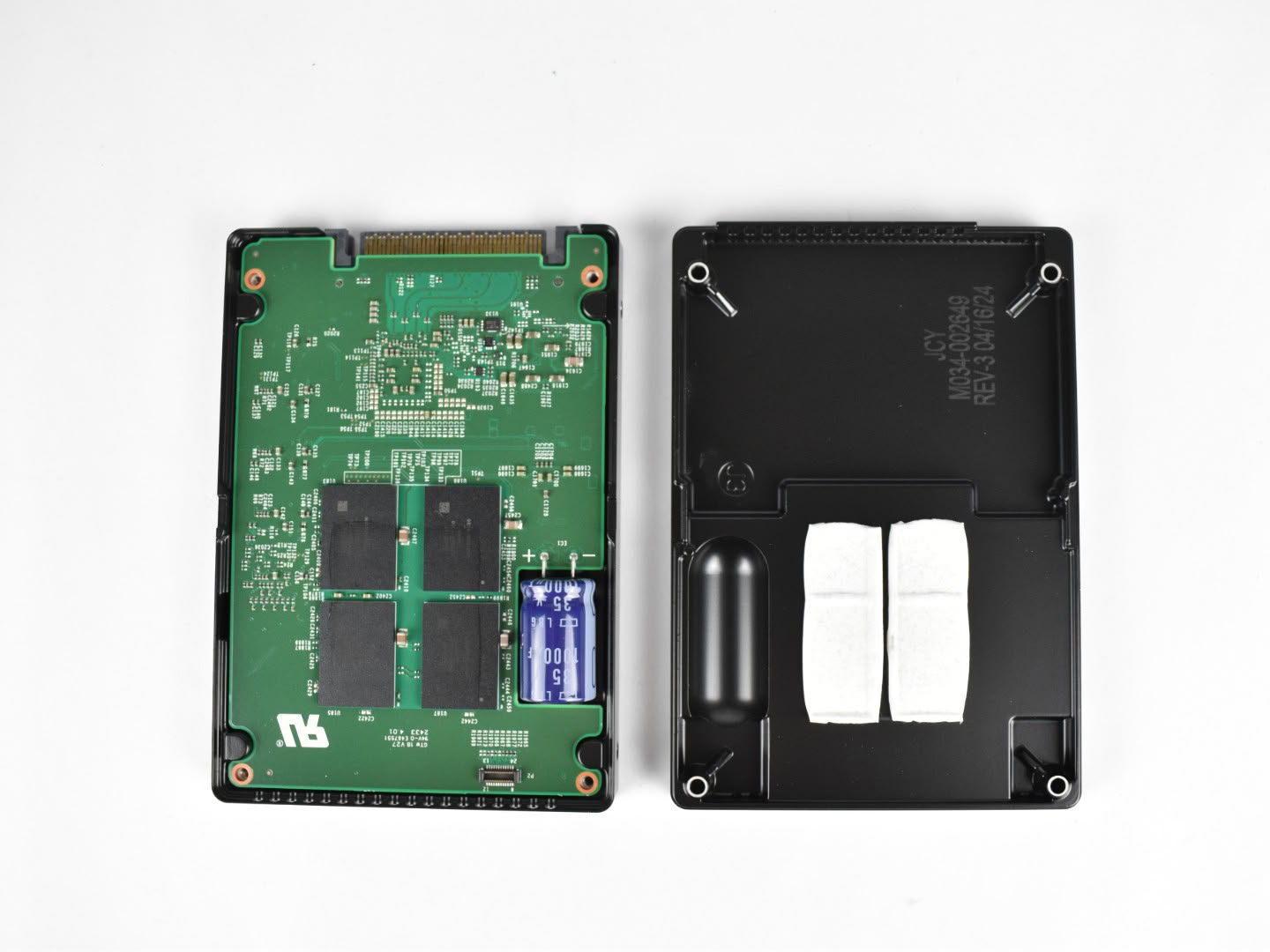
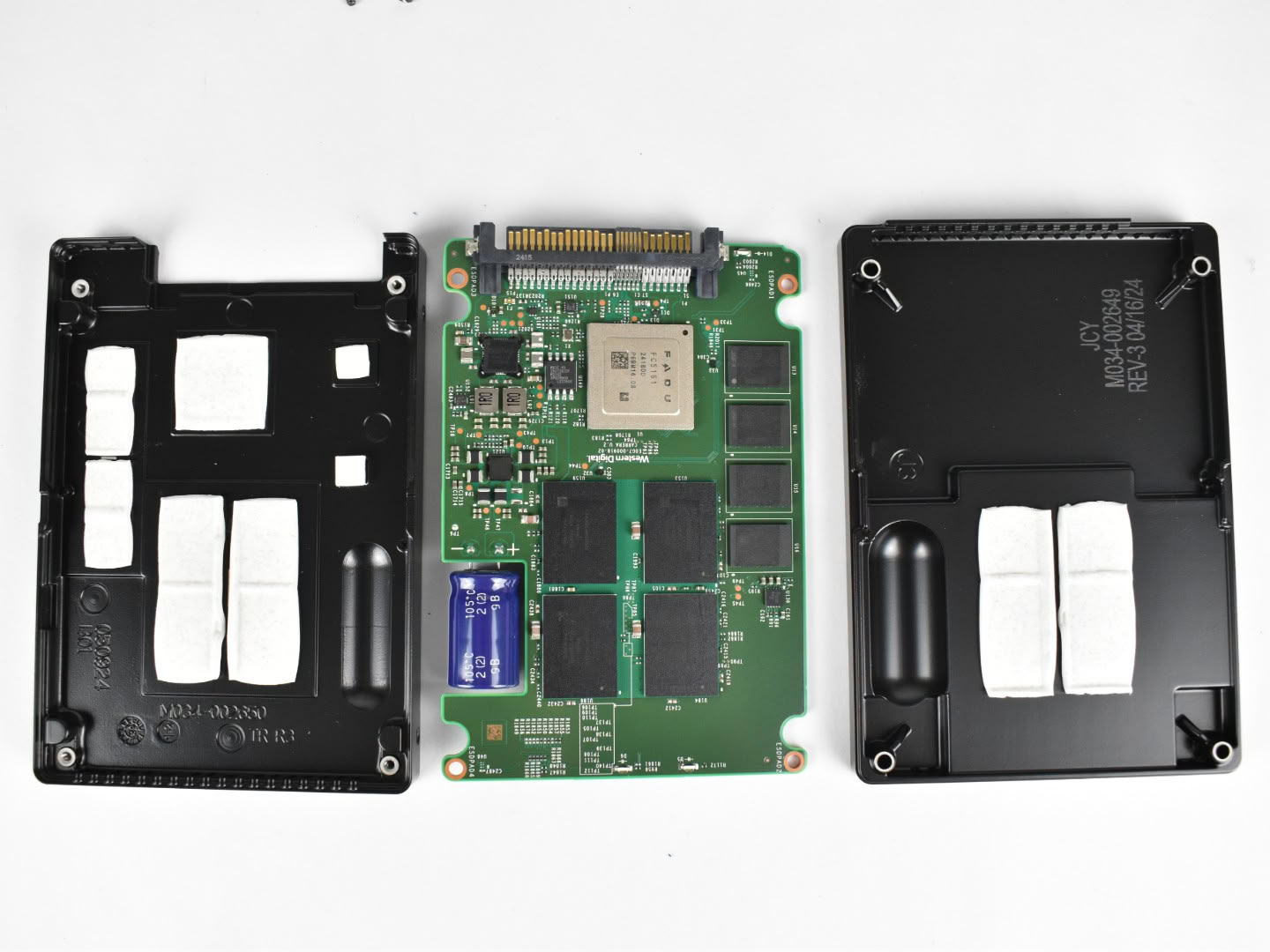
After removing all four screws, after removing the four screws securing the enclosure, we gain access to the SSD's internal PCB. The rear side houses four NAND flash packages, while removing the PCB from the metal chassis reveals the front side, which contains the drive's primary components. Here we find the FADU FC5161 controller, which we'll discuss in more detail below, along with four additional NAND flash packages, four DRAM cache ICs, and the supporting circuitry for both the VRM and the Power Loss Protection (PLP) system.
Controller

This SSD features the FADU FC5161, an in-house developed enterprise controller from the South Korean company FADU. It is a 16-channel controller designed for PCIe 5.0 SSDs and manufactured on an advanced process node. The controller adopts a heterogeneous RISC-V architecture, combining SiFive Essential 64-bit S51-MC application cores with 32-bit E31-MC microcontroller cores, both featuring floating-point units (FPUs). This design allows compute-intensive storage tasks to be separated from lower-level system management functions, improving efficiency while maintaining the flexibility offered by the open-standard RISC-V ISA.
Its 16 NAND channels communicate with the flash memory at speeds of up to 2400 MT/s, a significant increase over previous-generation enterprise controllers. The FC5161 also supports PCIe 5.0 x4, NVMe 2.0, and Flexible Data Placement (FDP), along with support for up to 128 namespaces, making it well suited for hyperscale and cloud storage deployments.
Similar to other modern enterprise controllers, FADU's adoption of the RISC-V architecture reflects the growing industry trend toward open-standard processor designs. Compared to traditional Arm-based solutions, RISC-V offers greater flexibility for architectural customization, allowing vendors to optimize their controllers for specific workloads while maintaining high performance, power efficiency, and low-latency operation.
Our Patreon Silver Supporters can read articles in single-page format.
Nov 15th, 2026 18:46 CST
change timezone
Latest GPU Drivers
New Forum Posts
- Your PC ATM (36431)
- It’s been fascinating times in Retro agian r36s isn’t even worth 50-65 dollars no more and newly listed Rm36 64gb 4in IPS models for only 34 dollars. (3)
- What is the latest game you finished or 100% (203)
- HP Office Jet 7740 Pro - Supply system problem with replacement cartridge (4)
- What are you playing? (26224)
- WarpCoreBench scores! (55)
- Local LLM General Discussion (691)
- Folding Pie and Milestones!! (10205)
- Asus Rog Maximus Z890 Extreme. (Various questions). (25)
- Power supply noise stops when I move the mouse (9)
Popular Reviews
- ASUS ROG Strix B850-I Gaming Wi-Fi7 W Review
- Corsair HX1000i Shift Crystal Review
- AMD Zen 6 Technical Deep Dive
- Upcoming Hardware Launches 2027 (Updated Nov 2026)
- Montech King 95 3D PRO Review
- NZXT C1200 Platinum Review
- Phantom Blade Zero Performance Benchmark Review - 35 GPUs Tested
- AMD Ryzen 7 9800X3D Review - The Best Gaming Processor
- NZXT H7 RGB+ Review
- NZXT H5 Review
TPU on YouTube
Controversial News Posts
- NVIDIA Co-Founder and CEO Jensen Huang Officially Resigns (428)
- Open Letter Asking NVIDIA to Reinstate Jensen Huang Passes 115,000 Signatures (184)
- OpenAI CEO Argues Home PCs Waste the World's Limited DRAM Supply (152)
- NVIDIA Launches Investigation Into Jensen Huang's Relationship With Suspected Chinese Spy (136)
- Intel "Raptor Lake Next" 16-Core and 20-Core CPUs Surface (130)
- Legendary Game Studio BioWare Shuts Down Following EA Layoffs (104)
- Dell CEO Says the Memory Shortage Will Get Worse in 2027 (95)
- NVIDIA GeForce RTX 50-Series Scheduled for up to $500 Price Hike This Week (89)