 19
Sandisk Optimus GX Pro 8100 2 TB Review
Rendering, Virtualization & File Synchronization »Thermal Throttling
Due to the compact form factor, M.2 drives lack the ability to actively cool themselves, usually having to rely on passive airflow instead. All vendors include some form of thermal throttling on their drives as a safeguard, which limits throughput once a certain temperature is exceeded.On this page, we will investigate whether the tested drive has such a mechanism, how high temperatures get, and what effect this has on performance. We will test the drive in a typical case, installed in the M.2 slot between the CPU and graphics card.
Each of the charts has time moving from left to right, showing transfer speeds in MB/s and also reporting the drive's temperature in degrees Celsius (measured using SMART).
Real-Life Temperatures
This thermal testing approach simulates typical SSD workloads using PCMark10 storage traces, which replay real-world disk usage without executing the full applications. It helps us create consistent, realistic usage patterns, not just primitive synthetic "random read" or "random write" operations. We can also reduce idle gaps in the trace playback to make the SSD work harder, but not unrealistically so. The recorded activity comes from apps like Adobe and Office, as well as gaming and file transfers. We repeat the entire test sequence three times to extend the total workload duration, followed by a cool-down period to observe how the SSD dissipates heat.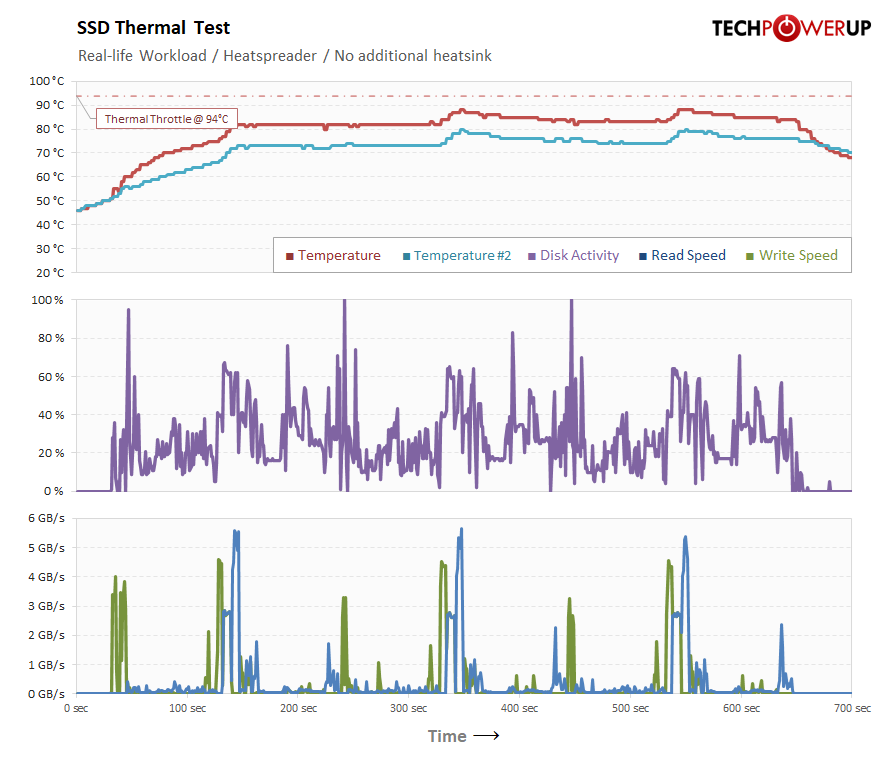
Even as a bare drive, with no heatsink, the Optimus GX Pro 8100 never throttles in this test. It does get warm though: the hotter of the two sensors peaks at 88°C, which leaves only 6°C of headroom to the 94°C throttling point. Sandisk sets that limit deliberately high—the same trick we saw on the SN8100—and combined with the efficient SM2508 it's enough to keep normal desktop workloads running at full speed without any cooling at all. If your M.2 slot sits under a hot graphics card with no airflow, a heatsink is still the safer choice.
Thermal Stress Test
In these tests, the SSD is hammered by nonstop incoming writes to simulate worst-case thermal stress under the heaviest possible load. The test also checks how the drive deals with thermal throttling and whether it continues to function normally. But it also shows that the temperature reported via software in SMART is actually quite a bit lower than the real temperature.Drive with Small Thermalright Heatsink
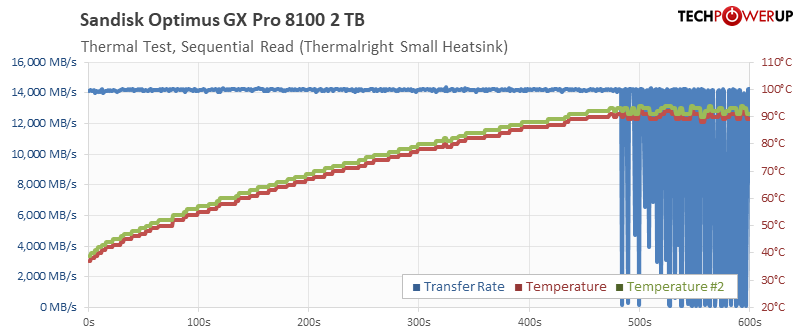
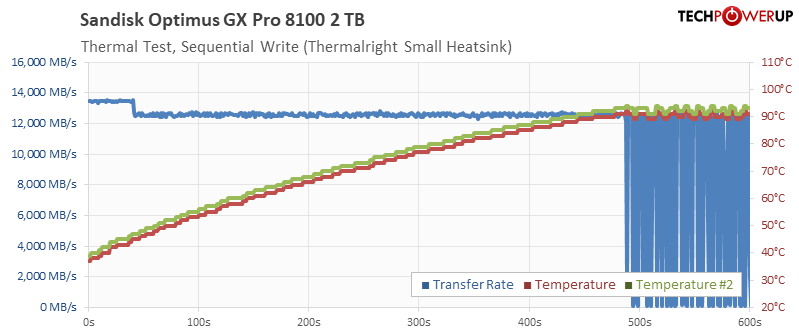
First, I installed a Thermalright TR-M2, which is a compact full-metal heatsink. The drive runs at full speed for around eight minutes of nonstop reads or writes before it reaches 94°C and starts throttling. Once that happens the throttling is aggressive—transfer rates collapse and recover in a rapid sawtooth rather than settling at a reduced rate. Eight minutes of uninterrupted maximum-speed transfers is far more than any consumer workload will ask for, but it does show that a small heatsink isn't enough if you plan to hammer the drive continuously.
Drive with Big Thermalright Heatsink
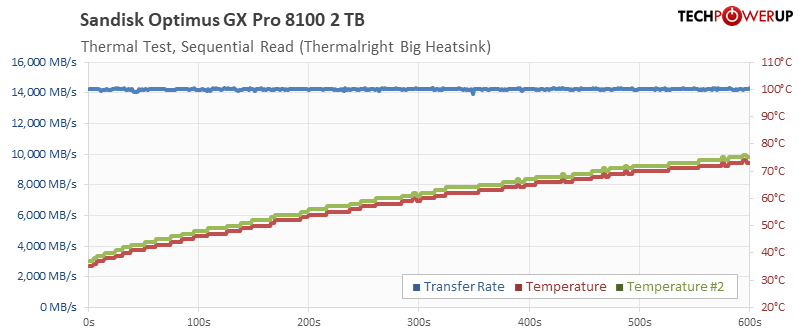
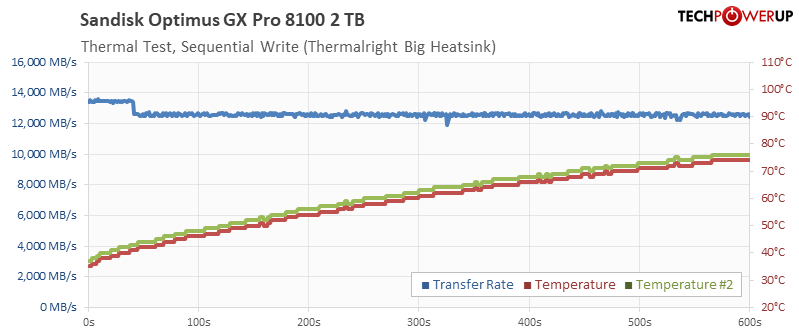
With the much bigger Thermalright HR-10, there is no more throttling at all. The drive runs the full ten minutes of nonstop transfers at unchanged speed, and temperature climbs to only 75°C by the end of the run, in both the read and the write test.
Thermal Image & Hot Spot
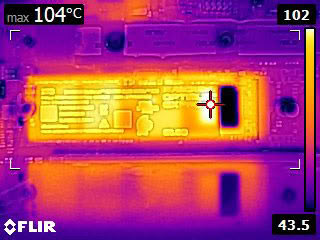
For this thermal image, we deliberately ran the drive without a heatsink, to reveal where the heat concentrates on the PCB. The controller is by far the hottest spot, with a peak surface temperature of 104°C. This test also confirms that thermal protection is working perfectly, reaching the limit and then not creeping up any further. The value is high but not an issue—these chips are designed to run at such temperatures constantly, and the high limit is exactly what buys the drive the throttle-free behavior during normal use.
Nov 15th, 2026 21:43 CST
change timezone
Latest GPU Drivers
New Forum Posts
- Asus Rog Maximus Z890 Extreme. (Various questions). (26)
- GPU Temperatures Rise Very Quickly in FurMark – Is This Normal? (7)
- Will zen 6 mobos have anything extra vs current ones? (46)
- Your PC ATM (36435)
- It’s been fascinating times in Retro agian r36s isn’t even worth 50-65 dollars no more and newly listed Rm36 64gb 4in IPS models for only 34 dollars. (6)
- Power supply noise stops when I move the mouse (10)
- Can you guess Which game it is? (320)
- What is the latest game you finished or 100% (203)
- HP Office Jet 7740 Pro - Supply system problem with replacement cartridge (4)
- What are you playing? (26224)
Popular Reviews
- ASUS ROG Strix B850-I Gaming Wi-Fi7 W Review
- Corsair HX1000i Shift Crystal Review
- AMD Zen 6 Technical Deep Dive
- Upcoming Hardware Launches 2027 (Updated Nov 2026)
- Montech King 95 3D PRO Review
- NZXT C1200 Platinum Review
- Phantom Blade Zero Performance Benchmark Review - 35 GPUs Tested
- AMD Ryzen 7 9800X3D Review - The Best Gaming Processor
- NZXT H5 Review
- NZXT H7 RGB+ Review
TPU on YouTube
Controversial News Posts
- NVIDIA Co-Founder and CEO Jensen Huang Officially Resigns (430)
- Open Letter Asking NVIDIA to Reinstate Jensen Huang Passes 115,000 Signatures (184)
- OpenAI CEO Argues Home PCs Waste the World's Limited DRAM Supply (152)
- NVIDIA Launches Investigation Into Jensen Huang's Relationship With Suspected Chinese Spy (136)
- Intel "Raptor Lake Next" 16-Core and 20-Core CPUs Surface (130)
- Legendary Game Studio BioWare Shuts Down Following EA Layoffs (104)
- Dell CEO Says the Memory Shortage Will Get Worse in 2027 (95)
- NVIDIA GeForce RTX 50-Series Scheduled for up to $500 Price Hike This Week (89)