 7
Sharkoon Skiller SGH40W Review - No-Frills Wireless
Microphone Performance »Sound Quality
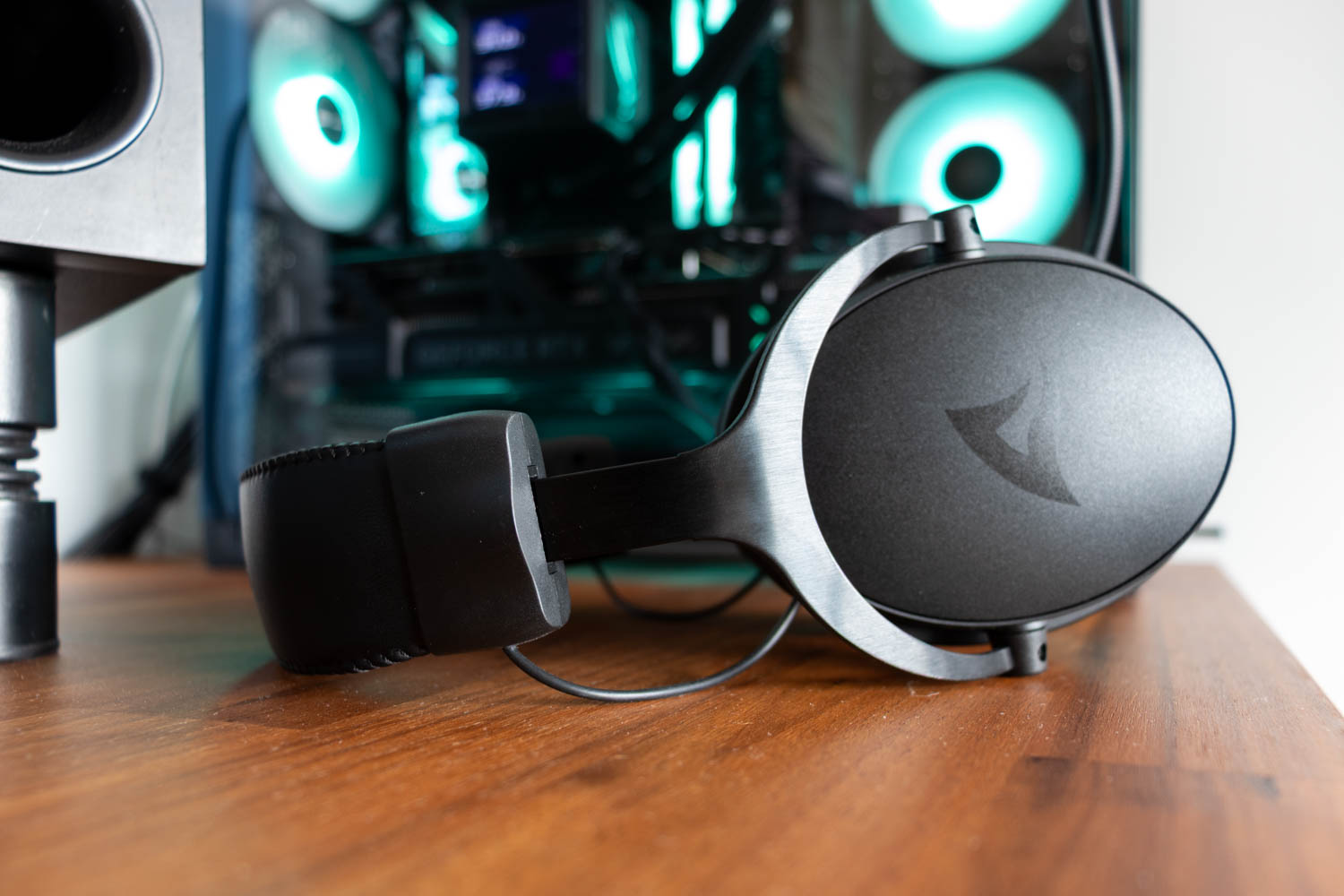
The Sharkoon Skiller SGH40W features custom-tuned 53 mm dynamic speaker drivers with an impedance of 32 Ω and a rated sensitivity of 105 dB. The specified frequency response spans from 20 Hz to 20 kHz.
For gaming headset frequency response measurements I'm using the miniDSP EARS headphone test fixture, probably the least expensive such device on the market. It consists of two miniDSP UMIK-1 microphones placed inside a pair of silicone ears and affixed to a steel headphone stand. It's a USB-powered device, perfectly integrated with the fantastic Room EQ Wizard (REW) software, which is used for headphone and microphone calibration, as well as doing the measurements themselves. Every single miniDSP EARS unit comes with its own microphone calibration files, which are loaded into REW before doing the measurements. The miniDSP EARS certainly has its quirks. The artificial ear canals aren't particularly deep, so I wouldn't consider it a viable option for IEM testing. The integrated microphones are exceptionally sensitive to headphone positioning, partially because of the screws affixing the silicone ears to the stand, which aren't perfectly flush with the silicone surface. Some users also claim that the fixture is too narrow for very large Hi-fi headphones, so they have to use rubber bands to tighten the clamping force. The latter isn't something I ever had an issue with, though; all my headsets and headphones fit perfectly.
Because of all that, the miniDSP EARS is prone to user error. Whoever is using it has to know how to interpret the results and, even more importantly, how to spot those that are clearly flawed. After getting rid of the bad data, assuming the initial configuration and calibration were done properly, the resulting frequency response measurements are usable and in line with what one would hear from the headphones (or headset) in question. My testing methodology mostly follows the best practices of using the miniDSP EARS as covered in great detail in this article on Headphonesty. The most significant difference is that I'm using the updated HEQ compensation, where a subjectively neutral headphone would measure approximately flat. To compensate for minor seal variances, I'm measuring each ear until I get 10 usable results and reseat the headphones, or headset, between runs. After I have my results for one ear, I apply a 1/12 octave smoothing and average the measured responses. I then repeat the process for the other ear for an idea of whether any channel imbalance exists. It's important to keep in mind that my results cannot be directly compared to anyone else's, as only an identical methodology conducted on my exact sample of the miniDSP EARS would yield directly comparable results.
For the Sharkoon Skiller SGH40W, I used the supplied 2.4 GHz wireless dongle as the source when doing my frequency response measurements. You can explore my gaming headset frequency measurement database on my personal Squiglink. Let's take a look at the frequency response measurement of the Sharkoon Skiller SGH40W.
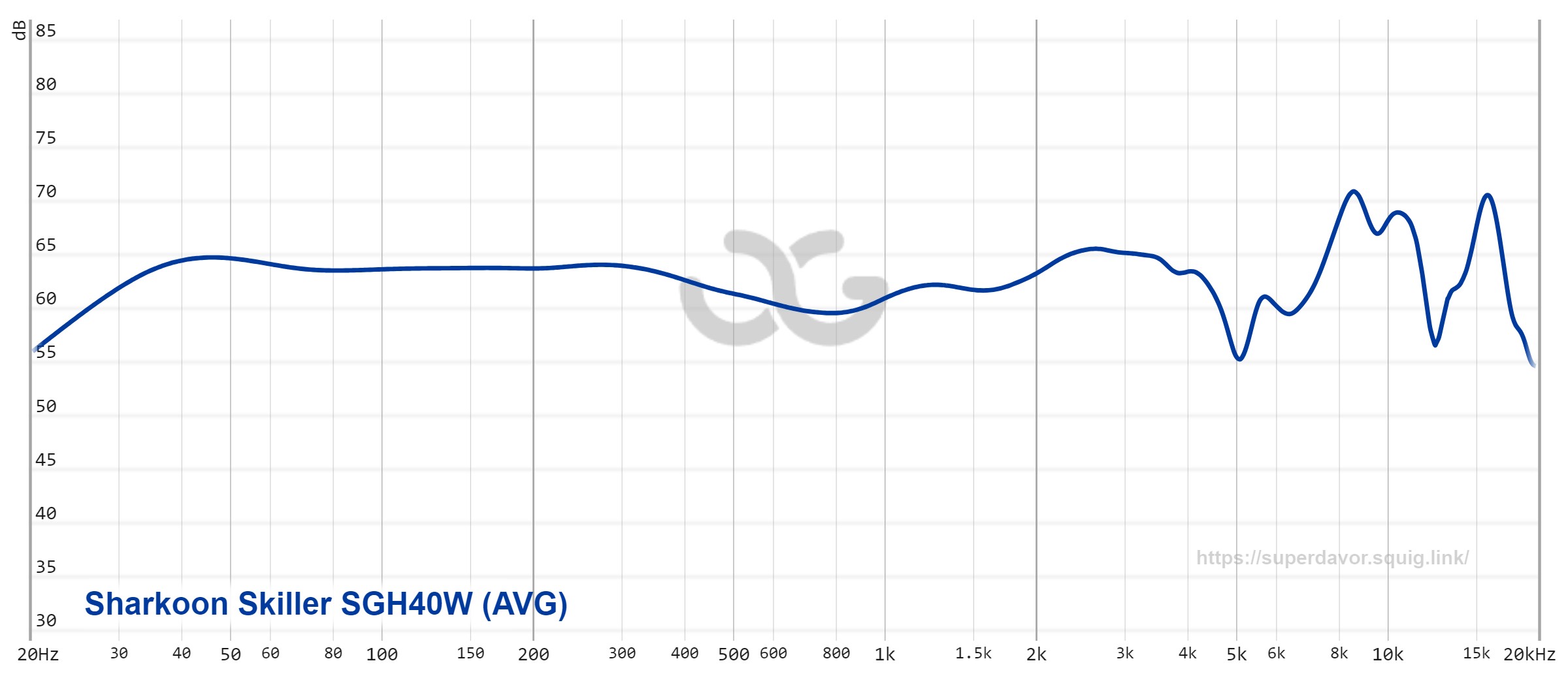
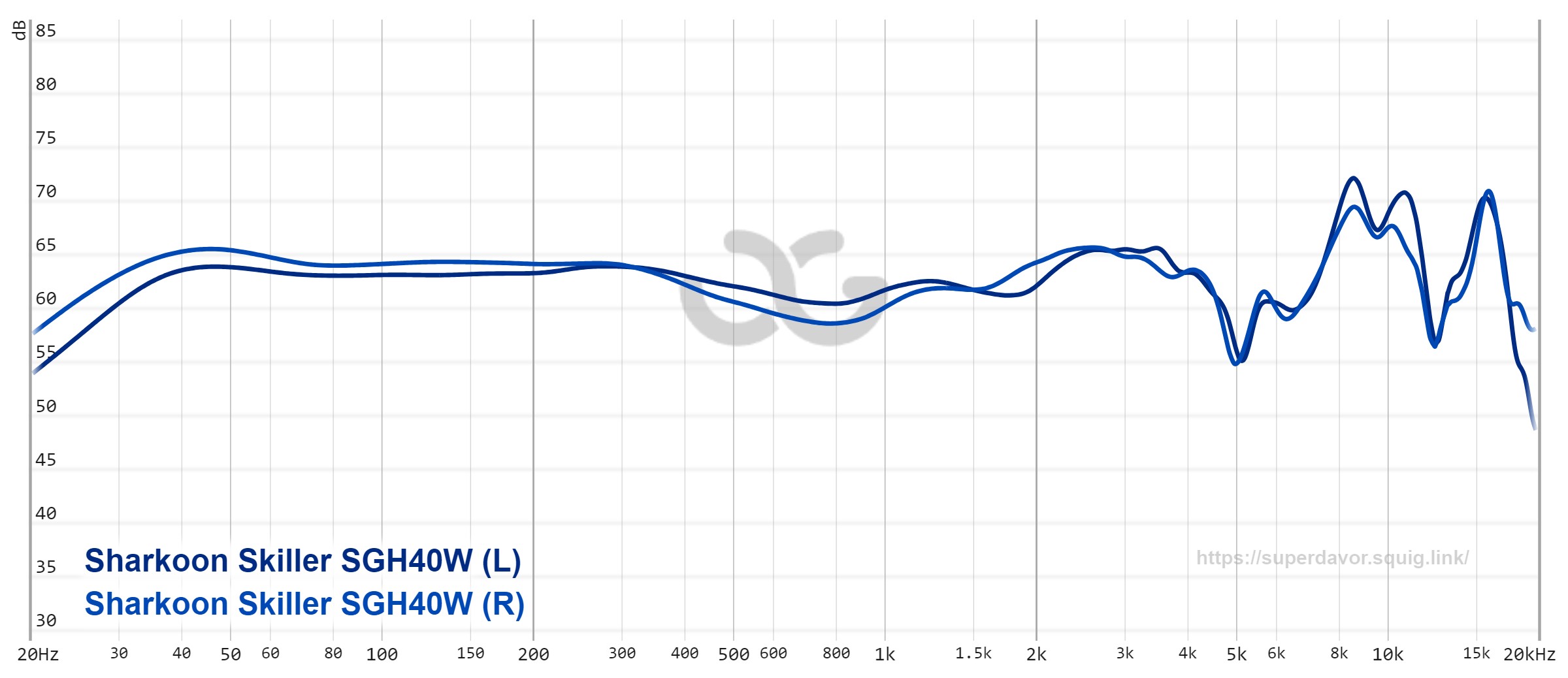
The frequency response of the Sharkoon Skiller SGH40W reveals a decidedly bass-forward tuning, a sound signature clearly targeted at gamers who want impact and excitement rather than studio-grade neutrality. Starting in the low end, the SGH40W delivers a broad, elevated bass shelf that extends from the sub-bass through the mid-bass region, without early roll-off. There's a noticeable hump centered around 40–50 Hz that adds a sense of rumble and weight. This bass emphasis carries through the entire low-frequency range, giving explosions, footsteps, and bass-heavy music genres a visceral, full-bodied presentation. The bass is more "thick shelf" than "punchy peak," which translates more to weight and warmth than tight impact. It's the kind of bass that puts a grin on your face during action sequences, but it can also feel overbearing if you prefer a flatter, more controlled low end.
Moving into the midrange, the response begins to gently slope downward from around 200 Hz through 600 Hz, before reaching a noticeable dip in the 800 Hz to 1 kHz region. This recession has a direct impact on how the SGH40W renders certain content: male vocals and lower-register instruments lose a bit of body and fullness, and the overall midrange presentation leans slightly hollow compared to headsets with a more neutral tuning. It's not severe enough to be called a deal-breaker, but it does mean the SGH40W won't be the most natural-sounding headset for vocal-heavy music or dialogue-driven content. This dip also improves perceived clarity in games by reducing masking, but at the cost of timbral accuracy, a classic "gaming tuning" tradeoff.
The upper midrange recovers well, with a gentle boost in the 2–3 kHz presence region that helps restore clarity and articulation to voices and instruments. This is a smart tuning choice, as it compensates for the lower midrange recession by ensuring that consonants, footstep details, and in-game communication cues remain audible and crisp. There's a pronounced dip centered around 4.5–5 kHz, which helps tame sibilance and prevent harshness, but also slightly softens the leading edge of transients, trading sharpness for long-term listening comfort. Above ~6–7 kHz, measurements should be interpreted with some caution due to the known limitations of the miniDSP EARS measurement rig, but the overall trend suggests decent treble extension with some unevenness. This can enhance the perception of detail and air, while introducing mild inconsistencies in timbre.
In gaming, the Sharkoon Skiller SGH40W performs well in titles like Battlefield 6 and ARC Raiders, where its bass emphasis adds weight to explosions and vehicle sounds, while the presence boost and elevated treble help with spatial awareness and target localization. It's not as analytical or three-dimensional as more neutrally tuned competitors, as the bass emphasis and recessed lower mids can occasionally mask subtle midrange cues, but for casual to competitive play, it's a satisfying experience. In music, the SGH40W is at its best with electronic, hip-hop, and pop genres that benefit from a bass-heavy presentation. Classical music and acoustic recordings sound a bit colored, with the recessed lower mids removing some of the warmth and body that these genres rely on.
Maximum volume is adequate for most users, with enough headroom to reach comfortable listening levels. Unlike some more expensive competitors I've tested, the Skiller SGH40W doesn't run out of volume at 100%, which is reassuring.
Nov 20th, 2026 14:05 PST
change timezone
Latest GPU Drivers
New Forum Posts
- How to prevent OLED burn damage due to PC freezes or power outtages? (48)
- Honestly, do you care about GTA VI? (208)
- When you could finally run Crysis maxed out? (63)
- WarpCoreBench scores! (80)
- GTA VI (20)
- Anthrophics IPO (25)
- GeekMagic Ultra Smart WiFi Weather Station (8)
- Very unusual two gaming-pc scenarios. (35)
- Can i play GTA 6 now? (Joke) (14)
- Zen 3 IF/IMC degradation (239)
Popular Reviews
- AMD Zen 6 Technical Deep Dive
- Ugreen NASync DXP4800 GT Review
- Microsoft Surface Laptop Ultra Review - The Next-gen Arm Laptop
- Corsair RM1200e (Second Generation) Review
- Acemagic Retro X3 Review
- Upcoming Hardware Launches 2027 (Updated Nov 2026)
- Pulsar Office Tour & First Look at P1 Dual-Sensor Mouse
- Biwin Black Opal NV7400 2 TB Review
- AMD Ryzen 7 9800X3D Memory Performance Scaling
- AMD Ryzen 7 9800X3D Review - The Best Gaming Processor
TPU on YouTube
Controversial News Posts
- NVIDIA Co-Founder and CEO Jensen Huang Officially Resigns (490)
- Report: Jensen Huang Eyes NVIDIA Comeback (255)
- Open Letter Asking NVIDIA to Reinstate Jensen Huang Passes 115,000 Signatures (184)
- OpenAI CEO Argues Home PCs Waste the World's Limited DRAM Supply (152)
- NVIDIA Launches Investigation Into Jensen Huang's Relationship With Suspected Chinese Spy (136)
- Intel "Raptor Lake Next" 16-Core and 20-Core CPUs Surface (130)
- Legendary Game Studio BioWare Shuts Down Following EA Layoffs (104)
- Dell CEO Says the Memory Shortage Will Get Worse in 2027 (95)