 22
Silicon Motion SM2504 XT Engineering Sample Review - Efficiency Record
Power Consumption & Efficiency »pSLC Cache / Write Intensive Usage
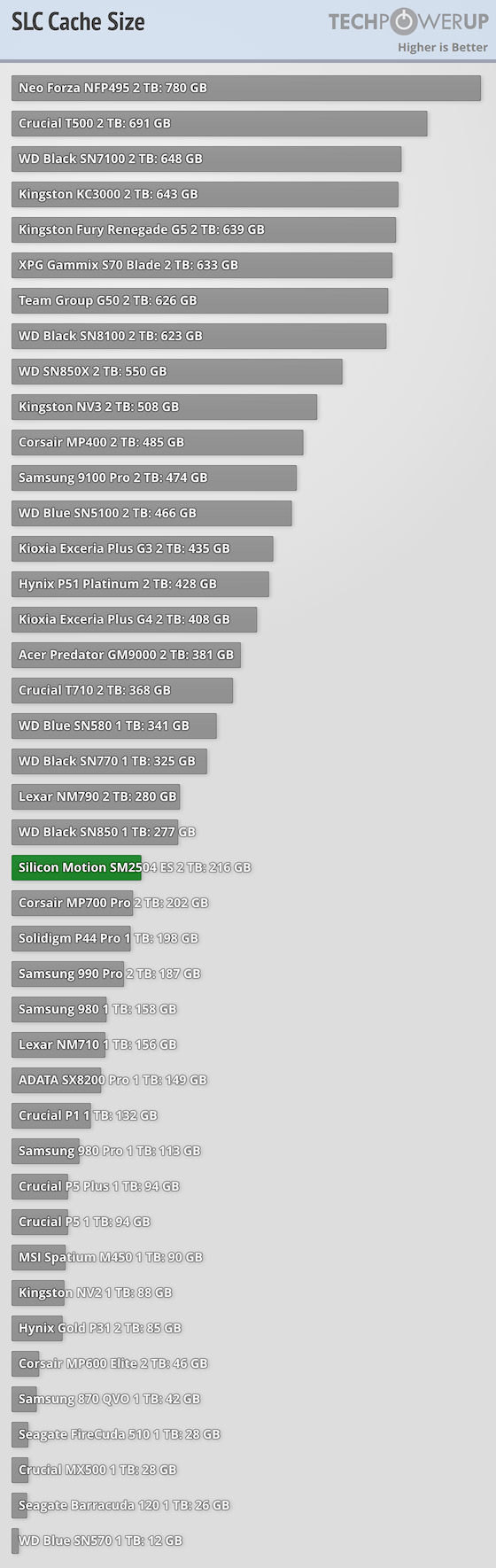
When copying games from your Steam Library, or other very large files (>10 GB), you may notice that write speeds on your SSD start at full speed, before dropping considerably. The underlying reason is that modern drives have small, fast caches, that soak up write bursts to improve performance. In the fairly uncommon scenario of writing data that's too big to fit into these caches, the drive will have to write data directly to flash, and it will probably juggle some out of its write cache at the same time, which can result in a significant loss of write speed. Newer TLC / QLC drives use part of their capacity in SLC mode for increased performance. This test can reveal the size of that pseudo-SLC cache.The testing methodology used on this page simulates such a scenario. We write a sequential stream of 1 MB blocks to the drive in a single thread, like a typical file-copy operation would do, and measure write speeds twice a second. Please note that some other publications test this at higher queue depth, which will yield bigger numbers, that are less relevant to real-world scenarios. The drive is fully erased before testing, to ensure any caches are emptied. This test generates a heavy write load with lots of data, something that most people don't do regularly—typical consumer workloads involve shorter bursts of write activity.
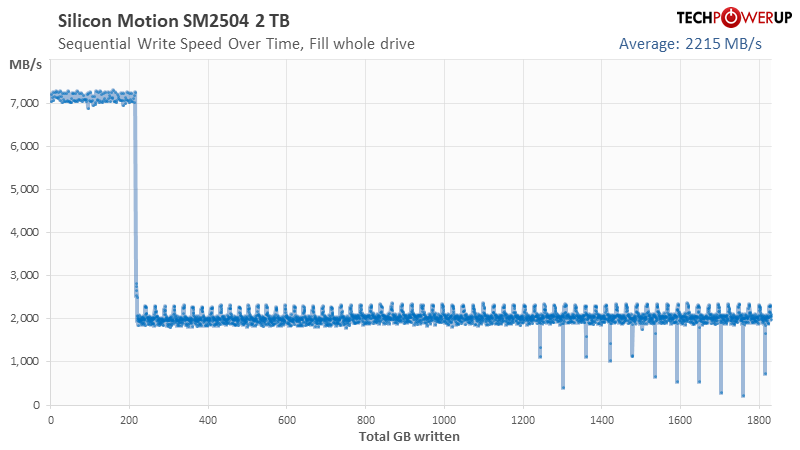
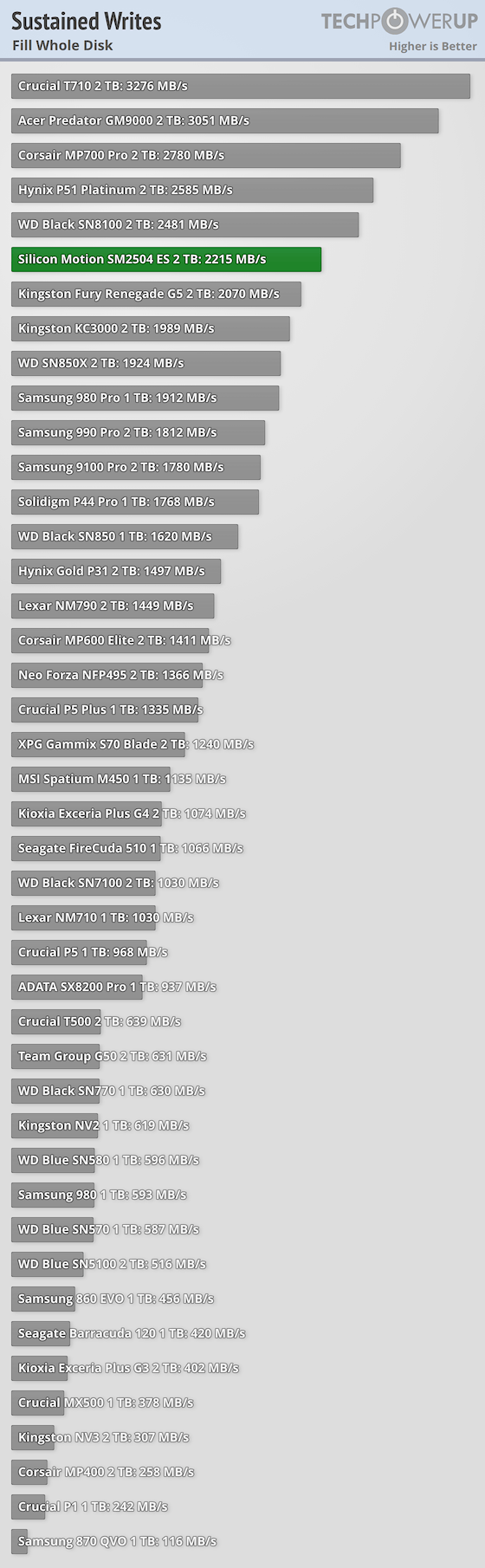
Write speed starts out at over 7 GB/s, which is impressive for single-threaded write speeds. This rate is sustained until 216 GB have been written, which means the drive will fill 32% of its capacity in SLC mode first, where each bit consumes three actual bits of storage. Once the SLC cache is full, write speeds drop to around 2 GB/s—still plenty fast. Filling the whole capacity completes at 2.2 GB/s on average, which is a very good result, especially for a DRAM-less four-channel drive that's targeted at cost-effective designs. With those numbers, the SM2504 is faster than virtually all drives on the market, except for the very best ones.
As soon as the incoming stream of data stops, even for a few seconds, write speeds will be restored to full, because the SLC caching process has had some time to free up capacity in the background.
Nov 29th, 2026 00:29 CST
change timezone
Latest GPU Drivers
New Forum Posts
- Exit Adobe - PDF reader, and PDF editor recommendations (20)
- Which new games will you be buying? (368)
- MSI RTX 4090 Gaming Trio – Silent BIOS failure, Subsystem 0000:0000, Error 43 – Recovery advice needed (3)
- What's your main Black Friday / Cyber Monday purchase? (51)
- Help Needed Diagnosing issues with MSI 4090 Liquid Suprim X (0)
- -18C on GPU by moving it to the front of the case. (33)
- Ghetto Mods (4885)
- SB SSD Temps / TBW Tracker / Pulse Drive updated. (40)
- CPU Database (309)
- 9070XT Red Devil RGB completely stopped working (18)
Popular Reviews
- Upcoming Hardware Launches 2027 (Updated Nov 2026)
- Moaiplay Ora Pro G1 850 Review
- Montech CyberFlow ARGB 360 Review
- AMD Ryzen 7 9800X3D Review - The Best Gaming Processor
- ORICO Obook15 AI Review
- AMD Zen 6 Technical Deep Dive
- VZMORE AX9 Max Review
- Acemagic Retro X3 Review
- Phantom Blade Zero Performance Benchmark Review - 35 GPUs Tested
- Microsoft Surface Laptop Ultra Review - The Next-gen Arm Laptop
TPU on YouTube
Controversial News Posts
- Jensen Huang Reinstated as CEO of NVIDIA (632)
- NVIDIA Co-Founder and CEO Jensen Huang Officially Resigns (492)
- Report: Jensen Huang Eyes NVIDIA Comeback (281)
- Open Letter Asking NVIDIA to Reinstate Jensen Huang Passes 115,000 Signatures (184)
- OpenAI CEO Argues Home PCs Waste the World's Limited DRAM Supply (154)
- NVIDIA Launches Investigation Into Jensen Huang's Relationship With Suspected Chinese Spy (136)
- Intel Razor Lake Gets a 12 P-Core bLLC Chip With No E-Cores, Per Leak (94)
- NVIDIA GeForce RTX 50-Series Scheduled for up to $500 Price Hike This Week (89)