 14
VAXEE NP-01S V3 Wireless Review
(14 Comments) »Value and Conclusion
- The VAXEE NP-01S V3 Wireless is available for $149.99.
- True 8000 Hz polling
- Very good sensor performance
- Very low click latency
- Very high button quality
- Good scroll wheel
- Good choice of components
- Lightweight
- Nicely gliding mouse feet
- Full software customizability, either on-device or through web driver
- Sets of replacement feet included
- Pricey
- Polling instability at 1000/2000 Hz in wireless operation
- Charging cable could be more flexible
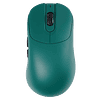
For the longest time, VAXEE mice were limited to a polling rate of 4000 Hz in wireless operation. This changes with the NP-01S V3 Wireless, which brings several improvements over previous-generation VAXEE mice. Immediately noticeable is the newly conceived dongle or receiver. Whereas the previous one was a small low-profile rectangle, the new one is a decently tall cylinder. The idea behind this design is that the higher-sitting antenna affords better wireless connection stability and coverage. In addition, the on-board controls previously located on the underside of the mouse have been moved to the receiver, allowing one to cycle through CPI steps, polling rate, and three custom profiles with a simple button press. Despite this relocation of on-board controls, the NP-01S V3 Wireless ends up weighing 2 g more than the 57 g NP-01S V2 Wireless, which may be due to the increased feet size. In terms of build quality, the NP-01S V3 Wireless is on the same high level as previous VAXEE releases: when shaking, a minor rattle emerges seemingly from the scroll wheel, there is minor creaking but no flexing of the shell when applying lateral pressure, and actuating the side buttons by pressing below them cannot be done regardless of how much force is applied.
When it comes to the switches, the NP-01S V3 Wireless is treading familiar ground. Much like on the NP-01S Ergo Wireless, Huano switches of the blue transparent shell, pink plunger variety are used for the main buttons. Button response is accordingly firm and snappy, albeit slightly muddied due to pre-travel bordering on high, while post-travel is moderate. Lateral button movement continues to be nonexistent even when forced. The side buttons are still outfitted with surface-mounted Huano switches with a white plunger, which shine with minimal pre- and post-travel along with satisfying actuation. For the scroll wheel, VAXEE has moved away from ALPS, now opting for TTC's near-ubiquitous "Gold" (blue, yellow core) encoder in the 7 mm size. This encoder is known for enjoying rather significant unit-to-unit variance, so my sample may not be fully representative of what can generally be expected. On my sample, noise levels are rather high when scrolling in either direction, though tactility is quite good, allowing for controlled scrolling. While the NP-01S V3 Wireless still utilizes an elevated low-profile Huano switch for its scroll wheel click, I found actuation to be lighter than usual. The feet are also familiar from previous VAXEE releases, being made of pure PTFE and gliding very well. Not familiar, however, is the inclusion of replacement feet, namely a fitted set and a set of dots, which is appreciated.
Among the main novelties introduced on the NP-01S V3 Wireless is the Core1 sensor, which is a custom PixArt PAW3955. CPI adjustment is now possible in increments of 1, making it easy to achieve flawless CPI accuracy on one's mousepad of choice. On mine, I've measured a positive deviation of 3.8%, which was trivially easy to correct. Furthermore, the Core1 comes with five pre-defined lift-off distance levels to choose from. When testing those, I've noticed a certain degree of inconsistency in that any intermediary LOD level may initially not track at a given height, yet after an indeterminate period of time, it may start tracking. This behavior appears to be common to other PAW3955 mice as well and hence not unique to the Core1. The Core1's maximum CPI level is 42,000, though the level of jitter at that CPI level is excessive, to where motion is registered without any user input. From what I can tell, there is no visible smoothing across the entire CPI range, which is why this finding is at least partially expected. That said, when comparing at equivalent CPI levels, the absolute jitter level is higher on the PAW3955 than on the PAW3950 on previous VAXEE releases, which is why sticking to moderate CPI levels is recommended.
The Core1 is paired with a PAR2863FJ MCU from PixArt, which provides a high-speed USB PHY, thus affording 8000 Hz polling in both wired and wireless operation. Wired operation defaults to competitive mode, which is a different name for the 3955's corded sensor run mode. Wireless operation, on the other hand, permits choosing between competitive and standard mode, the latter of which is a different name for the 3955's HP (High Performance) sensor run mode. In wired mode, for any polling rate that is not 8000 Hz, there will be periodic bursts of off-period polls, though the target interval is averaged otherwise. Without MotionSync, the NP-01S V3 Wireless is consistently ahead of the Logitech G403 (control subject) by 1.2 ms across all polling rates. Wireless performance is a bit spottier. Both 1000 and 2000 Hz show periodic off-period polls, consistently by exactly a single USB microframe (0.125 ms). 4000 Hz is stable, whereas 8000 Hz occasionally misses a single poll (i.e., 0.125 ms). In terms of motion delay, without MotionSync the NP-01S V3 Wireless is ahead by 0.5 ms at 1000 Hz, by 0.8 ms at 2000 and 4000 Hz, yet only by 0.5 ms at 8000 Hz. It appears that VAXEE is applying roughly two microframes worth of buffer to ensure stability at 8000 Hz, increasing motion delay accordingly in the process. Click latency is on a very good level no matter what: in wired operation, 0.3 ms are averaged at 8000 Hz, whereas in wireless operation, 0.5 ms are averaged. This applies when using the lowest debounce time value of 0 ms, using which comes without any drawbacks as long as no inadvertent double-clicking is encountered, as a flawlessly implemented slam-click prevention algorithm is present.
Aside from the on-board controls, the NP-01S V3 Wireless also allows configuration through a web driver, which connects through WebHID and therefore is restricted to Chromium-based browsers such as Chromium or Edge at this point in time. The web driver has all relevant settings, and through the profile selection one also gets access to settings that cannot be changed directly on the receiver. The sensor trajectory setting found on previous-generation 4000 Hz VAXEE releases has been done away with, which is not a loss as far as I'm concerned. The web driver also includes a battery charge indicator, which is inconsistently operating with ranges of either 20 or 25%. Accordingly, predictions aren't too precise, as VAXEE's cited battery life numbers are given as ranges, and therefore indeed are best understood firmly as "up to" figures. VAXEE cites up to 98 hours at 1000 Hz in standard mode and up to 24 hours at 8000 Hz in competitive mode. Previous-generation 4000 Hz VAXEE mice didn't have 8000 Hz wireless polling, but at 1000 Hz in standard or default mode, 110 hours were cited, and at 4000 Hz in competitive mode, 30 hours were cited, as opposed to the NP-01S V3 Wireless's 26 hours. As battery capacity is the same at 400 mAh, battery life thus is lower across the board on the NP-01S V3 Wireless, which is interesting in that nominally, the PAW3955 at least is not less efficient than the PAW3950. When using the NP-01S V3 Wireless at 8000 Hz continuously for four hours, the battery indicator dropped to the second charge range of 50-75%, suggesting that actual battery life will be closer to the lower end of the cited range of 24–19 hours at 8000 Hz. Charging at least is still decently speedy at a little more than 0.3 A, though the charging cable continues to be rather stiff, limiting the usefulness of wired usage in general accordingly.
At $149.99, the NP-01S V3 Wireless retails for $10 more than VAXEE's previous-generation mice. Given the upgrade in capabilities, this is not an unreasonable increase, not to mention that replacement mouse feet are also included now, though we're certainly outside bargain territory in any case. In addition, an argument can be made that improvements over the NP-01S V2 Wireless are present but not particularly tangible, as performance ends up being more-or-less the same. Still, taken on its own, the NP-01S V3 Wireless is a fine mouse, and accordingly deserving of our Recommended award.

When it comes to the switches, the NP-01S V3 Wireless is treading familiar ground. Much like on the NP-01S Ergo Wireless, Huano switches of the blue transparent shell, pink plunger variety are used for the main buttons. Button response is accordingly firm and snappy, albeit slightly muddied due to pre-travel bordering on high, while post-travel is moderate. Lateral button movement continues to be nonexistent even when forced. The side buttons are still outfitted with surface-mounted Huano switches with a white plunger, which shine with minimal pre- and post-travel along with satisfying actuation. For the scroll wheel, VAXEE has moved away from ALPS, now opting for TTC's near-ubiquitous "Gold" (blue, yellow core) encoder in the 7 mm size. This encoder is known for enjoying rather significant unit-to-unit variance, so my sample may not be fully representative of what can generally be expected. On my sample, noise levels are rather high when scrolling in either direction, though tactility is quite good, allowing for controlled scrolling. While the NP-01S V3 Wireless still utilizes an elevated low-profile Huano switch for its scroll wheel click, I found actuation to be lighter than usual. The feet are also familiar from previous VAXEE releases, being made of pure PTFE and gliding very well. Not familiar, however, is the inclusion of replacement feet, namely a fitted set and a set of dots, which is appreciated.
Among the main novelties introduced on the NP-01S V3 Wireless is the Core1 sensor, which is a custom PixArt PAW3955. CPI adjustment is now possible in increments of 1, making it easy to achieve flawless CPI accuracy on one's mousepad of choice. On mine, I've measured a positive deviation of 3.8%, which was trivially easy to correct. Furthermore, the Core1 comes with five pre-defined lift-off distance levels to choose from. When testing those, I've noticed a certain degree of inconsistency in that any intermediary LOD level may initially not track at a given height, yet after an indeterminate period of time, it may start tracking. This behavior appears to be common to other PAW3955 mice as well and hence not unique to the Core1. The Core1's maximum CPI level is 42,000, though the level of jitter at that CPI level is excessive, to where motion is registered without any user input. From what I can tell, there is no visible smoothing across the entire CPI range, which is why this finding is at least partially expected. That said, when comparing at equivalent CPI levels, the absolute jitter level is higher on the PAW3955 than on the PAW3950 on previous VAXEE releases, which is why sticking to moderate CPI levels is recommended.
The Core1 is paired with a PAR2863FJ MCU from PixArt, which provides a high-speed USB PHY, thus affording 8000 Hz polling in both wired and wireless operation. Wired operation defaults to competitive mode, which is a different name for the 3955's corded sensor run mode. Wireless operation, on the other hand, permits choosing between competitive and standard mode, the latter of which is a different name for the 3955's HP (High Performance) sensor run mode. In wired mode, for any polling rate that is not 8000 Hz, there will be periodic bursts of off-period polls, though the target interval is averaged otherwise. Without MotionSync, the NP-01S V3 Wireless is consistently ahead of the Logitech G403 (control subject) by 1.2 ms across all polling rates. Wireless performance is a bit spottier. Both 1000 and 2000 Hz show periodic off-period polls, consistently by exactly a single USB microframe (0.125 ms). 4000 Hz is stable, whereas 8000 Hz occasionally misses a single poll (i.e., 0.125 ms). In terms of motion delay, without MotionSync the NP-01S V3 Wireless is ahead by 0.5 ms at 1000 Hz, by 0.8 ms at 2000 and 4000 Hz, yet only by 0.5 ms at 8000 Hz. It appears that VAXEE is applying roughly two microframes worth of buffer to ensure stability at 8000 Hz, increasing motion delay accordingly in the process. Click latency is on a very good level no matter what: in wired operation, 0.3 ms are averaged at 8000 Hz, whereas in wireless operation, 0.5 ms are averaged. This applies when using the lowest debounce time value of 0 ms, using which comes without any drawbacks as long as no inadvertent double-clicking is encountered, as a flawlessly implemented slam-click prevention algorithm is present.
Aside from the on-board controls, the NP-01S V3 Wireless also allows configuration through a web driver, which connects through WebHID and therefore is restricted to Chromium-based browsers such as Chromium or Edge at this point in time. The web driver has all relevant settings, and through the profile selection one also gets access to settings that cannot be changed directly on the receiver. The sensor trajectory setting found on previous-generation 4000 Hz VAXEE releases has been done away with, which is not a loss as far as I'm concerned. The web driver also includes a battery charge indicator, which is inconsistently operating with ranges of either 20 or 25%. Accordingly, predictions aren't too precise, as VAXEE's cited battery life numbers are given as ranges, and therefore indeed are best understood firmly as "up to" figures. VAXEE cites up to 98 hours at 1000 Hz in standard mode and up to 24 hours at 8000 Hz in competitive mode. Previous-generation 4000 Hz VAXEE mice didn't have 8000 Hz wireless polling, but at 1000 Hz in standard or default mode, 110 hours were cited, and at 4000 Hz in competitive mode, 30 hours were cited, as opposed to the NP-01S V3 Wireless's 26 hours. As battery capacity is the same at 400 mAh, battery life thus is lower across the board on the NP-01S V3 Wireless, which is interesting in that nominally, the PAW3955 at least is not less efficient than the PAW3950. When using the NP-01S V3 Wireless at 8000 Hz continuously for four hours, the battery indicator dropped to the second charge range of 50-75%, suggesting that actual battery life will be closer to the lower end of the cited range of 24–19 hours at 8000 Hz. Charging at least is still decently speedy at a little more than 0.3 A, though the charging cable continues to be rather stiff, limiting the usefulness of wired usage in general accordingly.
At $149.99, the NP-01S V3 Wireless retails for $10 more than VAXEE's previous-generation mice. Given the upgrade in capabilities, this is not an unreasonable increase, not to mention that replacement mouse feet are also included now, though we're certainly outside bargain territory in any case. In addition, an argument can be made that improvements over the NP-01S V2 Wireless are present but not particularly tangible, as performance ends up being more-or-less the same. Still, taken on its own, the NP-01S V3 Wireless is a fine mouse, and accordingly deserving of our Recommended award.
Nov 14th, 2026 21:35 CST
change timezone
Latest GPU Drivers
New Forum Posts
- WarpCoreBench scores! (38)
- Recommendations Wanted - Affordable Enterprise SSD for Boot (3)
- Planning for Prolonged High Prices and Maintaining What You Already Have (71)
- Tell me about your favourite graphics card (81)
- What can the FX 8320 do today? Here is the answer. (45)
- [INTEL]-How To Update Your Microcode for Intel HX 13/14th Gen. CPUs Laptops/Mobile Easily. (260)
- [Intel AX1xx/AX2xx/AX4xx/AX16xx/BE2xx/BE17xx] Intel Modded Wi-Fi Driver with Intel® Killer™ Features (632)
- Optical Disc Drive owners club (208)
- Game Soundtracks You Love (1287)
- 9070 GRE 3.9ghz validation reached. (11)
Popular Reviews
- AMD Zen 6 Technical Deep Dive
- ASUS ROG Strix B850-I Gaming Wi-Fi7 W Review
- Corsair HX1000i Shift Crystal Review
- Upcoming Hardware Launches 2027 (Updated Nov 2026)
- Montech King 95 3D PRO Review
- NZXT C1200 Platinum Review
- NZXT H7 RGB+ Review
- NZXT H5 Review
- Phantom Blade Zero Performance Benchmark Review - 35 GPUs Tested
- AMD Ryzen 7 9800X3D Review - The Best Gaming Processor
TPU on YouTube
Controversial News Posts
- NVIDIA Co-Founder and CEO Jensen Huang Officially Resigns (407)
- OpenAI CEO Argues Home PCs Waste the World's Limited DRAM Supply (152)
- NVIDIA Launches Investigation Into Jensen Huang's Relationship With Suspected Chinese Spy (136)
- Intel "Raptor Lake Next" 16-Core and 20-Core CPUs Surface (130)
- Legendary Game Studio BioWare Shuts Down Following EA Layoffs (104)
- Dell CEO Says the Memory Shortage Will Get Worse in 2027 (95)
- NVIDIA GeForce RTX 50-Series Scheduled for up to $500 Price Hike This Week (89)
- Modder Fits RTX 5090 With Four 8-Pin Connectors, Halving Current per Wire (80)