 34
Zotac GeForce RTX 5070 Solid Review
Overclocking & Power Limits »Energy Efficiency
Energy Efficiency calculations are based on measurements using Cyberpunk 2077, Stalker 2 and Spider-Man 2. We record power draw and FPS rate to calculate the energy efficiency of the graphics card as it operates.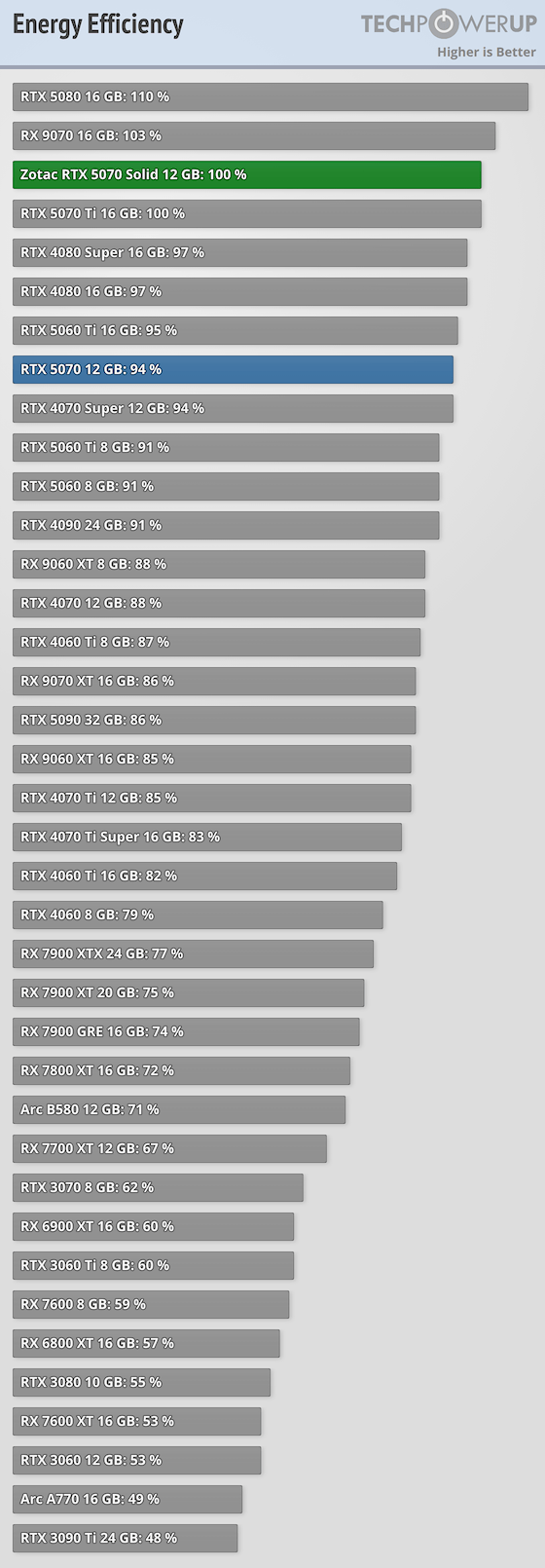
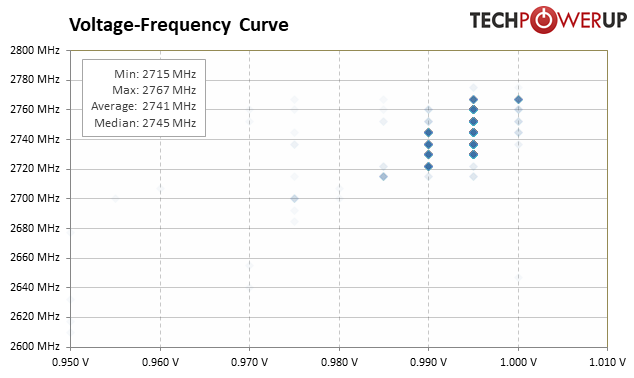
Voltage Frequency Curve
The card will dynamically adjust clocks and voltage based on render load, temperature, and other factors.For the graph below, we recorded all GPU clock and GPU voltage combinations of our 1440p resolution benchmarking suite. The plotted points are transparent, which allows them to add up to indicate more often used values. A light color means the clock and voltage combination is rarely used, and a dark color means it's active more often. The minimum and maximum values are 99th and 1st percentile, so outliers are excluded.
Clock States
| Clock Frequencies & Voltage | |||
|---|---|---|---|
| GPU Clock | Memory Clock | GPU Voltage | |
| Idle | 225 MHz | 51 MHz | 0.800 V |
| Multi-Monitor | 225 MHz | 101 MHz | 0.800 V |
| Video Playback | 399 MHz 337 to 502 MHz | 51 MHz | 0.805 V 0.800 to 0.810 V |
| Furmark | 2366 MHz 2347 to 2400 MHz | 1750 MHz | 0.888 V 0.885 to 0.895 V |
| Gaming (Cyberpunk 2077) | 2835 MHz 2827 to 2842 MHz | 1750 MHz | 1.031 V 1.030 to 1.035 V |
| Gaming (Stalker 2) | 2818 MHz 2812 to 2820 MHz | 1750 MHz | 1.020 V 1.020 to 1.025 V |
| Gaming (Spider-Man 2) | 2857 MHz | 1750 MHz | 1.040 V |
| Ray Tracing (Cyberpunk 2077) | 2804 MHz 2797 to 2812 MHz | 1750 MHz | 1.023 V 1.020 to 1.025 V |
| V-Sync (Cyberpunk 2077) | 2838 MHz 2812 to 2850 MHz | 1750 MHz | 1.035 V |
| Gaming (25 Games) | 2714 MHz 2055 to 2895 MHz | 1750 MHz | 0.990 V 0.805 to 1.040 V |
Nov 16th, 2026 03:14 CST
change timezone
Latest GPU Drivers
New Forum Posts
- GPU Temperatures Rise Very Quickly in FurMark – Is This Normal? (12)
- Is a C6K 2026 or a400m worth coming from a samsung bu8000 ? (0)
- [Community Benchmark] MrH OpenCL Benchmark 2.0e (Windows Only – CPU & GPU) (4)
- What can the FX 8320 do today? Here is the answer. (60)
- Your PC ATM (36443)
- Asus Rog Maximus Z890 Extreme. (Various questions). (27)
- Will zen 6 mobos have anything extra vs current ones? (47)
- The Official Thermal Interface Material thread (2301)
- It’s been fascinating times in Retro agian r36s isn’t even worth 50-65 dollars no more and newly listed Rm36 64gb 4in IPS models for only 34 dollars. (6)
- Power supply noise stops when I move the mouse (10)
Popular Reviews
- ASUS ROG Strix B850-I Gaming Wi-Fi7 W Review
- Corsair HX1000i Shift Crystal Review
- AMD Zen 6 Technical Deep Dive
- Upcoming Hardware Launches 2027 (Updated Nov 2026)
- Montech King 95 3D PRO Review
- NZXT C1200 Platinum Review
- Phantom Blade Zero Performance Benchmark Review - 35 GPUs Tested
- AMD Ryzen 7 9800X3D Review - The Best Gaming Processor
- NZXT H7 RGB+ Review
- NZXT H5 Review
TPU on YouTube
Controversial News Posts
- NVIDIA Co-Founder and CEO Jensen Huang Officially Resigns (430)
- Open Letter Asking NVIDIA to Reinstate Jensen Huang Passes 115,000 Signatures (184)
- OpenAI CEO Argues Home PCs Waste the World's Limited DRAM Supply (152)
- NVIDIA Launches Investigation Into Jensen Huang's Relationship With Suspected Chinese Spy (136)
- Intel "Raptor Lake Next" 16-Core and 20-Core CPUs Surface (130)
- Legendary Game Studio BioWare Shuts Down Following EA Layoffs (104)
- Dell CEO Says the Memory Shortage Will Get Worse in 2027 (95)
- NVIDIA GeForce RTX 50-Series Scheduled for up to $500 Price Hike This Week (89)