Tuesday, October 18th 2011

Ivy Bridge Quad-Core to Have 77W TDP, Intel Plans for LGA1155 Ivy Bridge Entry
Intel's next generation "Ivy Bridge" Core processors slated for 2012 will mark the beginning of Intel's transition to the brand new 22 nanometer fab process. It looks like Ivy Bridge will significantly benefit from this transition, since Intel will raise the bar in terms of energy-efficiency. Even the fastest P1 (performance 1) tier quad-core chips will have TDP rated as low as 77W, down from the 95W Core i7 2600K, for example, has.
The punters at Intel marketing have sliced the market down to finer segments, to better address it. The market is sliced in terms of price-segments (vertical), and in terms of target users (horizontal). The two markers are independent of each other, yet they complement each other in pin-pointing areas of the market Intel can address. Ivy Bridge LGA1155 is restricted to P1 (performance tier 1) segment on the top, with higher tiers, along with HEDT (high-end desktop) being reserved for Sandy Bridge-E LGA2011, and future "Ivy Bridge-E". Horizontally, Intel will have "K" quad-core parts for Enthusiast, standard (locked) quad-core vPro for the Standard, "T" quad-core for Performance-optimized lifestyle, and "S" for Power-optimized lifestyle. Chaotic as it looks, the table below lays out the lineup perfectly.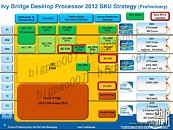 Unlocked "K" and standard (locked) vPro quad-core parts have TDP of 77W, performance-optimized "T" quad-core parts at 65W, and power-optimized "S" quad-core parts at 45W. There are dual-core Core i3 parts, too, with TDP of 55W (35W for the "S" variants).
The P1 segment parts will fall within the Core i7-3700 series, these chips will have the full 8 MB L3 cache present on the Ivy Bridge silicon, and 4 cores with 8 threads (HyperThreading enabled). Just below P1 segment are the MS2 and MS1 segments, the MS2 segment will include quad-core parts with 6 MB L3 cache, and no HyperThreading. The top-most MS2 part will have an unlocked multiplier, much like today's Core i5-2500K. MS2 and MS1 segment parts will take up Core i5-3500 series, Core i5-3400 series, and Core i5-3300 series. There will be just one class of dual-core parts, in the power-optimized MS1 segment. These segments will get have an updated feature-set over the present generation, that includes AES-NI acceleration, PP-DRNG.
Dual-core parts will span across key low-end and value segments. The 55W dual-core silicon will form the bed for SKUs in all four horizontal segments, in T2, T1, and L3 vertical segments. T2 and T1 segment parts will carry the Core i3-3100 series SKUs. These chips will have HyperThreading technology enabled, along with AVX, and updated GPU feature-set. The L3 segment will house the cheapest Ivy Bridge processor, in the Pentium Dual-Core G2000 family. This chip will now support dual-channel DDR3-1600 MHz.
Moving on to backwards compatibility with current Intel 6-series chipset motherboards, let me kill the suspense here. Ivy Bridge will run on Intel 6-series chipset motherboards, provided:
Last but not the least, Intel Smart Response technology (SRT) will be updated to be more functional, and perform even better than it does. Intel will seggregate SRT support among both processors and chipsets. So to be able to use SRT, besides having a compatible chipset, you'll also need a compatible processor. Future Q77, Z77, and H77 chipsets will support SRT, on Core i3, Core i5, and Core i7 processors.
Sources:
ChipHell, VR-Zone
The punters at Intel marketing have sliced the market down to finer segments, to better address it. The market is sliced in terms of price-segments (vertical), and in terms of target users (horizontal). The two markers are independent of each other, yet they complement each other in pin-pointing areas of the market Intel can address. Ivy Bridge LGA1155 is restricted to P1 (performance tier 1) segment on the top, with higher tiers, along with HEDT (high-end desktop) being reserved for Sandy Bridge-E LGA2011, and future "Ivy Bridge-E". Horizontally, Intel will have "K" quad-core parts for Enthusiast, standard (locked) quad-core vPro for the Standard, "T" quad-core for Performance-optimized lifestyle, and "S" for Power-optimized lifestyle. Chaotic as it looks, the table below lays out the lineup perfectly.

The P1 segment parts will fall within the Core i7-3700 series, these chips will have the full 8 MB L3 cache present on the Ivy Bridge silicon, and 4 cores with 8 threads (HyperThreading enabled). Just below P1 segment are the MS2 and MS1 segments, the MS2 segment will include quad-core parts with 6 MB L3 cache, and no HyperThreading. The top-most MS2 part will have an unlocked multiplier, much like today's Core i5-2500K. MS2 and MS1 segment parts will take up Core i5-3500 series, Core i5-3400 series, and Core i5-3300 series. There will be just one class of dual-core parts, in the power-optimized MS1 segment. These segments will get have an updated feature-set over the present generation, that includes AES-NI acceleration, PP-DRNG.

Moving on to backwards compatibility with current Intel 6-series chipset motherboards, let me kill the suspense here. Ivy Bridge will run on Intel 6-series chipset motherboards, provided:
- They use the following chipsets: Z68, P67, H67, or H61 (Q67 and Q65 are not supported);
- The motherboards feature ME8L UEFI update. For this:
o Your motherboard should currently feature a UEFI firmware
o It should support ME8L update process at the physical level, where the EEPROM is sufficiently large


74 Comments on Ivy Bridge Quad-Core to Have 77W TDP, Intel Plans for LGA1155 Ivy Bridge Entry
Gigabyte has lost my trust with their inability to embrace UEFI, dying $150 Z68 boards and tricky marketing (which they always get busted for something concerning PCIe lane counts or Gen3 compatibility). I think my GA-E350N-USB3 is the last board I will use from them.
Even though companies will have quite adequate existing PCs, their environmental policies will get them to invest in 22nm CPUs. Intel needs to match equally sparsam chipsets and not do "An Atom" on their chipset.
I think in the next 18 months we will see hybrid mobile/desktop systems. Basically a corpoate desktop running on a mobile ULV platform
of course its going to be a 3.5inch screen.
Its called inter-connectivity to other devices such as LCD's and panels(17-30" lcd/ledhdtv ect..) in the future and its very possible, huge market is available if its utilized.
Nice try though :)
**EDIT**As in, PSP size and portability on the go.
When @ home or work you dock it, connect it, sync it to a large monitor. ARM processors are progressing at great speed. The reason being, is that every single company that is in the market using ARM processor's are STRIVING to beat the competition in all ways, especially with smart phone's, tablets, and PDA's.
EXAMPLE:
Samsung with there NEXUS phones.
Apple with there Iphone's. There already dual core, and perform a lot of task reasonably well.
Add in the rest of the market and its a competition fiesta !!
Its like having 4-6 different Intel's and AMD's striving to beat one another in speed, usability, and diversity when it comes to hardware. Where there's competition there is ALWAYS improvement.
I'm hoping this will drop the price of the 2500k/2600k when the cpu's come out in early 2012 since that will probably be my next upgrade along with a 560ti.
waiting for me8L details >_>
Irritable Bowl Economics.
$1000+ cpus.
EDIT: Ok.. one unlocked IBE (IBS?) chip prognosticated to come in at under $600. Cant tell the difference between it and the $1000 version of the same chip though :S
You might also argue that gamers upgrade components and systems on a much more regular basis than non-gamers - so things aren't quite that black and white...While a large percentage of those would be for the budget box/OEM/office ws, many tend to be snapped up by gamers also - IGP chipset boards tend to be much cheaper than full-fat enthusiast chipsets mobo's, they also offer a suitable backup if you're between graphics upgrades, and offer a fallback position if you're graphics get fubar.Those "unsuitable" graphics cards still contribute to a sizeable proportion of Stream usersTrue...but then, a sizeable percentage of people either have both (laptop + desktop) or a gaming capable laptop.
Sixteen billion dollars in PC gaming revenue might not be everyones idea of big money (forecast to reach $23bn by 2014), but it isn't chump change either. I would also certainly expect AMD's Gaming Evolved and Nvidia's TWIMTBP game dev programs to keep pushing system requirements higher to keep GPU sales ticking over (another $13.8bn to add into the equation)Intel just released their Q3 financials...$3.5bn profit from a record $14.2bn revenue for the quarterprobably says that they aren't in any immediate danger of having to subsist off ramen noodles and pizza slices.Three thoughts on that one...
1.Yup, That's why Dell and HP still sell.
2. AMD are well and truly f%<$@! in that case
3. Pro markets (server/ws/hpc) and diversificationCool...might come about if if you think ARM can oust x86 in any reasonable timeframe. That's one helluva '"if".Socket 2011 = SB-E (Sandy Bridge-E) not IB-E at this stage.
Pricing supposedly starts at $294* (quad BCLK OC only) then <$600 (hex unlocked), $1k (extreme). Same pricing as Intel usually adopt for enthusiast chips (see Core i7 920, 940/950, 965XE/975XE for X58 for example)
* www.cpu-world.com/news_2011/2011081501_Intel_Sandy_Bridge-E_processors_priced.html
This is nice and all, but i still cant see reason why it must be arm arch inside those simple internet browsing/word processing devices. I believe amd, intel or both of them will tune their low power x86 cores (bobcat/atom/whatever) soon enough (they are not so miserable at the moment afterall). Of course arm designs are better now, they have been paying attention to this LP market way longer then intel/amd, they arch are optimized for it (created with those LP ideas in mind). I really doubt intel will give up its market share without tough fight. Time will tell.
no upgrading for me xd
there is no need for that in the first place 2600k ftw xd
Think about it, every device that is powerful enough for average joe will replace one of their desktop CPUs. Even if such a device has an Intel/AMD CPU, that CPU is going to be tiny and cheap (if they want a chance to compete with ARM devices at least), so no matter how you look at it, the mayority of their market shifted from an ASP of $150 per CPU + $100 mobo, to average of $25 per SoC. The company they are today is gone either way, no way to mantain their several dozen billion revenue. So Intel is going to fight the trend, the adoption of such devices as much as they can. The reason (all this is only my opinion obviously) is this, following the example prices from above:
- If the device is powered by an Intel SoC. They lost 1 desktop consumer (-$250) for one SoC consumer (+$25), that is, they lost $225 (compared to current market) and contributed to such devices becoming better, by simply being competitive. (because if the device uses Intel is safe to assume it is better than ARM)
- If device is ARM, they lost $250, but there's not as much competition as ARM is the only one really pushing for faster chips. Yeah, there's many people producing ARM based chips, but only one designing them and moving the tech forward. Big difference compared to 2 big companies/conglomerates fighting each other in designs and production.
The logical steps for Intel are clear for the first few years. Fight back sure, by creating SoCs, but do not compete entirely, do not create the kind of killer SoC that would take the crown yes, and the market share, but at the price of demostrating that those devices are (more) powerful. Use other methods to enter the market rather than using superior tech. This means that for a few years they will bleed desktop CPU market and will not gain too much market share on portable devices, but it's better than contributing to the trend and make the shift happen overnight. More years selling the $250 solution, even losing market, is better than being king in a less profitable (per sale) market, and everybody knows (even Intel), that they would not be king either, only another name in a long list of SoC manufacturers.
Like I said that's my opinion.