Friday, January 23rd 2026

Intel Core Ultra Series 4 "Nova Lake" Processors Launch in Late-2026
Intel is preparing to launch its Core Ultra Series 4 "Nova Lake" processor generation toward the end of 2026, CEO Lip-Bu Tan confirmed. This processor generation would span various form-factors, including importantly, desktop. Intel is building its next-generation "Nova Lake-S" desktop processor around the new Socket LGA1954 platform that replaces the current LGA1851. The company is planning to release Core Ultra Series 3 "Arrow Lake Refresh" for LGA1851 in the run-up to "Nova Lake-S" by yearend.
With "Nova Lake," Intel is expected to make fundamental changes to its processor design to help the company claw back performance leadership over AMD in the desktop segment. These changes include a doubling in CPU core counts going up to 16P+32E, a new iGPU based on the Xe3 "Celestial" graphics architecture, a new NPU that meets Copilot+ requirements, and the introduction of special SKUs with BLLC (big last-level cache), Intel's answer to AMD's 3D V-Cache. Intel will update the CPU complex with new "Coyote Cove" P-cores, and "Arctic Wolf" E-cores, both of which are expected to improve IPC over the current "Lion Cove" and "Skymont" combo. "Coyote Cove" does not feature HyperThreading, something the Intel CEO wants to see restored on the company's P-cores, but "Nova Lake" will make up for it with a numerical increase in P-core counts.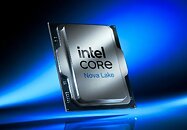
Source:
VideoCardz
With "Nova Lake," Intel is expected to make fundamental changes to its processor design to help the company claw back performance leadership over AMD in the desktop segment. These changes include a doubling in CPU core counts going up to 16P+32E, a new iGPU based on the Xe3 "Celestial" graphics architecture, a new NPU that meets Copilot+ requirements, and the introduction of special SKUs with BLLC (big last-level cache), Intel's answer to AMD's 3D V-Cache. Intel will update the CPU complex with new "Coyote Cove" P-cores, and "Arctic Wolf" E-cores, both of which are expected to improve IPC over the current "Lion Cove" and "Skymont" combo. "Coyote Cove" does not feature HyperThreading, something the Intel CEO wants to see restored on the company's P-cores, but "Nova Lake" will make up for it with a numerical increase in P-core counts.

62 Comments on Intel Core Ultra Series 4 "Nova Lake" Processors Launch in Late-2026
Who at Intel is going. "yeah normies need 64 threads and half of them need to be weaker than the other half". Anyone who actually needs that is just going TR or Xeon. I understand this is a cheaper alternative for some people than TR or Xeon, but the mass majority that will get something like this will NEVER need 32e cores.
Also their new E-Cores are on par with the last gen P-Cores in terms of IPC, and the clocks seem to be going up as well and now E-Cores will have the same instructions as the P-Cores.
If anything the P-Cores seem to be there just to top benchmark charts.
The IGPU of modern Intel CPUs is also incredibly useful, and the E cores add more MT more efficiently than a quarter of the number of P cores would.
I just think TPU members prefer big cores, for various reasons based on past experiences from Raptor or older, and not the latest E-cores.Also, four low power cores on top of that.
I hope they revert the course of adding HT back tbh. At these core counts it doesn't seem necessary, and I'd take a more secure P core with 5% more throughput and 5% lower power draw than a second thread only adding 30% of the MT best case scenario.
Intel is essentially Amd from the past. The only difference is Amd didn't get a bailout from government.
But bigger numbers do look better on PR material.
www.techpowerup.com/340587/intel-nova-lake-s-engineering-sample-runs-52-cores-at-4-8-ghz
Also the modern E-Cores are also OoOE like the P-Cores, while the old ones iirc weren't.
The LPE Cores are the old-school E-Cores.
And its not 16+32
Its (8+16) + (8+16) + 4With (8+16) + (8+16) + 4 you will not see big benefit where latency kicks in.
If 12 Zen cores in one chiplet will give any benefit over 8 ... we have to wait for it to come.
I wont bet on Intel.
You know, lower prices etc.
At least Amd will give me +4 full "p-cores", which will fit into my existing motherboard. Same can't be said about LGA1851 and Nova Lake.
Meanwhile, people will be buying DDR5-5600 memory because it will be a little less horribly priced than 6000.
That's why AMD did not get any money while Intel and TSMC did. Because there are not enough semiconductor manufacturing sites in the US. I'm sure if AMD had fabs, they would have gotten paid too.
What saved it was getting rid of its fabs and a 1bn dollar settlement from Intel, for the x86 licences and anticompetitive practices lawsuit, not government/taxpayer money.
By the way, the consumer/taxpayer just got the middle finger from Intel:
www.techpowerup.com/345535/intel-reallocates-pc-production-capacity-to-server-cpus-amid-tight-wafer-supply
Games are not only thing suffering more with bigger latency.
6 cores as good as 8 cores?
You may be right with old games made to use 1~4 cores.
But there are games utilising more than 6 cores.
And not of them are simulators like Factorio.
www.techspot.com/articles-info/3075/bench/HZD.png
www.techspot.com/articles-info/3075/bench/SM2.png
www.techspot.com/articles-info/3075/bench/ACC.png
Slow RAMs, 16GB RAM or less, 8GB VRAM or less, slow GPU ... and every other bottleneck makes L3 cache and number of cores less and less relevant.
However, Panther Lake will share the µarch, with both E and LPE-cores being Darkmont and both living in the compute tile. The difference is just that the LPE ones will clock lower and won't have an L3.
I assume Nova Lake will be similar to MTL, using Arctic wolf cores for both E and LPE, but with the LPE-cores being shunned to the SoC tile with lower clocks and no L3.