Thursday, April 18th 2013

AMD Reports 2013 First Quarter Results
AMD (NYSE:AMD) today announced revenue for the first quarter of 2013 of $1.09 billion, an operating loss of $98 million and a net loss of $146 million, or $0.19 per share. The company reported a non-GAAP operating loss of $46 million and a non-GAAP net loss of $94 million, or $0.13 per share.
"Our first quarter results reflect our disciplined operational execution in a difficult market environment," said Rory Read, AMD president and CEO. "We have largely completed our restructuring and are now focused on delivering a powerful set of new products that will accelerate our business in 2013. We will continue to diversify our portfolio and attack high-growth markets like dense server, ultra low-power client, embedded and semi-custom solutions to create the foundation for sustainable financial returns."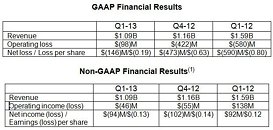
 Quarterly Financial Summary
AMD's outlook statements are based on current expectations. The following statements are forward-looking, and actual results could differ materially depending on market conditions and the factors set forth under "Cautionary Statement" below.
For the second quarter of 2013, AMD expects revenue to increase 2 percent, plus or minus 3 percent, sequentially.
For additional details regarding AMD's results and outlook please see the CFO commentary posted at quarterlyearnings.amd.com.
"Our first quarter results reflect our disciplined operational execution in a difficult market environment," said Rory Read, AMD president and CEO. "We have largely completed our restructuring and are now focused on delivering a powerful set of new products that will accelerate our business in 2013. We will continue to diversify our portfolio and attack high-growth markets like dense server, ultra low-power client, embedded and semi-custom solutions to create the foundation for sustainable financial returns."

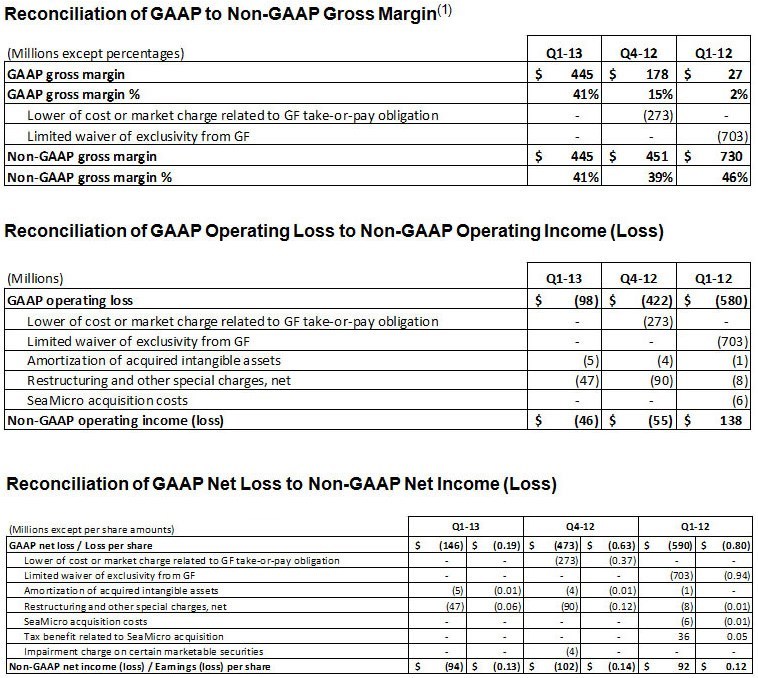
- Gross margin was 41 percent.
o Gross margin increased sequentially due to a $20 million benefit from sales of inventory that had been previously reserved which positively impacted gross margin by 2 percentage points. - Cash, cash equivalents and marketable securities balance, including long-term marketable securities, was $1.2 billion at the end of the quarter.
o First quarter cash was bolstered by the closing of a sale and leaseback transaction of the "Lone Star Campus" in Austin, Texas generating cash proceeds of approximately $164 million, net of certain fees. - Computing Solutions segment revenue decreased 9 percent sequentially and 38 percent year-over-year. The sequential decrease was primarily due to lower desktop, notebook and chipset unit shipments. The year-over-year decline was driven primarily by lower unit shipments.
o Operating loss was $39 million, compared with an operating loss of $323 million in Q4 2012 and operating income of $124 million in Q1 2012. The Q4 2012 operating loss included the impact of a GLOBALFOUNDRIES-related "lower of cost or market" (LCM) charge of $273 million.
o Microprocessor Average Selling Price (ASP) increased sequentially and decreased year-over-year. - Graphics segment revenue increased 3 percent sequentially and decreased 12 percent year-over-year. Graphics processor unit (GPU) revenue was flat sequentially and down year-over-year.
o Operating income was $16 million, compared with $22 million in Q4 2012 and $34 million in Q1 2012.
o GPU ASP increased sequentially and year-over-year.
- Sony announced a semi-custom AMD APU would power its upcoming PS4 gaming console. The APU combines AMD's "Jaguar" processor cores and next-generation AMD Radeon graphics, integrating a combination of x86 processor cores and advanced graphics IP unique to AMD.
- Highlighting AMD's commitment to optimizing the world's top PC titles for AMD Radeon graphics cards, the company launched the "Never Settle: Reloaded" promotion. The current program bundles up to five of the year's most anticipated PC games ─ "BioShock Infinite" by 2K Games and Irrational Games, "Crysis 3" by Electronic Arts and Crytek, "DmC Devil May Cry" by Capcom, "Tomb Raider" by Square Enix and Crystal Dynamics and most recently, "Far Cry 3 Blood Dragon" by Ubisoft ─ with the purchase of select AMD Radeon HD 7900 Series, HD 7800 Series as well as HD 7790 and HD 7770 graphics cards.2
- AMD ushered in the new frontier of gaming realism with the introduction of TressFX Hair - a collaboration with Crystal Dynamics to deliver the world's first real-time hair rendering technology that can react to forces like gravity, wind and head movement in a playable game. The technology uses the DirectCompute programming language to unlock the capabilities of the AMD Graphics Core Next architecture and is featured heavily in the newly launched PC version of Tomb Raider.
- AMD expanded its server graphics solutions with the introduction of the AMD FirePro R5000 remote graphics card supporting remote 3D-graphics workflows and full computing experiences over IP networks.
- AMD moved into cloud gaming with AMD Radeon Sky Graphics, based on AMD Graphics Core Next architecture. Working with CiiNow, G-Cluster, Otoy and Ubitus, AMD developed a flexible cloud gaming technology that enables developers and service providers to deliver excellent gaming experiences through PCs, tablets, smart TVs and mobile devices.
- AMD announced AMD Turbo Dock Technology which automatically adjusts performance of the AMD accelerated processing unit (APU) higher while a hybrid PC is docked and being used for more complex tasks like content creation.
- AMD began shipping the next generation of AMD Elite A-Series APUs, codenamed "Richland," which combine improved performance and battery life4,5 with advanced user experiences like AMD Face Login and AMD Gesture Control.
- AMD extended its commitment to drive the development of accelerated applications that tap into the full compute performance of the APU through collaboration with Aviary to bring an optimized version of its popular photo editing tool to Windows 8 PCs and tablets powered by AMD APUs.
- AMD announced that the SeaMicro SM15000 server is now certified for CDH4, Cloudera's Distribution, creating a "Hadoop-in-a-Box" solution. Red 5, Livestream and Wayfair also announced they have deployed SeaMicro-powered microservers across their businesses.
- AMD launched the AMD Open 3.0 server platform, a radical rethinking of the server motherboard designed to the standards developed by the Open Compute Project. The AMD Open 3.0 server enables substantial gains in computing flexibility, efficiency and operating cost by simplifying motherboard design.
- Aligned with the company's strategy to reduce investments and capital in non-core parts of the business, AMD announced that it sold and leased-back its "Lone Star Campus" in Austin, Texas, generating approximately $164 million in cash, net of certain fees.
AMD's outlook statements are based on current expectations. The following statements are forward-looking, and actual results could differ materially depending on market conditions and the factors set forth under "Cautionary Statement" below.
For the second quarter of 2013, AMD expects revenue to increase 2 percent, plus or minus 3 percent, sequentially.
For additional details regarding AMD's results and outlook please see the CFO commentary posted at quarterlyearnings.amd.com.
41 Comments on AMD Reports 2013 First Quarter Results
To add to your comment, it also applies with the CPU market of AMD.
AMD can have the fast CPU on the market and customers will still opt for a slower and more expensive Intel solution. The history show us that even when the lower end Sempron & Duron Socket A and Socket 754 was outperforming the "high end" Pentium 4 Northwood, back when the Athlon XP was topdog, and when the Athlon 64 and Athlon FX was outperforming the Pentium 4 Prescott & Cedar Mill, and when the Athlon X2 was outperforming the Pentium D...customers were still loyal to Intel.
In my experience the non enthusiasts (largest in the CPU market) assume Intel means quality, regardless of benchmarks or market changes. This correlates to the GPU market too, non enthusiasts will always assume Nvidia means quality.
Only gradual change and money dumped into marketing will change customer perception of ATI/AMD.
I'm sure visitors/guest read comments and say, "Bah, more Headline posters in this forum, Next" (Click to there next source)
:rolleyes:
AMD op base is at $700m. Aslong at it keeps op above that so no need to panic.
Revenue
Q1-2013 $1,088 (above $700mil)
Gross Margin
Q1-2013 41% (Q4-2012 15% / Q1-2012 2%)
Op loss
Q1-2013 98m (Q4-2012 422m / Q1-2012 580m)
Unless a pre-schooler can beat you at adding and subtracting the numbers are headed in the right direction. The new management is doing its job.:toast:
Take your driver issues to a driver based thread fella ,as it's getting boreing reading similar responses to every amd titled thread.
I didn't single anyone out though as a troll but I am seriously pondering the possibility we have hired trolls in this forum .for clarity Imho you are not one .
Human smokes a possibility though :p
After two more read through's im putting most of my posts in this thread down to a terrible day at work sos guys..
From what I've seen, with AMD drivers over the last 2 years, there has not been any problem. Whether or not someone's favorite game is properly supported, at launch, is not a problem with the driver 'technology', it's a problem that's tied to relationships between game developers and AMD (and Nvidia, because they have the same problem as well). It's a people problem that's common to both major GPU companies, not a tech problem.
An uncommon configuration that's not properly supported immediately for your time wasting satisfaction is also not a problem with the driver technology, it's another people problem. A people problem tied to the aforementioned communication with game developers common to both AMD and Nvidia.
AMD's per unit profit margin is smaller than Nvidia's, so it shouldn't surprise anyone that they haven't spent as much on driver development... it costs millions a year to hire a large group of driver developers.
If it takes them longer to make an update, that's why, but then that is also a people problem, not a driver technology problem... because the drivers do eventually get updated.
Nothing at all to do with technology, everything to do with face to face, person to person, communication, and differing business strategies.
However, I do know that there are standing open offers to developers that want to work for AMD. Whether or not the pay is commensurate wit the expectations of those positions is another thing, but fundamentally, I think that AMD has some talented hardware engineers, clearly, or I'd not really be spending so much on their products. I'm pretty quick to bash AMD, but you won't find a single Nvidia product in my house. Be that as it may, several people have posted recently concerned that my opinion about said drivers and how I vocalize it, so while the drivers, in your perspective, may not have an impact on their bottom line, for me, it does, since stores are less likely to fill their selves with AMD products in something like drivers is an issue.
And so, local stores don't stock AMD high-end GPUs in any sort of quantity, and are not ordering more unless requested to do so directly by a customer.
www.memoryexpress.com/Search/Products?Search=7970
That's one of the largest retailers here in Canada, serving half the physical country with parts in retail stores, with a whopping total of 14 units of 7970 GPUs in stock, from only one brand, and maybe 30 units of 7950's, from a mix of brands.
If stores don't order cards, IHVs don't order chips, and AMD gets less sales. You are right, it doesn't affect AMD right this second, but it does affect them on a quarterly basis, when orders are placed at your favorite trade shows. That's what trade shows are for...so IHV's can show their stuff to purchasers from retailers. June is coming, which means Computex is coming, and more orders for more parts...and without working Crossfire drivers, it makes it hard to stores to sell multiple cards, and turn a profit. Which means they are likely to buy less units this time around.
Drivers DO matter, but you do raise another important aspect of the big puzzle that is any business in the industry right now. As far as I am concerned, the entire lack of sales recently is entirely do to "people issues". 10000%.
:rockout:
I just recently thought of all the times pc hardware FAILED me, my expectations or plain caused me grief and each time id have happily shouted my rage across the rooftops and stood firm against any praise for the part in question.
When things work I seldom care to praise anyone as I too, expect things to work right and as advertised.
People should consider rephrasing their words perhaps as for every upset person there are many happy quite ones.
Imho regardless of which brand , there is too much, and to venomous bashing going on
BSN - Apple's Graphics CTO Raja Koduri Leaves the Company, Goes back to AMD
AMD is clearly restructioning Financially and Personel wise. 1-2yrs we will see what kind of impact these personel moves make.
www.anandtech.com/show/6907/the-king-is-back-raja-koduri-leaves-apple-returns-to-amd
AMD has arguably the best CPU engineer in the world in charge of their CPU division (Jim Keller as of August 2012) and now, as of today, one of the very top GPU engineers in the world in charge of their 'Visual Computing' division, Raja Koduri. These guys would not have come back to AMD (they're both former AMD employees) if they didn't see something positive in Rory Read's plan for the company going forward.
This is an extremely good sign.
erm..not holding my breth, though. :wtf: