Thursday, March 17th 2022

Apple's Graphics Performance Claims Proven Exaggerated by Mac Studio Reviews
Apple made some bold claims at the launch of its new Mac Studio computers when it came to the performance of the new systems and it looks like Apple was exaggerating those claims by quite some margin when it comes to the graphics performance. The first reviews of the new Mac Studio went live today and thanks to those reviews, despite the limited benchmarks that were performed on the new systems from Apple, that as so often Apple's performance metrics are still relying on the reality distortion field. Most of the publications that got their hands on the new systems focused on CPU benchmarks and there's no doubt the Ultra version of the M1 processor is a beast when used for things like video rendering and complex image manipulation, where it's butting heads with an AMD Ryzen Threadripper 3970X.
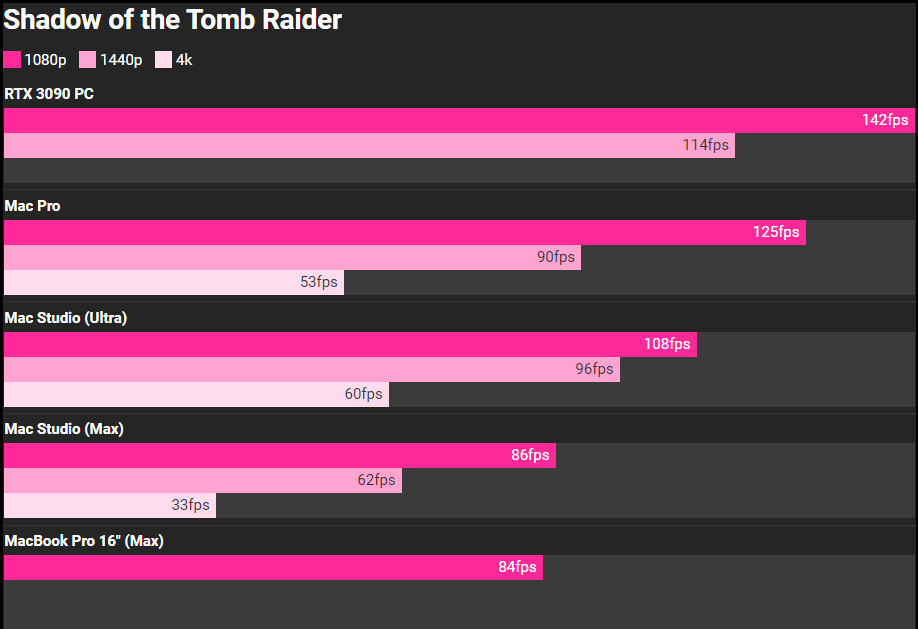
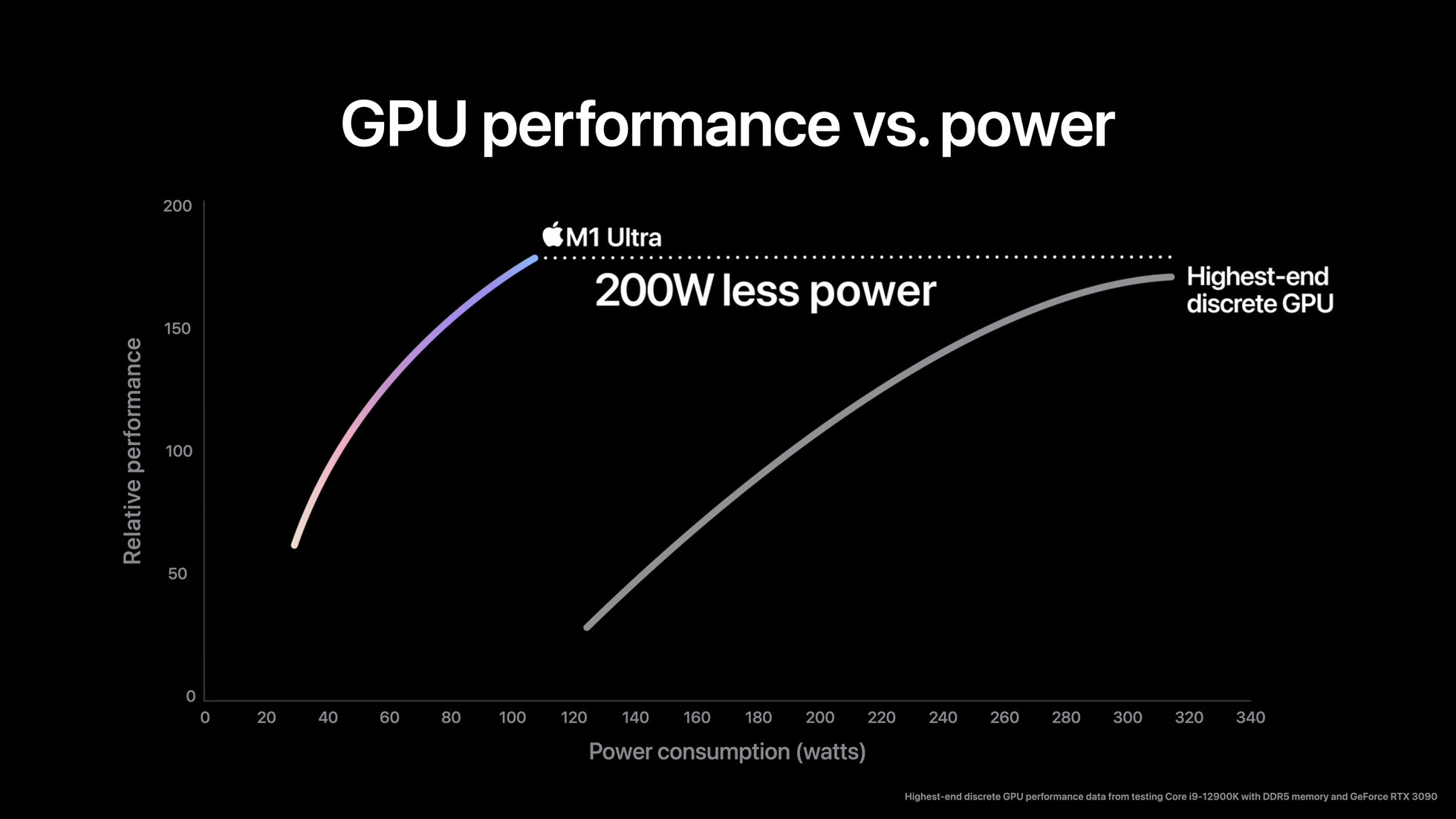
However, Apple's 64-core GPU isn't quite what the company claimed. In the presentation footnotes Apple provided details on the "highest-end discrete GPU" that they compared to, which was an NVIDIA GeForce RTX 3090. If we were to be kind to Apple, we would say that the company was slightly off target here, but it's actually not even remotely close. Tom's Guide tested the M1 Ultra SoC in Sid Meier's Civilization 6 and got a whopping 38.85 FPS at 1440p, which is beaten soundly by a Lenovo ThinkPad P1 Gen 4 with a GeForce RTX 3070 laptop GPU that scored 64.9 FPS at 4K. Likewise, The Verge decided to test the claims and had a system with an actual GeForce RTX 3090 in it and ran Shadow of the Tomb Raider and the PC managed 142 FPS at 1080p, with the M1 Ultra coming in quite far behind at 108 FPS. Moving up to 1440p the 3090 came in at 114 FPS, with the M1 still trailing behind, if not quite as badly at 96 FPS.
 The issue here isn't the actual performance, as it's no doubt decent figures considering the max power draw of the Mac Studio is 370 W, far less than any PC with a GeForce RTX 3090 in it. However, Apple's inflated performance claims are getting old and tired and the company really needs to do better. It's highly unlikely that anyone will be buying a US$4999 Mac Studio to play games on, as that's what the base model with the 64-core GPU costs. As such, Apple should provide realistic benchmark comparisons, as overall the Mac Studio is an impressive piece of kit in its own right. Based on the first reviews, it's likely going to end up being used by a lot of creative companies that would normally use Macs for their workflow.
Sources:
Tom's Guide, The Verge
However, Apple's 64-core GPU isn't quite what the company claimed. In the presentation footnotes Apple provided details on the "highest-end discrete GPU" that they compared to, which was an NVIDIA GeForce RTX 3090. If we were to be kind to Apple, we would say that the company was slightly off target here, but it's actually not even remotely close. Tom's Guide tested the M1 Ultra SoC in Sid Meier's Civilization 6 and got a whopping 38.85 FPS at 1440p, which is beaten soundly by a Lenovo ThinkPad P1 Gen 4 with a GeForce RTX 3070 laptop GPU that scored 64.9 FPS at 4K. Likewise, The Verge decided to test the claims and had a system with an actual GeForce RTX 3090 in it and ran Shadow of the Tomb Raider and the PC managed 142 FPS at 1080p, with the M1 Ultra coming in quite far behind at 108 FPS. Moving up to 1440p the 3090 came in at 114 FPS, with the M1 still trailing behind, if not quite as badly at 96 FPS.
151 Comments on Apple's Graphics Performance Claims Proven Exaggerated by Mac Studio Reviews
In this case would it safe to say Apples white lie is a 6, or better?, rating on the RDF?
www.3dmark.com/hall-of-fame-2/wild+life+3dmark+score+extreme+preset/version+1.0
I am not an Apple basher. I have used their desktop products for most of my life. What I have an issue with is the trajectory of the honesty in marketing with Apple. Why the vague graphs in presentations? Why compare to a 3090? Just why?
Look I don't care what brand makes what claims because I always assume it's BS until proven otherwise. Most sites suck because they basically just post the marketing brochure without any questions asked. Good to see this site not just lapping up the coolaid.
When a company makes a big, bold claim like this, they need to be a bit more specific, as their presentation suggests all GPU workloads, which clearly isn't true.See above, they're actually doing worse in other GPU benchmarks.
IF you want to bench, we need to bench World of Warcraft, Total War Rome Remastered, Myst, Tunic, 3DMark Wildlife, or Baldur's Gate 3. Those are the only major native games on Mac Silicon (hard to believe I know, but gaming on the Mac is quite dead).
Tunic is great! Been playing it on my Xbox all day!
Apple deserves the criticism. They have native games. They could have put them in their reviewer's guide. But they prefer misleading TDP limited "industry standard compute benchmarks" over actual truth. Apple is at fault. But it is not true that the M1 Ultra is as slow as people are suggesting. It's about RTX 3080 level. Beats the 3070 easily.
I'll admit that none of the reviews so far, are especially techy and there's also a shortage of "proper" benchmarks for MacOS. As such, this has to be taken for what it is, but my point is still the same, companies need to stop making up silly comparisons in their presentations. The Mac Studio will sell to the target audience without silly comparisons.
Apple needs a portable gaming device or console, as energy efficiency is key there.
This fudginess is where Apple thought(mistakenly) that they could get away with their deception.
Now I'd like to be clear, M1Ultra is an impressive piece of tech, there can be no doubt of that. However, it is FAR from the "World's most powerful chip for a personal computer." For one, the systems the M1Ultra is available in are NOT in the budget of the "Personal" computer range. They are exclusively Prosumer and workstation systems. Second, they are not the most powerful single systems in the world, whether Personal or Professional/Workstation sectors.
Regardless of how impressive M1Ultra is, Apple knowingly lied. That is something the industry and the user base can not allow or tolerate.
arstechnica.com/gadgets/2022/03/mac-studio-review-a-nearly-perfect-workhorse-mac/2/#h1
Much more interesting is the Max version, which without the scaling problems seems to be at RX 5700 level in FHD, a little bit better than RX 5700 at QHD and a little bit worse than 5700XT at 4K which is excellent result for a 1275-1300MHz 4096 cores GPU, exceeding Polaris performance/terraflop efficiency and only -15% vs a RDNA 5700XT (-20% vs RX 5700) regarding performance/terraflop efficiency.
The real problem is the transistors needed to achieve this performance level (taking account also the frequency differences/scaling of course)
Apple switching to x86 hardware made it much easier to compare performance between a Mac and a Windows or Linux system. No longer could Apple hide behind PowerPC and software that didn't run on other systems.
Apple's x86 hardware was generally underwhelming and a generation or two behind. Mac Pros had some high end stuff, but they would go years without updates.
Apple also had their falling out with Nvidia over the faulty laptop chips. In the years when Nvidia dominated GPU performance, Apple was stuck with AMD.
Intel's 10nm issues and the quality of what they delivered didn't help, but I think Apple's true motivation for developing the M1 is so that they can again hide behind a different architecture.
Apple did not fare well with x86 hardware.
The M1 is a very well designed and implemented platform and it gets a lot out of a few watts, but it's not the performance monster Apple makes it out to be. Apple is back to their "40 times faster than PC!!!!!" claims with a lot of missing asterisks and fine print. The M1's biggest advantage for Apple isn't performance, it's obfuscation for marketing.